국민 여동생 (gungmin yeodongsaeng) — The Name a Whole Country Cherished Like a Little Sister
국민 여동생
국민 여동생 (gungmin yeodongsaeng) is a nickname given to a young, bright-image female celebrity whom the entire nation cherishes and cheers for as if she were their own little sister. Translated literally, it means “the nation’s little sister” — and fittingly, the place you’ll actually hear it is usually in front of a television. The whole family is gathered in the living room watching the year-end music awards, someone says “she’s so cute,” and the person next to them replies, “she’s the 국민 여동생 these days, you know.” The key to this expression is that it isn’t an inside nickname that only works within a fan club — even your parents’ generation, who know nothing about K-pop, will understand it instantly.
Three conditions have to be met for this nickname to stick. First, she has to be young — generally a teenager or in her early twenties. Second, her image has to be bright and unblemished. Third, her face has to be known nationwide, beyond any particular fan base. If even one of the three is missing, the label doesn’t apply. No matter how well she sings, if her image is strong and charisma-driven, nobody calls her ‘국민 여동생’; and no matter how popular she is, if that fame lives only inside a fandom, the ‘국민’ part doesn’t hold up.
The temperature here is closer to family affection than to fan devotion. There’s almost no romantic interest in this phrase. If anything, it leans toward a protective instinct — “we have to look after her.” That’s why it feels natural when a celebrity called 국민 여동생 drinks milk in a commercial or shows up in a school uniform, and why the public reacts awkwardly when she comes back with heavy makeup or a boundary-pushing concept. It’s a compliment and a fence at the same time.
Finally, this phrase has an expiration date. People age; a “little sister” can’t. So when an actress once called 국민 여동생 passes thirty, the title quietly disappears and the press starts calling her “the actress So-and-so” instead. That’s also part of why the phrase isn’t used as often in Korea as it once was.
A Real Conversation
Setting: a subway transfer corridor. On the wall hangs a birthday ad for an idol that fans pooled their money to put up.
Emily: 야, 이거 봐. 팬들이 돈 모아서 낸 광고지? Hey, look at this. Fans chipped in for this ad, right?
Jun-kyung: 어, 생일 광고. 얘 데뷔했을 때는 진짜 국민 여동생이었는데. Yeah, a birthday ad. Back when she debuted she really was the nation’s little sister.
Emily: 지금은 아니야? 아직 인기 많잖아. Not anymore? She’s still popular.
Jun-kyung: 인기는 더 많지. 근데 국민 여동생은 유통기한이 있어. 서른 넘으면 아무도 안 그래. More popular, actually. But “nation’s little sister” has an expiration date. Once you’re past thirty, nobody says it.
Emily: 아, 그래서 요즘 기사에서 그 말 잘 안 보이는구나. Ah, that’s why I barely see it in articles these days.
Jun-kyung: 응. 그냥 이름으로 부르는 게 낫지, 뭐. Yeah. Better to just call her by her name, honestly.
This Sounds Off
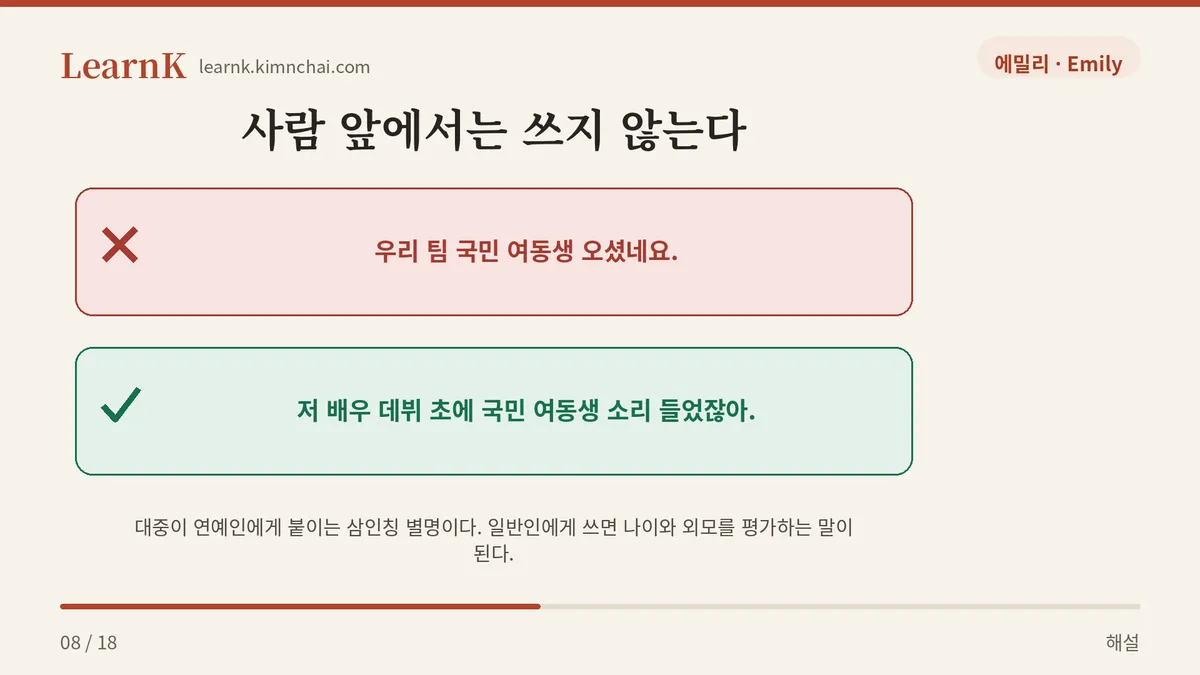
✗ (to a new coworker you’ve just met) 오, 우리 팀 국민 여동생 오셨네요. ✓ (while watching entertainment news) 저 배우 데뷔 초에 국민 여동생 소리 들었잖아. → This is a nickname the public gives to celebrities, not a compliment you pay to ordinary people. Used on a female colleague at work, it becomes a remark judging her age and looks — and in Korean companies today, that kind of comment is treated as potential sexual harassment.
✗ (to a senior actress in her forties) 선배님은 지금도 국민 여동생 같으세요. ✓ (to a senior actress in her forties) 선배님은 데뷔 때부터 지금까지 사랑받으시네요. → Said to someone’s face, it stops being praise and becomes a way of treating them as “still the young one.” This expression is a third-person label, so it’s almost never used directly to the person it describes.
Example Sentences by Situation
Situation 1 — The whole family is watching the year-end awards show. A rookie girl idol appears on screen, and your mother asks who she is.
“쟤가 요즘 국민 여동생이야. 광고를 몇 개를 찍는지 몰라.” (jyaega yojeum gungmin yeodongsaeng-iya. gwanggo-reul myeot gae-reul jjingneunji molla.) “She’s the nation’s little sister these days. I’ve lost count of how many commercials she’s in.”
Situation 2 — A friend you haven’t seen in a while brings up an actress’s new project. You want to say you were surprised by how different it was from her old image.
“국민 여동생이었던 애가 악역을 하니까 진짜 새롭더라.” (gungmin yeodongsaeng-ieotdeon aega angyeog-eul hanikka jinjja saeropdeora.) “Seeing someone who used to be the nation’s little sister play a villain was really refreshing.”
Situation 3 — You’re talking about Korean entertainment and explaining why this phrase has faded.
“요즘은 국민 여동생이라는 말을 잘 안 써요. 좀 옛날 말 같거든요.” (yojeum-eun gungmin yeodongsaeng-iraneun mareul jal an sseoyo. jom yennal mal gatgeodeunyo.) “People don’t really use ‘nation’s little sister’ anymore. It feels a bit dated.”
Politeness Levels and Related Expressions
The phrase itself is a noun, so it carries no built-in polite or casual form. The verb ending that follows sets the temperature. Among friends you’d say 국민 여동생이야 (gungmin yeodongsaeng-iya); in a setting that calls for politeness, 국민 여동생이에요 (gungmin yeodongsaeng-ieyo) or 국민 여동생으로 불렸습니다 (gungmin yeodongsaeng-euro bullyeotseumnida). But no matter how many honorifics you stack on, one thing doesn’t change: this isn’t a phrase you say to the person herself.
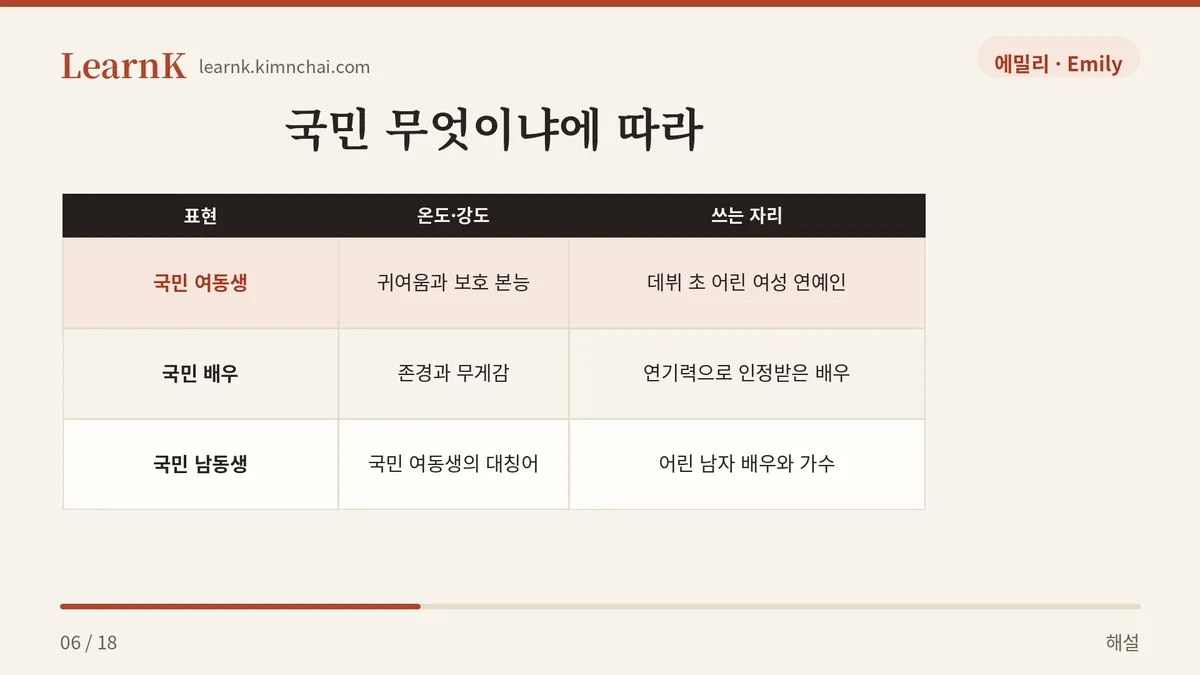
‘국민 ○○’ is a productive word-building pattern, so there’s a whole family of similar nicknames alongside it. The differences come down to age, gender, and how much respect is packed in.
| Expression | Tone & Intensity | Where It’s Used |
|---|---|---|
| 국민 여동생 (gungmin yeodongsaeng) | Cuteness + protective instinct, family-like warmth | Female celebrities in their teens to early twenties, early in their careers. Not used for ordinary people |
| 국민 첫사랑 (gungmin cheotsarang) | Fluttery, wistful | Actresses etched into memory for playing a first love in a youth film or drama |
| 국민 배우 (gungmin baeu) | Respect, gravitas | Any age or gender. For actors recognized for their craft |
| 국민 남동생 (gungmin namdongsaeng) | The male counterpart to 국민 여동생 | Young male actors and singers |
Read the table vertically and the rule appears. When what follows is a family term (여동생 / 남동생), the meaning always comes with “young” attached; when it’s an occupation (배우 / 가수), the standard becomes skill rather than age. That’s why 국민 배우 can still apply past sixty, while 국민 여동생 falls away once you’re past thirty.
Cultural Background — A Nickname Made by the Living Room TV
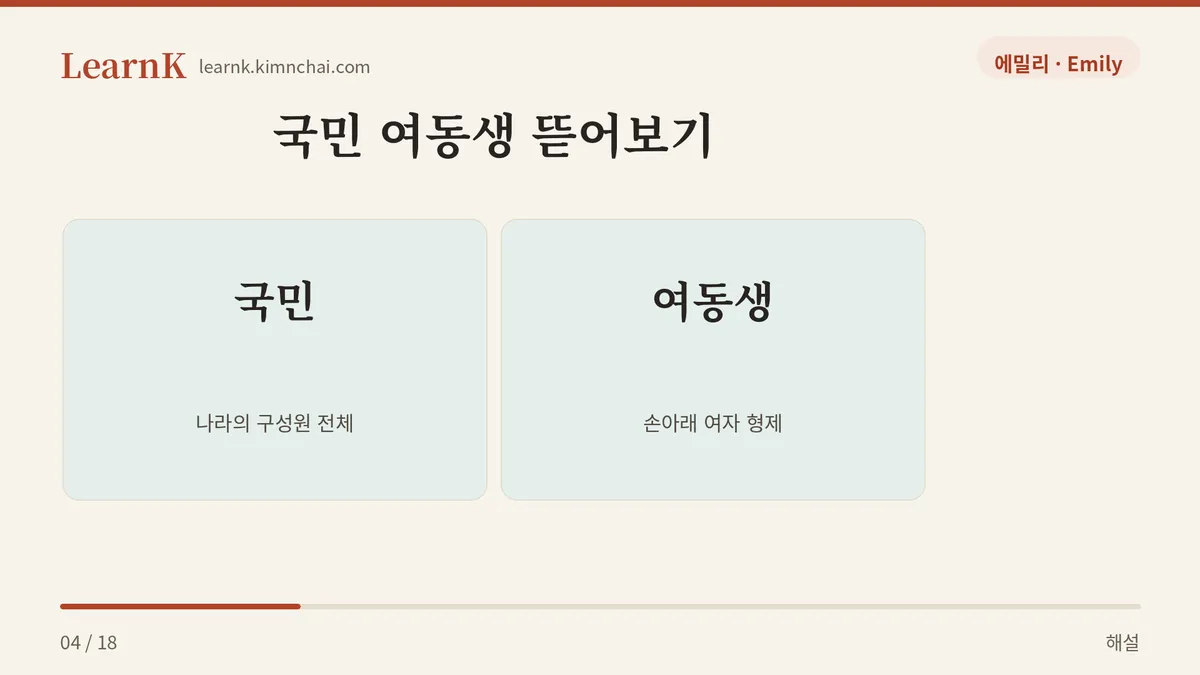
The word formation is simple: 국민 (國民, all the members of a nation) + 여동생 (a younger sister). It’s the meaning “a little sister shared by the entire nation,” stitched together exactly as it sounds. What’s interesting is that a big, formal Sino-Korean word like ‘국민’ has been bundled together with ‘여동생,’ a small and intimate family term. Borrowing family titles to express mass popularity is common in Korean — calling an older actress ‘국민 엄마’ (the nation’s mom) comes from the same mold.
Behind this phrase’s power lies an era when the whole family watched the same channel at the same time. When there were only a handful of channels and everyone gathered in the living room on a weekend evening, it was possible for one person to be imprinted on the entire country at once. The actress Moon Geun-young, who became known as a child actor and then won enormous affection with the 2004 film My Little Bride, became the defining example of this nickname, and the same title later passed to figures like IU and Suzy, who gained nationwide recognition at a young age early in their careers. In Suzy’s case, after the film Architecture 101 (2012), the nickname ‘국민 첫사랑’ followed her more often instead.
Things are different now. Everyone watches a different platform with a different algorithm, so it’s hard for “one person the whole nation knows” to emerge. On top of that, criticism has steadily grown within Korea that calling a grown woman a “little sister” indefinitely is itself uncomfortable. It’s a title automatically revoked with age, and it leaves behind only an image of being “young and innocent” rather than anything about the acting she does or the music she makes. So these days, articles and broadcasts tend to wrap the phrase in the past tense — “once called the 국민 여동생” — or avoid it altogether.
This is exactly why the expression is useful for Korean learners. Knowing the meaning alone is only half of it. Once you also know when it burned hot and why it has cooled, you can read the subtle distance that clings to it when a Korean person brings it up — that particular temperature where affection and slight embarrassment mix.
Today’s Quiz
Which of the following uses 국민 여동생 naturally?
① 부장님, 이번에 들어온 신입이 완전 국민 여동생이에요. ② 그 배우는 데뷔 초에 국민 여동생으로 불렸어요. ③ 할머니, 우리 동네 국민 여동생이세요!
Answer: ②
① uses it on an ordinary coworker. Because this is a nickname the public attaches to celebrities, saying it about a colleague at work turns into a remark judging her age and appearance. ③ has the age exactly backwards — once ‘여동생’ is in there, it only works for someone young. It sounds most natural when, as in ②, you’re referring to a celebrity in the third person, especially in the past tense.
Definitions and example sentences are from the National Institute of Korean Language’s Basic Korean Dictionary (krdict.korean.go.kr); that portion of this post, including our translations, is licensed under CC BY-SA 2.0 KR.