국룰 (gungnyul): The 'National Rule' — That Unwritten Rule Everyone Just Takes for Granted
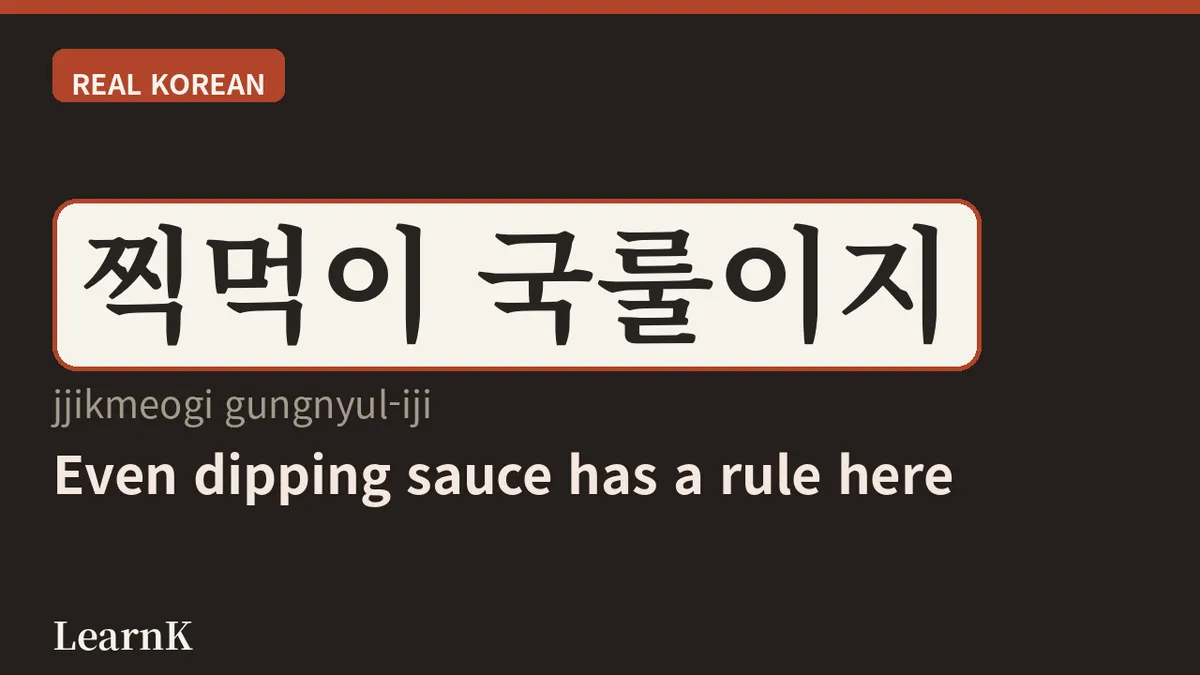
When you order fried chicken, cola is naturally supposed to come with it; ramen has to have kimchi; and when you get in an elevator, someone always presses the ‘close’ button at least once. None of this is written into law, yet there are moments when you just feel, “But everyone does it this way, right?” Korea’s younger generation sums up situations like these in just two syllables: 국룰 (gungnyul). This expression pops up several times a day in online communities, YouTube comments, and group chats with friends. Today, let’s dig into it in depth.
국룰
국룰 (gungnyul) is a newly coined word, short for ‘국민 룰 (gungmin rul)’ — literally “national rule.” It combines the ‘국 (guk)’ from ‘국민 (國民, gungmin, “the people / citizens”)’ with ‘룰 (rul)’, the Korean pronunciation of the English word “rule.” Taken literally, it means “a rule the whole nation follows” — in other words, an unspoken agreement that nobody officially made and nobody is forced to keep, yet everyone naturally abides by.
There’s one thing to watch out for with the pronunciation. Looking at the letters alone, ‘국룰’ would seem to be read [guk-rul], but in reality the consonants shift and it’s actually pronounced [궁뉼] (gungnyul). This happens because the final consonant ‘ㄱ (g)’ meets ‘ㄹ (r/l)’, and the sound softens into a nasal one. It’s tricky at first, but once you read it aloud a few times, you’ll get used to it quickly.
The nuance is light and playful. It’s a fun way to express the conviction of “this is the absolute truth” or “no arguments allowed.” It’s not a serious rule but more like “common sense that just makes sense among us,” so it’s also used the other way around — to tease someone who breaks the 국룰.
Example Sentences by Situation
1. When talking about food combinations
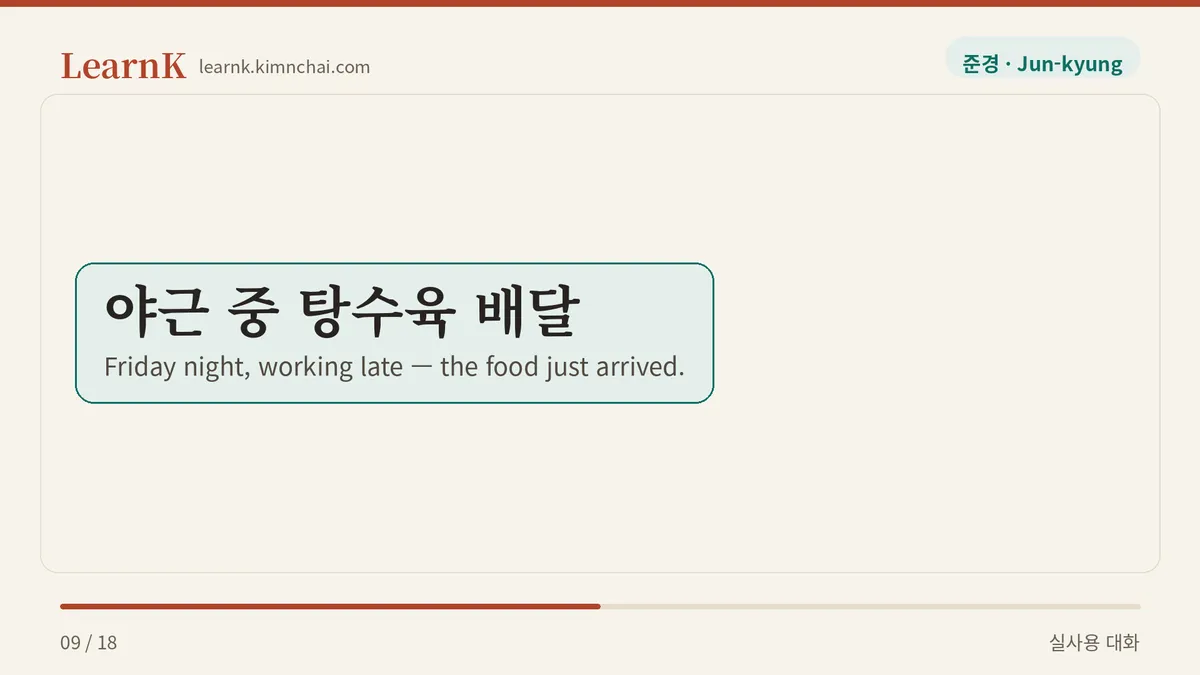
탕수육은 무조건 소스에 찍어 먹는 게 국룰 (gungnyul) 이지! (Tangsuyugeun mujokeon soseue jjigeo meokneun ge gungnyul-iji!) “Dipping sweet-and-sour pork in the sauce is obviously the 국룰 (gungnyul)!”
Whether you pour the sauce over 탕수육 (tangsuyuk, sweet-and-sour pork) — called 부먹 (bumeok) — or dip it — called 찍먹 (jjikmeok) — is a long-running debate among Koreans. Here, the speaker is playfully insisting that “dipping is obviously the correct answer.”
2. When talking about customs or etiquette
첫 출근 날엔 조금 일찍 가는 게 국룰 (gungnyul) 아니야? (Cheot chulgeun naren jogeum iljjik ganeun ge gungnyul aniya?) “Isn’t showing up a little early on your first day of work the 국룰 (gungnyul)?”
This expression captures the social awareness that “everyone does it this way,” even though it’s not in any rulebook. Adding ’~ 아니야? (~ aniya?, “isn’t it?”)’ gives it a soft tone that seeks the other person’s agreement.
3. When talking about the rules of games or culture
노래방 마지막 곡은 신나는 걸로 끝내는 게 국룰 (gungnyul) 이잖아. (Noraebang majimak gogeun sinnaneun geollo kkeutnaeneun ge gungnyul-ijana.) “Ending your last song at 노래방 (noraebang, karaoke) with something upbeat is the 국룰 (gungnyul), you know.”
This refers to a “mood-based agreement” that everyone naturally keeps, even though there’s no official rule.
Comparing Casual vs. Polite Speech and Similar Expressions
Since 국룰 is a newly coined word, it’s basically used in casual, friendly settings. But if you want to make it a bit more formal, you can adjust it like this:
- Casual: 이건 국룰이지. (igeon gungnyul-iji.) — “This is the 국룰, for sure.”
- Slightly polite: 이건 국룰이에요. (igeon gungnyul-ieyo.) — “This is the 국룰.”
That said, it doesn’t suit company reports or formal remarks addressed to elders. In those cases, swap it for standard words like 불문율 (bulmullyul, an unwritten rule) or 암묵적인 규칙 (ammukjeogin gyuchik, an implicit rule). A similar coined word is 개취 (gaechwi, short for ‘개인 취향 (gaein chwihyang, personal taste)’), which is closer to individual preference than 국룰. If 국룰 means “common sense shared by everyone,” then 개취 means “my own personal choice” — so they’re actually opposite concepts.
Cultural Background
Behind the widespread use of 국룰 lies online community culture. People who don’t even know each other’s faces build a sense of connection by confirming shared feelings — like “beer with chicken is the 국룰.” It also spread through broadcasts, via the subtitles of variety shows and the witty talk of YouTubers, and now it has become an everyday word used widely by people from their teens to their thirties. As you watch Korean content, you’ll often come across moments where ‘국룰’ pops up in the subtitles — and if you catch yourself thinking, “Ah, that thing everyone takes for granted!” then your sense of Korean is already at a native level.
Wrap-Up Quiz
A friend says, “영화관에선 팝콘 먹는 게 국룰이지! (Yeonghwagwaneseon papkon meokneun ge gungnyul-iji!)” — “Eating popcorn at the movie theater is the 국룰!” Which of the following best matches the meaning of ‘국룰’ here?
- An action forbidden by law
- A custom that isn’t forced but that everyone naturally takes for granted
- A special preference that’s mine alone
The correct answer is number 2. You’ve now got it firmly memorized, right? — 국룰 means “an unspoken rule that everyone naturally follows even though no one made them.” Starting today, try confidently shouting to your Korean friends, “이건 국룰이지! (igeon gungnyul-iji!)” — “This is the 국룰!”