Gunssak — When Your Mouth Reacts Before You Do
군싹
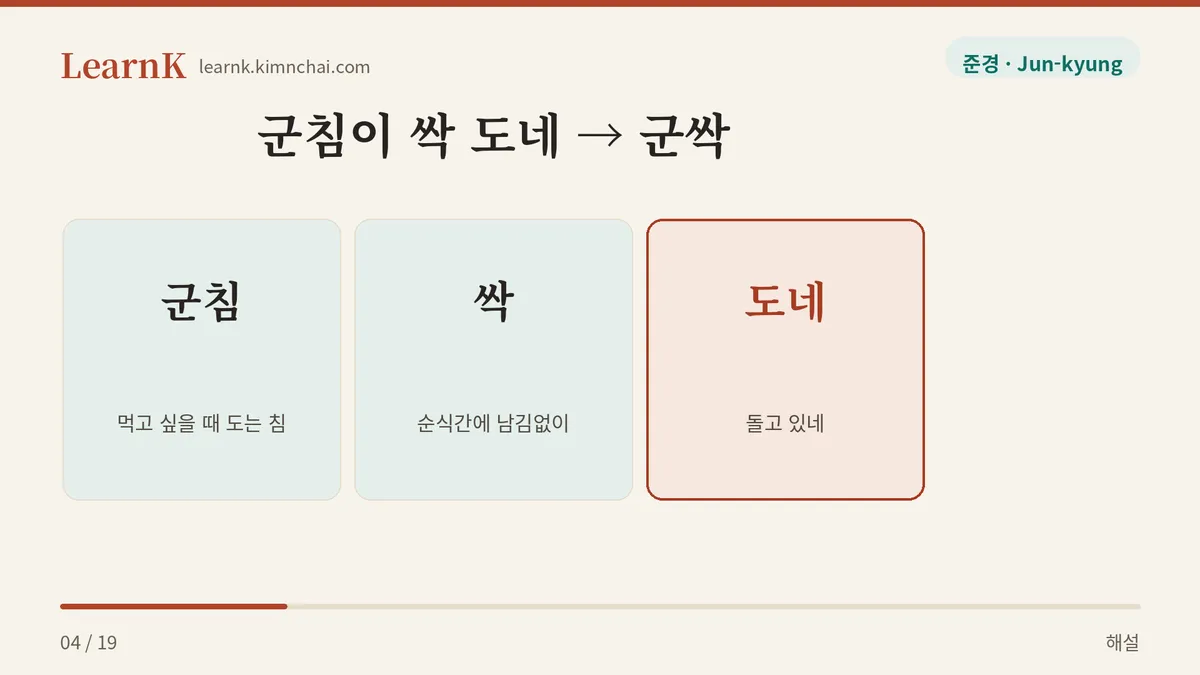
군싹 (gunssak) is internet slang, a shortened form of 군침이 싹 도네 (gunchimi ssak done) — “my mouth is watering.” It means something looks so good that just seeing it makes saliva pool in your mouth. If you’ve ever been scrolling through your phone late at night and your thumb stopped dead on a photo of cheese stretching into a long string — that exact moment is when Koreans drop these two syllables in the comments.
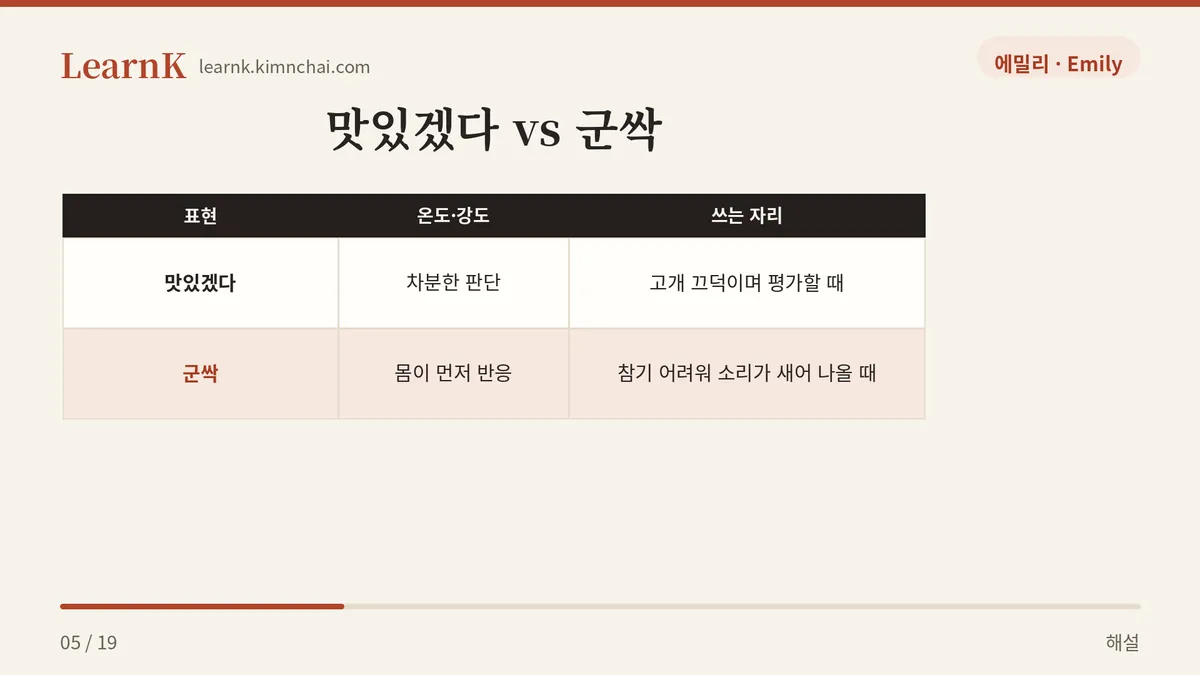
Korean already has plenty of ways to say “that looks delicious.” But 군싹 occupies a slightly different seat among them. If 맛있겠다 (masitgetda) is a verdict your brain reached, 군싹 is closer to a report that your body reacted first. Not a judgment — a reflex. So you don’t use it when you’re nodding politely over a nice dish; you use it when you can’t hold it in and the sound just leaks out.
In terms of intensity, it sits a level above 맛있겠다 — sometimes two. There’s exaggeration baked in, and the person hearing it knows that. That’s why it fits places where everyone’s having fun rather than places where food is being seriously evaluated. It’s also why mukbang live chats get carpet-bombed with this word second by second.
Inside a sentence it behaves like a noun. You’ll see forms like 군싹이다 (gunssagida), 군싹 오네 (gunssak one), and 군싹각 (gunssakgak). That last one is worth a note: 각 (gak) is current slang meaning “it’s shaping up to go that way,” so 군싹각이다 is basically “this is heading straight for drooling territory” — a heads-up that you’re about to want it badly.
What it gets applied to stretches a little past food, too. The original phrase 군침이 돌다 (gunchimi dolda) has long doubled as a metaphor for eyeing something you covet, so if you say 군싹 about limited-edition sneakers or a wildly discounted listing, Koreans will follow you just fine. Using it about a person, though, changes the flavor completely — more on that below.
A Real Conversation
Setting: A traditional market on the way home from work. They’re walking past a dakgangjeong shop and can hear the oil sizzling.
Jun-kyung: 야, 저기 봐. 방금 튀겨서 나왔어. Hey, look over there. It just came out of the fryer.
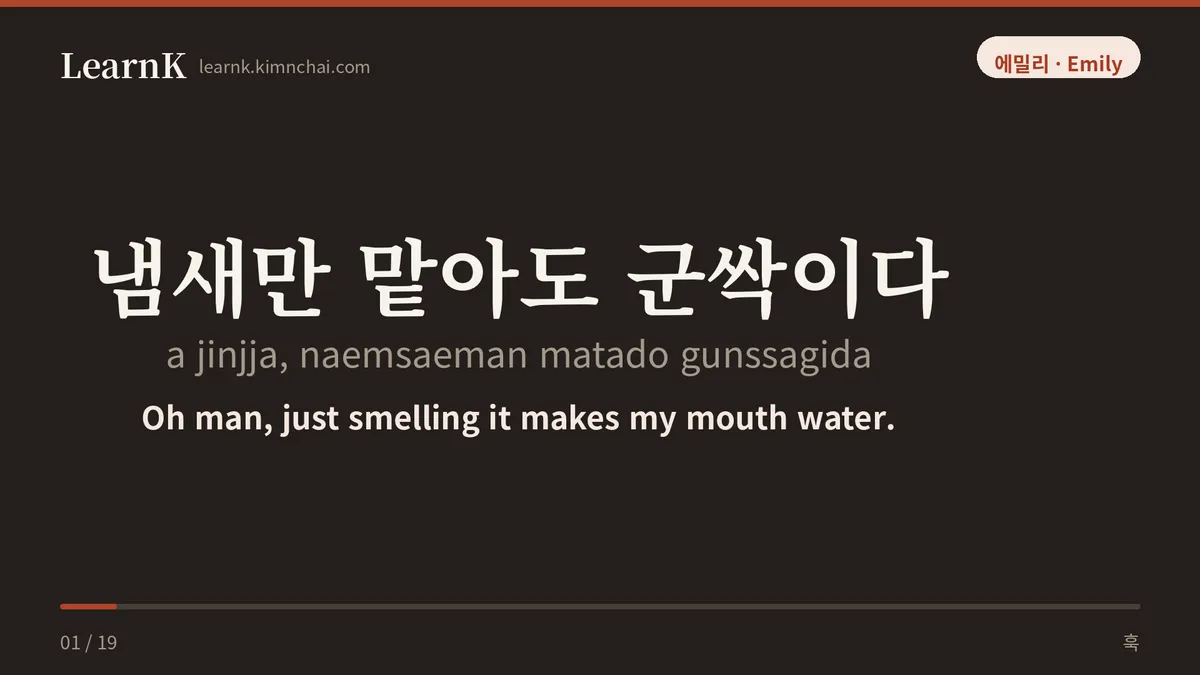
Emily: 아 진짜, 냄새만 맡아도 군싹이다. Oh man, just smelling it makes my mouth water.
Jun-kyung: 너 아까 저녁 먹었다며? Didn’t you say you already ate dinner?
Emily: 저녁은 저녁이고 닭강정은 닭강정이지. Dinner is dinner, and sweet-and-spicy chicken is sweet-and-spicy chicken.
Jun-kyung: 하나 살까? 반반으로. Should we get one? Half and half.
Emily: 콜. 아, 사진부터 찍자. 이거 올리면 댓글에 다들 군싹이라고 난리 날걸. Deal. Oh, let’s take a photo first. If I post this, the comments will all be “gunssak.”
When It Sounds Off
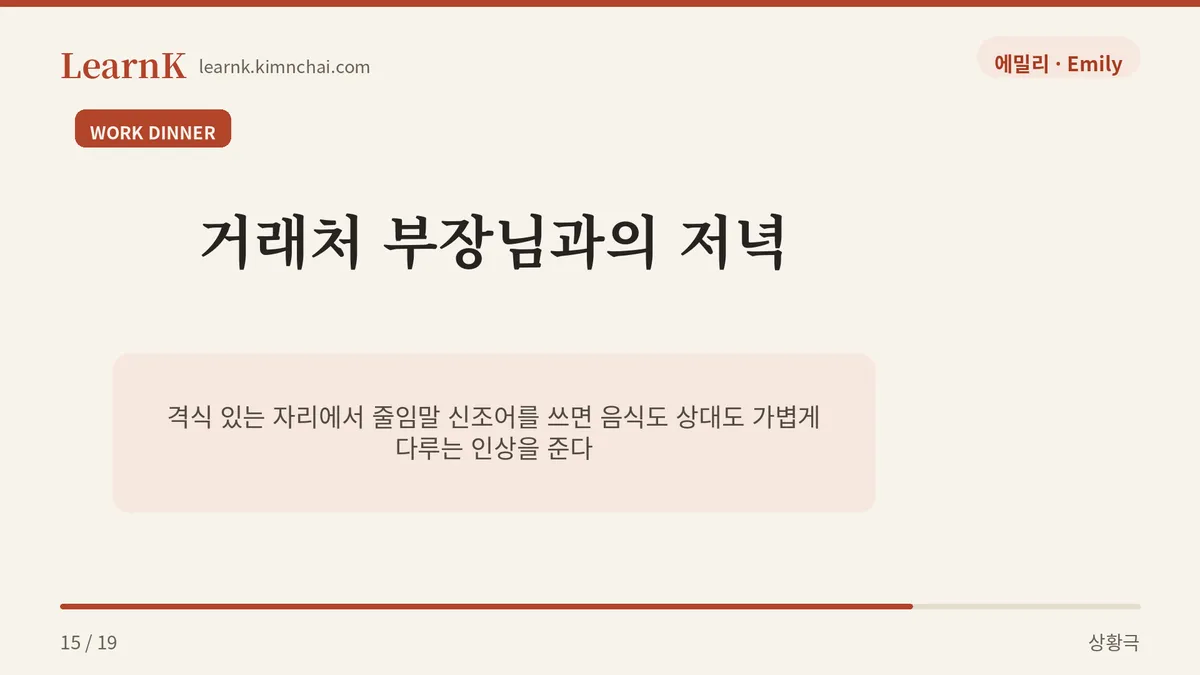
✗ (At dinner with a manager from a client company) 부장님, 이 한우 군싹이네요. Sir, this hanwoo beef is total gunssak.
✓ (Quietly, to the coworker next to you) 야, 이거 군싹이다. Hey, this is gunssak.
→ It’s a clipped slang term, so in formal settings or in front of someone senior to you it comes across as treating the food lightly. In those situations, 정말 맛있어 보이는데요 (jeongmal masisseo boineundeyo) — “this really does look delicious” — is the safe choice.
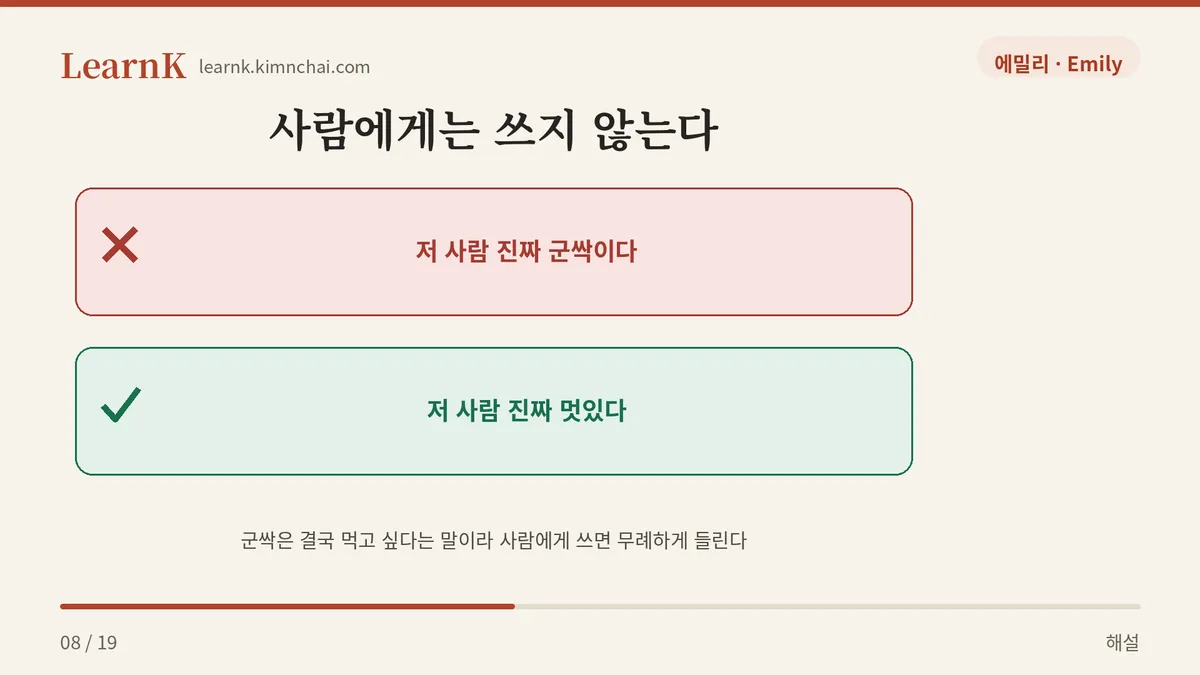
✗ (Looking at someone walking by) 저 사람 진짜 군싹이다. That person is seriously gunssak.
✓ (Looking at someone walking by) 저 사람 진짜 멋있다. That person is seriously good-looking.
→ At the end of the day, 군싹 means “I want to eat that.” Aimed at a person, it turns them into food, and it lands as rude. Use it for things, never for people.
Example Sentences by Situation
1. Posting a photo in a delivery-app review
사진만 봐도 군싹이네요. 다음에 또 시킬게요. (sajinman bwado gunssakineyo. da-eume tto sikilgeyo.) Just looking at the photo makes my mouth water. I’ll be ordering again.
The -요 (-yo) ending is there because it’s a message to the shop owner, but 군싹 itself is still casual. Reviews and comment sections are spaces where nobody knows anyone’s face and the mood is light, so it passes naturally.
2. Commenting on a friend’s travel photos
야, 대게 사진 좀 그만 올려. 자기 전에 보니까 진짜 군싹이야. (ya, daege sajin jom geuman ollyeo. jagi jeone bonikka jinjja gunssakiya.) Hey, stop posting snow crab photos. Seeing this right before bed is making my mouth water.
It’s mock complaining, but it’s actually a compliment. 군싹 sounds most natural exactly like this — paired with a playful “you made me hungry, this is your fault.”
3. Scrolling through a secondhand marketplace app
이 가격에 이 렌즈? 이거 군싹각인데. (i gagyeoge i renjeu? igeo gunssakgakinde.) This lens at this price? My wallet is about to open.
This is the extended usage that works even when there’s no food involved. “I want to eat it” has slid over into “I want to own it,” and it comes out often in front of a shocking price or a limited edition.
Formal vs. Casual, and Similar Expressions
군싹 has no polite form of its own. You can attach -이에요 (-ieyo) and say 군싹이에요 (gunssagieyo), but that only makes your speech level polite — the lightness of the word itself stays put. In front of someone senior, you’re better off switching to a different word entirely.
| Expression | Tone & intensity | Where it’s used |
|---|---|---|
| 군싹 (gunssak) | Very light and giddy; deliberately over the top | Peers, social media comments, mukbang chat. Not with elders or in formal settings |
| 군침이 돌다 (gunchimi dolda) | Neutral; usable in writing | Anywhere. Shows up in articles and essays |
| 맛있어 보여요 (masisseo boyeoyo) | Polite and plain | With elders, people you’ve just met, guests |
| 침 고인다 (chim goinda) | Colloquial, blunt | Only among very close friends |
Cultural Background — An Interjection for the Mukbang Era
The word-building behind 군싹 is simple. 군침 (gunchim) is the saliva that pools in your mouth on its own when you want to eat something, and 싹 (ssak) is an adverb picturing something spreading through completely in an instant. Add 도네 (done) and you get 군침이 싹 도네; keep only the first syllable of each chunk and you get 군싹. Korean has a long habit of lopping off everything but the front of a long phrase, and lately it’s sped up so much that people joke 별걸 다 줄인다 (byeolgeol da jurinda) — “they’ll shorten literally anything.” Online you’ll also often see a variant that swaps -네 (-ne) for -노 (-no), mimicking a Gyeongsang-province speech pattern.
Behind the word’s spread is Korea’s mukbang culture. In Korea, food has long been something you watch together and talk about together, not something you eat quietly alone. The drama 식샤를 합시다 (Siksya-reul Hapsida) — Let’s Eat (tvN, 2013) — became a hit by lingering on long close-ups of its lead actually eating, where the chewing sounds and facial expressions carried more weight than the dialogue. That reaction when the person onscreen takes a bite and the viewer swallows without meaning to — 군싹 is precisely the name given to that reaction.
Which is why this word comes alive when it’s handed to someone else rather than muttered to yourself. Almost nobody sits alone at a meal mumbling 군싹. Instead it goes under a friend’s photo, into a live chat window, or over to the person beside you as you walk through a market. Saying out loud that your mouth is watering — announcing an intensely private bodily reaction on purpose — is about as natural an interjection as you could ask for in a culture built around eating together.
Today’s Quiz
Which of the following is the most awkward place to use 군싹?
① A comment on a friend’s photo of raw fish ② A review left on a delivery app ③ Something you say to a client’s manager over dinner ④ A mukbang live-stream chat window
Answer: ③
①, ②, and ④ are all settings that are either relaxed or close to anonymous, so slang moves around freely. ③ is a situation that calls for good manners, and the other person is your senior, so a light abbreviation like 군싹 gives the impression that you’re treating both the food and the person casually. Here, swap it for 정말 맛있어 보입니다 (jeongmal masisseo boimnida).
Definitions and example sentences are from the National Institute of Korean Language’s Basic Korean Dictionary (krdict.korean.go.kr); that portion of this post, including our translations, is licensed under CC BY-SA 2.0 KR.