광안리 (Gwangalli) — The Beach Where Busan Locals Gather at Night
광안리
Gwangalli is a place name that covers two things at once: a beach in Busan’s Suyeong-gu district, and the neighborhood sitting right in front of it. In Roman letters it’s written 광안리 (Gwangalli), but when you say it out loud it doesn’t come out as a literal “gwang-an-ri” — it turns into [광알리] (gwangalli). Try telling a Korean 이번 주말에 부산 가요 (ibeon jumare Busan gayo), “I’m going to Busan this weekend.” Eight out of ten will shoot a question straight back at you: 광안리 가세요? (Gwangalli gaseyo?) — “Are you going to Gwangalli?” Busan has plenty of beaches, but the second evening plans come up, this is the name that pops out by default.
On a map, Gwangalli is one strip of sand about 1.4 kilometers long. But 광안리 (Gwangalli) in actual Korean conversation points to something far bigger than that sand. The Gwangan Bridge stretching across the water, the hour after sunset when the lights come on along it, the cafes and raw-fish restaurants lined up down the shore, the people flopping onto the sand to crack open a can of beer — all of it is packed inside that one name. Which is why 광안리 갈래? (Gwangalli gallae?) doesn’t mean “let’s go to that beach.” It’s much closer to “let’s eat dinner and hang out by the water for a while.”
Put it next to Haeundae, its neighbor of a similar type, and the difference in temperature gets clear. If Haeundae is a place you dress up for, Gwangalli is a place you go in slippers. Haeundae has high-rise hotels and a broad beach; Gwangalli has low steps that are perfect for perching on and a convenience store. Even the order a Busan local uses when showing a friend from Seoul around is more or less fixed: Haeundae in the daytime, Gwangalli at night.
See It in Real Conversation
Situation: Saturday, five in the afternoon. You’ve just arrived at Busan Station and you’re standing at the subway turnstiles, suitcase in hand.
Emily: 숙소 체크인이 일곱 시래. 두 시간 붕 떴는데 어디 가지? Check-in isn’t until seven. We’ve got two hours to kill — where should we go?
Jun-kyung: 바로 광안리 가자. 지금 출발하면 시간 딱 맞아. Let’s head straight to Gwangalli. If we leave now the timing’s perfect.
Emily: 해운대 아니고? 다들 부산 하면 해운대라던데. Not Haeundae? Everyone says Haeundae when they think of Busan.
Jun-kyung: 해운대는 내일 아침에 걷고. 밤은 광안리가 이겨, 진짜로. We’ll walk Haeundae tomorrow morning. But at night, Gwangalli wins — seriously.
Emily: 왜? 거기 뭐 있는데? Why? What’s over there?
Jun-kyung: 어두워지면 다리에 불 들어와. 그거 보려고 다들 모래에 앉아 있는 거야. Once it gets dark, the bridge lights up. That’s why everyone’s just sitting out on the sand.
Emily: 아, 광안대교. 사진으로만 봤네. 그럼 편의점부터 들르자. Ah, the Gwangan Bridge. I’ve only ever seen photos. Then let’s stop by a convenience store first.
Jun-kyung: 그럼 그럼. 광안리는 손 비우고 가는 데가 아니지. Exactly. Nobody shows up to Gwangalli empty-handed.
This Sounds Off
It’s a place name, so it isn’t a word you have to adjust depending on who you’re talking to — but there are two misunderstandings learners trip over again and again.
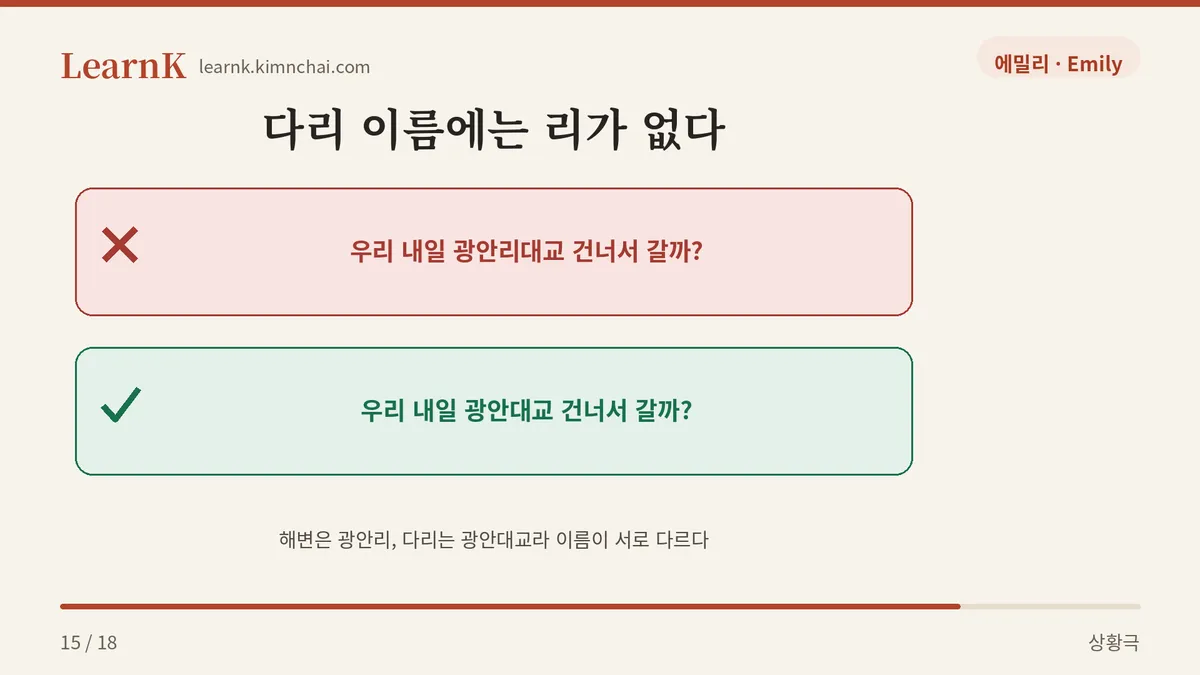
✗ 우리 내일 광안리대교 (Gwangallidaegyo) 건너서 갈까? ✓ 우리 내일 광안대교 (Gwangandaegyo) 건너서 갈까? Should we cross the Gwangan Bridge tomorrow? → The beach is 광안리 (Gwangalli); the bridge is 광안대교 (Gwangandaegyo). The bridge’s name doesn’t take the 리 (ri). Graft the beach’s name onto the bridge and your listener will need an extra beat to work out what you meant.
✗ (in November) 이번 주말에 광안리 (Gwangalli) 가서 수영하자! ✓ (in November) 이번 주말에 광안리 (Gwangalli) 가서 야경 보자! Let’s go to Gwangalli this weekend and see the night view! → The name says “beach,” but swimming is not why most Koreans go to Gwangalli. Getting in the water is a midsummer, official-open-season thing; for the other ten months of the year, Gwangalli is a place to walk, look, and eat. Say 광안리 가자 (Gwangalli gaja) in the middle of winter and nobody is packing a swimsuit.
Example Sentences by Situation
1. Planning a Busan trip — a conversation about where to slot the first evening. Gwangalli lands on the “night course” far more often than the “day course.”
첫날 저녁은 광안리로 잡았어요. (Cheotnal jeonyeogeun Gwangalliro jabasseoyo.) I’ve set the first evening aside for Gwangalli.
2. Choosing where to stay — when Koreans describe a location in Busan, they reach for the beach name rather than the district name (Suyeong-gu). 광안리 쪽 (Gwangalli jjok) is understood as “within walking distance of Gwangalli Beach.”
광안리 쪽에 숙소 잡을까요? (Gwangalli jjoge suksso jabeulkkayo?) Should we book a place near Gwangalli?
3. Saying where you live — Gwangalli is the name of a tourist spot and the name of a residential neighborhood at the same time. When a Busan local says this, it doesn’t mean “I live on the beach” — it means “I live in that neighborhood.”
저 광안리 살아요. 바다까지 걸어서 오 분이요. (Jeo Gwangalli sarayo. Badakkaji georeoseo o bunniyo.) I live in Gwangalli. Five minutes on foot to the water.
Formal vs. Casual, and Related Expressions
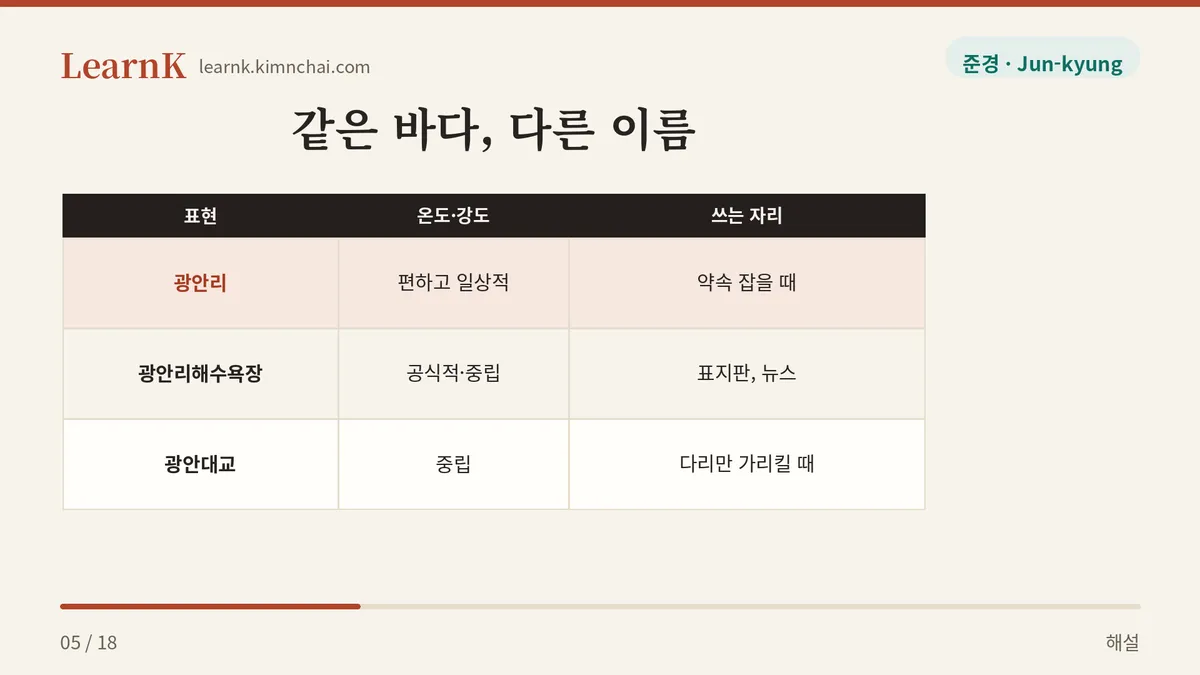
A place name itself has no polite/casual distinction. The politeness is carried by the verb that follows it. In 광안리 가 보셨어요? (Gwangalli ga bosyeosseoyo?) and 광안리 가 봤어? (Gwangalli ga bwasseo?), what changes is 가다 (gada), not 광안리 (Gwangalli). What you do have to choose between are the several different ways of naming the same place.
| Expression | Tone / intensity | Where it’s used |
|---|---|---|
| 광안리 (Gwangalli) | Relaxed, everyday | Making plans. Covers the beach and the neighborhood as one thing |
| 광안리해수욕장 (Gwangalli haesuyokjang) | Official, neutral | Signs, news, public announcements |
| 광안대교 (Gwangandaegyo) | Neutral | When you mean the bridge and only the bridge |
| 해운대 (Haeundae) | Big and polished | A different beach. The neighbor a few subway stops away |
Cultural Background — The Hour the Bridge Lights Up
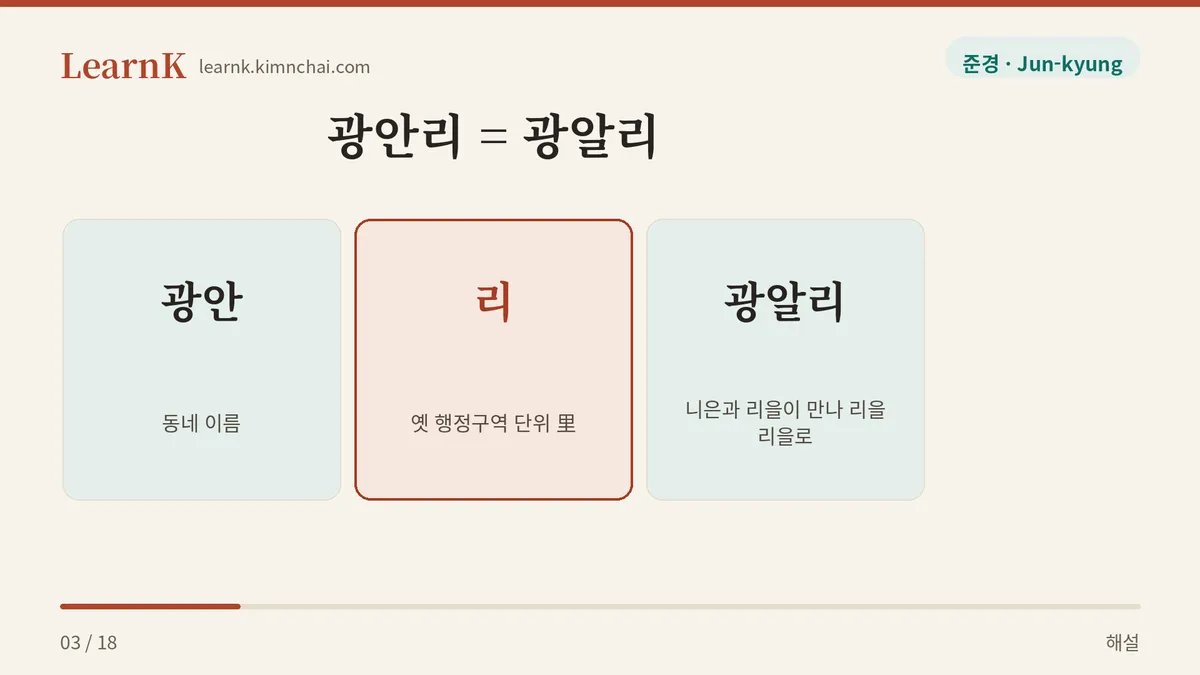
The 리 (ri) at the end of the name comes from an old administrative unit (里). The administrative dong covering this area today is called 광안동 (Gwangan-dong), but the beach kept the older name and it hardened into 광안리 (Gwangalli). So it happens quite naturally that people write Gwangan-dong on their mail and make plans in Gwangalli.
The decisive moment that gave Gwangalli its current standing was a bridge being laid across the water. When the Gwangan Bridge opened in the early 2000s, an enormous illuminated structure appeared directly in front of the beach. Until then Gwangalli was a quiet beach living in Haeundae’s shadow, but from the moment the bridge started lighting up, it took on its identity as “the beach you go to at night.” If a night scene in a drama or variety show set in Busan has a long ribbon of glowing bridge in the background, nine times out of ten it was shot at Gwangalli.
Over the last few years, drone light shows above the beach on weekend evenings have pulled in even bigger crowds. At the Busan Fireworks Festival in the fall, the fireworks go up with the Gwangan Bridge as the backdrop, and on that day the sand fills up hours ahead of time. Buying freshly sliced raw fish at the nearby Millak-dong fish market and eating it by the water is another long-running routine. That said, drinking on the beach and in the waterfront park can be restricted by hour or by zone depending on local government policy, so it’s worth reading the on-site signboards before you spread out your mat.
There’s one more reason Gwangalli is useful to Korean learners: the word contains an entire pronunciation rule. When ㄴ meets ㄹ, it shifts to ㄹㄹ — liquid assimilation, 유음화 (yueumhwa) — which gives you [광알리] (gwangalli). It’s the same rule that makes 신라 read as [실라] (Silla) and 연락 read as [열락] (yeollak). Pronouncing one place name properly is enough to make your Korean a step more natural.
Today’s Quiz
Which of the following sounds the most natural?
① 내일 광안리대교 위에서 사진 찍자. (Naeil Gwangallidaegyo wieseo sajin jjikja.) ② 12월인데 광안리 가서 수영하자. (Sibiworinde Gwangalli gaseo suyeonghaja.) ③ 저녁 먹고 광안리 가서 야경 보자. (Jeonyeok meokgo Gwangalli gaseo yagyeong boja.) ④ 광안리는 부산 해운대구에 있는 다리 이름이야. (Gwangallineun Busan Haeundae-gue inneun dari ireumiya.)
Answer: ③ Explanation — ① is wrong because the bridge’s name is 광안대교 (Gwangandaegyo). ② sounds off because nobody gets in the water at Gwangalli in December. ④ doesn’t work either: Gwangalli isn’t a bridge, it’s a beach and neighborhood in Suyeong-gu. Paired with “after dinner” and “the night view,” as in ③, Gwangalli sits at exactly its natural temperature.
Definitions and example sentences are from the National Institute of Korean Language’s Basic Korean Dictionary (krdict.korean.go.kr); that portion of this post, including our translations, is licensed under CC BY-SA 2.0 KR.