광탈 (gwangtal): Falling at the Speed of Light — Essential Slang for the Audition & Job-Hunting Era

A contestant on an audition show who performs a single stage and then immediately packs their bags. A job seeker who gets a “rejected” text just one day after the document-screening results come out. Korea’s younger generation captures moments like these in just two syllables: 광탈 (gwangtal). Today, let’s take a deep dive into this vivid piece of slang that shows up constantly in K-dramas, variety shows, and the everyday conversations of young Koreans.
광탈
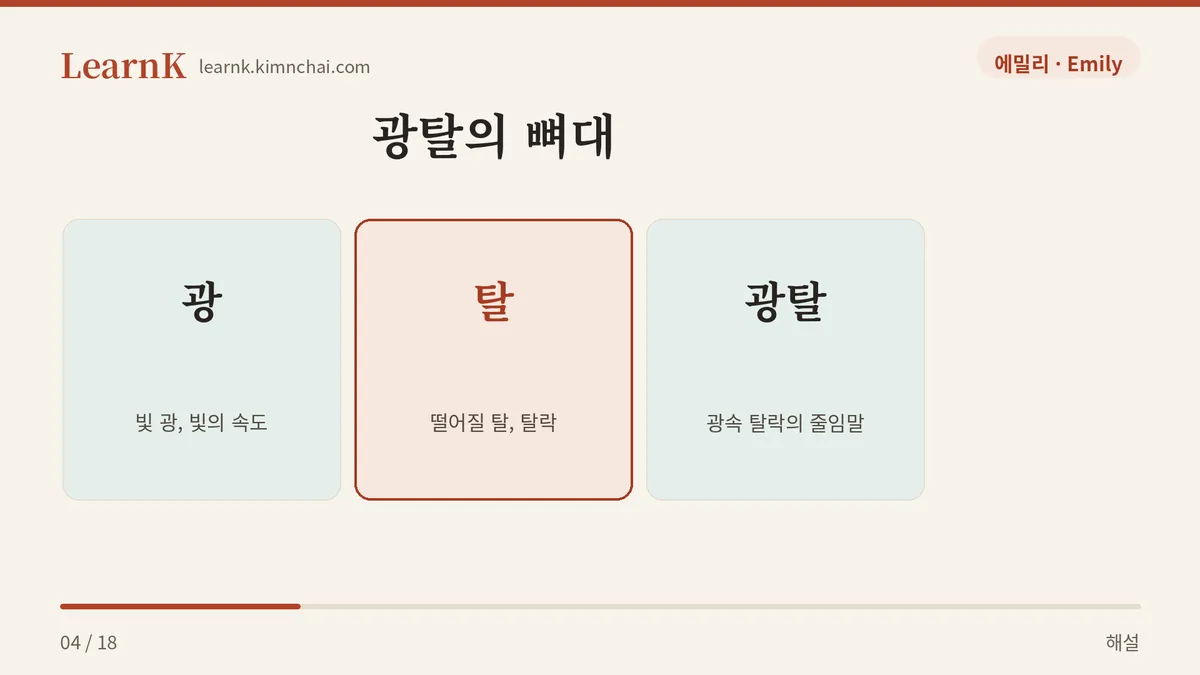
광탈 (gwangtal) is a coined word that combines ‘빛 광 (光, light)’ and ‘벗을·떨어질 탈 (脫, to shed / to drop out).’ It originally comes from 광속 탈락 (gwangsok tallak) — literally “to be eliminated at the speed of light.” It means being knocked out very quickly, very early on in some kind of evaluation or competition.
The key nuance is ‘speed’ and ‘emptiness.’ It’s not simply that you were eliminated (탈락 (tallak)), but that you got cut in an instant, before you even had a chance to get your hopes up — and it carries that sense of frustration and self-mockery. That’s why it’s often used with a light, bitter laugh — an “ugh, dropped out again” kind of feeling — rather than genuine sorrow.
It’s mainly used in three situations. First, early elimination from audition or competition programs. Second, an early rejection in a job application or exam (especially the document screening round). Third, losing or dying right at the start of a game.
Example Sentences by Situation
Example 1 — Job hunting
3년 준비한 회사인데 서류에서 광탈했어. (3-nyeon junbihan hoesa-inde seoryu-eseo gwangtal-haesseo.) It’s a company I spent three years preparing for, and I got knocked out at the very first paperwork stage.
This expresses the deflating feeling of not even making it past the document screening — the first gate — at a company you put a lot of effort into applying to. As in “광탈했어,” the word is often turned into a verb by adding -하다 (-hada).
Example 2 — Audition program
내 최애가 1라운드에서 광탈이라니, 믿을 수 없어! (nae choe-ae-ga il-raundeu-eseo gwangtal-irani, mideul su eopseo!) My absolute favorite got eliminated in round one — I can’t believe it!
This is the cry a fan lets out when a contestant they love (최애 (choe-ae) = the object of one’s greatest affection) drops out right away in the first round. Here, the word is used as a noun, as in “광탈이라니.”
Example 3 — Gaming / everyday life
오늘 게임 왜 이래, 시작하자마자 광탈이야. (oneul geim wae irae, sijakhajamaja gwangtal-iya.) What’s with this game today — I got wiped out the second it started.
This is a light grumble for when you lose in an instant as soon as you fire up a game. It’s the kind of thing friends toss around with a laugh.
Comparing Formal and Casual Speech, and Similar Expressions
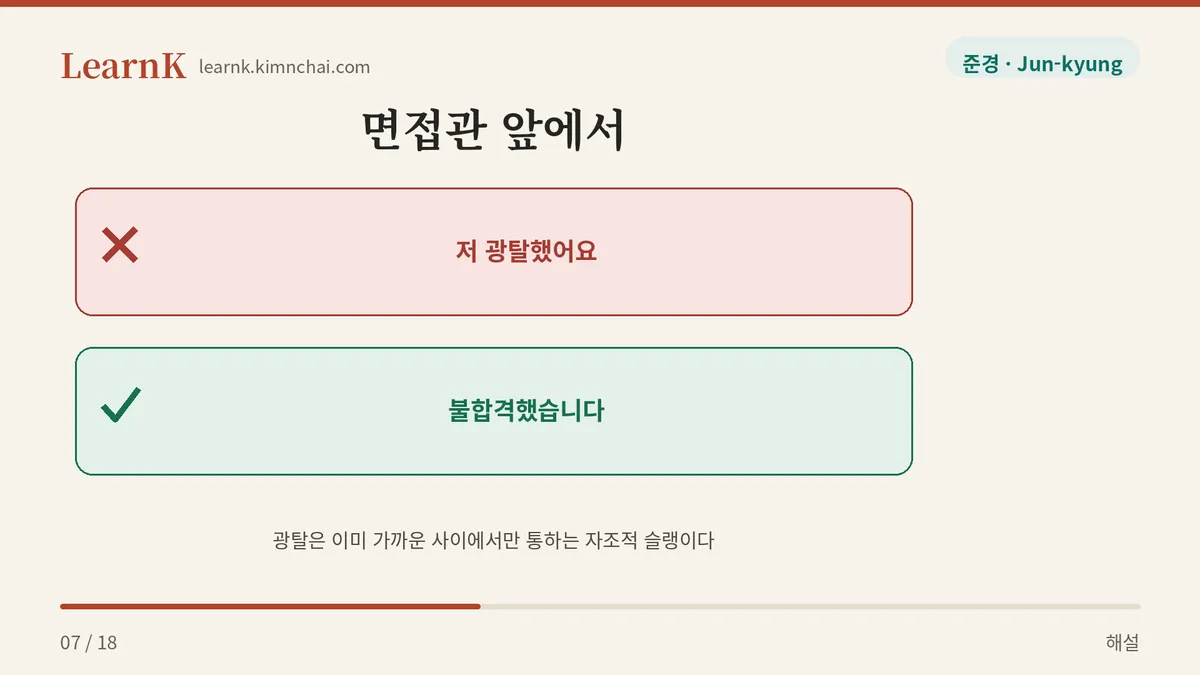
Since 광탈 is slang, it’s basically used in casual, informal (반말) situations. With friends you’d say “나 광탈했어 (na gwangtal-haesseo),” and if you need to be a little more polite, you can go as far as “저 광탈했어요 (jeo gwangtal-haesseoyo).” However, in official documents, in front of an interviewer, or in formal settings where you need to show respect to elders, it’s safer to skip the slang and use “불합격했습니다 (bulhapgyeok-haetseumnida)” or “탈락했습니다 (tallak-haetseumnida).”
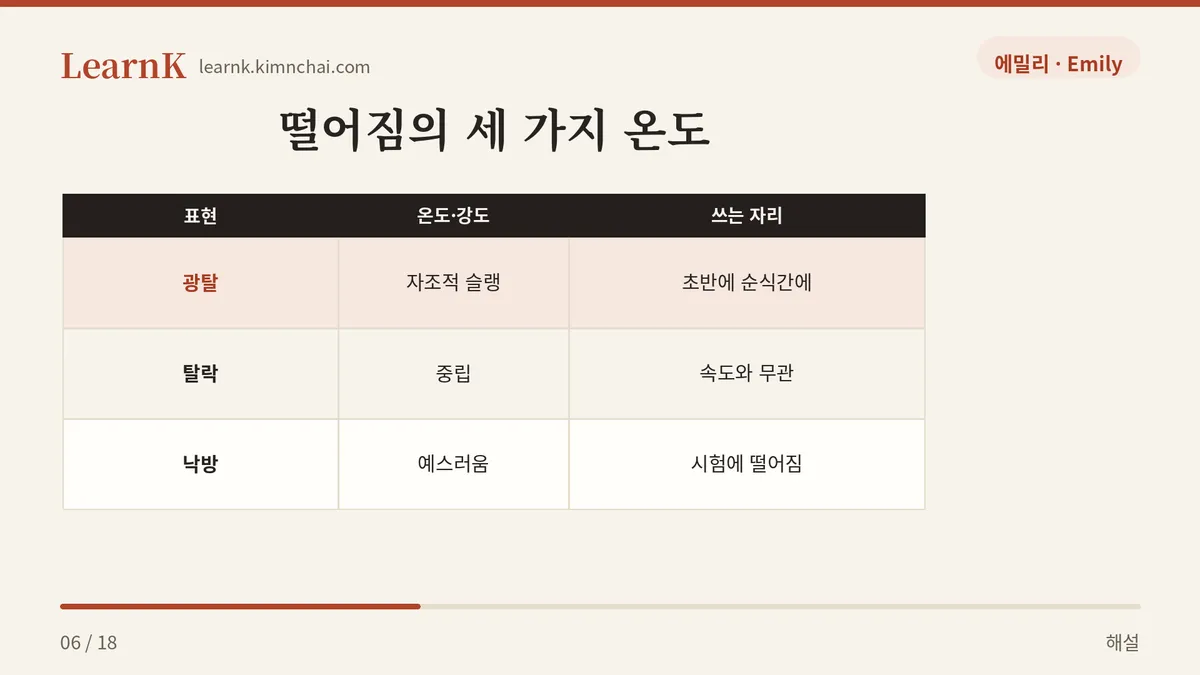
It helps to learn some similar expressions too. 탈락 (tallak) is a neutral ‘elimination’ with no connotation of speed; 낙방 (nakbang) is a somewhat old-fashioned word meaning failing an exam; and 떨어지다 (tteoreojida) is the most common everyday verb. On the flip side, passing is 합격 (hapgyeok), and getting through a preliminary round is 통과 (tonggwa). In short, you can think of 광탈 as the emotionally amped-up version of ‘탈락.‘
Cultural Background — Why the ‘Speed of Light,’ of All Things?
Behind the spread of the word 광탈 lies Korea’s fierce culture of competition. As audition-survival variety shows swept the nation and job-application ratios of hundreds-to-one became routine, young people needed a word to express ‘fast failure’ with a touch of self-deprecation. 광탈 is this generation’s way of digesting that frustration with humor rather than heaviness.
This sentiment shows up often in dramas too, when they depict the exhaustion of job seekers or trainees. In coming-of-age dramas dealing with the tough job market, for instance, there’s often a recurring scene where the protagonist crumbles under one rejection after another — and the emotional core of scenes like that is compressed into this single word, ‘광탈.‘
Closing Quiz
A friend says with a bitter laugh, “나 이번에도 서류에서 ______했어” (“I got ______ at the document stage again this time”). What’s the slang word that fills the blank, meaning ‘to be knocked out in an instant, early on’?
Answer: 광탈 (gwangtal) — it means being eliminated at the speed of light. Starting today, try adding this vivid expression to your Korean!