계란말이 (gyeranmari) — The Side Dish With the Recipe Built Into Its Name

계란말이
계란말이 (gyeranmari) means a dish made by pouring beaten egg into a pan and rolling it up as it fries. When a Korean hears this word, the picture that comes to mind is nearly identical for everyone: a plate of thick-cut slices from a yellow cylinder, green scallion and orange carrot showing in every cross-section, and the spot on the table that chopsticks head for first.
There are really three places where this word gets said out loud: the kitchen in the morning while a lunchbox is being packed, the counter at a 분식집 (bunsikjip, a cheap snack-food shop), and a bar late at night when everyone is picking something to eat with their drinks. For a Korean learner, 계란말이 (gyeranmari) matters not because it’s the name of a dish, but because the temperature of the language in those three places is completely different.
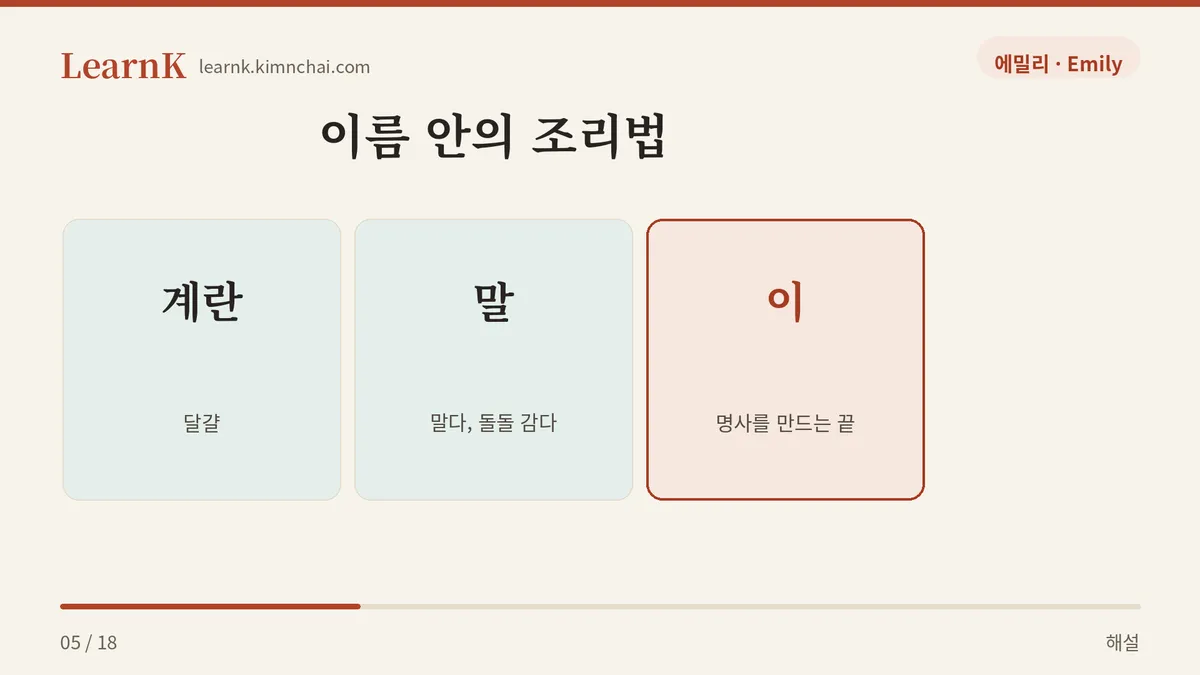
The heart of 계란말이 (gyeranmari) is the 말이 (mari) on the end. It’s the verb 말다 (malda, to roll something up) plus the noun-forming suffix ‑이 (-i). The whole cooking method is packed into the name — the rolled thing. If it isn’t rolled, the name doesn’t even hold. 김밥 (gimbap) and 잡채 (japchae) get their names from ingredients or shape, but with 계란말이 (gyeranmari), the motion of the hand is the identity.
That’s why the word carries a quiet weight of 정성 (jeongseong, care and effort). A 계란프라이 (gyeranpeurai, fried egg) is done in three minutes, but 계란말이 (gyeranmari) has to be folded and rolled again and again over low heat, and it tears the moment you rush. It’s a dish that takes hands. This is exactly why 너희 어머니 계란말이 진짜 잘하신다 (neohui eomeoni gyeranmari jinjja jalhasinda, “Your mom is really good at gyeranmari”) counts as serious praise in Korea. It isn’t recognizing expensive ingredients — it’s recognizing the time someone put in.
And yet 계란말이 (gyeranmari) isn’t the least bit fancy. At a 분식집 (bunsikjip) it’s a side dish you order next to your 김밥 (gimbap) for a few thousand won, and at a bar it’s the most unintimidating thing on the menu. Real effort goes in, but nothing about it feels like a burden — and among Korean side dishes, that combination is rarer than you’d think.
Checking It in the National Institute of Korean Language Dictionary
First, let’s see how the dictionary built by the national language institute writes this word up.
계란말이 「명사」 (noun) 계란을 풀어 돌돌 말아 가면서 부쳐 낸 음식. (Gyeraneul pureo doldol mara gamyeon buchyeo naen eumsik.) A dish made by beating eggs and pan-frying them while rolling them up. — National Institute of Korean Language, Basic Korean Dictionary (krdict.korean.go.kr)
The entire cooking sequence sits inside that one-line definition: beat (stir) → roll → fry. It also means that if any one of those three actions is missing, you’ve made a different dish.
Here are the multilingual translations the dictionary attaches.
[en] gyeranmari; rolled omelet — Rolled omelet, made by stirring eggs and rolling them in a frying pan. [ja] たまごやき【卵焼き】 — 卵をかきまぜ、くるくる巻いて筒状に焼いた料理。 [es] Rollo de huevo, plato que se elabora batiendo huevos y friéndolos en una sartén para luego formar un rollo. [zh] 鸡蛋卷 — 将打好的蛋液一边翻卷一边煎出来的食物。 — National Institute of Korean Language, Basic Korean Dictionary (krdict.korean.go.kr)
Portuguese isn’t included in this dictionary. The following is not a dictionary quotation but our own rendering — [pt] gyeranmari; omelete enrolada — ovos batidos fritos e enrolados na frigideira.
Notice that all four languages make sure to include a verb meaning “to roll” (rolled, 巻いて, enrollar, 翻卷). The translators, too, decided that the center of this word isn’t the egg — it’s the rolling.
Now let’s look at the actual usage examples the dictionary lists.
승규의 도시락에는 항상 계란말이 반찬이 들어 있었다. (Seunggyu-ui dosirageneun hangsang gyeranmari banchani deureo isseotda.) Seung-gyu’s lunchbox always had gyeranmari in it. — National Institute of Korean Language, Basic Korean Dictionary (krdict.korean.go.kr)
The adverb 항상 (hangsang, always) is the key. 계란말이 (gyeranmari) isn’t special-occasion food; it’s the everyday, repeated lunchbox side dish. And it also means that someone rolled it and tucked it in, every single morning.
지수는 계란말이를 부치려고 했지만 계란이 잘 말리지 않아서 계란 부침개처럼 되어 버렸다. (Jisuneun gyeranmarireul buchiryeogo haetjiman gyerani jal malliji anaseo gyeran buchimgaecheoreom doeeo beoryeotda.) Ji-su tried to make gyeranmari, but the egg wouldn’t roll properly, so it ended up like an egg pancake. — National Institute of Korean Language, Basic Korean Dictionary (krdict.korean.go.kr)
This single example confirms the definition of 계란말이 (gyeranmari) from the opposite direction. Even with identical ingredients, if it isn’t rolled, it isn’t 계란말이 (gyeranmari) — it’s 계란 부침개 (gyeran buchimgae, an egg pancake). Beginner cooks in Korea fail in exactly the same way, so this is a fun sentence for learners to memorize.
네 어머니는 계란말이를 참 잘하시는 것 같아. (Ne eomeonineun gyeranmarireul cham jalhasineun geot gata.) Your mother seems really good at making gyeranmari. — National Institute of Korean Language, Basic Korean Dictionary (krdict.korean.go.kr)
Here’s that “praise for the effort” idea as an actual sentence. The ‑시‑ (-si-) in 잘하시는 (jalhasineun) honors your friend’s mother, while the sentence ends in casual speech (‑아, -a). It’s the classic honorific combination you use when talking to a friend about that friend’s parents.
계란말이를 부치다. (Gyeranmarireul buchida.) 계란말이를 만들다. (Gyeranmarireul mandeulda.) — National Institute of Korean Language, Basic Korean Dictionary (krdict.korean.go.kr)
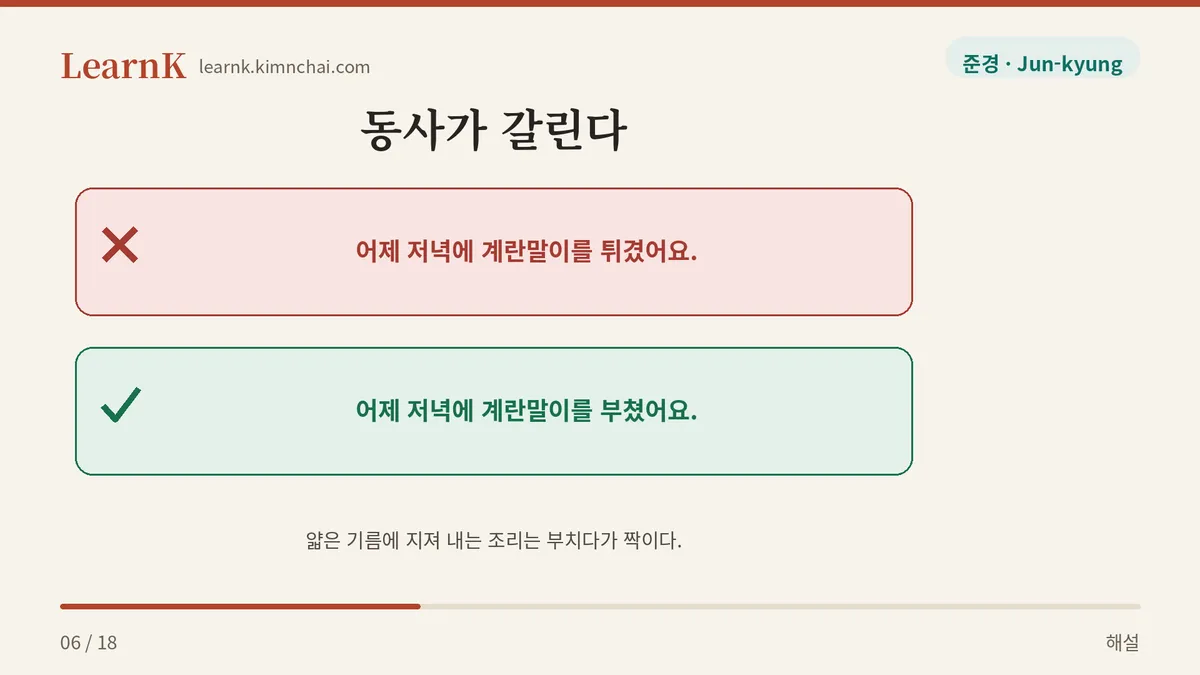
It matters that the verbs the dictionary pairs with it are 부치다 (buchida, to pan-fry) and 만들다 (mandeulda, to make). Not 굽다 (gupda, to grill/bake), not 튀기다 (twigida, to deep-fry). For cooking that involves a thin film of oil and a shallow sizzle, Korean uses 부치다 (buchida).
맛있는 계란말이. (Masinneun gyeranmari.) 치즈 계란말이. (Chijeu gyeranmari.) 야채 계란말이. (Yachae gyeranmari.) — National Institute of Korean Language, Basic Korean Dictionary (krdict.korean.go.kr)
Just put an ingredient name in front and you’ve made a variation. 치즈 계란말이 (chijeu gyeranmari, cheese gyeranmari) and 야채 계란말이 (yachae gyeranmari, vegetable gyeranmari) are written with a space, and you’ll meet them in exactly this form on menus.
Seeing It in a Real Conversation
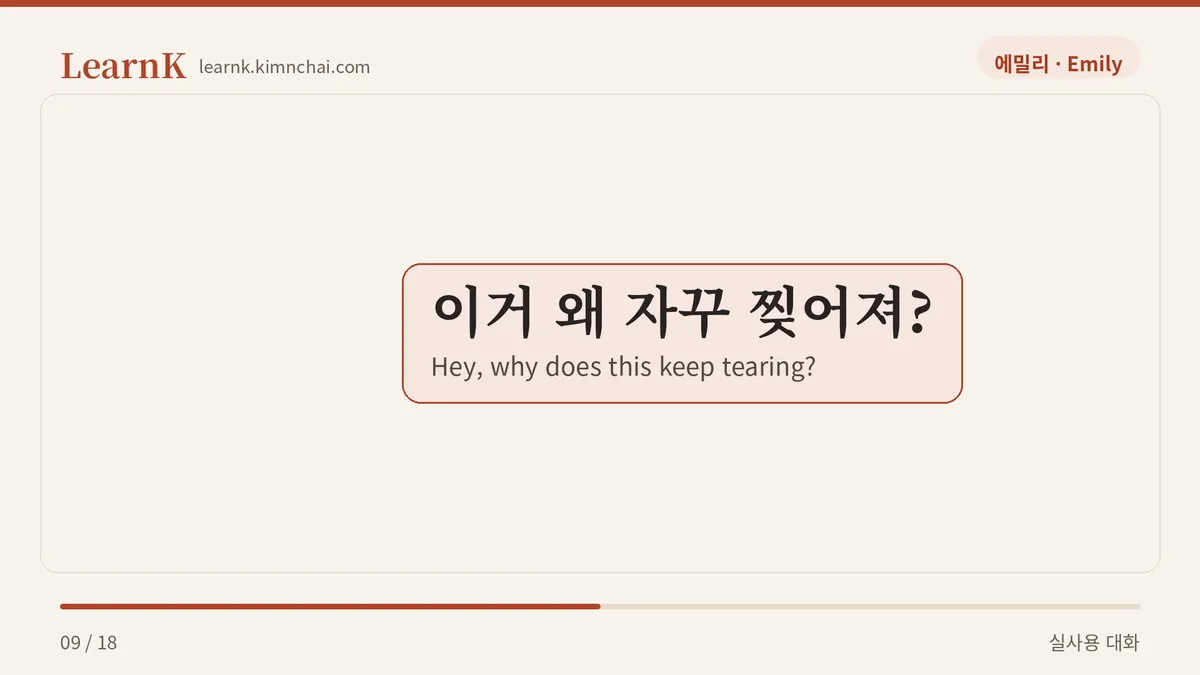
Setting: Sunday evening, the kitchen at Jun-kyung’s place. Emily is doing a practice run of the side dish she plans to pack for lunch tomorrow. The egg keeps tearing in the pan.
에밀리: 야, 이거 왜 자꾸 찢어져? 말 때마다 부서지네. Hey, why does this keep tearing? It falls apart every time I roll it.
준경: 불이 세서 그래. 약불로 줄이고, 반쯤 익었을 때 말아야 계란말이가 되지. The heat’s too high. Turn it down low and roll it while it’s half-cooked — that’s how it becomes gyeranmari.
에밀리: 아 진짜? 나 지금까지 다 익히고 나서 말았는데. Oh really? I’ve been cooking it all the way through and rolling it after.
준경: 그러니까 부침개가 되지. 젓가락 줘 봐. 한 번에 말지 말고 조금씩, 조금씩. That’s why it turns into a pancake. Give me the chopsticks. Don’t roll it all at once — little by little.
에밀리: 오, 된다 된다. 근데 너 왜 나보다 계란말이를 더 잘해? Oh, it’s working, it’s working. But why are you better at gyeranmari than me?
준경: 나 고등학교 삼 년 내내 내 도시락 내가 쌌어. 이건 그냥 손이 기억하는 거야. I packed my own lunch every day for three years of high school. My hands just remember it.
This Sounds Off
계란말이 (gyeranmari) is the name of an object, so it isn’t a word you adjust depending on who you’re talking to. Instead, here are two misunderstandings learners actually trip over.
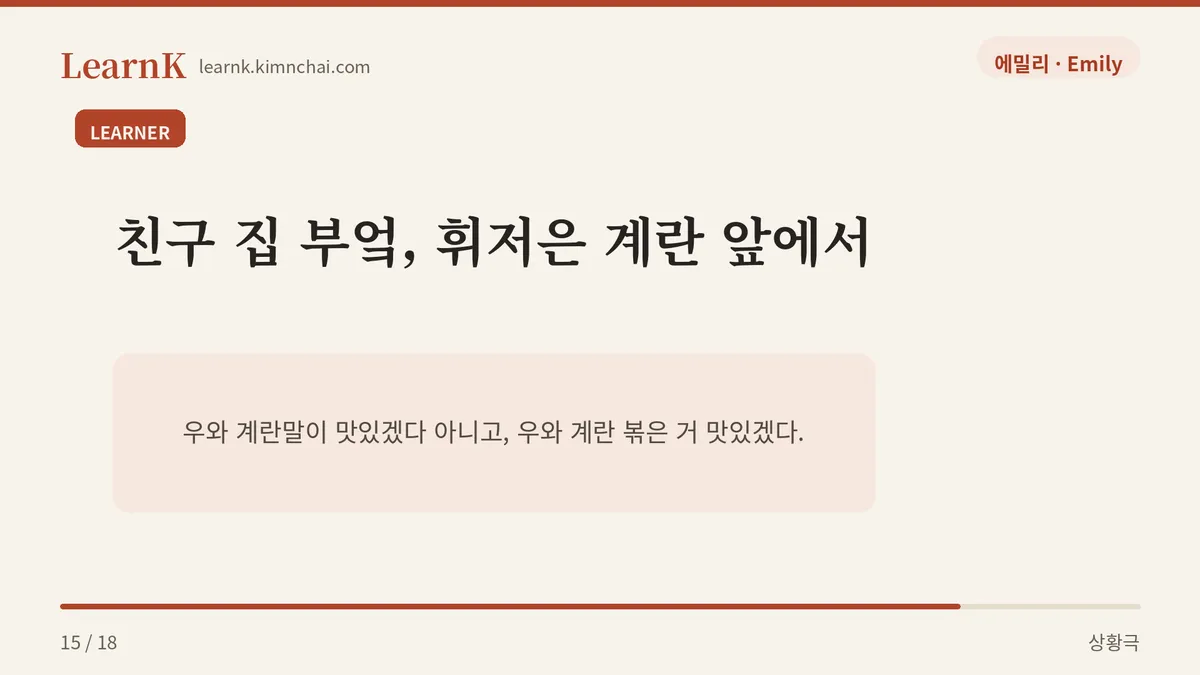
✗ (Looking at scrambled egg in a frying pan) 우와, 계란말이 맛있겠다! (Uwa, gyeranmari masitgetda!) ✓ (Same situation) 우와, 계란 볶은 거 맛있겠다! (Uwa, gyeran bokkeun geo masitgetda!) → 말이 (mari) means “the rolled thing.” You don’t attach this name to an egg dish that hasn’t been rolled. Even the dictionary example says 계란이 잘 말리지 않아서 계란 부침개처럼 되어 버렸다 (gyerani jal malliji anaseo gyeran buchimgaecheoreom doeeo beoryeotda) — Korean is very strict here.
✗ 어제 저녁에 계란말이를 튀겼어요. (Eoje jeonyeoge gyeranmarireul twigyeosseoyo.) ✓ 어제 저녁에 계란말이를 부쳤어요. / 만들었어요. (Eoje jeonyeoge gyeranmarireul buchyeosseoyo. / mandeureosseoyo.) → For cooking with a thin coat of oil and a shallow fry, 부치다 (buchida) is the matching verb. Use 튀기다 (twigida, to deep-fry) or 굽다 (gupda, to grill), and a completely different dish appears in your listener’s head — the grammar is fine, but you sound like someone who doesn’t cook.
Example Sentences by Situation
1. Ordering at a 분식집 (bunsikjip)
Lunchtime. One roll of 김밥 (gimbap) isn’t enough, but adding 라면 (ramyeon) feels too heavy. The middle ground Koreans pick most often here is 계란말이 (gyeranmari).
이모, 김밥 두 줄이랑 계란말이 하나요. (Imo, gimbap du jul-irang gyeranmari hanayo.) Auntie, two rolls of gimbap and one gyeranmari, please.
Calling an older female shop owner 이모 (imo, literally “maternal aunt”) at a 분식집 (bunsikjip) is an extremely common form of address. Ending the sentence with 하나요 (hanayo) is also a clipped register used only when ordering.
2. Picking something to eat with drinks at a bar
You’ve agreed to a light drink after work. You’re flipping through the menu, each waiting to see what the other wants.
오늘은 무거운 거 말고, 계란말이에 맥주 한 잔만 하자. (Oneureun mugeoun geo malgo, gyeranmarie maekju han janman haja.) Let’s skip the heavy stuff today — just gyeranmari and a beer.
When you use the particle ‑에 (-e) as in 계란말이에 맥주 (gyeanmarie maekju), it means “drinking B with A as the snack.” This structure gets used every single day over drinks.
3. Packing a lunchbox in the morning
A busy morning kitchen, everyone getting ready for work or school. Someone asks what to put in.
오늘 도시락에 계란말이 넣어 줄까? (Oneul dosirage gyeranmari neoeo julkka?) Should I put gyeranmari in your lunch today?
The ‑어 주다 (-eo juda) in 넣어 줄까? (neoeo julkka?) means doing something for someone else. Since 계란말이 (gyeranmari) is a hands-on dish, this sentence is effectively an offer of “should I spend ten more minutes for you?”
Honorific vs. Casual Speech, and Related Expressions
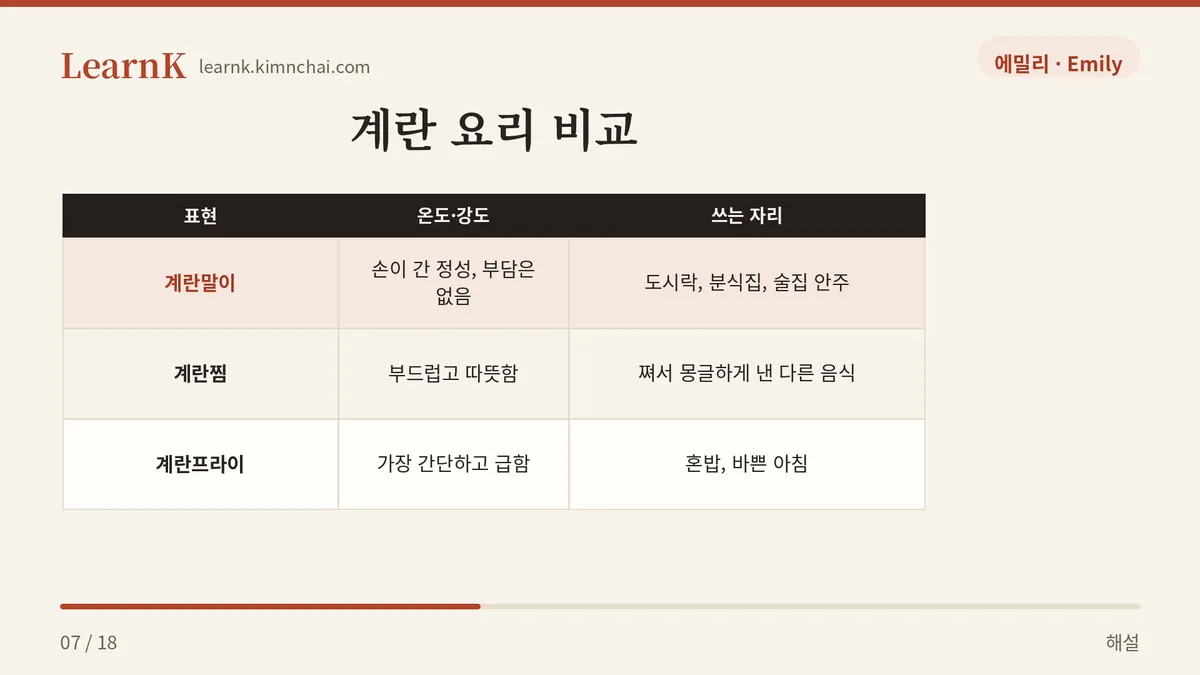
계란말이 (gyeranmari) is a noun, so there’s no politeness level built into it. The politeness is decided by the verb that follows. To a friend: 계란말이 해 줄까? (gyeranmari hae julkka?). To someone older: 계란말이 해 드릴까요? (gyeranmari hae deurilkkayo?). And when talking about someone else’s mother, you slip in the ‑시‑ (-si-): 계란말이를 부쳐 주셨어요 (gyeranmarireul buchyeo jusyeosseoyo).
Here’s how it sits relative to similar-looking egg dishes.
| Expression | Tone / intensity | Where it’s used |
|---|---|---|
| 계란말이 (gyeranmari) | Hands-on care, but no pressure | Lunchboxes, home cooking, 분식집 (bunsikjip), bar snacks. Everywhere |
| 달걀말이 (dalgyalmari) | Same dish, a slightly more proper feel | Cookbooks, TV subtitles. Places that choose the native-Korean spelling |
| 계란찜 (gyeranjjim) | Soft and warm | A different dish. Steamed into a fluffy custard |
| 계란프라이 (gyeranpeurai) | Simplest and most rushed | Eating alone, breakfast. The lightest weight of effort |
계란 (gyeran, 鷄卵) is a Sino-Korean word and 달걀 (dalgyal) is native Korean. Both are standard, so 계란말이 (gyeranmari) and 달걀말이 (dalgyalmari) are both correct — but in real conversation, you’ll hear 계란말이 (gyeranmari) overwhelmingly more often.
Cultural Background — The Yellow Stripe Under the Lunchbox Lid
The place 계란말이 (gyeranmari) holds at the Korean table is almost fused with the word 도시락 (dosirak, lunchbox). Before school meal programs took hold, the lunchbox you carried to school was one compartment of rice and two or three of side dishes. 김치 (kimchi) leaks brine, fish smells, and 나물 (namul, seasoned vegetables) go limp fast. Something that still tastes fine cold, doesn’t run, comes pre-cut into pieces easy to pick up, and — above all — that kids actually like: 계란말이 (gyeranmari) was the one thing that met every condition. That’s why it reads like proof that Mom got up early that morning.
It’s also why lunchbox scenes recur in Korean dramas. A friend picks only the 계란말이 (gyeranmari) out of someone else’s lunchbox, and the owner pretends to be annoyed while nudging the lid over — the whole relationship between the two is explained without a line of dialogue, so the same image keeps showing up in school dramas and period pieces alike. Once you know that sharing side dishes is a language of intimacy in Korea, you understand why the scene gets used so often.
A bit more on the name: 계란말이 (gyeranmari) is an extremely transparent coinage, 말다 (malda) plus ‑이 (-i). The same pattern is all over Korean food names. 무침 (muchim) comes from 무치다 (muchida, to toss with seasoning); 볶음 (bokkeum) comes from 볶다 (bokda, to stir-fry). Roughly half of Korean dish names are just the cooking motion turned into a noun, so learning one verb lets you read several lines of a menu at once.
Finally, a lot of learners ask about the relationship to Japanese 다마고야키 (damagoyaki, たまごやき). Since the dictionary lists 卵焼き as the Japanese equivalent, the form is nearly the same — but the flavor goes in a different direction. The Japanese version often has sugar or mirin for a sweet note, while Korean 계란말이 (gyeranmari) tends to have finely chopped vegetables like carrot, scallion, and onion, seasoned savory with salt. That’s why Japanese visitors trying 계란말이 (gyeranmari) in Korea for the first time so often say, “There’s no sweetness.”
Today’s Quiz
Ji-su beat some eggs and poured them into the pan, but the heat was so high that the edges cooked through in an instant. In the end she couldn’t roll it and moved it to a plate flat. What did Ji-su make?
① 계란말이 (gyeranmari) ② 계란 부침개 (gyeran buchimgae) ③ 계란찜 (gyeranjjim)
Answer: ②
The National Institute of Korean Language dictionary wrote down this exact situation — 계란이 잘 말리지 않아서 계란 부침개처럼 되어 버렸다 (gyerani jal malliji anaseo gyeran buchimgaecheoreom doeeo beoryeotda), “the egg wouldn’t roll properly, so it ended up like an egg pancake.” Even with the same ingredients, drop the rolling motion and you can’t call it 계란말이 (gyeranmari). That’s the fearsome thing about a word with the recipe inside its name. If you take away just one sentence from today, make it this one — 계란말이를 부치다 (gyeranmarireul buchida). Not 굽다 (gupda), not 튀기다 (twigida), but 부치다 (buchida).
Definitions and example sentences are from the National Institute of Korean Language’s Basic Korean Dictionary (krdict.korean.go.kr); that portion of this post, including our translations, is licensed under CC BY-SA 2.0 KR.