계란빵 (gyeranppang) — The Winter Street-Stall Bread Your Hands Remember First
계란빵
계란빵 (gyeranppang) literally means “bread made by putting egg into flour dough and steaming or baking it.” If you’ve ever walked past a street stall on a winter evening — just outside a subway exit, or in the alley by a school — with white steam rising off a square cast-iron mold, the things sitting in a row inside that mold were exactly this bread. Batter is poured into the long oval slots, a whole egg is cracked right on top, and then it bakes, so the finished bread has the yolk still there in the middle, domed and intact.
For Korean speakers, this word is remembered as a temperature before it is remembered as a taste. When you take a fresh one still in its paper bag, your palm goes hot even through a glove; you slip the bag into your coat pocket, walk, and pull one out while waiting at a crosswalk. That’s why this word attaches more often to a sentence like “bought one and walked” than to “ate one.”
Here’s the point learners miss most often. 계란빵 is not a blanket term for “bread with egg in it.” French toast isn’t 계란빵. Neither is an egg sandwich. Neither is castella. The word is the proper name of exactly one street snack, baked in a small mold. And its flavor has a clear direction — not sweet, but plain and clean. There’s a little sugar in it, but the base note is egg, so the person who isn’t into sweet things is generally the one choosing 계란빵 in front of the stall.
Checking the National Institute of Korean Language dictionary
계란빵 (gyeranppang) 「명사」 (noun) 밀가루 반죽에 계란을 넣어 찌거나 구운 빵. — Bread made by putting egg into flour dough and steaming or baking it. [en] egg bread — Bread made by mixing eggs with flour and baking it all in a small mold. [ja] たまごパン【卵パン】 — 小麦粉に卵を入れて焼いたり蒸して作ったパン。 [es] pastel de huevo — Pastel de huevo, pan hecho con una masa de harina y huevo que se cocina en un molde pequeño. [zh] 韩式鸡蛋糕 — 在和好的面粉中放入鸡蛋后蒸出或烤出的面食。 — National Institute of Korean Language, Basic Korean Dictionary (krdict.korean.go.kr)
The dictionary carries no Portuguese definition for this word. The single line below is not a dictionary quotation but our own rendering — pão de ovo: massa de farinha com um ovo inteiro, assada em uma forma pequena.
It’s worth noticing that the English definition contains the phrase “in a small mold.” Going by the Korean definition alone, you’d think any bread with egg in it would qualify — but the English spells out the mold. Which is to say: this bread’s identity lies not only in its ingredients but in how it’s baked.
계란빵은 맛도 좋지만 계란이 하나 통째로 들어가 있어서 영양가도 높을 것 같다. Gyeranppang tastes good, and since there’s a whole egg in it, it seems like it must be nutritious too. — National Institute of Korean Language, Basic Korean Dictionary (krdict.korean.go.kr)
This is the most common thing people say while eating one. The key phrase is “계란이 하나 통째로 (a whole egg, all in one piece)” — the example sentence itself teaches you the defining feature of this bread: the egg isn’t beaten and stirred into the batter, it goes in whole, laid right on top. The ending -을 것 같다 (-eul geot gatda) at the end of the sentence expresses a guess rather than a flat assertion, so the nuance is “I don’t actually know the nutrition facts — it just looks that way to me.”
승규는 길에서 파는 계란빵으로 허기를 달랬다. Seung-gyu took the edge off his hunger with gyeranppang sold on the street. — National Institute of Korean Language, Basic Korean Dictionary (krdict.korean.go.kr)
Two phrases here place this food exactly: 길에서 파는 (gireseo paneun, sold on the street) and 허기를 달래다 (heogireul dallaeda, to quiet one’s hunger for a while). It isn’t a proper meal but something that fills the gap between meals, and it isn’t bought sitting down in a shop but standing on the street.
아니, 붕어빵은 너무 달아서 별로야. 난 계란빵을 좋아해. Nah, bungeoppang is too sweet for me. I like gyeranppang. — National Institute of Korean Language, Basic Korean Dictionary (krdict.korean.go.kr)
This is exactly the conversation that happens in front of a real stall. In Korean, 계란빵 is almost always mentioned paired with 붕어빵 (bungeoppang), and the line dividing them is generally sweetness. It’s also the most practical piece of information the dictionary gives you — 계란빵 is the not-sweet one.
따뜻한 계란빵. 담백한 계란빵. 맛있는 계란빵. Warm gyeranppang. / Plain, clean-tasting gyeranppang. / Delicious gyeranppang. — National Institute of Korean Language, Basic Korean Dictionary (krdict.korean.go.kr)
The dictionary even lists the modifiers that habitually attach to this word. What matters is that 따뜻한 (warm) and 담백한 sit side by side. When Koreans praise 계란빵, the word they reach for isn’t 달다 (sweet) but 담백하다 (dambaekhada, clean and light — neither greasy nor sweet).
계란빵을 만들다. 계란빵을 팔다. To make gyeranppang. / To sell gyeranppang. — National Institute of Korean Language, Basic Korean Dictionary (krdict.korean.go.kr)
These are the base forms with the word in object position. The fact that both the making verb and the selling verb are listed means this word belongs to the person buying it and to the person running the stall.
Seeing it in real conversation
Setting: six in the evening in December, in front of Exit 3 of a subway station. Steam is rising from the mold at the stall.
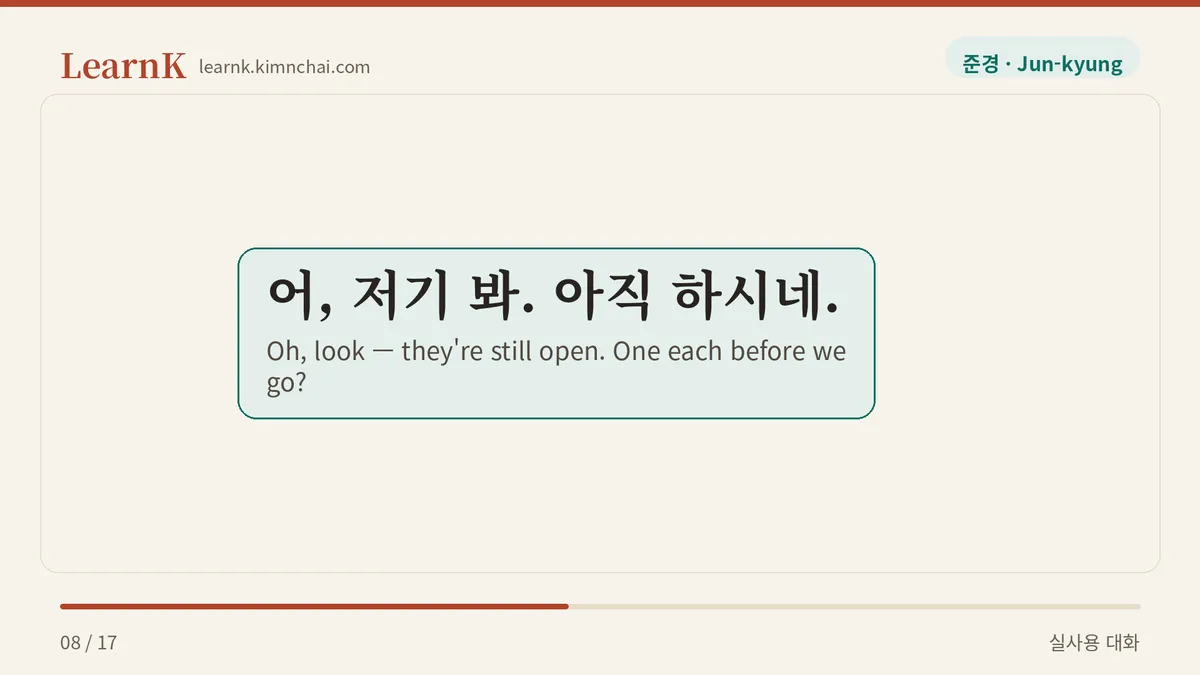
준경: 어, 저기 봐. 아직 하시네. 하나씩 먹고 갈까? Oh, look — they’re still open. Should we grab one each before we head off?
에밀리: 좋아. 근데 나 붕어빵 말고 계란빵. 팥이 너무 달아서 저녁 못 먹겠어. Sure. But I want gyeranppang, not bungeoppang. The red bean’s so sweet it ruins my dinner.
준경: 오, 취향 확실하네. 이모, 계란빵 두 개 주세요! Ha, you know what you like. Excuse me, two gyeranppang please!
에밀리: 야, 이거 완전 손난로다. 장갑보다 낫다. Dude, this is basically a hand warmer. Better than gloves.
준경: 그러다 식으면 맛없어. 노른자 안 터지게 조심해. It’s no good once it cools. Careful not to break the yolk.
에밀리: 알았어. 근데 진짜 계란 하나가 통째로 들어 있네? Okay, okay. But wow — there really is a whole egg in here.
Ways this sounds wrong
계란빵 is the name of a thing, so it isn’t a word you adjust depending on who you’re talking to or where you are. Instead, there are two misunderstandings learners keep tripping over.
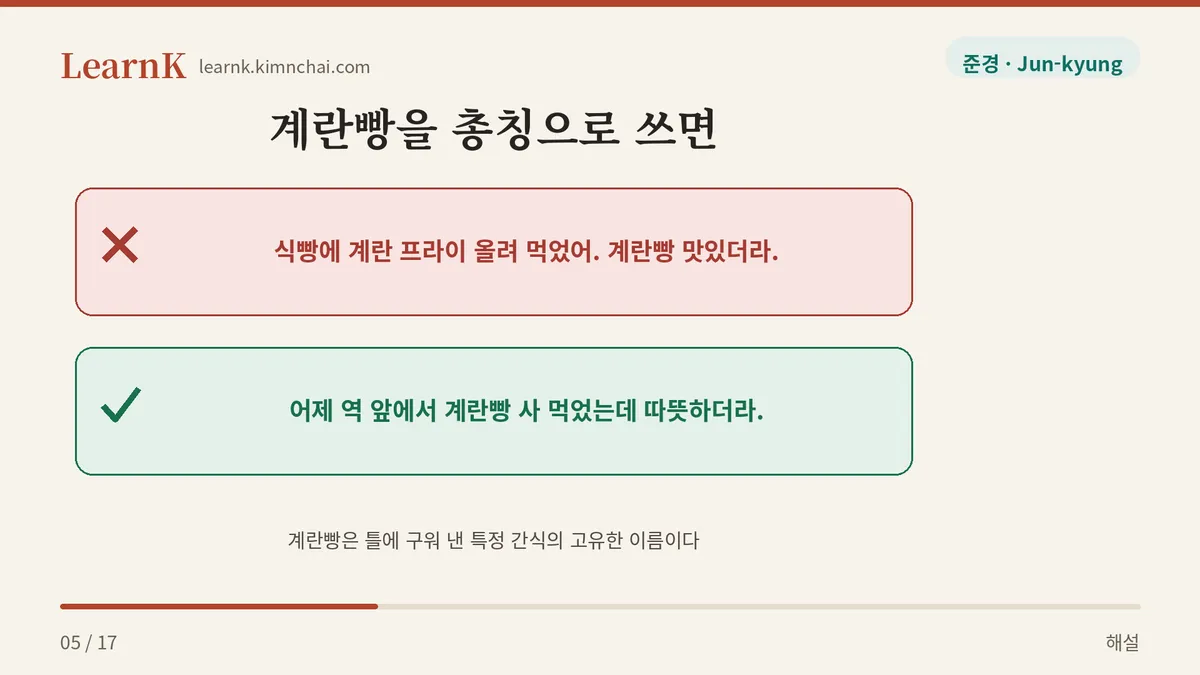
✗ 아침에 식빵에 계란 프라이 올려 먹었어. 계란빵 맛있더라. I had a fried egg on toast this morning. The “gyeranppang” was good. ✓ 아침에 식빵에 계란 프라이 올려 먹었어. / 어제 역 앞에서 계란빵 사 먹었는데 따뜻하더라. I had a fried egg on toast this morning. / I bought a gyeranppang in front of the station yesterday — it was so warm. → 계란빵 isn’t a general term for “bread with egg in it”; it’s the name of one specific snack baked in a mold. Something doesn’t become 계란빵 just because there’s egg in it.
✗ 디저트로 달달한 거 먹고 싶다. 계란빵 먹으러 가자. I want something sweet for dessert. Let’s go get gyeranppang. ✓ 디저트로 달달한 거 먹고 싶다. 붕어빵 먹으러 가자. I want something sweet for dessert. Let’s go get bungeoppang. → 계란빵 isn’t a snack you eat for sweetness. That’s exactly why the dictionary example puts it on the opposite side of “붕어빵은 너무 달아서 (bungeoppang is too sweet).” Pick 계란빵 when you’re craving something sweet and your Korean friend will ask back, “그건 안 단데? (But that one isn’t sweet, is it?)”
Example sentences by situation
① Ordering at a stall
계란빵 두 개만 주세요. (gyeranppang du gaeman juseyo.) Just two egg breads, please.
You could simply say 두 개 주세요, but slipping in the particle -만 (-man) softens the request considerably. It means “just this much, that’s all,” which sounds modest — so Koreans tack it on almost by habit at small shops and street stalls.
② Offering one to a friend
출출하지? 내가 계란빵 하나 사 줄게. (chulchulhaji? naega gyeranppang hana sa julge.) Bit peckish, right? I’ll buy you an egg bread.
출출하다 (chulchulhada) is much lighter than 배가 고프다 (to be hungry); it points to that slightly empty feeling between meals. It’s the exact size of hunger that suits 계란빵 best. -아/어 줄게 (-a/eo julge) is the casual form for offering someone a small favor.
③ Reporting back after trying it
그 집 계란빵은 반죽이 두툼해서 한 끼 대신 먹어도 되겠더라. (geu jip gyeranppangeun banjugi dutumhaeseo han kki daesin meogeodo doegetdeora.) The gyeranppang there has such thick batter you could eat it instead of a meal.
The ending -더라 (-deora) is used to report something you found out through direct experience. It signals that this isn’t hearsay — you went yourself and ate it yesterday — which is why it’s the ending Koreans love most when talking about food.
Formal and casual speech, plus related words
계란빵 is the name of an object, so the word itself doesn’t change shape with politeness level. Formal and casual always part ways at the end of the sentence.
- Casual: 계란빵 먹을래? (gyeranppang meogeullae?) — “Want a gyeranppang?”
- Polite: 계란빵 드실래요? (gyeranppang deusillaeyo?) — this uses 드시다 (deusida), the honorific form of 먹다 (meokda, to eat).
- When ordering: 계란빵 하나 주세요. (gyeranppang hana juseyo.) — with a stall owner you use polite speech regardless of age.
Worth noting: the native Korean word for egg is 달걀 (dalgyal), so plenty of people call it 달걀빵 (dalgyalppang) instead. Both are understood, but 계란빵 is the dictionary headword and the one more commonly written on stall signs.
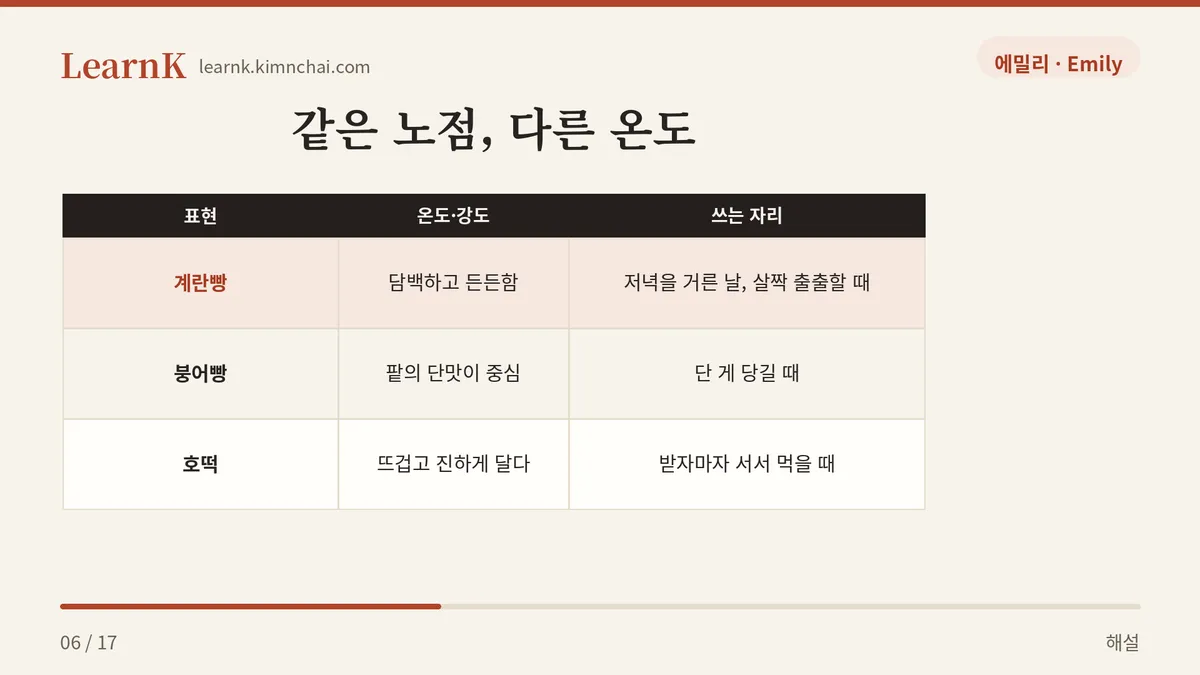
| Expression | Temperature & intensity | Where it’s used |
|---|---|---|
| 계란빵 (gyeranppang) | Clean-tasting and filling. Closer to a meal than a snack | Winter street stalls. When you’re a little hungry |
| 붕어빵 (bungeoppang) | Sweet and cozy. Built around the sweetness of red bean | The same stall. When you’re craving something sweet |
| 호떡 (hotteok) | Piping hot and intensely sweet | Markets and streets. Eaten standing, the moment it’s handed over |
| 카스텔라 (kaseutella) | Soft and fluffy, faintly sweet | Bakeries and packaged snacks. Not tied to a season |
Cultural background — the warmth of a winter street stall
Korea’s winter streets have a fixed roster of snacks: 붕어빵 (bungeoppang), 호떡 (hotteok), 군고구마 (gungoguma, roasted sweet potato), 어묵 국물 (eomuk gukmul, fish-cake broth), and 계란빵. Among them, 계란빵 holds a slightly special position. The others are mostly sweet or soupy, while 계란빵 is a plain, protein-carrying food — so it’s often what someone who skipped dinner picks up on the way home. There’s a reason the dictionary example reaches for the phrase 허기를 달랬다 (took the edge off his hunger).
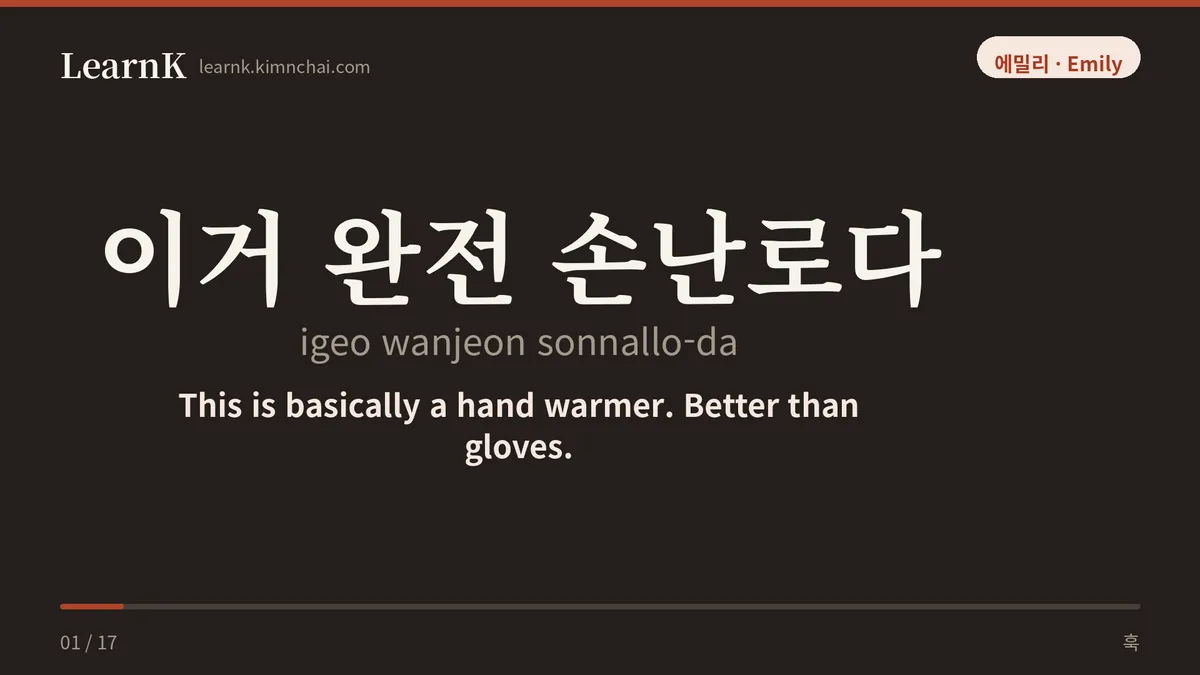
The name itself is worth a look. 계란 (gyeran) comes from the Sino-Korean 鷄卵 (鷄 chicken, 卵 egg), while 빵 (ppang) is a loanword from Portuguese pão, which entered Korean by way of the Japanese パン. So 계란빵 is a name where a Sino-Korean word and a Western loanword meet inside a single compound. Every Korean snack name with 빵 in it — 붕어빵 (bungeoppang), 국화빵 (gukhwappang), 소보로빵 (soboroppang) — shares that old borrowing.
These days, with urban tidy-ups thinning out the stalls, where you can buy one has itself become information. When winter starts, apps where users register and share stall locations on a map get popular enough to make the news. 계란빵 also shows up constantly as a prop in the winter episodes of dramas. Two people, each holding a paper cup of fish-cake broth in one hand and sharing a 계란빵 with the other — no prop shows the temperature of a relationship better, and without a single line of dialogue.
Today’s quiz
Which word best fits the blank in the conversation below?
A: 나 오늘은 단 거 말고 좀 든든한 게 먹고 싶어. A: Today I don’t want something sweet — I want something more filling.
B: 그럼 붕어빵 말고 ( ) 먹자. 계란 하나가 통째로 들어 있어서 배부르대. B: Then let’s get ( ) instead of bungeoppang. They say it’s filling because there’s a whole egg in it.
① 호떡 (hotteok) ② 카스텔라 (kaseutella) ③ 계란빵 (gyeranppang) ④ 식빵 (sikppang)
Answer: ③ 계란빵 (gyeranppang)
호떡 and 카스텔라 are both on the sweet side, so they don’t meet the condition “단 거 말고 (not something sweet),” and 식빵 (sliced white bread) isn’t sold side by side at a street stall. If you also caught that the clue “계란 하나가 통째로 (a whole egg, all in one piece)” is the definition of 계란빵, then you’ve properly taken away what today’s lesson had to give.
Definitions and example sentences are from the National Institute of Korean Language’s Basic Korean Dictionary (krdict.korean.go.kr); that portion of this post, including our translations, is licensed under CC BY-SA 2.0 KR.