계약결혼 (gyeyakgyeolhon) — The Contract They Sign in Episode 3 and Tear Up in Episode 12
계약결혼 (gyeyakgyeolhon)
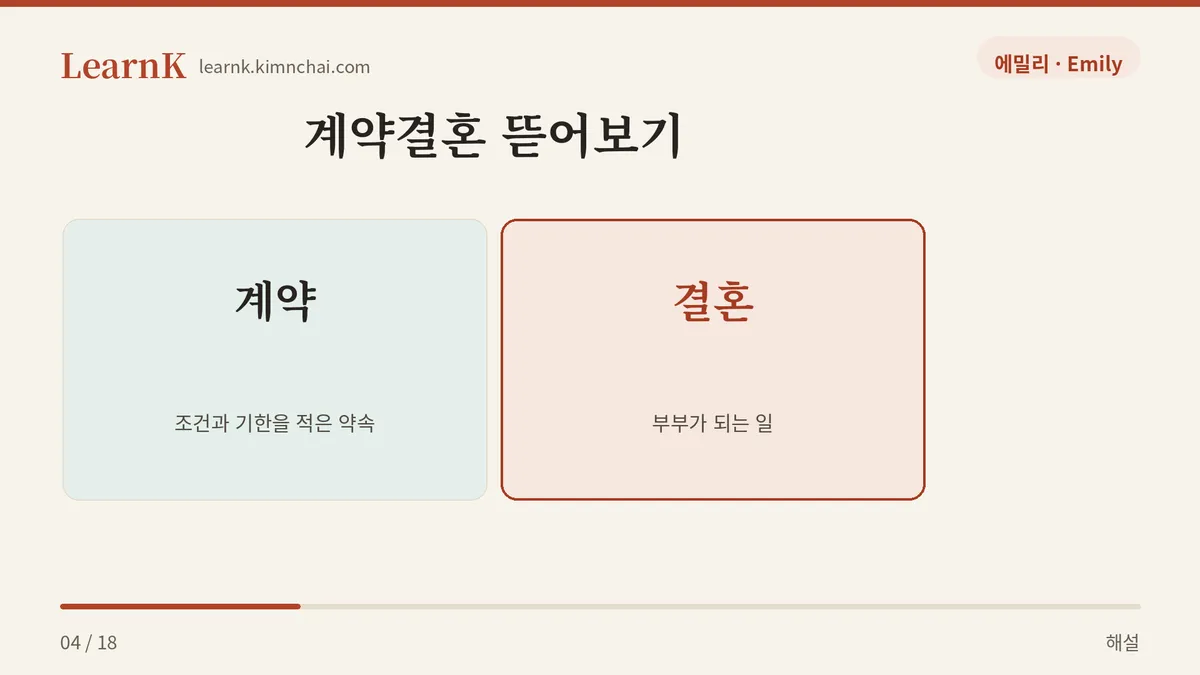
계약결혼 (gyeyakgyeolhon) means a relationship in which two people settle on a time frame and a set of conditions in advance, agree to take on only the outward form of marriage, and then live as a married couple. On paper they’re husband and wife — but what sits at the starting line isn’t love, it’s a contract. That’s the whole word.
Watch even a handful of Korean dramas and you can’t dodge this one. It turns up again and again in synopses on streaming sites, in community reviews, in the titles of YouTube recap videos. The tricky part for learners is that you won’t really find it in a dictionary. It isn’t a legal term and it isn’t standard everyday vocabulary either — it’s a word that grew up inside stories and then crossed over into ordinary conversation. So learners catch the meaning fast, but use it without knowing how far they can take it, and end up freezing the room.
The word formation is simple: 계약 (契約, gyeyak — contract) and 결혼 (結婚, gyeolhon — marriage), stuck together as-is. The meaning is just as literal, but for the word to actually apply, three things have to be in place. First, there’s a time limit. Usually a fixed end date — one year, six months. Second, there are clauses. Rules that exist as an actual document: hand-holding is allowed, separate bedrooms are mandatory, that sort of thing. Third, there’s a purpose other than marriage. To stop the parents from nagging, to qualify for company housing that only married employees get, to satisfy the terms of an inheritance — love is not on the list of purposes.
The temperature shifts dramatically depending on where you use it. Talking about fiction, it’s light and fun, practically a genre label. Say it about an actual married couple, and it becomes a suspicion: those two are bound by a transaction, not by feelings. Same word — a joke on one side, an insult on the other.
A Real Conversation
Scene: Sunday night at Jun-kyung’s place. Episode 4 has just finished and the autoplay countdown for the next one is ticking.
Jun-kyung: 야, 잠깐 멈춰 봐. 저 둘 지금 계약결혼한 거 맞지? Hey, pause for a sec. Those two just entered a contract marriage, right?
Emily: 응, 딱 1년짜리. 근데 벌써 눈빛이 이상해. 이거 백 퍼 진짜 사랑 된다. Yeah, a one-year deal. But the way they look at each other is already off. This is 100% turning into real love.
Jun-kyung: 뻔한데 왜 자꾸 보게 되냐. It’s so predictable — why do I keep watching?
Emily: 뻔해서 보는 거야. 계약결혼은 국룰이잖아. 3화에 계약서 쓰고 12화에 찢고. You watch it because it’s predictable. Contract marriage is the standard formula — sign in episode 3, tear it up in episode 12.
Jun-kyung: 조항 좀 봐라. 손잡기는 되고 뽀뽀는 안 되고. 이걸 누가 지켜. Look at those clauses. Hand-holding allowed, kissing not allowed. Who could actually keep that?
Emily: 못 지키니까 12화까지 가는 거지. 빨리 눌러, 넘어간다. Exactly — they can’t, which is why it takes twelve episodes. Hurry up and hit play, it’s about to skip.
This Sounds Off
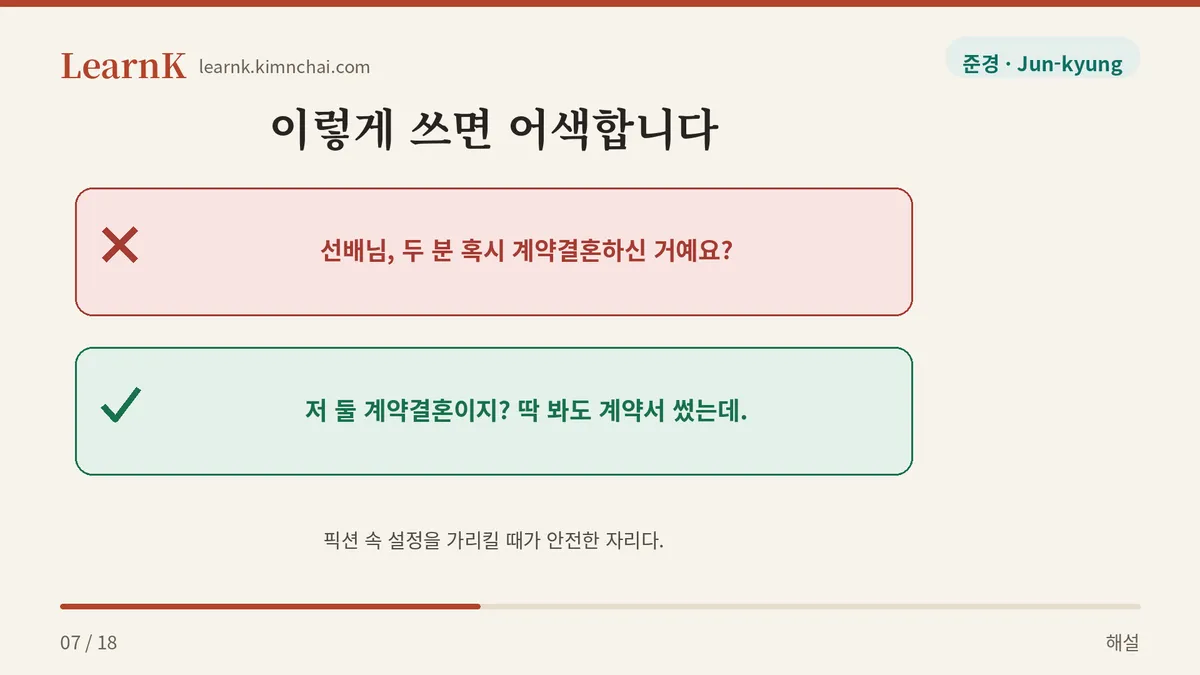
✗ (To a senior colleague and their spouse, who seem a little distant with each other) 선배님, 두 분 혹시 계약결혼하신 거예요? (seonbaenim, du bun hoksi gyeyakgyeolhonhasin geoyeyo?) ✓ (To a friend you’re watching a drama with) 저 둘 계약결혼이지? 딱 봐도 계약서 썼는데. (jeo dul gyeyakgyeolhoniji? ttak bwado gyeyakseo sseonneunde.) → Aimed at a real person’s marriage, it doesn’t land as a joke — it lands as the suspicion that they didn’t marry for love. Pointing at a setup in fiction is the safe place for it.
✗ 비자 받으려고 서류만 올린 것도 계약결혼이라고 하죠? (bija badeuryeogo seoryuman ollin geotdo gyeyakgyeolhonirago hajyo?) ✓ 비자 받으려고 서류만 올린 건 **위장결혼 (wijanggyeolhon)**이라고 해요. (bija badeuryeogo seoryuman ollin geon wijanggyeolhonirago haeyo.) → A 계약결혼 is a private arrangement between the two people involved, but a 위장결혼 is a crime — deceiving the state. Mix the two up and your drama chat suddenly turns into a news story.
Example Sentences by Situation
① Recommending a drama to a friend
계약결혼물 좋아하면 이거 꼭 봐. 3화부터 재밌어져. (gyeyakgyeolhonmul joahamyeon igeo kkok bwa. samhwabuteo jaemiisseojyeo.) If you like contract-marriage stories, you have to watch this. It gets good from episode 3.
The thing to notice here is -물 (-mul). It’s a suffix that groups works by type, used like 로맨스물 (romaenseumul, romance stories), 좀비물 (jombimul, zombie stories), 사극물 (sageungmul, historical dramas). Say 계약결혼물 (gyeyakgyeolhonmul) and you’re pointing at the entire body of works built on the contract-marriage setup.
② Throwing out a joke when you’re worn down by nagging about marriage
엄마 잔소리 때문에 진짜 계약결혼이라도 하고 싶다. (eomma jansori ttaemune jinjja gyeyakgyeolhonirado hago sipda.) Mom nags me so much that I honestly want to do a contract marriage just to shut it down.
-이라도 (-irado) is the key. It’s a particle carrying a note of resignation — “it’s not the best option, but at least this” — and it’s what makes the sentence a joke rather than a genuine plan. You’ll see this one all over group chats the day after a holiday.
③ Summing up your thoughts on a work (polite speech)
계약결혼으로 시작해서 진짜 사랑으로 끝나는 이야기예요. (gyeyakgyeolhoneuro sijakhaeseo jinjja sarangeuro kkeunnaneun iyagiyeyo.) It’s a story that begins as a contract marriage and ends as real love.
This is a frame you can use word-for-word to summarize a work in a slightly formal setting, like a Korean class or a book club. Swap out the words at either end and it carries over to a different work.
Polite vs. Casual, and Similar Expressions
계약결혼 is a noun, so there’s no honorific level built into the word itself. Polite and casual speech split at the predicate that follows it.
- Casual: 저거 계약결혼이야. (jeogeo gyeyakgyeolhoniya.)
- Polite: 저건 계약결혼이에요. (jeogeon gyeyakgyeolhonieyo.)
- Relaying what happened to someone else: 드라마에서 계약결혼을 했대요. (deuramaeseo gyeyakgyeolhoneul haetdaeyo.)
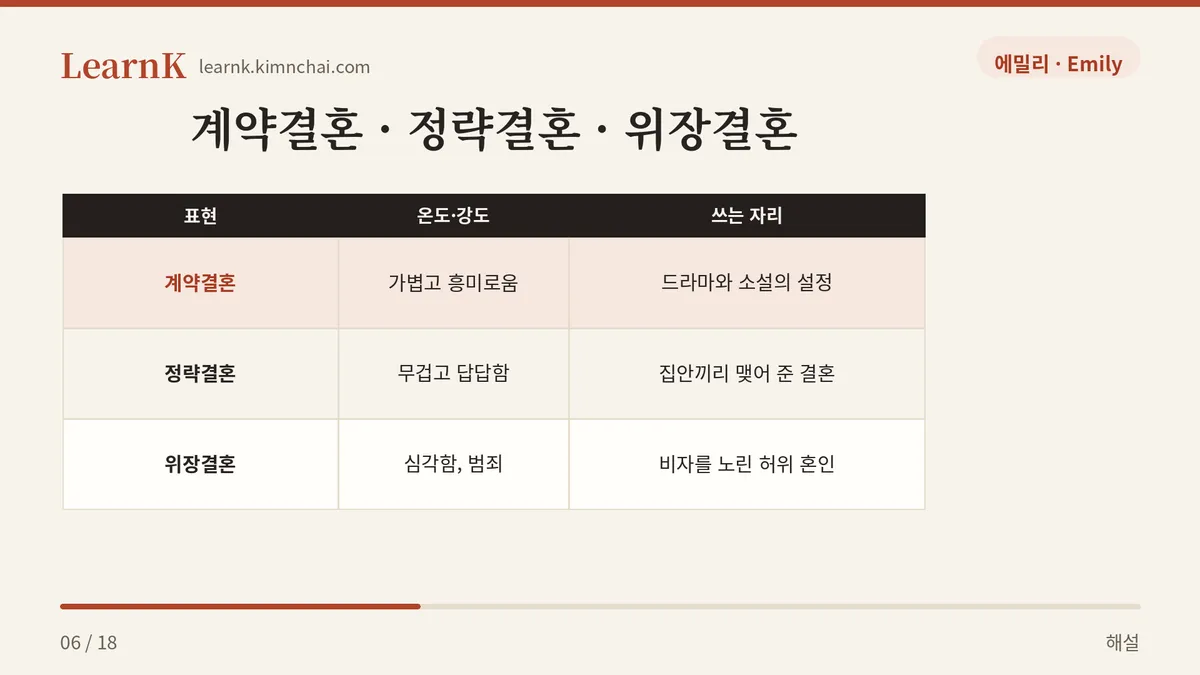
There are words that look similar but can never be swapped in for one another. Learn to tell these four apart and half of Korean drama commentary becomes readable.
| Expression | Temperature / intensity | Where it’s used |
|---|---|---|
| 계약결혼 (gyeyakgyeolhon) | Light, intriguing | A setup in dramas and novels. Not used about real couples |
| 정략결혼 (jeongnyakgyeolhon) | Heavy, suffocating | A marriage arranged between families for mutual interest. Historical dramas, chaebol stories |
| 위장결혼 (wijanggyeolhon) | Serious, criminal | A sham marriage filed to obtain a visa or a status. News, courtrooms |
| 사실혼 (sasilhon) | Neutral, administrative | Living as a married couple in practice without registering the marriage. Legal and administrative documents |
The pair learners mix up most is 계약결혼 and 정략결혼. The fork in the road is who decided. If the two people involved set the terms themselves, it’s 계약결혼; if the elders of the families arranged it, it’s 정략결혼.
Cultural Background — A Device for Manufacturing a Reason to Stay Close
Korean romance dramas have one long-standing homework problem: how do you keep two people who have no feelings for each other under a single roof? 계약결혼 is the tidiest answer to that problem. Because there’s a contract, neither one can run away; because there are no feelings yet, viewers get to watch feelings form from the very beginning. That’s how this setup has survived for over twenty years.
For Korean viewers, the work remembered as the prototype of the genre is the drama Full House (풀하우스, KBS2, 2004) — the story of a woman trying to win back a house that was swindled away from her and a man with an agenda of his own, who become a married couple for a set period. Countless works since have played variations on that structure. Some put the setup right up front, like Marriage Contract (결혼계약, MBC, 2016), which puts the contract in the title. The specific lines differ from work to work, but the skeleton is astonishingly consistent — the contract read aloud, separate bedrooms, unavoidable physical contact, and the true feelings that burst out right before the contract expires.
Outside of dramas, though, 계약결혼 isn’t an actual institution in Korean society. Once you register a marriage, it is legally a full marriage, and whatever term or clauses are written on that contract have no force at all. So in real life the word is almost always used as a joke or a metaphor. Someone being pushed to get married tosses it out with a sigh, or people whisper it about a couple who seem indifferent to each other. As we saw above, that second use is quite rude — for learners, the first one is all you need to keep.
Today’s Quiz
Which of the following uses 계약결혼 most naturally?
① 저희 부모님은 집안 어른들 소개로 만나 계약결혼 하셨어요. (jeohui bumonimeun jiban eoreundeul sogaero manna gyeyakgyeolhon hasyeosseoyo.) ② 이 드라마는 계약결혼으로 시작해서 진짜 사랑으로 끝나요. (i deuramaneun gyeyakgyeolhoneuro sijakhaeseo jinjja sarangeuro kkeunnayo.) ③ 비자를 받으려고 서류만 올리는 것도 계약결혼이라고 불러요. (bijareul badeuryeogo seoryuman ollineun geotdo gyeyakgyeolhonirago bulleoyo.)
The answer is ②. A marriage arranged by the family elders, as in ①, is 정략결혼 (jeongnyakgyeolhon), and filing a false registration to gain a status, as in ③, is 위장결혼 (wijanggyeolhon). When the two people involved set the term and the conditions themselves, and there’s no love at the start — only then is it 계약결혼.
Definitions and example sentences are from the National Institute of Korean Language’s Basic Korean Dictionary (krdict.korean.go.kr); that portion of this post, including our translations, is licensed under CC BY-SA 2.0 KR.