해피엔딩 (haepiending) — The Word Flying Around at 11 p.m. on Finale Night
해피엔딩 (haepiending) means an ending where the story finishes happily, exactly the way you hoped it would. It’s a loanword lifted straight from the English happy ending, but in Korean it doesn’t only point to the last scene of a novel or a drama. It gets used at 11 p.m. on a Sunday, in the final five minutes of a 16-episode drama you’ve followed for six months — and it gets used on the evening a lost wallet turns up at the police box. Whether it’s someone else’s life or just your own day, when a Korean wants to say “this one turned out well,” this is the word they reach for most comfortably.
The meaning is simple, but actually using it comes with three conditions.
First, it presumes an ending. ‘엔딩 (ending)’ literally means ending. So it doesn’t attach well to things still in progress. Call a couple who’ve been dating for a month a 해피엔딩 and a Korean will laugh, then ask right back, “아직 시작인데? (ajik sijaginde?)” — “But it’s only just started?” For this word to come out, the matter has to be tied off first.
Second, it carries a bright, light temperature. It came over from storytelling, so there’s something theatrical about it, and that means it doesn’t fit formal settings. Say “이번 분기는 해피엔딩입니다 (ibeon bungineun haepiendingimnida)” in a meeting room and it might pass as a joke, but it won’t pass as a report. Friends, family, and social media are this word’s home.
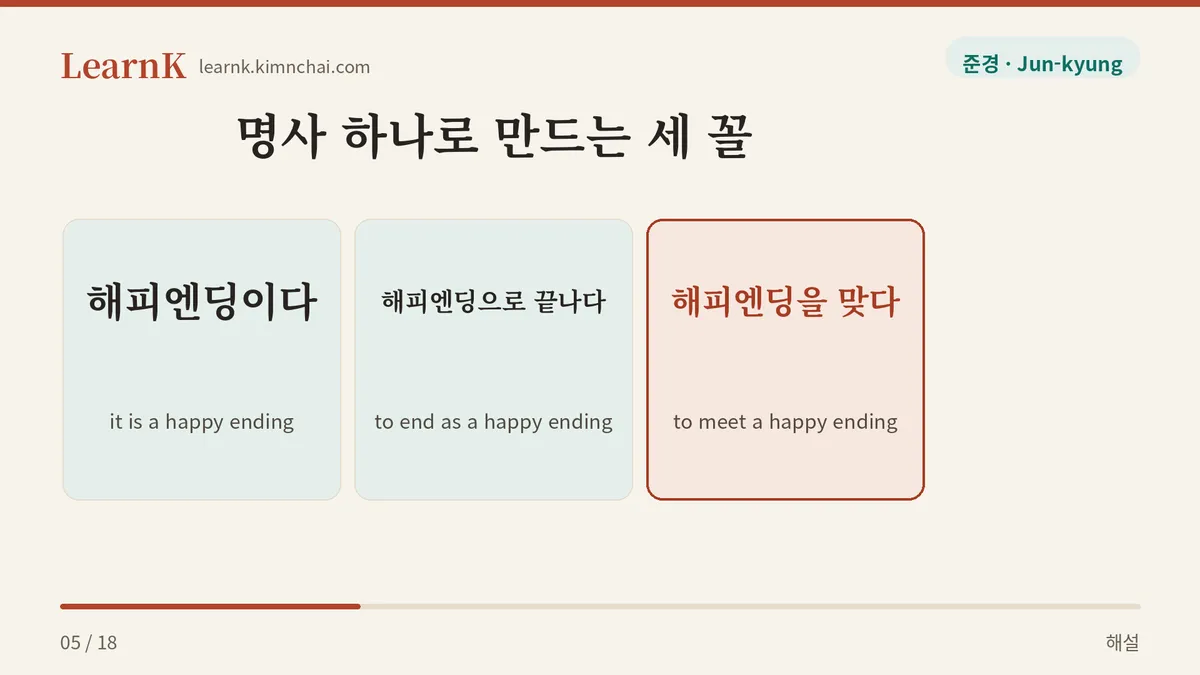
Third, it’s a noun. So it conjugates by attaching to ‘이다 (ida)’. Memorize three shapes — 해피엔딩이다 (haepiendingida), 해피엔딩으로 끝나다 (haepiendingeuro kkeutnada), and 해피엔딩을 맞다 (haepiendingeul matda) — and you can build almost any sentence you need. The opposite is 새드엔딩 (saedeuending), and sitting between the two is 열린 결말 (yeollin gyeolmal), an open ending.
Seeing It in a Real Conversation
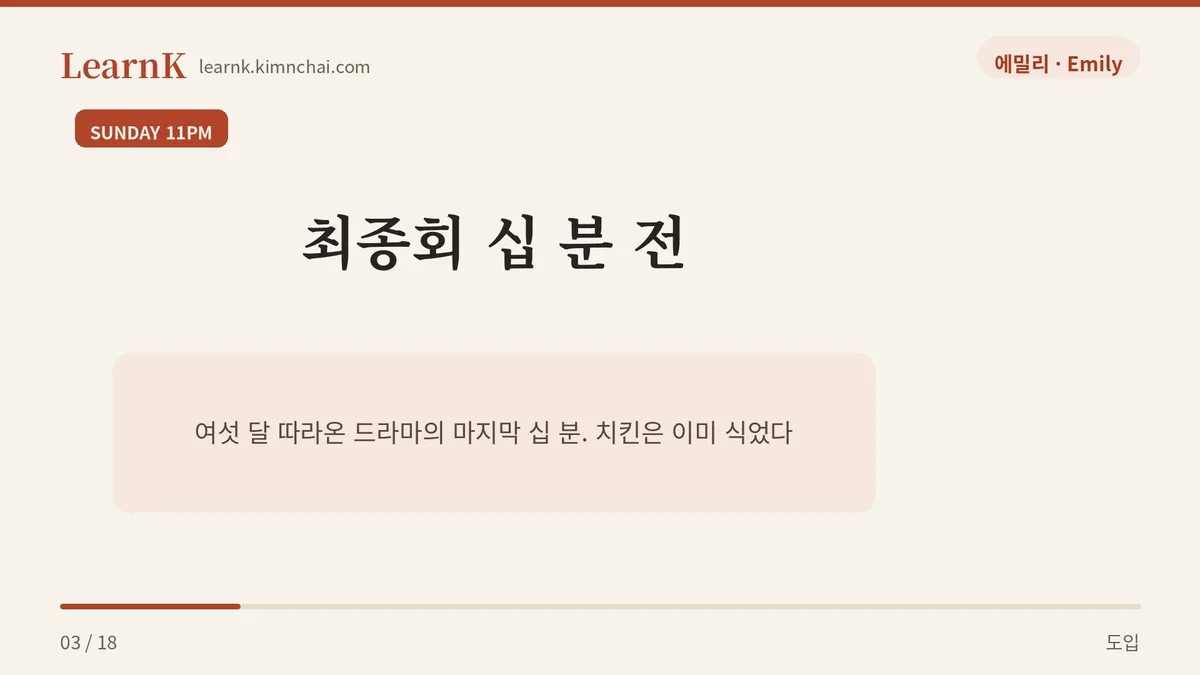
Scene: 11 p.m. on a Sunday, the living room of Jun-kyung’s apartment. The finale of the drama they’ve been watching together for six months has ten minutes left. The chicken has already gone cold.
Jun-kyung: 야, 나 이거 못 보겠어. 남주 죽는 거 아니야? Hey, I can’t watch this. The male lead’s going to die, isn’t he?
Emily: 죽으면 나 이 작가 다시는 안 봐. 무조건 해피엔딩이어야 돼. If he dies, I’m never watching anything by this writer again. It absolutely has to be a happy ending.
Jun-kyung: 근데 아까 예고에 병원 나왔잖아. 느낌이 쎄한데… But there was a hospital in the preview. I’ve got a bad feeling…
Emily: 아 좀, 초 치지 마. 눈 감고 있어. 해피엔딩이면 내가 깨워 줄게. Oh, come on, don’t jinx it. Just keep your eyes closed. I’ll wake you up if it’s a happy ending.
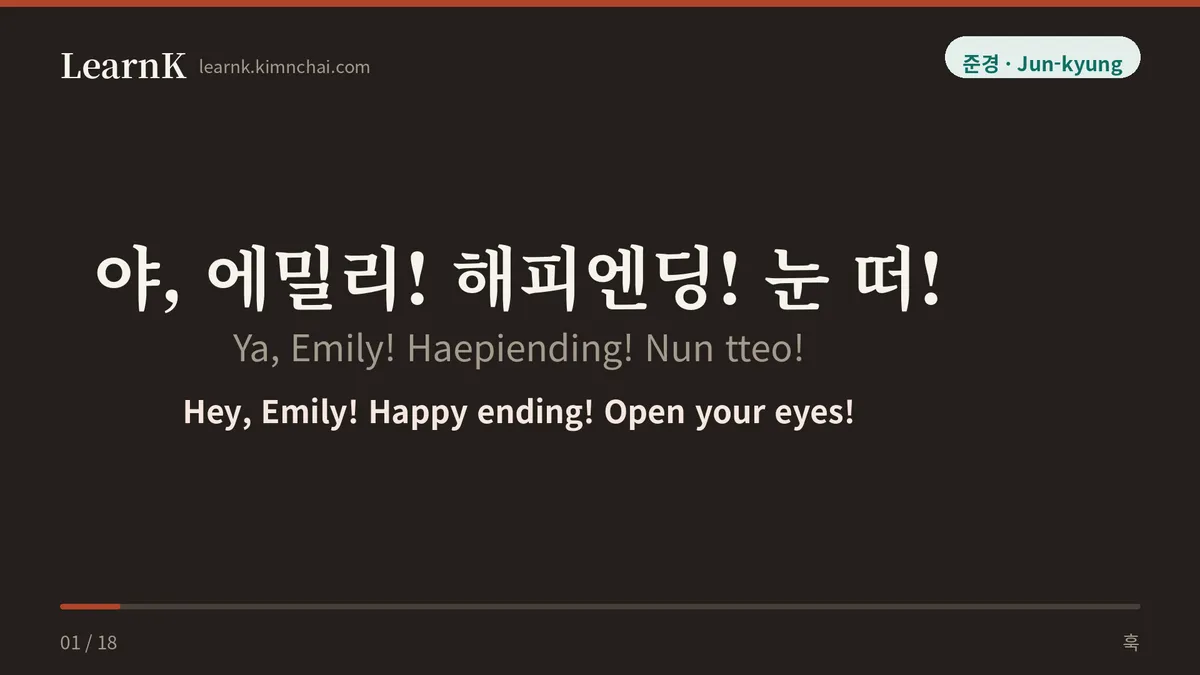
Jun-kyung: (10분 뒤) 어? 결혼식이야? 야, 에밀리! 해피엔딩! 눈 떠! (Ten minutes later) Huh? A wedding? Hey, Emily! Happy ending! Open your eyes!
Emily: 거봐, 내가 뭐랬어. 이 작가 사람 안 죽인다니까. See? What did I tell you. I said this writer doesn’t kill people off.
Using It This Way Sounds Off
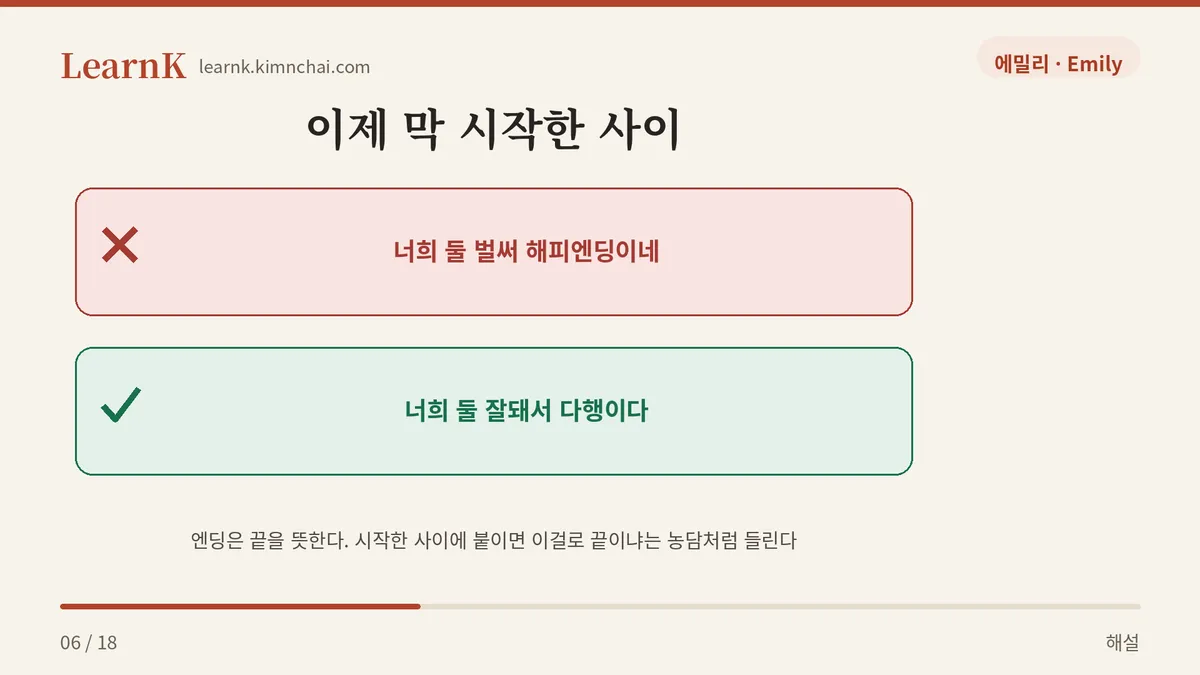
✗ (to a friend three weeks into a relationship) 너희 둘 벌써 해피엔딩이네. (neohui dul beolsseo haepiendingine.) — “You two are already a happy ending.” ✓ (to a friend three weeks into a relationship) 너희 둘 잘돼서 다행이다. (neohui dul jaldwaeseo dahaengida.) — “I’m glad it’s working out for you two.” → ‘엔딩’ means ending. Pin it on a relationship that’s only just begun and it sounds like a joke: “So that’s it, then? It’s over?”
✗ (presenting to executives) 이번 프로젝트는 해피엔딩이었습니다. (ibeon peurojekteuneun haepiendingieotseumnida.) — “This project was a happy ending.” ✓ (presenting to executives) 이번 프로젝트는 무사히 마무리됐습니다. (ibeon peurojekteuneun musahi mamurdwaetseumnida.) — “This project was wrapped up without incident.” → The grammar is perfectly fine, but the temperature is off. It’s the register of a drama review, so in an official report it gives the impression you’re treating the work lightly. Among teammates in a casual setting, though, it fits beautifully.
Example Sentences by Situation
1) When something you lost comes back
You’ve just gotten word that the wallet you left on the subway is sitting in the lost-and-found, and you want to give a friend the bottom line.
지갑 파출소에 있대. 이 정도면 해피엔딩이지. Jigap pachulsoe itdae. I jeongdomyeon haepiendingiji. (Full form: 지갑이 파출소에 있대. 이 정도면 해피엔딩이지.) “They say my wallet’s at the police box. As these things go, that’s a happy ending.”
‘이 정도면 해피엔딩이지 (i jeongdomyeon haepiendingiji)’ is worth memorizing as one whole chunk. It means “it may not be perfect, but it didn’t end badly,” and Koreans use it constantly when they’re totting up the events of a day.
2) When you’re passing on news about someone who prepared for a long time
You’re relaying to one friend the story of another who passed the exam on their third attempt.
걔 삼수 끝에 붙었대. 결국 해피엔딩이네. Gyae samsu kkeute butteotdae. Gyeolguk haepiendingine. “Apparently she passed on her third try. A happy ending in the end, huh.”
Paired with ‘결국 (gyeolguk)’ — “in the end” — the phrase carries the sheer length of time that person went through. It’s a single word that acknowledges all the hardship that came before it.
3) When you’re starting a conversation about a drama
The very first question Koreans ask when they’re on the fence about whether to watch something.
그 드라마 해피엔딩이야, 새드엔딩이야? 스포는 그것만. Geu deurama haepiendingiya, saedeuendingiya? Seupoyneun geugeotman. “Is that drama a happy ending or a sad ending? That’s the only spoiler I want.”
In Korea this question isn’t asked because someone wants the ending in advance — it’s asked to gauge how much emotion it’s safe to invest. There are genuinely a lot of people who, on hearing “sad ending,” will say “그럼 나중에 볼래 (geureom najunge bollae)” — “Then I’ll watch it later” — and put it off.
Polite Forms, Casual Forms, and Similar Expressions
Since it’s a noun, you only have to swap out the ‘이다’. Casual is 해피엔딩이야 (haepiendingiya), general polite is 해피엔딩이에요 (haepiendingieyo), and the formal style is 해피엔딩입니다 (haepiendingimnida). That said, as noted above, occasions that call for the formal style are rare in the first place. It does sound natural in places where you’re speaking as if telling a story — a wedding toast, or remarks at a retirement party.
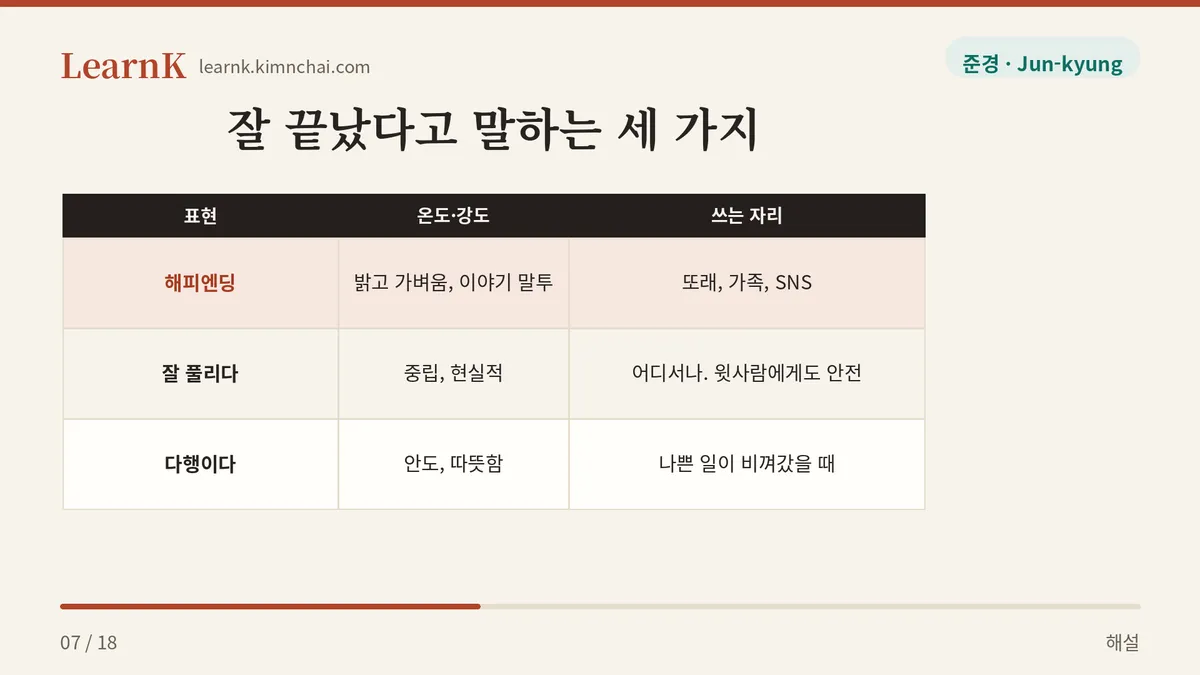
| Expression | Temperature / Intensity | Where It’s Used |
|---|---|---|
| 해피엔딩 (haepiending) | Bright and light, storytelling register | Peers, family, social media. Not for official reports |
| 새드엔딩 (saedeuending) | The opposite. Mixed with regret and resentment | Same settings. A regular in ending debates |
| 열린 결말 (yeollin gyeolmal) | Neutral, literary | Reviews and criticism. When interpretation is left to the audience |
| 잘 풀리다 (jal pullida) | Neutral, down-to-earth | Anywhere. Safe even with superiors |
| 다행이다 (dahaengida) | Relief, warmth | Anywhere. When misfortune passed someone by |
Here’s the practical feel for it. When you’re summing up someone else’s story, 해피엔딩. When you’re saying your own affairs went well, 잘 풀렸어요 (jal pullyeosseoyo). When something bad passed you by, 다행이에요 (dahaengieyo). Learn to tell these three apart and your Korean gets noticeably more natural.
Cultural Background — The Temperature of Finale Night
There’s a broadcasting structure behind why this word flies around so much in Korea. For a long time, Korean dramas weren’t made in seasons but as self-contained runs of around 16 episodes. Two months and the story is over; there’s no next season. So a single final episode carries enormous weight, and viewers watch worrying about the ending from episode one. Posting reactions in real time as the finale airs, and — if it turns out to be a sad ending — denouncing the writer well into the next day: that culture came from here. The more directly a work deals with death — like 《도깨비 (Dokkaebi)》 (tvN, 2016–2017), which tells the love story of a grim reaper and a goblin — the more the phrase “제발 해피엔딩 (jebal haepiending)” — “please, a happy ending” — followed it through the entire broadcast run.
The word formation is simple: it’s a loanword that brought the English happy ending over meaning and all. But once inside Korean, it took one step further. In English it mostly stays put, pointing to the ending of a story; in Korean, 해피엔딩 walks out of the story and attaches itself to real-life events. A chaotic move, a hospital test result, a secondhand-marketplace dispute, a lawsuit that dragged on for years — all of them can become “결국 해피엔딩 (gyeolguk haepiending),” a happy ending after all. The habit of summarizing your own day as if it were a story is baked right into this word.
Which makes it a strange sort of gift for Korean learners. You already know what it means — but you have to learn where it belongs all over again.
Today’s Quiz
Which of the following is the most awkward situation in which to use 해피엔딩?
- Telling a friend about a finale where two people who had broken up find each other again
- Passing on the news that a neighbor found their lost puppy after three days
- Wrapping up a quarterly performance report in front of executives
- Hearing that a friend who prepared for a long time passed the exam
Answer: 3. Not because the grammar is wrong, but because the temperature is off. 해피엔딩 is the register of storytelling, so in a setting that deals in numbers and accountability it gives the impression you’re taking the work lightly. There, “무사히 마무리됐습니다 (musahi mamurdwaetseumnida)” is the right call. Say the exact same thing among teammates at a company dinner and number 3 becomes perfectly natural too — the right place for this word is decided not by the event, but by the relationship.