해운대 (haeundae): The Name of a Beach — and of a Neighborhood Where People Live

해운대
해운대 (haeundae) is a stretch of coastline in Haeundae-gu, Busan — a tourist destination famous for its hot springs, its swimming beach, and its beautiful scenery. It’s two and a half hours from Seoul by KTX; get off at Busan Station, transfer to the subway, and you’re there. It’s also the word that foreigners planning a trip to Korea are most likely to type into the search bar right after “Busan.”
What’s interesting is that Koreans picture different sizes when they say this word. When a traveler says 해운대 가자 (haeundae gaja), they mean the sandy beach. When someone from Busan says 저 해운대 살아요 (jeo haeundae sarayo), they mean a city district of several hundred thousand people. The 해운대 you hear in subway announcements is a station on Line 2. One name covers a sea, a neighborhood, and a station all at once. If you don’t know about this difference in scale, conversations drift subtly out of sync — more on that later.
In terms of tone, 해운대 is a colorless proper noun. For people from Busan, though, it carries just a little weight. It has become so famous that it picked up a “tourist course” image, so when you bring up 해운대 with a local friend, you’ll often get a lukewarm 거긴 여름에 발 디딜 데도 없는데 (geogin yeoreume bal didil dedo eomneunde) — “there’s nowhere to even put your foot down there in summer.” But change the season and the face changes too. Mention the winter sea, or 해운대 in the early morning, and most people come around to 그건 좋지 (geugeon jochi) — “now that’s good.” A season rides along with the name.
Checking it in the National Institute of Korean Language dictionary

해운대 (haeundae) (noun) A beach in Haeundae-gu, Busan Metropolitan City. It is famous as a tourist destination for its hot springs, swimming beach, and fine scenery. — National Institute of Korean Language, Basic Korean Dictionary (krdict.korean.go.kr)
The first thing worth noticing in the definition is the order of the list. “Hot springs” comes before “swimming beach.” That may be a surprise to learners who knew 해운대 only as a summer beach, but this area has been known for its hot springs for a very long time, and hotels and bathhouses nearby still draw on that spring water today. The dictionary, in effect, has added one more season to the name.
[en] Haeundae — A beach in Haeundae-gu, Busan. It is famous for its hot springs, beach, and beautiful scenery. — National Institute of Korean Language, Basic Korean Dictionary (krdict.korean.go.kr)
[ja] ヘウンデ【海雲台】 — 釜山広域市海雲台区にある海辺。温泉や海水浴場、景色の良い観光地として有名である。 — National Institute of Korean Language, Basic Korean Dictionary (krdict.korean.go.kr)
[es] Haeundae — Una playa ubicada en el distrito de Haeundae, en la ciudad metropolitana de Busan. Es famosa por sus aguas termales, su balneario y su hermoso paisaje como destino turístico. — National Institute of Korean Language, Basic Korean Dictionary (krdict.korean.go.kr)
[zh] 海云台 — 位于釜山广域市海云台区的海滨。以温泉、海水浴场和优美的风景著称的旅游胜地。 — National Institute of Korean Language, Basic Korean Dictionary (krdict.korean.go.kr)
Put the Japanese headword, with 【海雲台】 beside it, next to the Chinese headword 海云台, and one thing jumps out at once: this name originally comes from Chinese characters. What each of the three characters points to is covered in the cultural background below.
The Basic Korean Dictionary does not carry a Portuguese definition for this entry. So we should note that the sentence below is not a dictionary quotation but our own translation, made for this post.
[pt] Haeundae — Praia situada no distrito de Haeundae, em Busan. É famosa por suas fontes termais, sua área de banho de mar e sua bela paisagem como destino turístico. (our own translation)
See it in a real conversation

Setting: the last week of December. You’ve just stepped off the KTX from Seoul at Busan Station. Suitcases in tow, you’re standing in front of the subway map.
Jun-kyung: 자, 짐부터 놓고 해운대 가자. 숙소가 거기야. Alright, let’s drop the bags and head to Haeundae. That’s where we’re staying.
Emily: 지금 12월인데? 바다 춥지 않아? In December? Isn’t the sea going to be freezing?
Jun-kyung: 그러니까 가는 거지. 겨울 해운대가 진짜야. 사람도 없고. That’s exactly why we’re going. Haeundae in winter is the real deal. And no crowds.
Emily: 아 맞다, 저번에 8월에 갔다가 파라솔밖에 못 봤잖아. Oh right, last time I went in August all I saw was parasols.
Jun-kyung: 저녁엔 달맞이길 한 바퀴 돌고, 들어와서 온천 하면 돼. In the evening we’ll do a loop along Dalmaji-gil, then come back and hit the hot spring.
Emily: 온천? 해운대에 온천이 있어? 나 한국 15년인데 그건 몰랐네. Hot springs? There are hot springs in Haeundae? Fifteen years here and I never knew.
These usages sound off
해운대 isn’t a word that raises or lowers anyone, just a name, so there’s no way to be impolite with it. There are, however, two misunderstandings learners run into again and again.
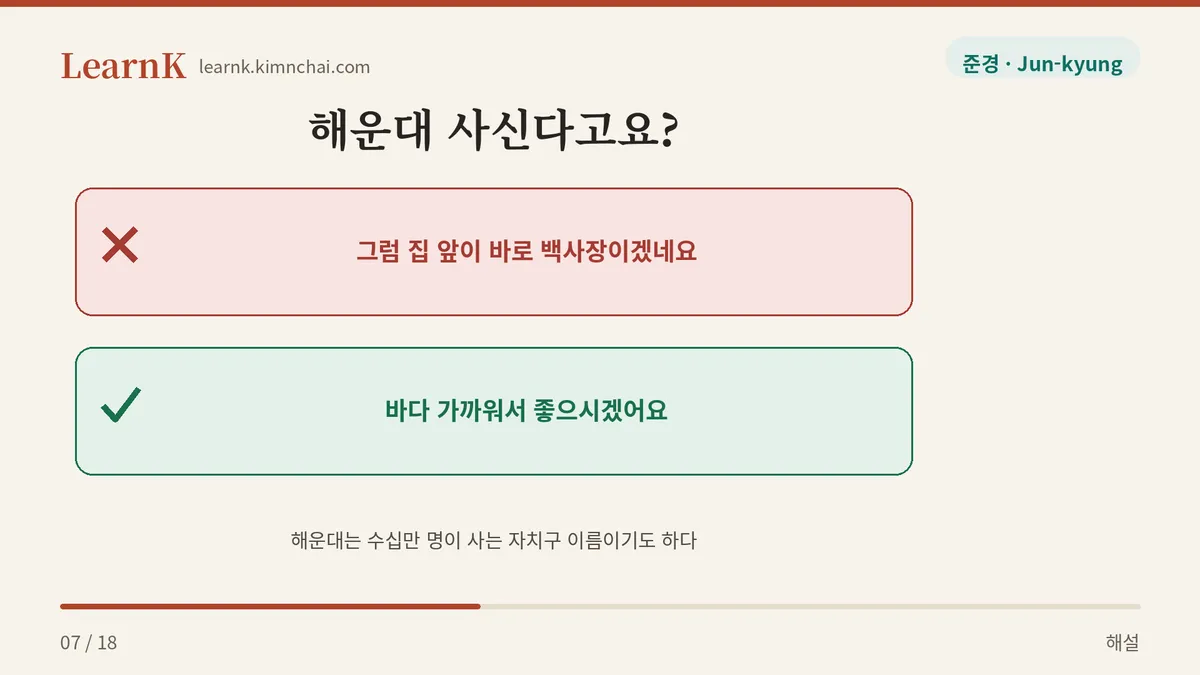
✗ (to a friend from Busan) 아, 해운대 사신다고요? 그럼 집 앞이 바로 백사장이겠네요! (a, haeundae sasindagoyo? geureom jip api baro baeksajangigenneyo!) “Oh, you live in Haeundae? So the beach must be right outside your door!”
✓ (to a friend from Busan) 아, 해운대 사신다고요? 바다 가까워서 좋으시겠어요. (a, haeundae sasindagoyo? bada gakkawoseo joeusigesseoyo.) “Oh, you live in Haeundae? Nice, being that close to the sea.”
→ 해운대 is the name of a beach and, at the same time, the name of one of Busan’s districts (해운대구, haeundae-gu). It’s a wide area where hundreds of thousands of people live, so saying you live in 해운대 doesn’t mean you live by the water. Homes several subway stops away from the sea are all 해운대 too.
✗ 이번 겨울에 부산 가는데, 겨울이라 해운대는 못 가겠네요. (ibeon gyeoure busan ganeunde, gyeouria haeundaeneun mot gagenneyo.) “I’m going to Busan this winter, so I guess Haeundae is off the table — it’s winter.”
✓ 이번 겨울에 부산 가는데, 해운대에서 바다 보고 오려고요. (ibeon gyeoure busan ganeunde, haeundaeeseo bada bogo oryeogoyo.) “I’m going to Busan this winter, and I’m planning to go see the sea at Haeundae.”
→ 해운대 isn’t a place that only opens during the season when you get in the water. In winter people walk the windy beach, climb the hill roads, and go for a hot spring. Remember that even the dictionary definition lists “hot springs” before “swimming beach.”
Example sentences by situation
1. First day of the trip, deciding where to book a place to stay
해운대 쪽으로 잡을까? 바다 보이는 방이 좋잖아. (haeundae jjogeuro jabeulkka? bada boineun bangi jotjana.) Should we book something over in Haeundae? A room with a sea view would be nice, right?
Adding 쪽 (jjok) after a place name, as in 해운대 쪽, makes it refer loosely to that general area rather than one exact spot. It’s a very handy expression for travelers who don’t yet know the place names in detail.
2. The answer you get when you ask for directions in Busan
지하철 2호선 타고 해운대역에서 내리시면 돼요. (jihacheol i-hoseon tago haeundaeyeogeseo naerisimyeon dwaeyo.) Just take subway Line 2 and get off at Haeundae Station.
Here 해운대 is the name of a station, not the sea. It’s about a ten-minute walk from the station to the beach, so 해운대역 (Haeundae Station) and the sea at 해운대 sit right next to each other without being the same place.
3. Telling someone you’ve just met where you’re from
저 부산 사람이에요. 해운대에서 나고 자랐어요. (jeo busan saramieyo. haeundaeeseo nago jarasseoyo.) I’m from Busan. I was born and raised in Haeundae.
The 해운대 in this sentence is a place to live, not a tourist site. If the listener replies 우와, 좋은 데 사시네요 (uwa, joeun de sasineyo) — “wow, you live somewhere nice” — the usual answer back is something like 뭐, 살면 다 똑같죠 (mwo, salmyeon da ttokgatjyo), “eh, once you live there it’s all the same.” That’s the standard modesty of people who live in a famous neighborhood.
Formal and casual speech, and similar expressions
해운대 is a name, so there’s no honorific level in the word itself. The level is set by the verb that follows it. 해운대 가자 (haeundae gaja) is casual speech between friends, 해운대 가요 (haeundae gayo) is soft polite speech, and 해운대 한번 가 보시죠 (haeundae hanbeon ga bosijyo) is what you’d say to suggest it to someone older than you or to a guest. Leave the name as it is and just swap the ending.
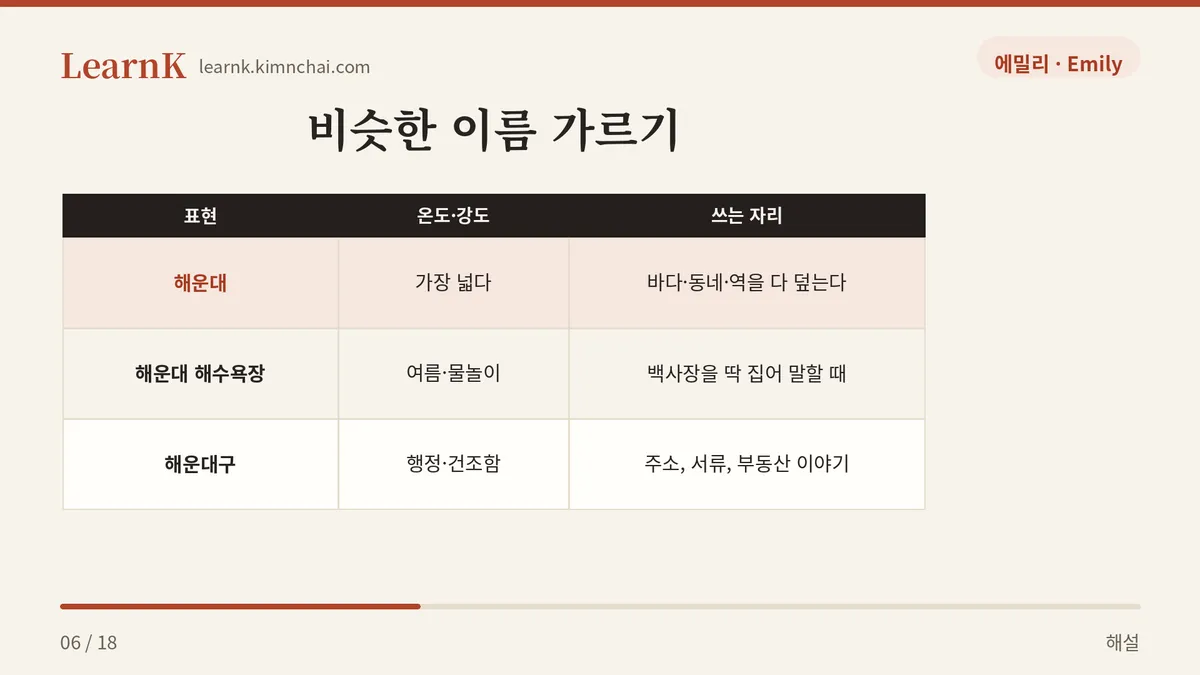
Here’s how the names that get confused with it in the same situations differ.
| Expression | Tone / scope | Where it’s used |
|---|---|---|
| 해운대 (haeundae) | The broadest. Covers the sea, the neighborhood, and the station | Anywhere. Just saying “해운대 가자” usually means the beach side |
| 해운대 해수욕장 (haeundae haesuyokjang) | Narrows toward summer and swimming | When you mean the beach itself, specifically. Signs, news |
| 해운대구 (haeundae-gu) | Administrative, so it sounds dry | Addresses, paperwork, real-estate and city-government talk |
| 광안리 (gwangalli) | Young, nighttime mood. The lit-up bridge | When it’s being paired off against 해운대. “해운대? 난 광안리” |
Cultural background — a name carved into rock
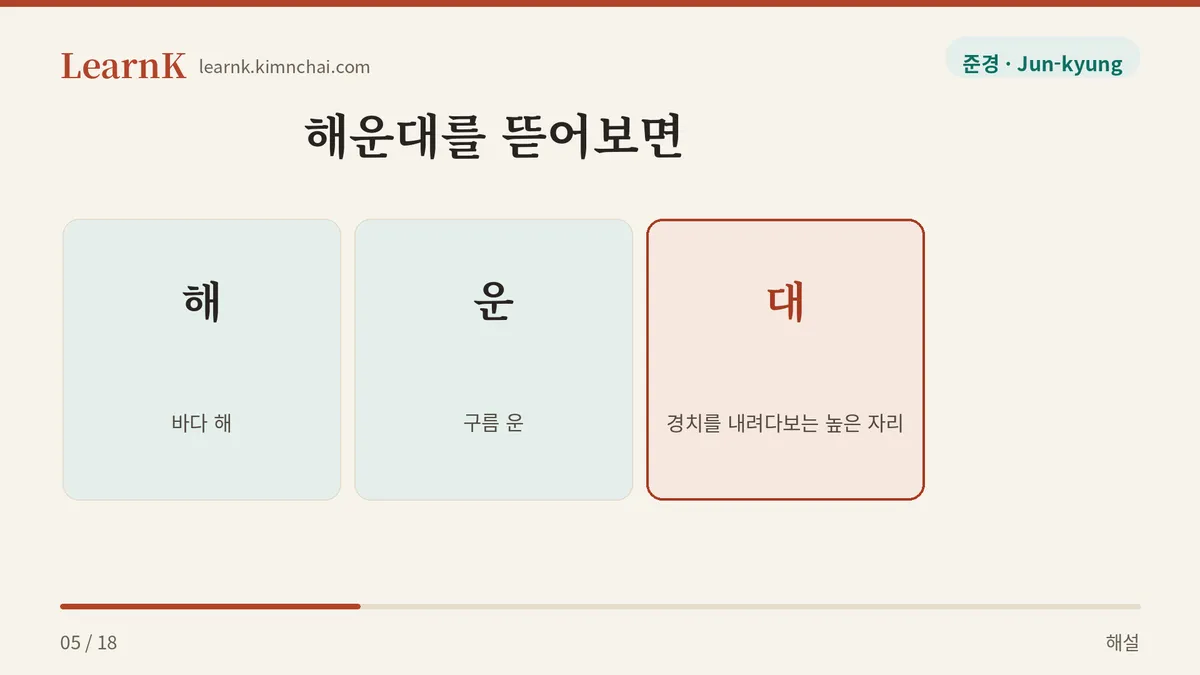
해운대 is a Sino-Korean name made of three characters: 해 (海), sea; 운 (雲), cloud; and 대 (臺), a raised terrace. 대 (臺) means a high, flat place that looks out over scenery, and Busan has a number of names ending in 대 — 태종대 (taejongdae), 몰운대 (morundae). It’s an old name tag that got attached to every spot with a commanding view of the sea.
As for the first two characters, there’s a story that has come down with the name. Choe Chi-won, a scholar of the late Silla period, used the pen name 해운 (海雲), and he is said to have carved the three characters 海雲臺 into a rock on Dongbaekseom (Dongbaek Island) here. The inscribed rock and a statue of Choe Chi-won still stand on the island today. It’s a long-transmitted origin story rather than an established fact, but it’s enough to give you a feel for the texture of the name. A place with a fine view, where sea and clouds meet — that’s the picture this name paints.
For Koreans, the name is also familiar as a movie title. 해운대, Yoon Je-kyoon’s 2009 disaster film about a giant wave rolling in on a packed peak-season beach, drew over ten million viewers. For a while after that, people would jokingly trace a wave in the air with their hand whenever 해운대 came up. And because the Busan Cinema Center, the hub of the Busan International Film Festival, is in Haeundae-gu, the name comes back into the news every autumn.
So the 해운대 a traveler sees in the middle of a summer afternoon, packed with people, is only one scene from this name. Older folks walking the beach at first light, people drinking coffee against a winter sea, the horizon seen from the hill road of Dalmaji-gil, and the hot spring in the evening — this is why the dictionary lists all three side by side: “hot springs, swimming beach, and scenery.”
Today’s quiz
Someone you meet in Busan says this:
“저 해운대 살아요.” (jeo haeundae sarayo.)
Which of the following does this not necessarily mean?
① They live in Busan ② They live somewhere inside Haeundae-gu ③ They live in a house right in front of the beach
The answer is ③. 해운대 is both the name of a beach and the name of a district where hundreds of thousands of people live, so even someone living several subway stops from the water will say “해운대 살아요.” If you’re curious, just ask one more question: 바다 근처세요? (bada geuncheoseyo?) — “Are you near the sea?”
Definitions and example sentences are from the National Institute of Korean Language’s Basic Korean Dictionary (krdict.korean.go.kr); that portion of this post, including our translations, is licensed under CC BY-SA 2.0 KR.