Hanok Maeul — Under the Tiled Roofs, a Neighborhood Where People Still Live
한옥마을
한옥마을 (hanok maeul) means a place where a number of hanok — traditional Korean houses roofed with tile or thatch — stand together and make up a single neighborhood. On a weekend morning, a map link drops into the group chat out of nowhere. You tap it and a photo loads: narrow alleys, black tiled roofs stacked one behind another, and underneath, these four syllables. It’s a word you’re guaranteed to run into the moment you talk about traveling in Korea, and it’s one of the very first place names a Korean learner actually gets to say out loud after arriving.
The word itself isn’t hard. It’s a compound of 한옥 (hanok) and 마을 (maeul), joined exactly as they are. But the center of gravity that learners miss isn’t at the front — it’s at the back. The key part isn’t 한옥, it’s 마을. Not an exhibition hall, a neighborhood. Show up without knowing that difference and you may find yourself pushing on somebody’s front gate and locking eyes with the owner.
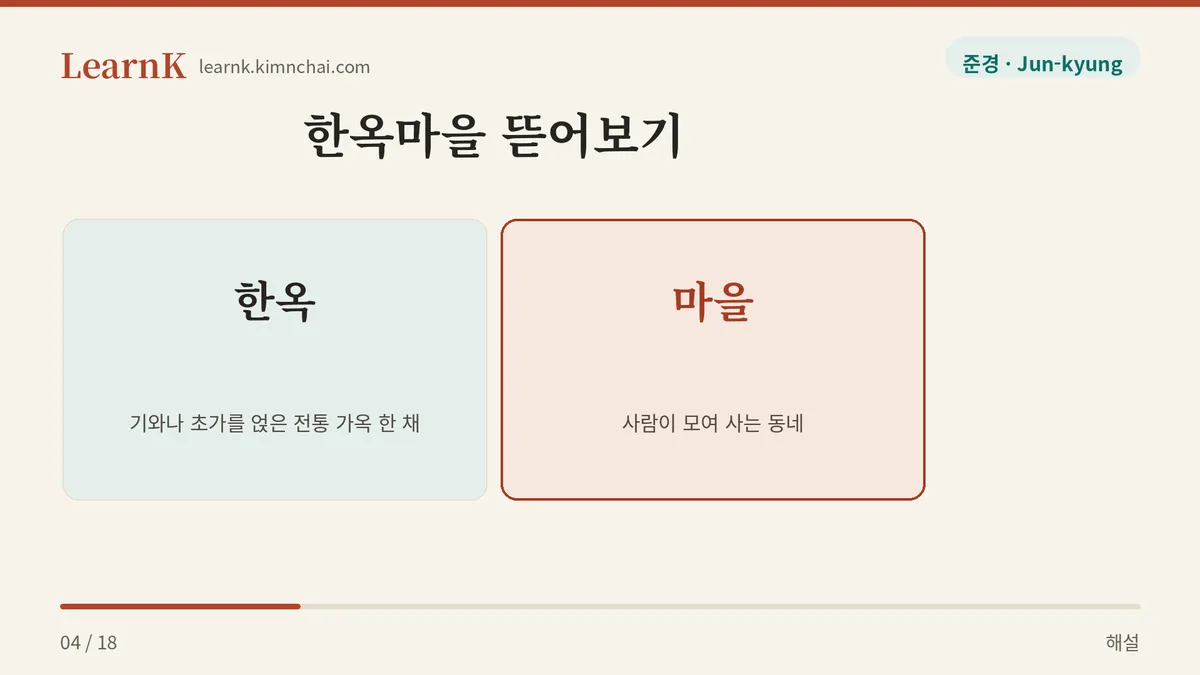
The best-known ones are 전주 한옥마을 (jeonju hanok maeul), Seoul’s 북촌 한옥마을 (bukchon hanok maeul), and 남산골 한옥마을 (namsangol hanok maeul), which was created by moving scattered hanok to one site and rebuilding them there. The first two are real addresses where people live and children head off to school; the last is essentially a park. Same name on the sign, completely different character.
A note on nuance. For Koreans, this word feels closer to weekend than to the old days. It doesn’t smell like a museum — it carries the everyday sense of a place that’s good for photos, good for walking, good for renting a 한복 (hanbok). That makes it a perfectly ordinary word you can use with an elder and with a friend alike.
Seeing It in Real Conversation
Scene: Bukchon, Saturday afternoon. You’re partway up a steep alley, catching your breath. A sign on the wall asks visitors to keep it down, since this is a residential area.
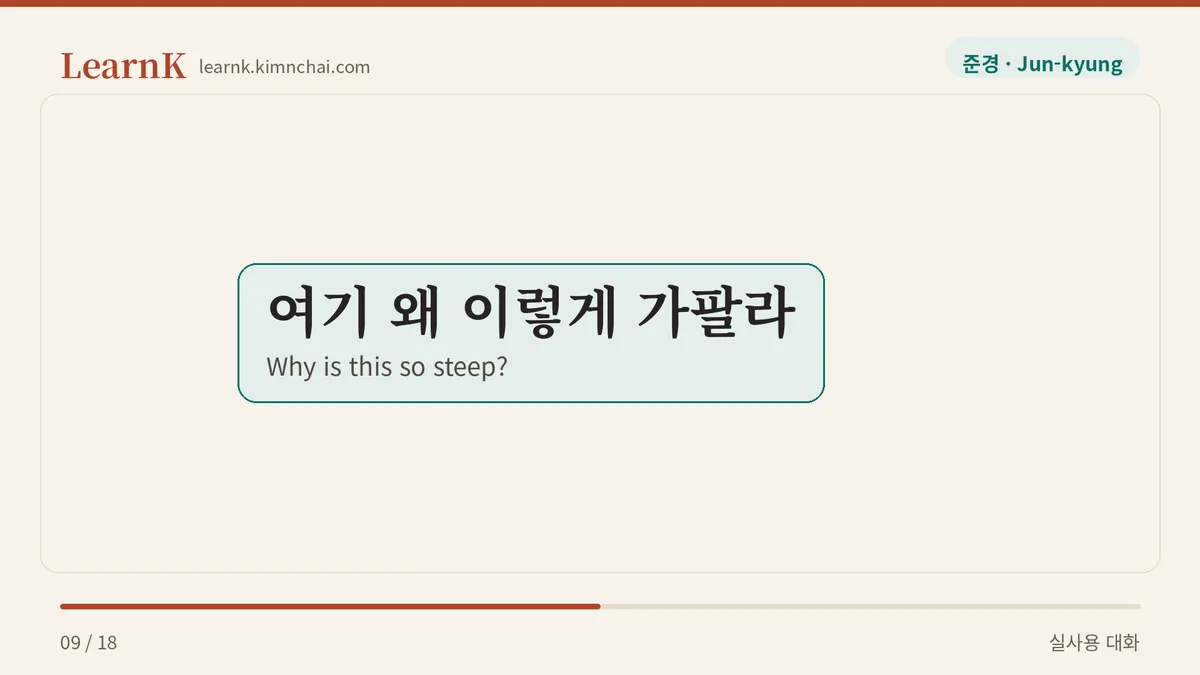
Jun-kyung: 헉, 헉… 잠깐만. 여기 왜 이렇게 가팔라. Huff, huff… hold on. Why is this so steep?
Emily: 그러게. 나 한옥마을 올 때마다 헷갈리는 게 있는데, 여기 진짜 사람 살아? Right? Something confuses me every time I come to a hanok village — do people actually live here?
Jun-kyung: 살지. 저 대문 안쪽은 그냥 남의 집이야. 아침엔 애들 학교 가고. Of course. Behind that gate is just somebody’s home. Kids head to school in the morning.
Emily: 헐, 진짜? 난 한옥마을이라길래 다 구경하라고 만들어 둔 덴 줄 알았어. Whoa, seriously? Since it’s called a hanok village, I assumed the whole thing was built for tourists.
Jun-kyung: 그건 민속촌이고. 여긴 동네야, 동네. 그래서 저 팻말 붙어 있는 거잖아. That’s a folk village. This is a neighborhood, a real one. That’s why the sign is there.
Emily: 아… 알겠어. 그럼 사진은 골목만 찍을게. 목소리도 좀 낮추고. Ah… got it. I’ll only photograph the alleys then. And keep my voice down.
Ways of Using It That Sound Off
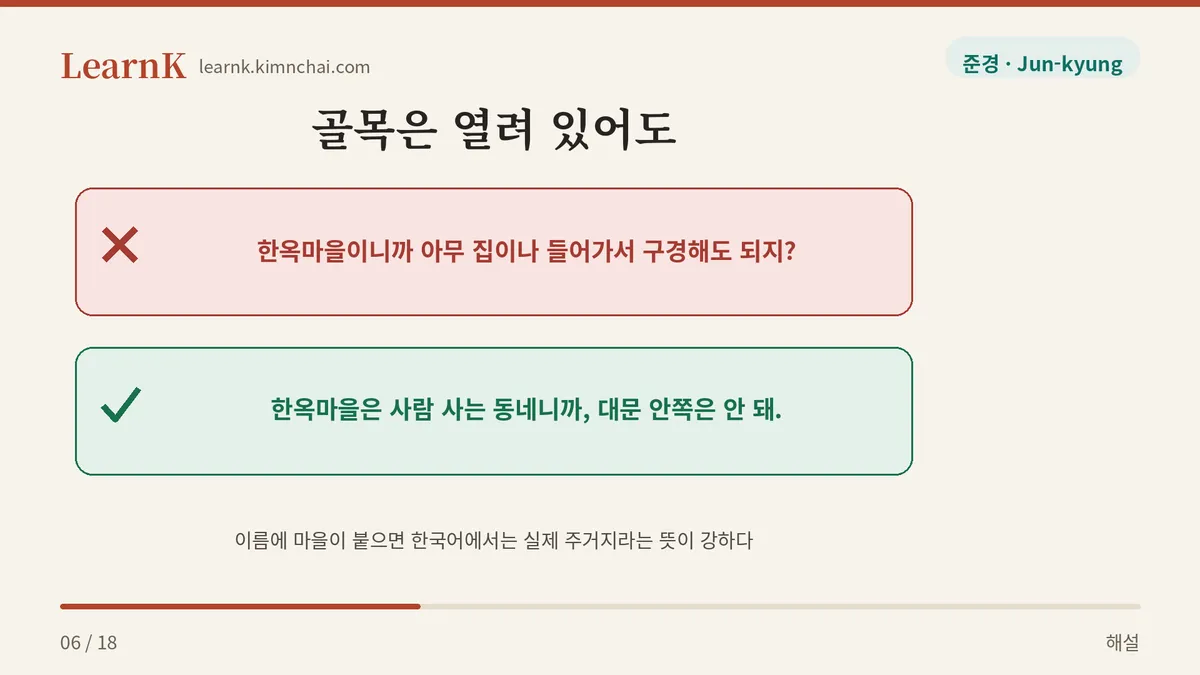
✗ 여기 한옥마을이니까 아무 집이나 들어가서 구경해도 되지? “This is a hanok village, so I can walk into any house and look around, right?”
✓ 여기 한옥마을은 사람 사는 동네니까, 대문 안쪽은 안 돼. “This hanok village is a neighborhood where people live, so past the front gate is off-limits.”
→ In Korean, when 마을 is attached to a name, it strongly implies an actual residential area. The alleys and the outer walls may be open to you, but everything past the gate is private property. It doesn’t merely sound rude — you really will be stopped.
✗ 주말에 한옥마을 가서 옛날 옷 입고 떡메 치는 체험 하자.
✓ 주말에 민속촌 (minsokchon) 가서 옛날 옷 입고 떡메 치는 체험 하자. “Let’s go to a folk village this weekend, put on old-style clothes, and try pounding rice cake.”
→ A 민속촌 (minsokchon) is a theme park that recreates and displays old ways of life. It has admission tickets and a performance schedule. A 한옥마을 is usually a neighborhood you simply walk into, with no entrance fee, and hands-on activities are run separately by individual shops. Blend the two together in a sentence and your Korean friend will pause for a beat.
Example Sentences by Situation
1. Proposing weekend plans
이번 주말에 전주 한옥마을 갈래? 거기 골목이 진짜 예뻐. ibeon jumare jeonju hanok maeul gallae? geogi golmogi jinjja yeppeo. Want to go to the Jeonju hanok village this weekend? The alleys there are seriously pretty.
This is the most common slot for the word. You attach the place name in front and pronounce the whole thing as one chunk. It travels with a regional name — 전주 한옥마을, 북촌 한옥마을 — in the overwhelming majority of cases, so if you just say 한옥마을 on its own, a Korean will usually ask back, “which hanok village?”
2. Letting someone know you’ve booked a place to stay
한옥마을 안에 한옥 스테이 하나 잡았어요. 마루에 앉아서 커피 마시면 딱이겠더라고요. hanok maeul ane hanok seutei hana jabasseoyo. marue anjaseo keopi masimyeon ttak igetdeoragoyo. I booked a hanok stay inside the hanok village. Sitting on the wooden floor with a coffee looked just perfect.
These days plenty of people visit a hanok village and simply stay the night. Here the particle 안에 (“inside”) matters. 한옥마을 안 / 한옥마을 근처 / 한옥마을 입구 — inside, nearby, at the entrance — are completely different locations in a Korean speaker’s mental map.
3. Picking a place to meet
한옥마을 입구 쪽에서 만나요. 안에서 만나자고 하면 서로 못 찾아요. hanok maeul ipgu jjogeseo mannayo. aneseo mannajago hamyeon seoro mot chajayo. Let’s meet over by the hanok village entrance. If we say we’ll meet inside, we’ll never find each other.
The alleys of a hanok village are close to a maze, and building names are hard to spot. So in real conversation Koreans always tack on a reference point: 입구 (the entrance), 정문 (the main gate), 주차장 앞 (in front of the parking lot). Pick up this habit and you’ll sound far more like a local.
Polite vs. Casual, and Similar Expressions
한옥마을 is a noun pointing to a thing and a place, so there’s no honorific baked into the word itself. Only the sentence ending shifts. With a friend, 한옥마을이야 (hanok maeuriya); with someone you’ve just met, 한옥마을이에요 (hanok maeurieyo). Invitations split the same way: 한옥마을 가자 (hanok maeul gaja) versus 한옥마을 가시죠 (hanok maeul gasijyo).
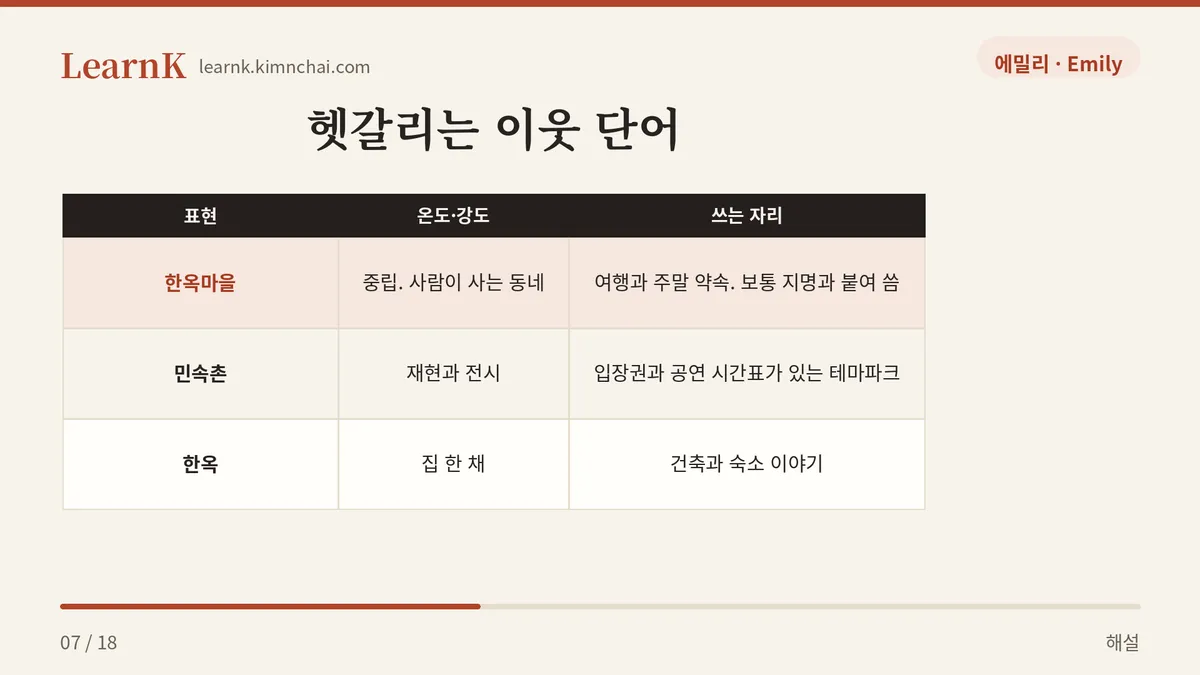
The neighboring words that are easy to confuse sort out like this.
| Expression | Temperature / Intensity | Where you use it |
|---|---|---|
| 한옥마을 (hanok maeul) | Neutral. A neighborhood where people still live | Travel and weekend plans. Usually paired with a place name |
| 민속촌 (minsokchon) | Recreation and display. Tickets and timetables | A theme park showing old ways of life |
| 한옥 (hanok) | Refers to a single house | Architecture and lodging talk |
| 고택 (gotaek) | Old and dignified | A single historic house managed as cultural heritage |
| 한옥 스테이 (hanok seutei) | Modern coinage. Booking and overnight stays | Travel apps and accommodation reviews |
Cultural Background — A Name Born Standing Next to 양옥
The word 한옥 was born out of a comparison. When 양옥 (yangok, 洋屋) — Western-style houses — arrived, people coined a word to distinguish theirs from those, joining 한 (韓) and 옥 (屋). Which means that back when everyone lived under tiled roofs, the name wasn’t needed at all. The 마을 tacked on the end isn’t Sino-Korean but pure native Korean, so a single word has a Sino-Korean element and a native one standing shoulder to shoulder.
The place names carry stories too. Seoul’s 북촌 (bukchon) means “the northern neighborhood,” measured from the Cheonggyecheon stream. Jeonju’s hanok village is commonly explained as a district where hanok gathered together in one spot as the city was transformed in the early twentieth century, and that district became the tourist destination it is today.
In TV drama it actually shows up more in contemporary series than in historical ones. The lead rents a room in an old house with a courtyard, and at night sits at the edge of the wooden floor with a glass of soju in front of him, staring out at the yard without a word. To Korean viewers, that floor and that yard read as a backdrop of comfort. In recent dramas the hanok isn’t a marker of social class or of a bygone era so much as a place where a worn-out person can sit down for a while.
That said, the reality isn’t as quiet as the photos. Residents have complained about noise and invasions of their privacy for years, and it has gone as far as measures restricting visiting hours and noise levels. Once you know that background, you can see that the sign on the wall isn’t decoration. The most Korean bit of etiquette in a hanok village isn’t dressing up beautifully in hanbok — it’s lowering your voice.
Today’s Quiz
A friend says to you: 나 이번 주말에 옛날 옷 입고 떡메도 쳐 보고, 마당놀이 공연도 보고 싶어. 어디 가면 될까? (“This weekend I want to wear old-style clothes, try pounding rice cake, and watch a courtyard performance. Where should I go?”)
① 한옥마을 (hanok maeul) ② 민속촌 (minsokchon) ③ 한옥 스테이 (hanok seutei)
Answer: ② The place where hands-on programs and performances run on a fixed timetable is the 민속촌. A 한옥마을 is a neighborhood with actual residents, so there are no scheduled performances or unified activity programs — individual shops run their own. That said, renting a hanbok and strolling the alleys is absolutely something you can do at a hanok village.
Definitions and example sentences are from the National Institute of Korean Language’s Basic Korean Dictionary (krdict.korean.go.kr); that portion of this post, including our translations, is licensed under CC BY-SA 2.0 KR.