Of All Days — Why Today?: Summing Up the Worst Timing in One Word

When you watch Korean dramas, you’ll often see a scene where the main character presses a hand to their forehead and sighs, “왜 하필 지금이야…” (“Why now, of all times…”). Oversleeping on the morning of an exam, a pimple showing up the day of a blind date, a downpour on the one day you forgot your umbrella — Koreans sum up this kind of “worst possible timing” in a single word: 하필 (hapil). Today, let’s really dig into this one aggrieved, ironic little adverb.
하필
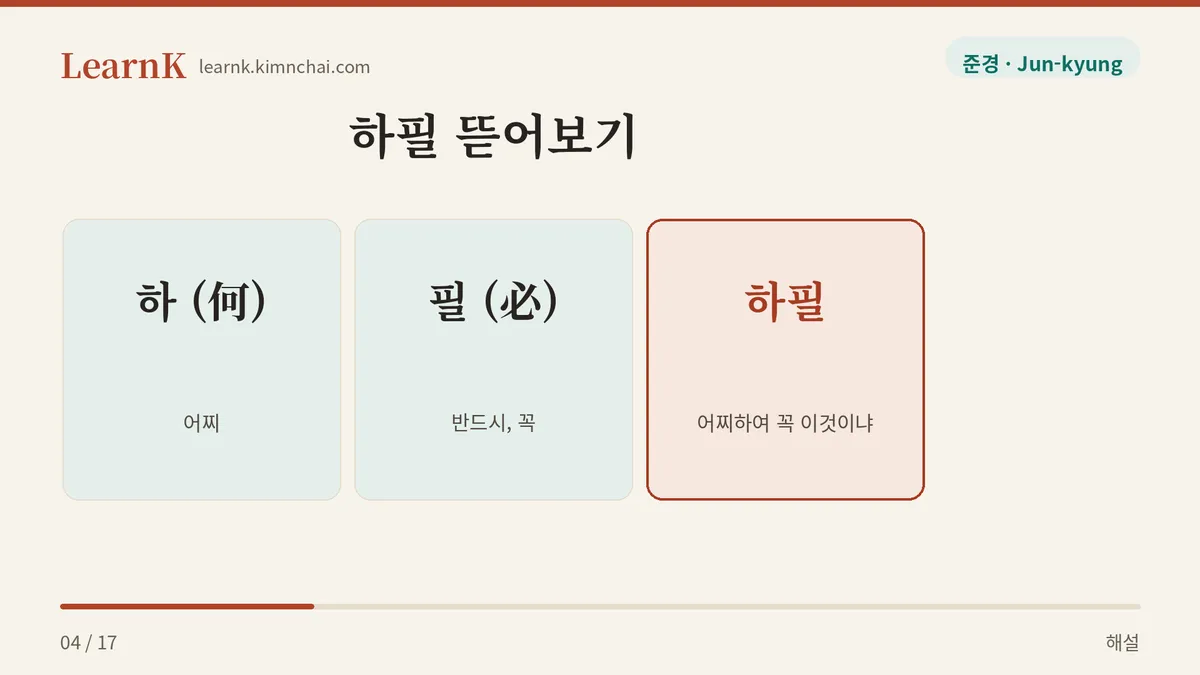
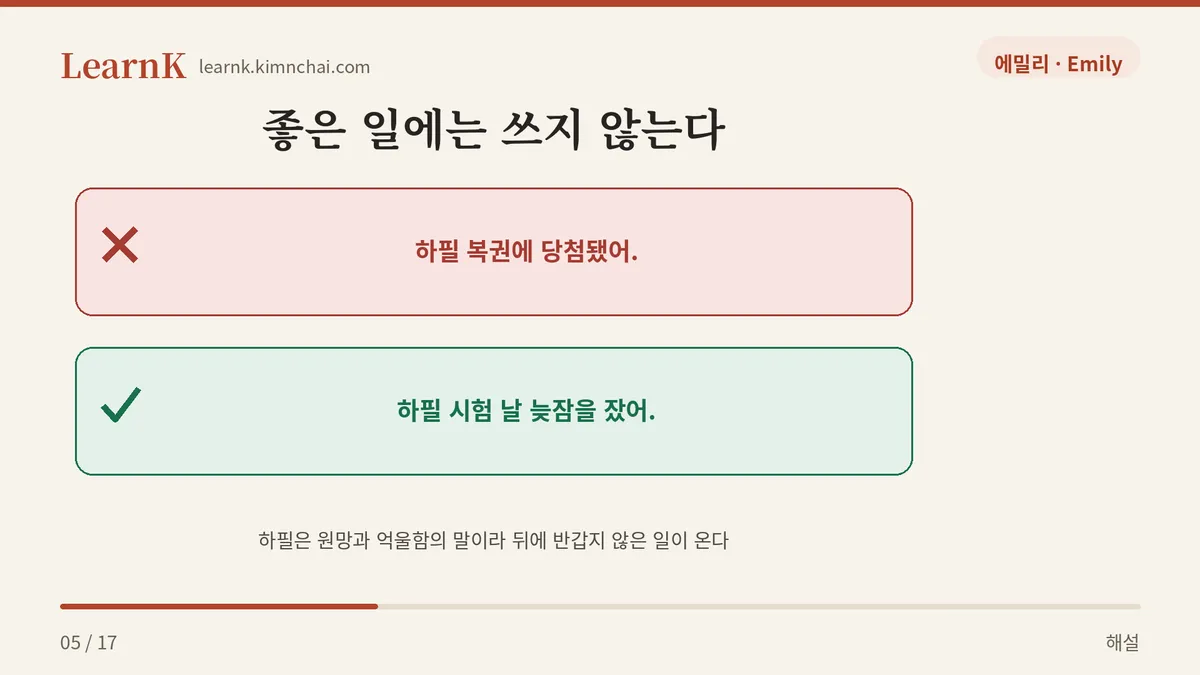
하필 (hapil) is an adverb that carries a sense of resentment and unfairness — “there are so many other times and so many other things, so why does it have to be this one, and why right now?” It’s not simply asking “why”; the key nuance is that something happened at the worst possible moment, as if the moment were hand-picked. That’s why 하필 is usually followed by something unwelcome — rain, a breakdown, a mistake, an absence.
When you want to emphasize it, the form 하필이면 (hapirimyeon) is also very common, as in “하필이면 오늘?” (“Of all days, today?”). The meaning is the same, but the feeling of resentment comes through even more strongly.
Checking the National Institute of Korean Language Dictionary

하필 (adverb) Not doing it some other way — why, of all things, exactly this. [en] of all things — Why the particular thing of all choices. [ja] よりによって【選りに選って】。こともあろうに [es] precisamente, ni más ni menos que [zh] 偏偏 — National Institute of Korean Language, Basic Korean Dictionary (krdict.korean.go.kr)
The phrase to watch in this definition is “어찌하여 꼭” (“why, exactly this”). The resentment of being caught by that particular one out of countless choices is compressed into this single word. Let’s look at some real example sentences.
결혼식을 하는 이 경사스러운 날에 하필 비가 쏟아져 나는 정말 속상했다. — National Institute of Korean Language, Basic Korean Dictionary (krdict.korean.go.kr)
On a joyous, once-in-a-lifetime day, when you’d hoped so badly for clear skies, the rain came down on that very day — the disappointment comes through exactly as it is. (“On this joyous wedding day, of all days it poured rain, and I was really upset.”)
리허설 할 때는 잘하더니 왜 하필 공연에서 실수를 해? — National Institute of Korean Language, Basic Korean Dictionary (krdict.korean.go.kr)
This is the situation where you were fine during rehearsals but slipped up on the one stage that mattered. It holds the frustration of “out of all those moments, why that crucial one?” (“You did fine in rehearsal, so why, of all times, did you mess up in the performance?”)
가는 날이 장날이라더니 하필 내가 온 날 지수는 여행을 가서 없구나. — National Institute of Korean Language, Basic Korean Dictionary (krdict.korean.go.kr)
Here you finally come to visit, only for the other person to be away on exactly that day. Paired with the proverb 가는 날이 장날 (“the day you go is market day”), it captures the ironic coincidence of 하필 perfectly. (“They say the day you go is market day — of all days, Ji-su went on a trip the day I came, so she’s not here.”)
하필이면 껌정 잉크라서 하얀 옷이 못쓰게 됐군. — National Institute of Korean Language, Basic Korean Dictionary (krdict.korean.go.kr)
This example emphasizes layers of bad luck: of all the colors, it had to be black ink that won’t wash out — and, of all things, on a white outfit. (“Of all things, it was black ink, so the white clothes are ruined.”)
Seeing It in a Real Conversation
Situation: The morning of moving day. There’s an “Under Maintenance” notice posted on the elevator by the entrance.
Jun-kyung: 에밀리, 큰일 났어. 엘리베이터 오늘 점검이래. Emily, we’ve got a problem. They say the elevator’s under maintenance today.
Emily: 뭐? 하필 이사하는 날에? 우리 짐 다 5층에 있는데? What? Of all days, on moving day? All our stuff is on the fifth floor.
Jun-kyung: 그러니까. 관리실에 물어보니까 오후 3시까지래. Right? I asked the office — they said it’ll last until 3 p.m.
Emily: 아 진짜. 왜 하필 오늘이야. 어제도 있고 내일도 있는데. Ugh, seriously. Why today of all days? There was yesterday, there’s tomorrow…
Jun-kyung: 이삿짐센터 아저씨들도 황당해하시더라. 계단으로 나르면 추가 요금이래. Even the movers were baffled. They said carrying it up the stairs costs extra.
Emily: 가는 날이 장날이라더니. 딱 이럴 때 이런다니까. “The day you go is market day,” as the saying goes. It’s always right at moments like this.
Example Sentences by Situation
-
하필 (hapil) — For an unexpected visit “3년 만에 고향 친구가 찾아왔는데 하필 내가 야근이라 얼굴도 못 봤어.” (“A friend from back home came to visit for the first time in three years, but of all days I had to work late, so I didn’t even get to see them.”) This expresses the disappointment of a long-awaited, welcome visit overlapping — of all days — with your busiest one, so you missed it.
-
하필이면 (hapirimyeon) — When something breaks “휴대폰이 하필이면 해외여행 첫날에 물에 빠졌지 뭐야.” (“Of all times, my phone fell in the water on the very first day of my trip abroad.”) After being fine the whole trip, why the first day? — the resentment rides heavily on 하필이면.
-
하필 (hapil) — In front of food “다이어트 시작한 날, 하필 회사에서 치킨을 시키더라고요.” (“The day I started my diet, of all things the office ordered fried chicken.”) This works well for laughing lightly about the ironic timing of temptation landing on the very day you made up your mind.
Formal/Casual Speech and Similar Expressions
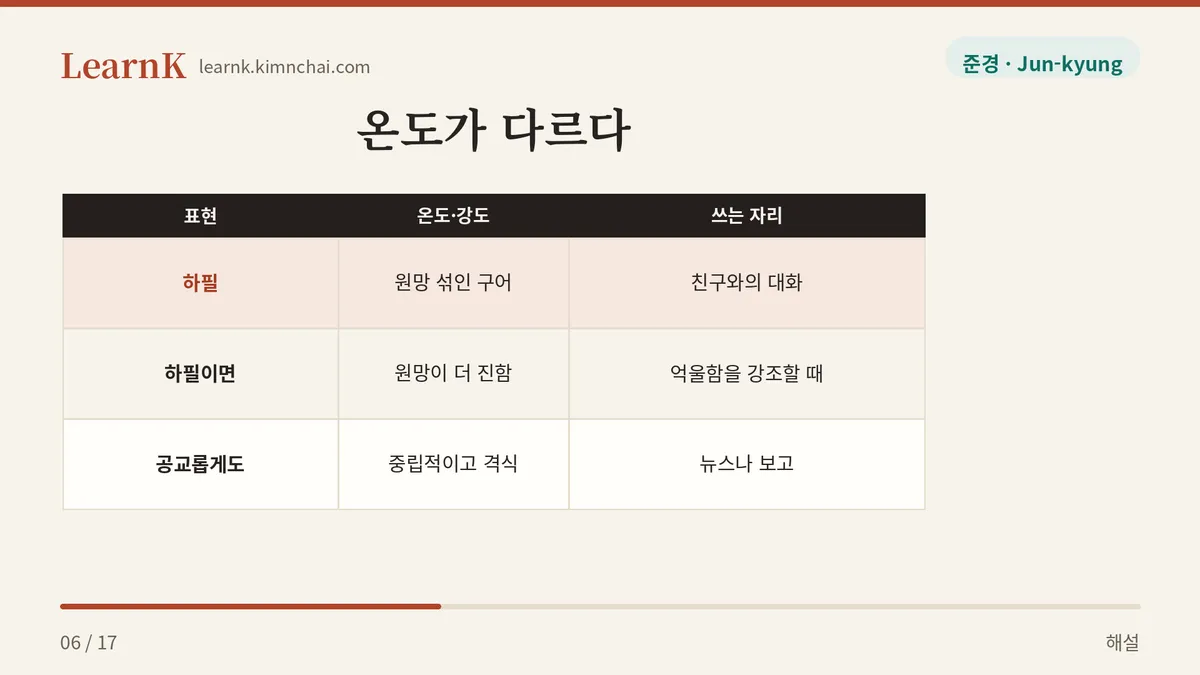
하필 is an adverb, so it carries no politeness level on its own. Whether the sentence sounds formal or casual depends on the predicate that ends it.
- Casual: “왜 하필 오늘 와?” (“Why are you coming today, of all days?”)
- Formal: “왜 하필 오늘 오셨어요?” (“Why did you come today, of all days?”)
A similar expression is 공교롭게도 (gonggyoropge-do). However, 공교롭게도 is more neutral and formal, closer to “as it happens / coincidentally,” while 하필 carries a much stronger feeling of resentment and regret. For a news article, 공교롭게도 fits; for chatting with a friend, 하필 is the natural choice.
Cultural Background
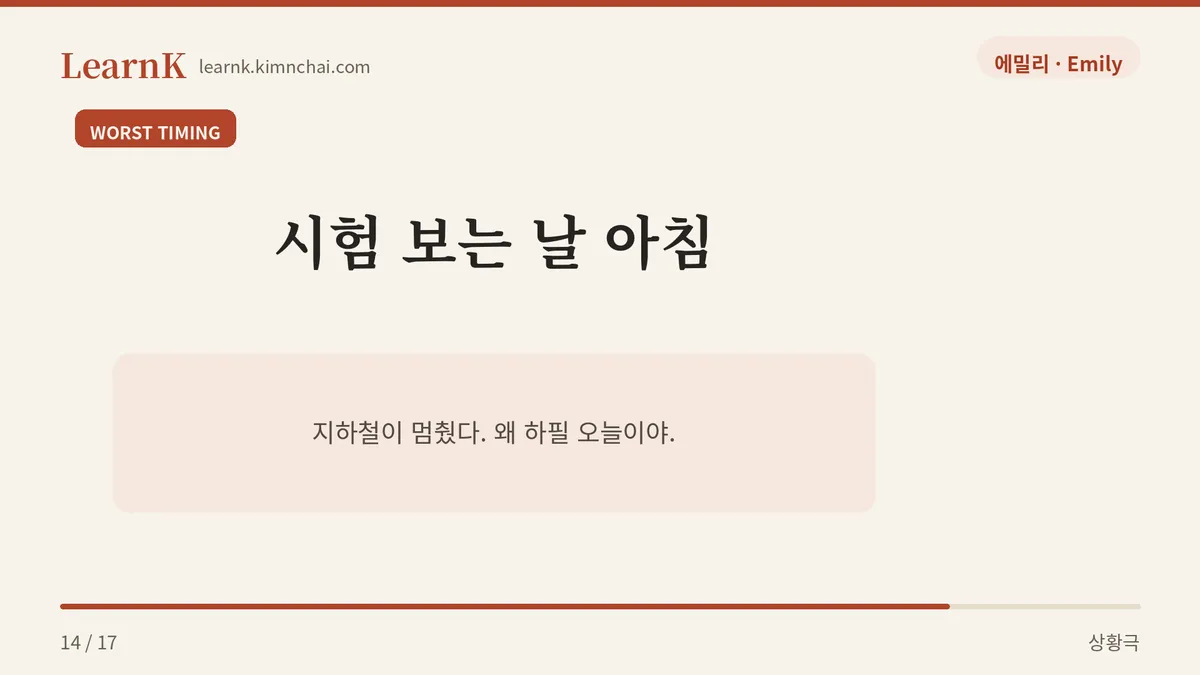
하필 is often paired with the proverb 가는 날이 장날 (“the day you go is market day”). It points to a situation where you made the effort to go, only for things to go wrong on that very day. Characters in Korean dramas blurt this word out at every decisive moment, too. Rain pouring down the day you didn’t bring an umbrella, the subway grinding to a halt on your first day at work — 하필 is the single word that presses the whole temperature of that unfairness into one place. So once you start using this word naturally, the emotion of Korean comes one step closer.
Closing Quiz
Which word fits most naturally in the blank below? “소풍 가는 날인데 ___ 비가 오네.” (“It’s the day of the picnic, but ___ it’s raining.”) ① 드디어 (finally) ② 하필 (of all days) ③ 부디 (please/kindly) ④ 마침내 (at last)
Answer: ② 하필. On the picnic day you’d been looking forward to, unwanted rain overlaps — an ironic bit of timing — so 하필 is the most natural fit.
Definitions and example sentences are from the National Institute of Korean Language’s Basic Korean Dictionary (krdict.korean.go.kr); that portion of this post, including our translations, is licensed under CC BY-SA 2.0 KR.