핫플 (hatpeul) — The Very Spot Everyone's Rushing to Right Now
핫플 (hatpeul) means the place people are flocking to most these days — a spot sitting right in the middle of the trend. It was made by shortening the English “hot place” Korean-style, so you won’t find it no matter how hard you dig through a dictionary, yet it flies back and forth several times a day on social media and in everyday conversation. When you’re deciding where to go on the weekend, when you’re leaving a comment under a friend’s photo, when you’re chatting with a taxi driver about a neighborhood — this is the first word out of anyone’s mouth in Korea when they need to point at “the place that’s blowing up right now.”
핫플 (hatpeul)
The heart of 핫플 (hatpeul) isn’t “a good place” — it’s “the place everyone’s piling into right now.” It isn’t a label you attach because the food is delicious or the view is lovely. A place becomes a 핫플 (hatpeul) when the cycle is spinning: people go out of their way to visit, they take photos and post them, and someone who sees those photos goes too. That’s why the word always carries a sense of now baked into it. 요즘 핫플 (yojeum hatpeul, “the hot spot these days”), 올해 핫플 (olhae hatpeul, “this year’s hot spot”), 새로 뜬 핫플 (saero tteun hatpeul, “the newly risen hot spot”) — even by slang standards, this word has an unusually short shelf life. A 핫플 (hatpeul) from three years ago is already not a 핫플 (hatpeul).
The temperature of the word is light and a little giddy. You have to line up, it’s crowded, it’s a bit pricey — and still you want to go at least once. That slight excitement and slight exhaustion live in the word at the same time. So 핫플 (hatpeul) can carry envy and a mild eye-roll alike. The single line 거기 핫플이잖아 (geogi hatpeurijana) reads as “lucky you” or as “that place is way too packed,” depending on the situation.
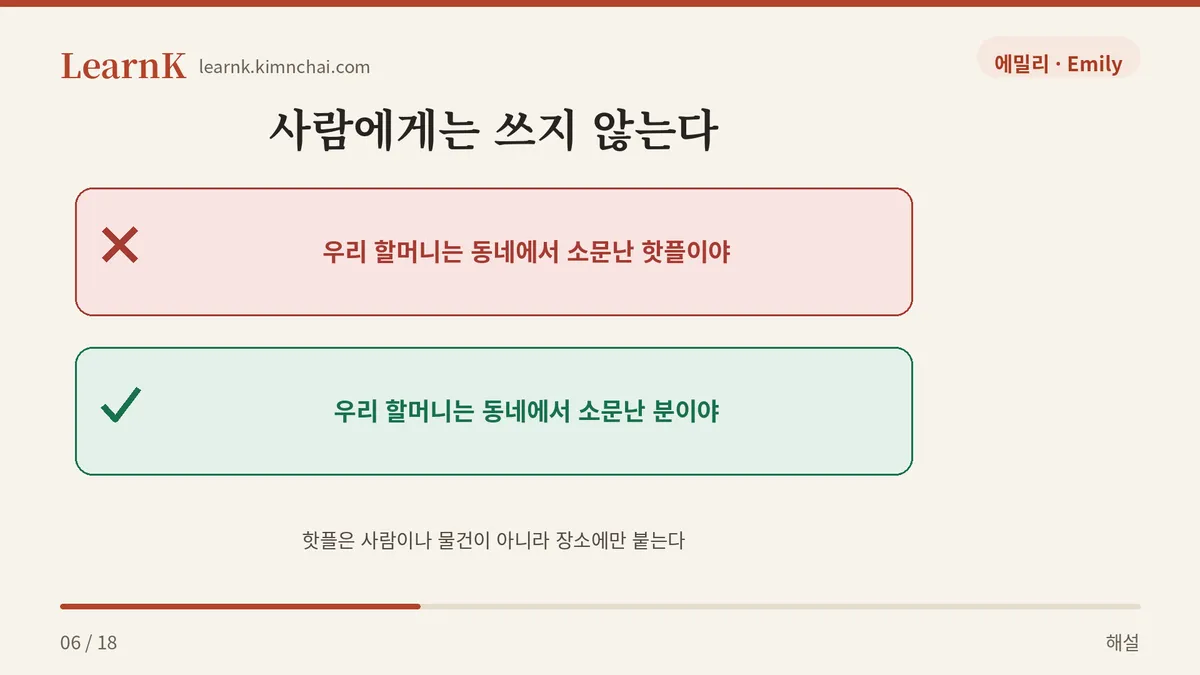
One more thing. 핫플 (hatpeul) attaches only to places. You don’t use it for people or things. A singer who’s doing well these days isn’t a 핫플 (hatpeul), and a trending handbag isn’t a 핫플 (hatpeul) either. Just respecting that boundary will make a learner’s sentences sound far more natural.
A Real Conversation
Scene: Saturday afternoon, in front of a pop-up store in a Seongsu-dong alley. The line stretches around the corner of the building.
Jun-kyung: 야, 이 줄 뭐야. 우리 앞에 서른 명은 되겠는데? Whoa, look at this line. There’ve gotta be thirty people ahead of us.
Emily: 그러니까 아침에 오자고 했잖아. 여기 요즘 서울에서 제일 핫플이야. That’s why I said we should come in the morning. This is the hottest spot in Seoul right now.
Jun-kyung: 작년까지만 해도 여기 그냥 인쇄소 골목이었는데. Up until last year this was just an alley full of print shops.
Emily: 핫플이 원래 그래. 이 년만 지나면 또 딴 데로 옮겨 가. That’s how hot spots go. Give it two years and it moves somewhere else.
Jun-kyung: 그럼 우린 지금 유행 한복판에 서 있는 거네. 다리는 아파 죽겠고. So we’re standing right in the middle of the trend. And my legs are killing me.
Emily: 참아. 여기까지 와서 사진도 안 찍고 가면 억울하잖아. Hang in there. Coming all this way and leaving without a photo would be a waste.
These Uses Sound Off
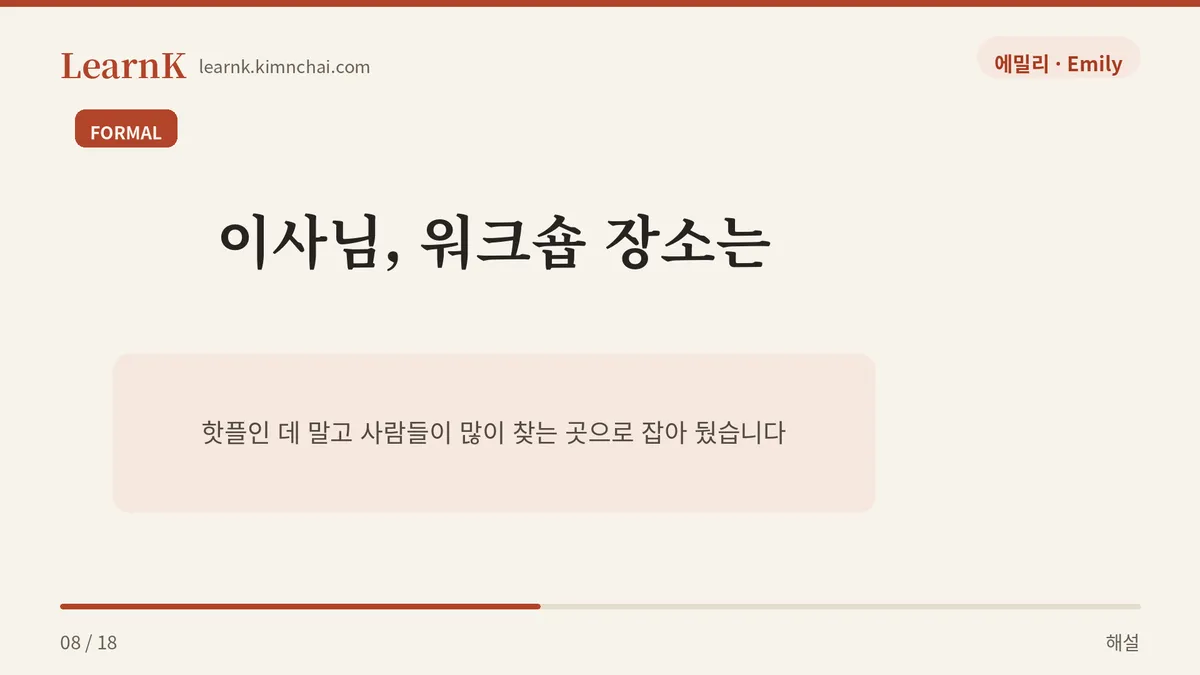
✗ (In a meeting, to an executive) 이사님, 워크숍 장소는 요즘 핫플인 데로 잡아 뒀습니다. (isanim, wokeusyop jangsoneun yojeum hatpeulin dero jaba dwotseumnida.) ✓ (In a meeting, to an executive) 이사님, 워크숍 장소는 요즘 사람들이 많이 찾는 곳으로 잡아 뒀습니다. (isanim, wokeusyop jangsoneun yojeum saramdeuri mani channeun goseuro jaba dwotseumnida.) “Sir, I’ve booked the workshop venue at a place a lot of people are going to these days.” → 핫플 (hatpeul) is a casual clipped word used among peers. Drop it into a formal report and you sound like someone who didn’t prepare.
✗ 출근길 2호선은 사람이 너무 많아서 완전 핫플이야. (chulgeungil i-hoseoneun sarami neomu manaseo wanjeon hatpeuliya.) ✓ 출근길 2호선은 사람이 너무 많아서 완전 지옥철이야. (chulgeungil i-hoseoneun sarami neomu manaseo wanjeon jiokcheoriya.) “Line 2 during the morning commute is so packed it’s a total hell-train.” → 핫플 (hatpeul) doesn’t mean “there are a lot of people”; it means “people crowd in because they want to go.” You don’t use it for a place you’re shoved into against your will.
Example Sentences by Situation
Situation 1. Friday night, texting a friend to make weekend plans
주말에 성수 갈래? 거기 새로 생긴 데가 요즘 핫플이래. (jumare seongsu gallae? geogi saero saenggin dega yojeum hatpeurirae.) Wanna go to Seongsu this weekend? I hear that new place there is the hot spot these days.
The ending -이래 (-irae) is used when you’re passing along something you heard from someone else. 핫플 (hatpeul) pairs unusually well with this reported-speech form, because it’s a status nobody grants alone — it’s created by a crowd piling in. That’s why “핫플이래 (hatpeurirae)” sounds far more natural than “내가 보기엔 핫플이야 (naega bogien hatpeuriya, ‘I’d say it’s a hot spot’).”
Situation 2. Mapping out a route for a friend visiting Korea
핫플만 돌면 줄 서다가 하루가 다 가요. 하나만 고르는 게 나아요. (hatpeulman dolmyeon jul seodaga haruga da gayo. hanaman goreuneun ge naayo.) If you only hit the hot spots, the whole day goes to waiting in line. Better to pick just one.
핫플 (hatpeul) itself doesn’t care whether you’re speaking casually or politely. Add -이에요 (-ieyo) / -입니다 (-imnida) and it becomes polite speech. Just note that it fits friendly polite speech, not truly formal settings.
Situation 3. Revisiting a neighborhood you used to frequent
여기 한때 핫플이었는데 지금은 조용하네. (yeogi hantae hatpeurieonneunde jigeumeun joyonghane.) This used to be the place to be, but it’s quiet now.
In the past tense, 핫플 (hatpeul) takes on a particular wistfulness. 핫플이었다 (hatpeurieotda) sums up a neighborhood’s whole rise and fall in a single word, and it’s a form Koreans really do use often.
Politeness Levels and Similar Expressions
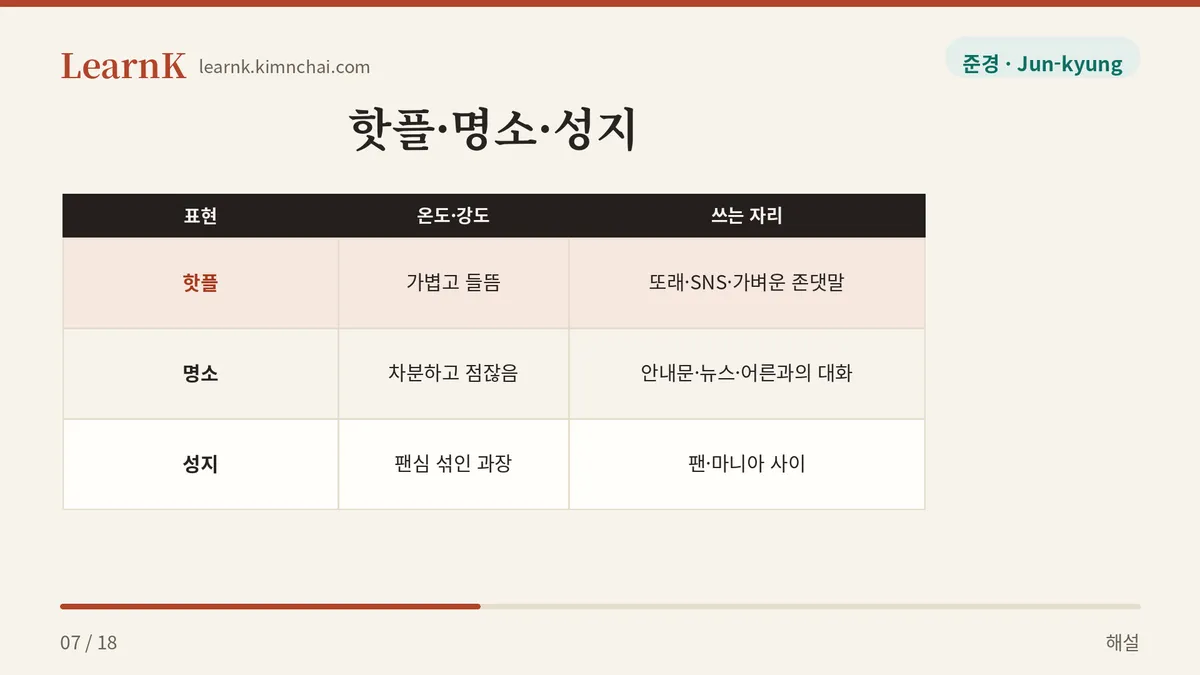
| Expression | Temperature & intensity | Where it’s used |
|---|---|---|
| 핫플 (hatpeul) | Light and giddy; emphasizes “trending now” | Among peers, on social media, in friendly polite speech. Avoid in reports or formal settings |
| 명소 (myeongso) | Calm and dignified; long-established fame | Anywhere — signage, news, conversation with elders |
| 맛집 (matjip) | Friendly and practical; food only | Safe with anyone. Restaurants only |
| 성지 (seongji) | Affection with a dash of exaggeration; fan devotion | Among fans and enthusiasts. Refers to a pilgrimage site for a particular niche |
Even for the same place, the word you pick changes. Gyeongbokgung Palace is a 명소 (myeongso), not a 핫플 (hatpeul); a café that opened yesterday is a 핫플 (hatpeul), not a 명소 (myeongso). When fans make the trip to a filming location, that’s a 성지 (seongji).
Cultural Background — A City Whose Alleys Keep Moving
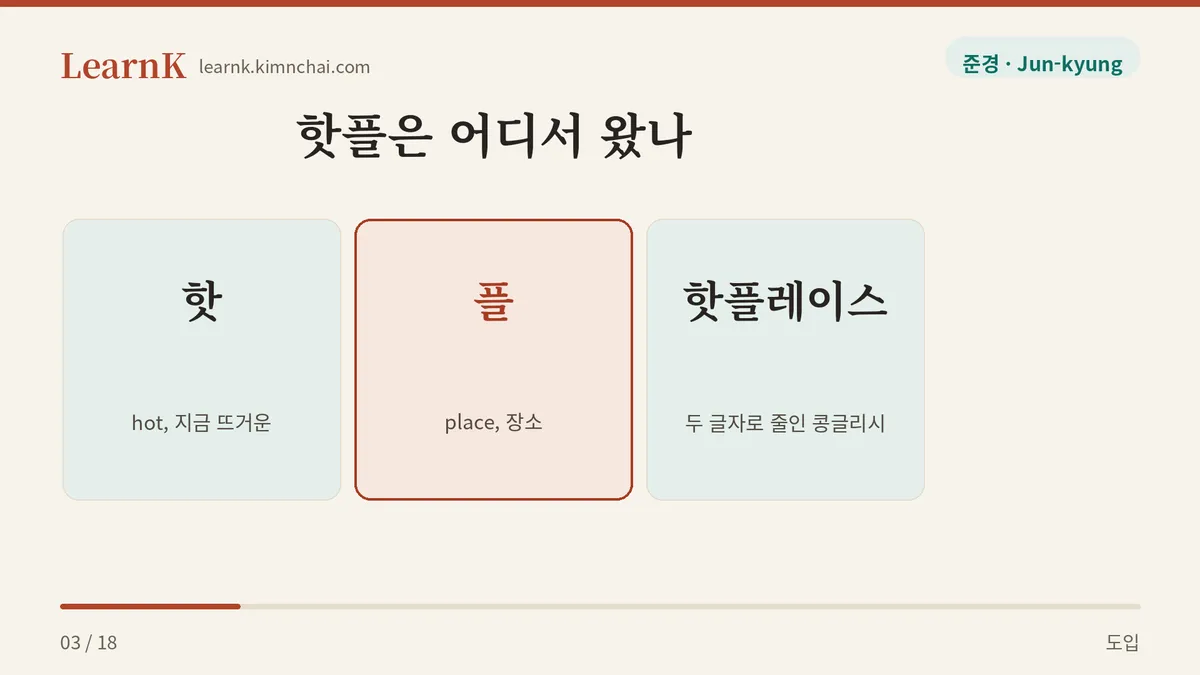
핫플 (hatpeul) comes from 핫플레이스 (hatpeulleiseu), the Konglish mash-up of English “hot” and “place,” clipped down again to two syllables. It’s the same long-standing Korean habit that turns 아이스 아메리카노 (aiseu amerikano, “iced americano”) into 아아 (a-a) and 셀프 카메라 (selpeu kamera, “self camera”) into 셀카 (selka). The original 핫플레이스 (hatpeulleiseu) is still around, but in speech it’s almost always 핫플 (hatpeul) that comes out.
There’s a reason rooted in the city of Seoul itself for why this word gets used so relentlessly. The fashionable neighborhood keeps changing every few years. Small shops move into alleys that used to hold print shops and factories, crowds gather, rents rise, and the shops get pushed out to another neighborhood. From Hongdae to Yeonnam, from Yeonnam to Mangwon, and then to Seongsu — people describe that whole migration simply as “핫플이 옮겨 갔다 (hatpeuri omgyeo gatda, ‘the hot spot moved’).” One short word ends up holding an entire map of the city’s movement.
It’s worth learning the words that travel alongside 핫플 (hatpeul), too: 오픈런 (opeunreon, “open run”), sprinting over in time for opening; 웨이팅 (weiting, “waiting”), standing in line; and 평일 낮 공략 (pyeongil nat gongnyak), the strategy of going on a weekday afternoon before the crowds hit. This scene shows up constantly in dramas, too. The lead finally lands a hard-to-get reservation and brings a date there, only for the line to be so long that the mood falls apart — a setup Korean romance dramas love, and one where 핫플 (hatpeul) does double duty as a prop carrying both butterflies and fatigue.
Today’s Quiz
Which of the following uses 핫플 (hatpeul) naturally?
- 우리 할머니는 동네에서 소문난 핫플이야. (uri halmeonineun dongneeseo somunnan hatpeuliya.)
- 요즘 저 골목이 핫플이라 주말엔 줄이 엄청 길대. (yojeum jeo golmogi hatpeulira jumaren juri eomcheong gildae.)
- 이 우산 진짜 핫플이다, 어디서 샀어? (i usan jinjja hatpeulida, eodiseo sasseo?)
The answer is number 2. 핫플 (hatpeul) doesn’t attach to people (number 1) or things (number 3) — only to places. Number 2 is a place, and it also brings in the time frame 요즘 (yojeum, “these days”) and a crowd by way of 줄이 길다 (juri gilda, “the line is long”), which is exactly the seat where this word sits most comfortably.