흑화하다 (heukhwahada) — The Moment the Sweet One Turns
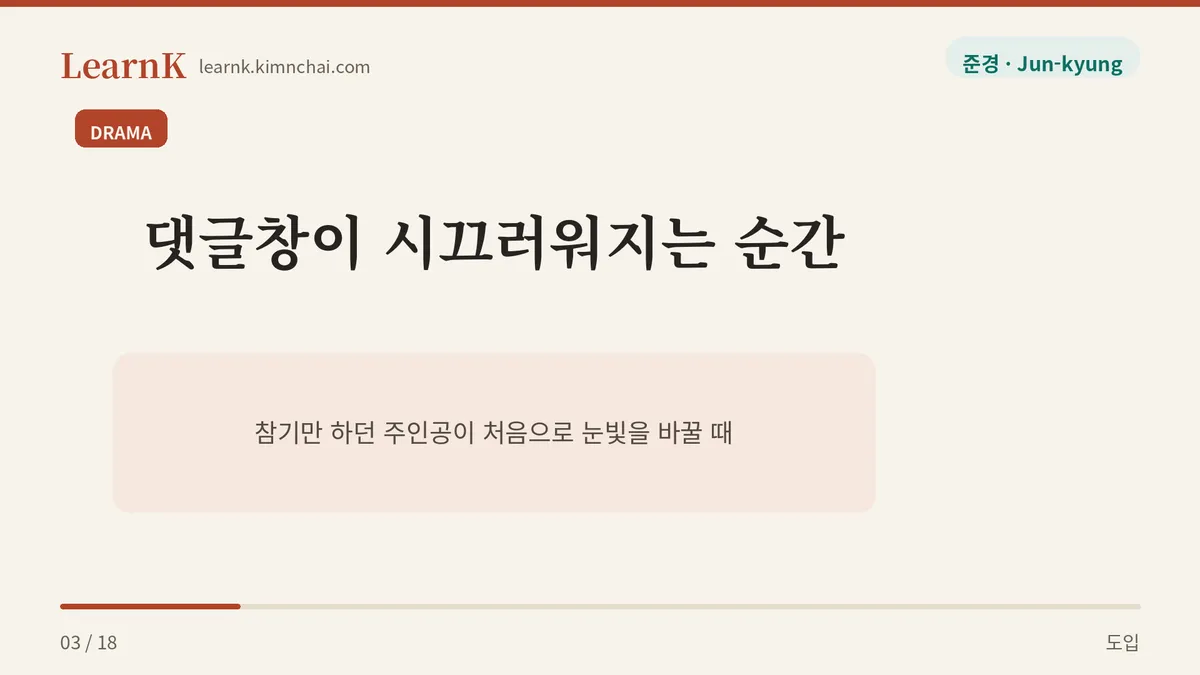
There are moments while watching a drama when the comment section suddenly gets loud. It’s the moment when the main character — who has spent twelve episodes smiling and swallowing everything — finally lets the look in their eyes change in episode 13. The word Korean viewers reach for in unison at that moment is today’s expression.
흑화하다
흑화하다 (heukhwahada) means that a kind or ordinary person, after being hurt or betrayed, changes completely toward something dark and aggressive. It isn’t simply getting angry, and it isn’t a bad mood that passes. It refers to a change in which the very personality that made that person who they were crosses over to the opposite side — a change that now looks difficult to come back from.
Splitting the nuance into three parts makes the usage much clearer.
First, there is always a cause. 흑화 (heukhwa) comes with a backstory attached. Someone they trusted stabbed them in the back, or something unfair happened and nobody took their side. That’s why this word carries less blame than a kind of acceptance — a sense of “yeah, no wonder.” It isn’t used for someone who simply has a bad personality for no reason.
Second, the change is huge and the direction is dark. Getting a little more irritable doesn’t cut it. There has to be a real drop — someone who only ever endured is now the first to draw the knife; someone who used to look after others starts using them instead.
Third, there’s a quiet thrill for the people watching. 흑화 (heukhwa) usually arrives together with “finally.” A character who could only take the abuse starts fighting back, and it feels great to watch. So even though the word points to a negative development, the tone is often downright excited.
It was originally used for characters in webtoons and dramas, but these days people also use it to describe changes in the people around them, joke-style. That “joke-style” condition matters a lot, though. We’ll come back to it later.
For reference, 흑화하다 (heukhwahada) is a new coinage that is not yet listed as a headword in the National Institute of Korean Language’s Basic Korean Dictionary. So the definition and example sentences in this post are not dictionary quotations — they’re an explanation put together from observing how the word is actually used.
Seeing It in Real Conversation
Situation: Sunday evening on Subway Line 2. Two people are sitting side by side, each looking at their own phone.
에밀리: 헐… 야, 준경아. 나 방금 소름 돋았어. Whoa… hey, Jun-kyung. I just got chills.
준경: 왜, 보던 웹툰? 뭐 어떻게 됐는데. What, the webtoon you’re reading? What happened?
에밀리: 그 착하던 주인공이 흑화했어. 눈빛부터 완전 달라졌어. That sweet main character went dark. Even the look in his eyes is completely different.
준경: 아, 드디어. 지난 화에서 친구한테 뒤통수 맞았잖아. 그럼 흑화 각이지. Ah, finally. He got stabbed in the back by his friend last episode. Then he was bound to turn.
에밀리: 근데 좀 시원해. 맨날 참기만 하는 거 답답했거든. But honestly it feels satisfying. It was frustrating watching him just take it every time.
준경: 그치. 다들 흑화하는 회차를 제일 기다려. 나도 그래. Right. Everyone waits for the episode where they turn. Me too.
The thing to watch for in this dialogue is Jun-kyung’s 흑화 각이지 (heukhwa gagiji). 각 (gak) is a current slang term meaning “the setup that makes something bound to happen,” and it travels with 흑화 (heukhwa) all the time. And Emily’s 좀 시원해 (jom siwonhae) — “it feels kind of satisfying” — shows you the temperature of this expression. Something bad has happened, and yet the air in the conversation is upbeat.
These Uses Sound Off
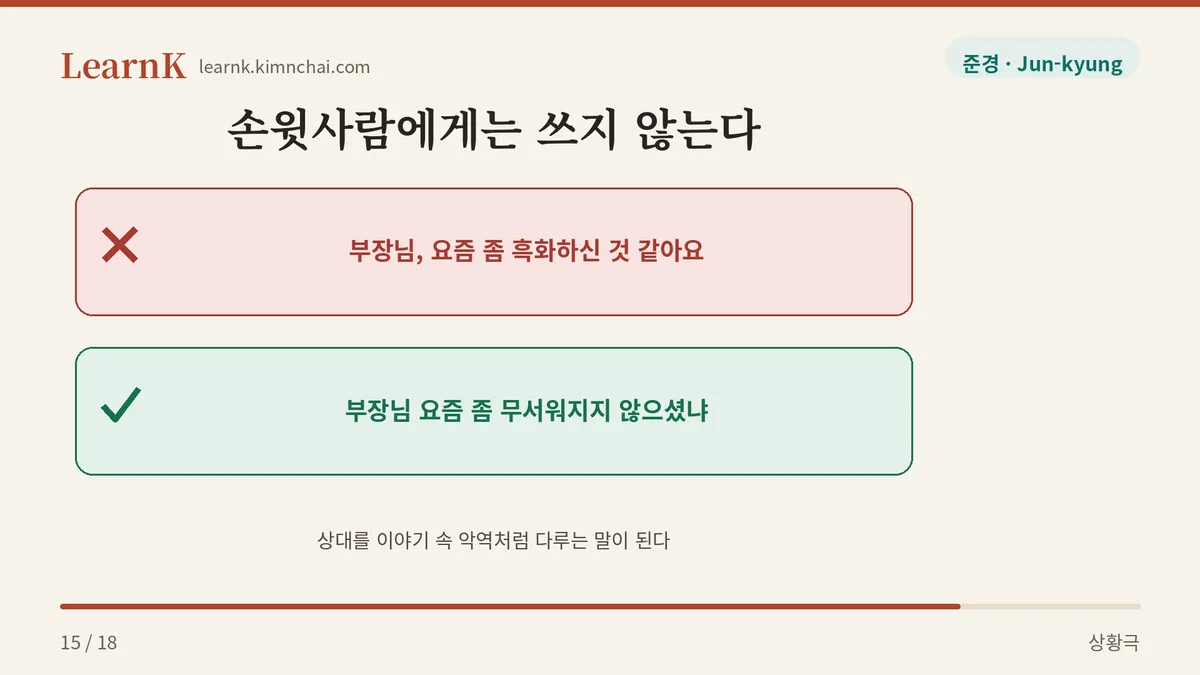
✗ (To your department head) 부장님, 요즘 좀 흑화하신 것 같아요. “Sir, I feel like you’ve gone a bit dark lately.” ✓ (To a coworker) 야, 부장님 요즘 좀 무서워지지 않으셨냐? “Hey, hasn’t the boss gotten kind of scary lately?” → 흑화하다 (heukhwahada) grew up inside webtoon and drama fandom, so pinning it on a personality change in someone senior to you amounts to treating them like a villain in a story. Switching to polite speech doesn’t remove the rudeness.
✗ (About the victim of a real incident) 그분도 그 일 겪고 흑화하셨네요. “So they went dark after going through that, huh.” ✓ (About the victim of a real incident) 그 일을 겪고 많이 달라지셨더라고요. “They’ve changed a lot since going through that.” → 흑화 (heukhwa) is a word for spectating “a fictional character’s dramatic awakening,” so amusement clings to it. Laid over a real person’s misfortune, it turns into a way of speaking that treats someone else’s pain as entertainment.
To sum up: 흑화하다 (heukhwahada) is only safe when it’s about a fictional character, or when you’re joking lightly with someone you’re close to.
Example Sentences by Situation
1. Recommending a drama to a friend This is a persuasion move Koreans use all the time to reel back in a friend who quit partway because the beginning dragged. You tell them when it gets good by pointing to the 흑화 (heukhwa) moment.
이 드라마 초반은 좀 느린데, 6화에서 주인공이 흑화해서 (heukhwahaeseo) 그때부터 진짜 재밌어져. The start of this drama is a bit slow, but the main character goes dark in episode 6, and from there it gets really good.
2. Teasing a friend during exam season A friend who always lent out their notes flatly refused this time. It isn’t real criticism — it’s said with a laugh, which is exactly where 흑화 (heukhwa) fits well.
쟤 원래 노트 다 빌려줬거든? 이번엔 안 된대. 완전 흑화했어 (heukhwahaesseo). She used to lend out all her notes, you know? This time she said no. She’s totally gone dark.
3. Leaving your thoughts on an ending in a fan community This is what you use when opinions split over how a work ends. The noun form, as in 흑화 엔딩 (heukhwa ending), is extremely common too.
**흑화 엔딩 (heukhwa ending)**도 나쁘진 않은데, 저는 그래도 회복하는 결말이 더 좋더라고요. A dark-turn ending isn’t bad either, but personally I still prefer an ending where they recover.
Polite and Casual Forms, and Similar Expressions
The casual form is 흑화했어 (heukhwahaesseo), and the polite forms are 흑화했어요 (heukhwahaesseoyo) or 흑화한 것 같더라고요 (heukhwahan geot gatdeoragoyo). Just remember that the polite form isn’t for using toward someone you should show respect to — it’s for talking with that person about a third party (usually a drama character).
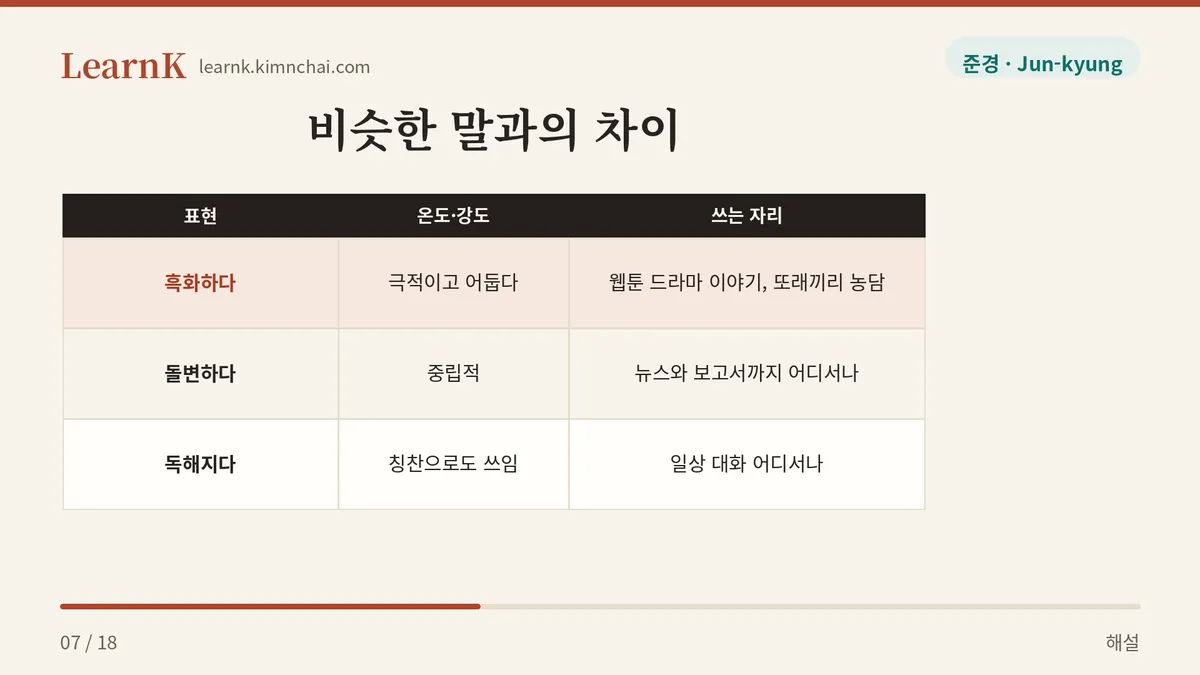
| Expression | Temperature & intensity | Where it belongs |
|---|---|---|
| 흑화하다 (heukhwahada) | Dramatic and dark, mixed with the fun of watching | Webtoon and drama talk, jokes among peers |
| 돌변하다 (dolbyeonhada) | Neutral; an attitude flips in an instant | Anywhere, even news reports and formal write-ups |
| 삐뚤어지다 (ppitureojida) | Toward a heart gone crooked, mixed with pity | Everyday conversation, especially worrying about someone younger |
| 독해지다 (dokhaejida) | Can even be praise for having gotten tougher | Everyday conversation, anywhere |
The key difference is whether a story is required. 돌변하다 (dolbyeonhada) works with no reason given, and 독해지다 (dokhaejida) can even lean positive. 흑화하다 (heukhwahada) is the only one that inevitably drags along the question, “Wait, what happened to them?”
Cultural Background — The 사이다 That Comes After the 고구마
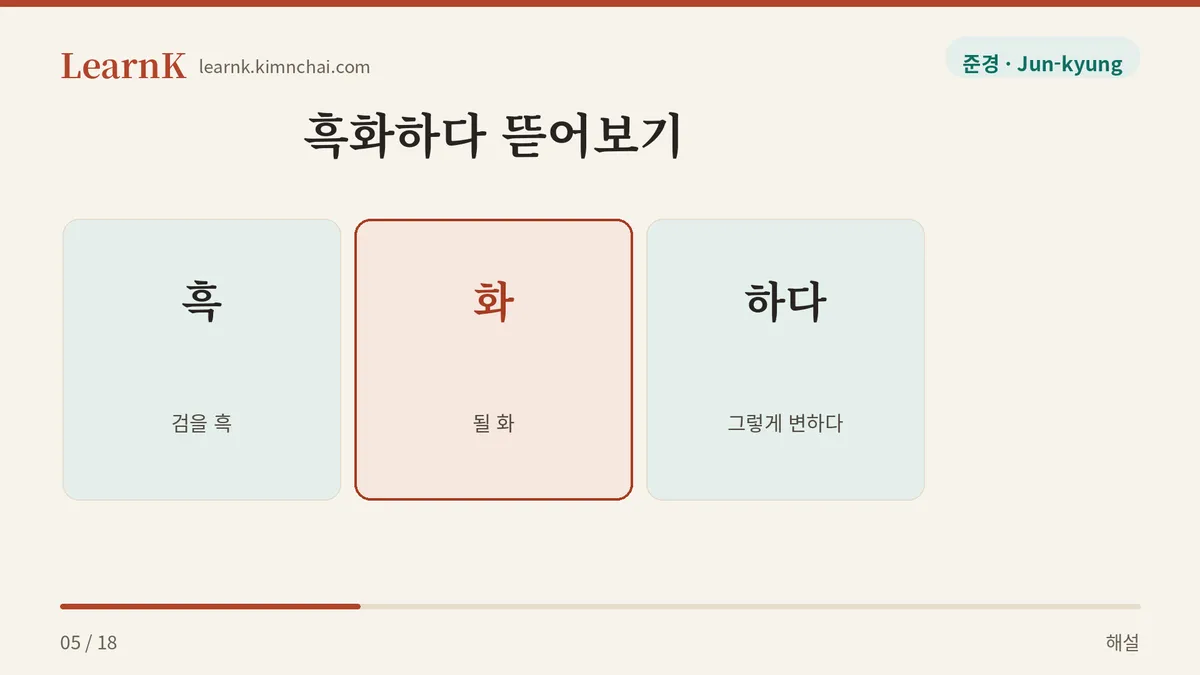
흑화 (黑化, heukhwa) is, character for character, “black” plus “become” — to turn black. It paints a person’s heart in color, and this simple picture lined up so neatly with a long-standing structure in Korean dramas that it spread through fandom fast.
Korean drama viewers call a frustrating stretch of plot 고구마 (goguma), “sweet potato,” and a cathartic one 사이다 (saida), “soda.” The metaphor is that a sweet potato sticks in your throat and soda washes it down. If the stretch where a good-hearted lead endures one injustice after another is the 고구마 (goguma), then 흑화 (heukhwa) is the switch that turns that 고구마 into 사이다 (saida). That’s why 흑화 (heukhwa) scenes are usually placed in the final few minutes of an episode — they hold viewers until next week.
Once you know this structure, it makes sense why Korean fans get excited about a change for the worse. 흑화 (heukhwa) isn’t read as the moment a character falls apart; it’s read as the moment all the accumulated unfairness finally starts getting paid for. In a drama culture where revenge stories are especially beloved, 흑화 (heukhwa) is essentially the flare that says, “the second half of the story has begun.”
Recently the word has walked right off the screen. When an idol known for a gentle personality performs a fierce concept on stage, fans call it a 흑화 콘셉트 (heukhwa concept); when a friend who always smiled turns firm, people laugh and say 드디어 흑화했다 (deudieo heukhwahaetda) — “they’ve finally gone dark.” It doesn’t mean the person has actually turned bad; it’s closer to saying they’ve started claiming what’s theirs. In a way, it’s practically a word of encouragement.
Today’s Quiz
Which of the following uses 흑화하다 the most naturally?
- 어제 사 온 바나나가 하루 만에 흑화했어. The bananas I bought yesterday went dark in a single day.
- (To your team leader) 팀장님, 요즘 흑화하신 것 같아요. Boss, I feel like you’ve gone dark lately.
- 그 캐릭터, 10화에서 흑화하고 나서 인기가 확 올랐대. Apparently that character’s popularity shot up after they went dark in episode 10.
Answer: 3
Number 1 uses it for an object that has physically turned black. The Chinese characters may line up, but 흑화하다 (heukhwahada) is only used for a change in a person’s character, so it sounds off. In that case you’d say 다 갈변했어 (da galbyeonhaesseo), “it’s all browned,” or 까맣게 됐어 (kkamatge dwaesseo), “it’s gone black.” Number 2 treats someone senior to you like a villain in a story, so it comes across as rude. Talking about a fictional character’s transformation and what came of it, as in number 3, is where this expression sits most comfortably.
If a scene comes up in whatever you’re watching tonight where someone’s eyes change, try opening the comment section. Somebody will surely have gotten there first and written exactly this — 드디어 흑화했다.