힐링 (hilling) — The Smallest Way Koreans Get Through the Day
Ask a Korean friend what they did over the weekend, and three or four out of ten will finish their answer with this one word. After the story about wherever they went, one more line always gets tacked on: ‘진짜 힐링됐어. (jinjja hillingdwaesseo.)’ — “That was seriously healing.”
힐링 (hilling)
힐링 (hilling) refers to the state in which a tired, used-up heart quietly loosens and recovers — or to the thing that makes that happen for you. It does not mean an illness was cured. A cup of 식혜 (sikhye), sweet rice punch, at the 찜질방 (jjimjilbang) on a Friday night; the sunset you happen to look up at on the way home from work; your dog’s face barreling toward you the second the front door opens — Koreans call all of these 힐링 (hilling). It isn’t big. It doesn’t change your life; it’s just the size that barely gets you through this one week.
The word came straight from English “healing,” but on its way into Korean it became far lighter and far broader than the original. English “healing” usually presupposes a wound, an illness, or trauma — something has to need mending for it to count. Korean 힐링 (hilling) needs no such premise. Just being tired is enough, and even if you aren’t particularly tired, feeling good is enough.
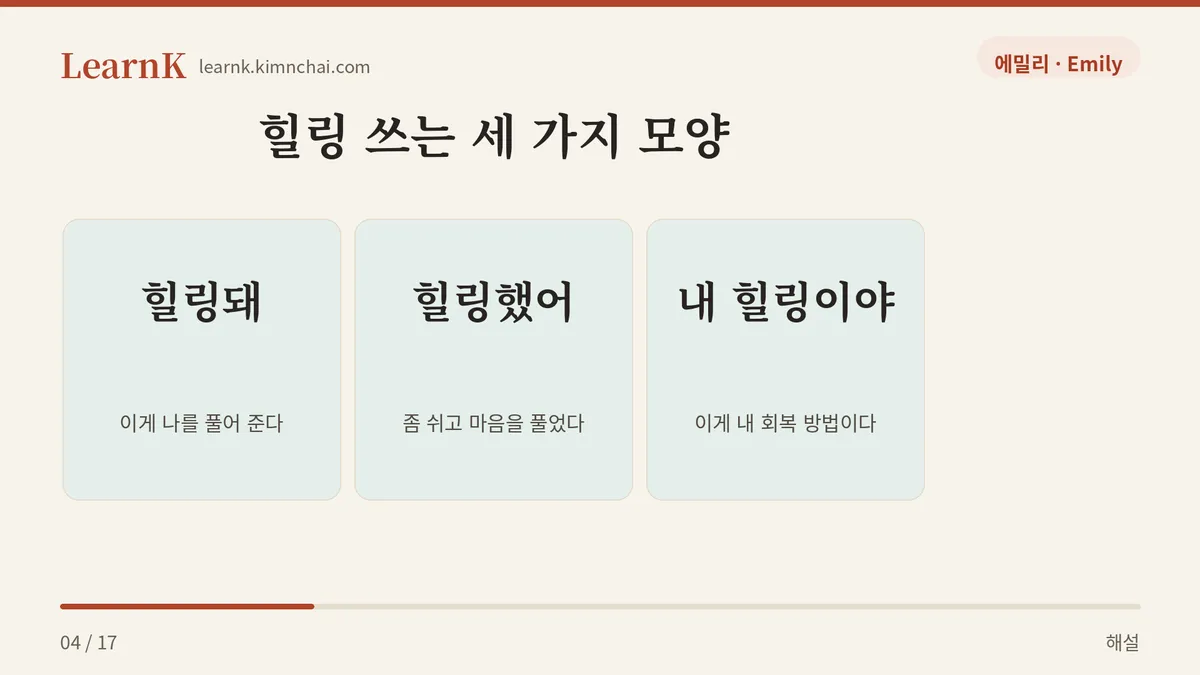
It generally shows up in four shapes.
- 힐링이 되다 / 힐링되다 (hillingi doeda / hillingdoeda) — the most common. ‘여기 오면 힐링돼.’ (“Coming here is healing.”)
- 힐링하다 (hillinghada) — ‘주말에 좀 힐링했어.’ (“I did a little healing over the weekend.”)
- ~가 내 힐링이다 (~ga nae hillingida) — ‘이게 내 힐링이야.’ (“This is my healing.”)
- 힐링 + noun — 힐링 여행 (hilling yeohaeng) healing trip, 힐링 음식 (hilling eumsik) healing food, 힐링 음악 (hilling eumak) healing music
The temperature of the word is warm and soft. What it lacks is weight. That lightness is both this word’s charm and — as we’ll see below — its trap.
A Real Conversation
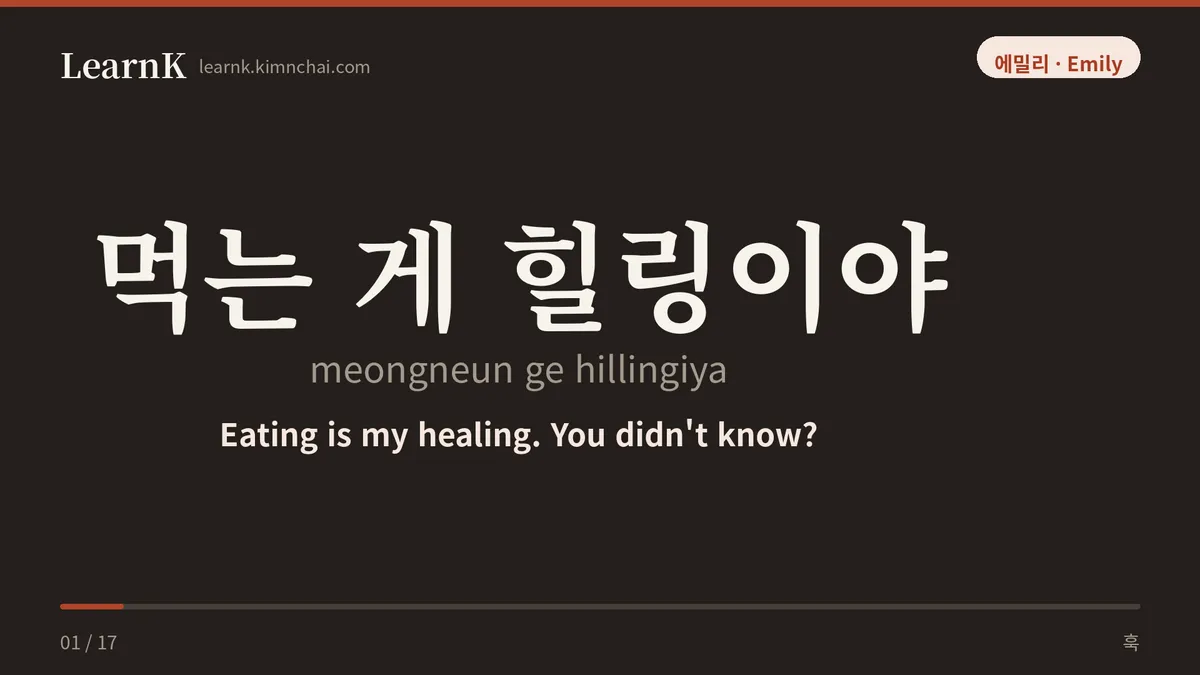
Setting: A 찜질방 (jjimjilbang) on a Friday night. They’re peeling roasted eggs and drinking 식혜 (sikhye).
Jun-kyung: 캬— 이 맛이지. 일주일 치가 싹 내려간다. Ahh, this is the taste. A whole week just drains right out of me.
Emily: 그니까. 여기 오면 진짜 힐링돼. 나 계란 두 개만 더 사 올까? Right? Coming here really is healing. Should I go grab just two more eggs?
Jun-kyung: 야, 너 아까 세 개 먹었잖아. Hey, you already had three.
Emily: 먹는 게 힐링이야. 몰랐어? Eating is my healing. You didn’t know?
Jun-kyung: 하여간… 이따 불한증막 한 번 더 갈 거지? Unbelievable… You’re going back in the hot room later, right?
Emily: 당연하지. 거기 5분이 이번 주 내 힐링 전부야. Obviously. Those five minutes are my entire healing for this week.
This Sounds Unnatural
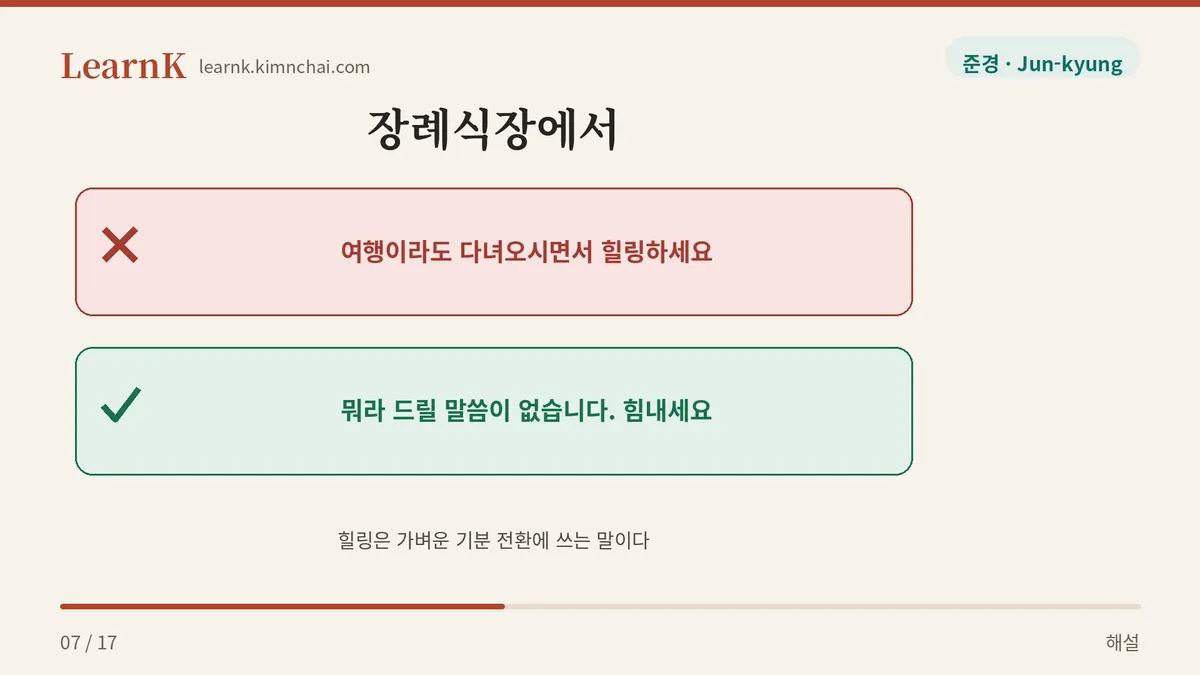
✗ (to a bereaved family member at a funeral) 여행이라도 다녀오시면서 힐링하세요. “Go take a trip or something and get some healing.” ✓ (to a bereaved family member at a funeral) 뭐라 드릴 말씀이 없습니다. 힘내세요. “I don’t know what to say. Please stay strong.” → 힐링 (hilling) is for light changes of mood. Placed in front of a major loss, it shrinks the other person’s grief down to something “you can shake off over the weekend.” In moments like this, reach for vocabulary in the 위로 (wiro) family instead.
✗ (to a colleague hospitalized after surgery) 수술 잘 끝났다며? 이제 힐링만 하면 되겠네. “I heard the surgery went well. Now all that’s left is the healing.” ✓ (to a colleague hospitalized after surgery) 수술 잘 끝났다며? 이제 회복만 하면 되겠네. “I heard the surgery went well. Now all that’s left is recovery.” → For the body actually mending, use 회복 (hoebok). 힐링 (hilling) is a word about the heart, so at a hospital bed it makes you sound like someone taking the situation lightly.
Example Sentences by Situation
1. Answering “What did you do this weekend?”
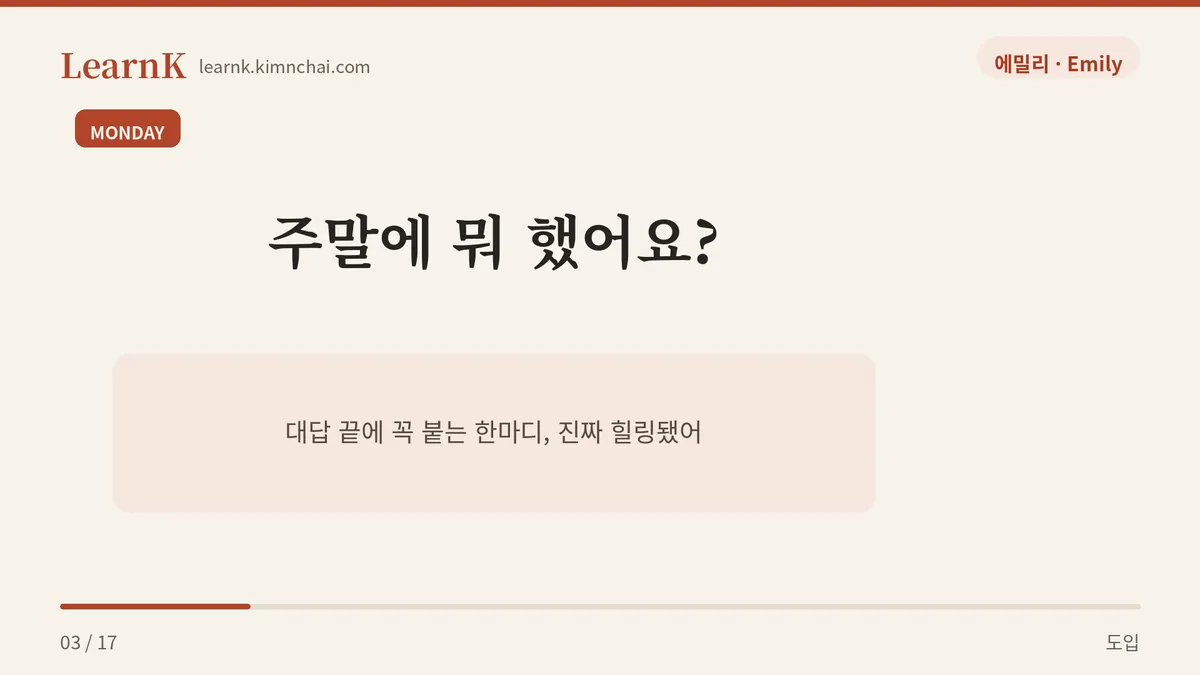
The most-exchanged question on a Monday morning in Korea is ‘주말에 뭐 했어요?’ (“What did you do over the weekend?”). Even if you did nothing impressive, this one word completes your answer.
주말에 아무것도 안 하고 누워만 있었는데 그게 진짜 힐링이었어요. (jumare amugeotdo an hago nuwoman isseonneunde geuge jinjja hillingieosseoyo.) I did nothing but lie around all weekend, and honestly, that was real healing.
It turns “I did nothing” away from laziness and toward recovery.
2. Introducing your hobby
When mentioning a hobby in a self-introduction or small talk, Koreans often use this word instead of ‘좋아해요’ (“I like it”). It explains why you like it in the same breath.
저는 주말에 혼자 빵 굽는 게 힐링이에요. (jeoneun jumare honja ppang gunneun ge hillingieyo.) Baking bread alone on the weekend is my healing.
There’s one more piece of information here than in ‘빵 굽는 걸 좋아해요’ (“I like baking bread”). It carries the sense that you do it not to get good at it, but because it unknots something inside you.
3. Complimenting someone
It also attaches to people, voices, and even paintings. Used this way, it becomes the highest form of praise: “being around you is easy.”
선배님이랑 얘기하면 그냥 힐링이 돼요. (seonbaenimirang yaegihamyeon geunyang hillingi dwaeyo.) Talking with you is just pure healing.
It isn’t rude to say to someone senior to you. That said, in very formal settings (interviews, reports), ‘큰 힘이 됩니다’ (“It means a great deal to me”) sounds more polished.
Polite vs. Casual Forms, and Similar Expressions
힐링 (hilling) is a noun, so politeness level is handled by the predicate that follows it.
- Casual: 힐링돼 / 힐링됐어 / 힐링이야
- Polite: 힐링돼요 / 힐링됐어요 / 힐링입니다
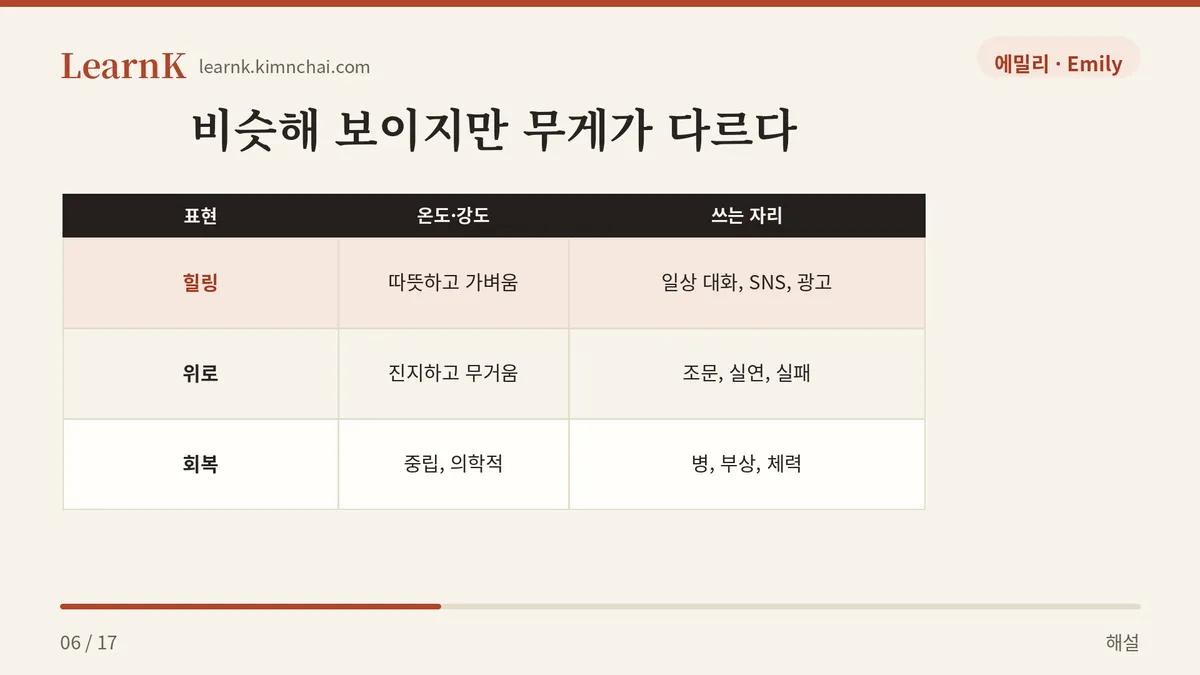
Several words look similar, but they sit in different places and carry different weight.
| Expression | Temperature & Intensity | Where it’s used |
|---|---|---|
| 힐링 (hilling) | Warm and light. The heart going soft | Everyday conversation, social media, advertising. Not for deep grief or illness |
| 위로 (wiro) | Serious and heavy | When someone is genuinely hurting. Condolences, heartbreak, failure |
| 휴식 (hyusik) | Neutral. Body-centered | Anywhere. Including official documents and public notices |
| 회복 (hoebok) | Neutral, medical | Illness, injury, stamina. Even appears on medical certificates |
To sum up: when the body rests, that’s 휴식 (hyusik); when the body mends, that’s 회복 (hoebok); when someone else tends to your pain, that’s 위로 (wiro); and when you can’t quite put your finger on it but your heart feels a little better, that’s 힐링 (hilling).
Cultural Background — A Word Made by Saunas and Variety Shows
This word was never originally part of Korean. It’s a loanword transcribing English “healing” sound for sound, and it spread fairly recently. In the early 2010s, broadcast programs that put the word front and center — the SBS variety show 《힐링캠프》 (Healing Camp, launched in 2011) being the flagship example — settled it into everyday speech.
The fact that a single word spread this fast also means there was an empty seat waiting for it. Korean already had ‘피곤하다’ (“to be tired”) and ‘쉬다’ (“to rest”), but it had no good word for that subtle state of a drained heart being refilled a little. 힐링 (hilling) walked right into that seat.
Which is why, in Korea today, this word is practically an industry. 힐링 여행 (hilling yeohaeng), 힐링 카페 (hilling kape), 힐링 음악 (hilling eumak) playlists, 힐링 푸드 (hilling pudeu). It’s been used so heavily in advertising that some people are tired of it and say it “smells like a sales pitch.” Even so, it stays sturdily alive in conversation, and the reason is simple: the moment you use this word, the other person understands without having to ask anything further.
That’s also why foreign learners get such a good reaction when they use it. It came from English, so it’s easy to pronounce, and more importantly, it signals “I’m worn out just like you, and I rest the same way you do.” Peel an egg at the 찜질방 (jjimjilbang) and say ‘여기 진짜 힐링이다’ (“This place is real healing”), and right there on the spot you’ll get credit for several years of living in Korea.
Today’s Quiz
You hear that a friend was laid up with a bad cold and body aches for three days and only managed to get up today. Which of the following is the most natural sentence?
- 이제 다 힐링됐어?
- 이제 좀 회복됐어?
- 오늘 힐링하러 병원 가?
The answer is 2. When the body was genuinely ill and is now mending, use 회복 (hoebok). Options 1 and 3 treat an illness as if it were a light mood problem, which sounds off. That said, once they’re fully better, this works just fine: ‘앓고 나서 죽 한 그릇 먹었는데 그게 진짜 힐링이었어.’ (“After being sick I had a bowl of porridge, and that was real healing.”) Because that’s the part where the heart, not the body, came undone.
Definitions and example sentences are from the National Institute of Korean Language’s Basic Korean Dictionary (krdict.korean.go.kr); that portion of this post, including our translations, is licensed under CC BY-SA 2.0 KR.