호캉스 (Hokangseu) — The Vacation That Doesn't Go Far: Your Suitcase, Thirty Minutes by Subway
호캉스
호캉스 (hokangseu) means a short vacation you spend holed up in a hotel instead of traveling far. No flight. No sightseeing itinerary planned down to the hour. You drag one suitcase onto the subway, check into a hotel thirty minutes away, take one dip in the pool, lie in bed watching TV, and check out at noon the next day. That’s a 호캉스 (hokangseu).
From late July into early August, when Korea’s summer vacation season hits, this word comes up several times a day. When someone asks 올여름 어디 가? (olyeoreum eodi ga?) — “Where are you going this summer?” — and you answer 그냥 호캉스나 하려고 (geunyang hokangseuna haryeogo), “I’ll just do a hokangseu,” that short reply carries more information than you’d think. It means: I don’t have the time or the stamina to go far, but sitting at home with nothing but the air conditioner on feels like a waste, and I’d like to sleep in a bed that isn’t mine for a night or two.
The heart of 호캉스 (hokangseu) isn’t the place — it’s the attitude. Not every hotel stay counts. Generally, three conditions have to line up before Koreans will use the word. First, the distance is short — inside the city you live in, or an hour or two away by car. Second, the purpose is rest, not tourism — you’re not going out to see the sights, you’re going to finish your whole day inside the hotel. Third, the stay is short — usually one night, two at the most.
The tone is light and a little giddy. It’s a coinage that spread in the late 2010s, but it’s settled in so thoroughly that it now shows up in news headlines and hotel ad copy as-is. Still, it remains a young, casual word, so when someone says 나 이번 주말에 호캉스 가 (na ibeon jumare hokangseu ga) — “I’m going on a hokangseu this weekend” — there’s a little bragging and a little excitement mixed in. It’s less a flat report than a happy announcement.
Grammatically it’s a noun, and in practice it shows up in almost exactly four forms:
- 호캉스(를) 가다 (hokangseu(reul) gada) — the most common. 주말에 호캉스 가. (jumare hokangseu ga.) “I’m going on a hokangseu this weekend.”
- 호캉스(를) 하다 (hokangseu(reul) hada) — often used when talking about plans. 올해는 호캉스만 하려고. (olhaeneun hokangseuman haryeogo.) “This year I’m just going to do a hokangseu.”
- 호캉스(를) 즐기다 (hokangseu(reul) jeulgida) — written/advertising register. Rarely used in conversation.
- 호캉스 다녀오다 (hokangseu danyeooda) — for after the fact. 어제 호캉스 다녀왔어. (eoje hokangseu danyeowasseo.) “I went on a hokangseu yesterday.”
Seeing It in Real Conversation
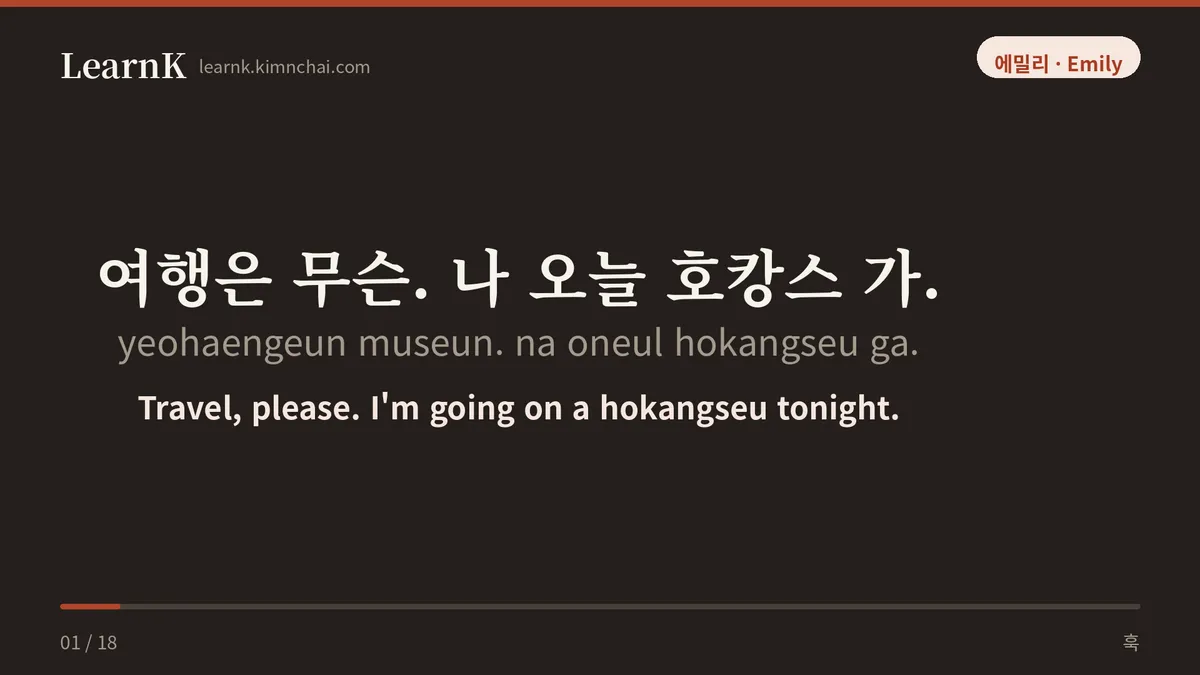
Situation: Friday evening, in the apartment elevator. Emily gets on dragging a suitcase.
Jun-kyung: 어, 캐리어? 이 시간에 어디 여행 가? Oh, a suitcase? Where are you off to at this hour?
Emily: 여행은 무슨. 그냥 시내 호텔이야. 나 오늘 호캉스 가. Travel, please. Just a hotel downtown. I’m going on a hokangseu tonight.
Jun-kyung: 아, 호텔에서 뻗어 있는 거? 근데 굳이 서울에서? Ah, just crashing at a hotel? But why in Seoul, of all places?
Emily: 멀리 가면 그게 더 피곤해. 수영장 한 번 들어갔다가 침대에서 안 나올 거야. Going far is more exhausting. One dip in the pool and I’m not leaving the bed.
Jun-kyung: 하긴. 나도 이번 여름은 호캉스나 할까 봐. Fair enough. Maybe I’ll just do a hokangseu this summer too.
Emily: 지금 예약해. 8월은 금방 다 차. Book it now. August fills up fast.
These Uses Sound Off
✗ (to your eighty-year-old grandmother) 할머니, 저 이번 주말에 호캉스 가요. ✓ (to your eighty-year-old grandmother) 할머니, 저 이번 주말에 호텔에서 하루 쉬다 오려고요. — “Grandma, I’m going to spend a night resting at a hotel this weekend.” → It’s a coinage only about ten years old, so depending on the generation, people simply won’t know it. If the meaning doesn’t get across, it isn’t expression — it’s noise. With older relatives, you’re better off spelling it out.
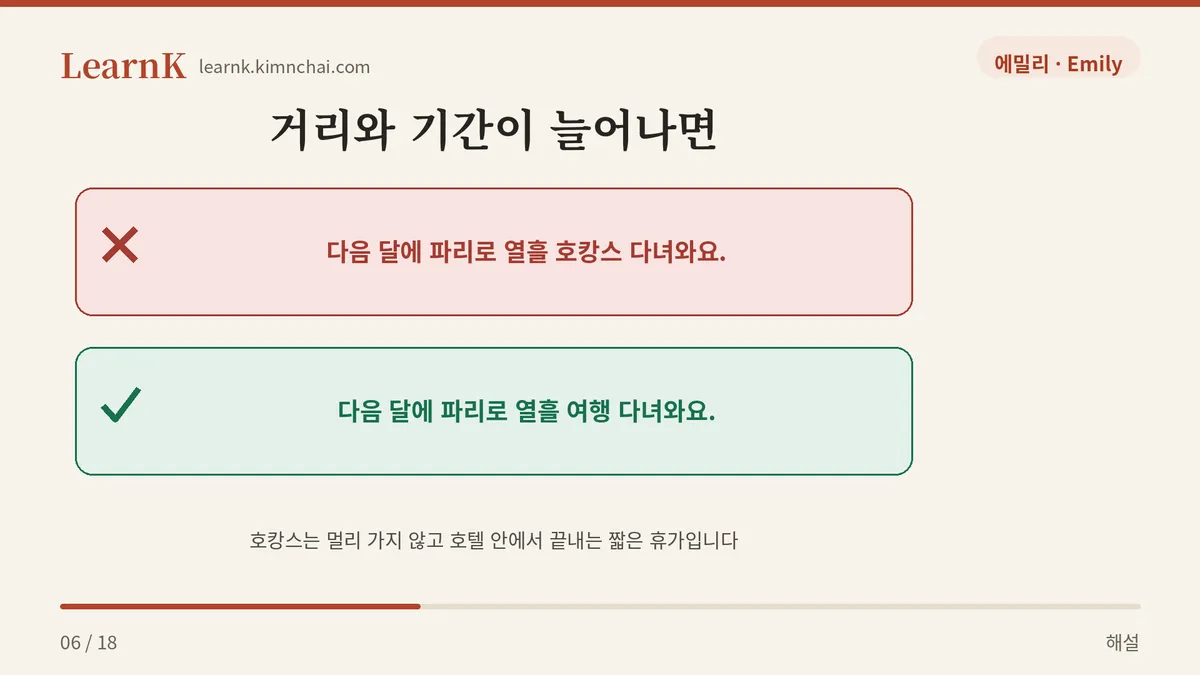
✗ 다음 달에 파리로 열흘 호캉스 다녀와요. ✓ 다음 달에 파리로 열흘 여행 다녀와요. — “I’m taking a ten-day trip to Paris next month.” → A 호캉스 (hokangseu) is a short break you finish inside a hotel without going far. Flying somewhere and touring a city for ten days is just a trip. The moment the distance and the duration stretch out, this word no longer applies.
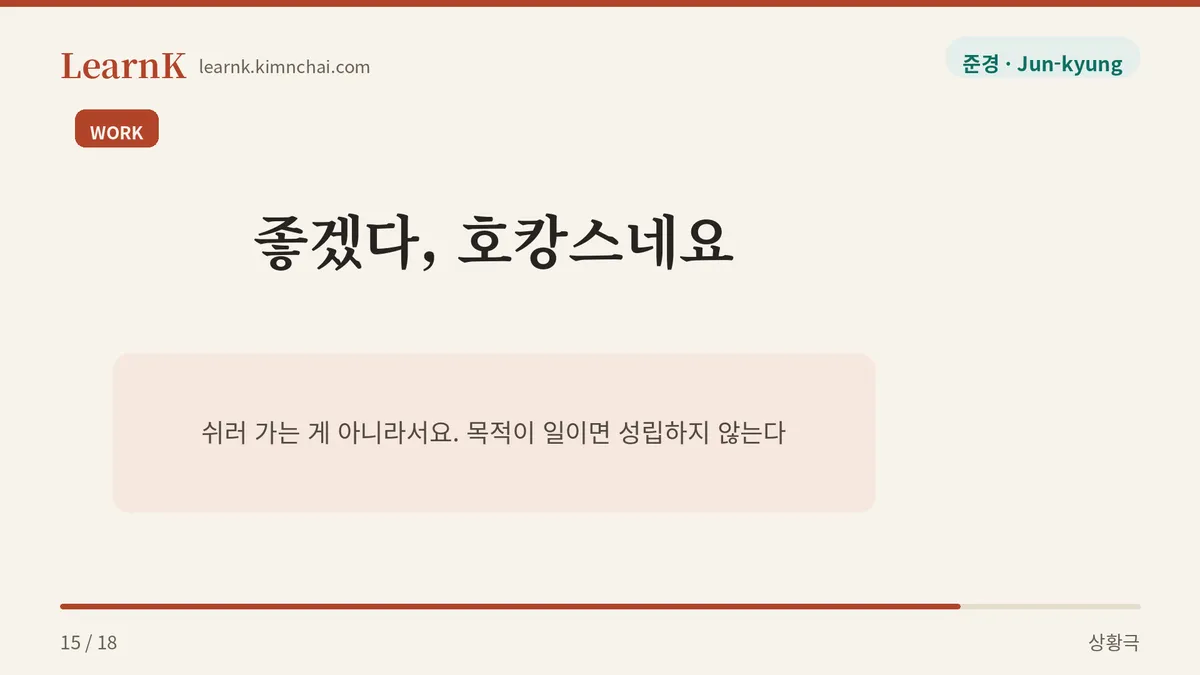
One more thing — a common misunderstanding. Staying in a hotel for a business trip is not a 호캉스 (hokangseu). 호캉스 is something you go do in order to rest, so if the purpose is work, it doesn’t qualify. If you reply to 부산 출장이라 호텔에서 자요 (Busan chuljangira hoterreseo jayo) — “I’m sleeping at a hotel because I’m on a business trip in Busan” — with 좋겠다, 호캉스네요 (jokketda, hokangseuneyo), “Lucky you, that’s a hokangseu,” the other person will laugh and correct you: 쉬러 가는 게 아니라서요 (swireo ganeun ge aniraseoyo), “It’s not a rest trip, though.”
Example Sentences by Situation
1. When a coworker asks about your summer vacation plans (polite speech)
저는 이번 여름엔 멀리 안 가고 호캉스만 하려고요. (jeoneun ibeon yeoreumen meolli an gago hokangseuman haryeogoyo.) This summer I’m not going far — I’m just going to do a hokangseu.
It’s an answer that admits your vacation plans are modest without making them sound sad. If you say 아무 데도 안 가요 (amu dedo an gayo), “I’m not going anywhere,” the conversation stops; if you say 호캉스 (hokangseu), the other person asks, “Which hotel?” Because it isn’t saying you have no plan — it’s naming what kind of plan you have.
2. Telling a friend about it after taking the kids (casual speech)
애들은 수영장에서 놀고 나는 선베드에 누워만 있었어. 이게 진짜 호캉스지. (aedeureun suyeongjangeseo nolgo naneun seonbedeue nuwoman isseosseo. ige jinjja hokangseuji.) The kids played in the pool and I just lay on a sun lounger. Now that’s a real hokangseu.
Among people raising kids, 호캉스 (hokangseu) has a very specific meaning: the time when the child plays on their own somewhere safe and the adult finally gets to sit down and let go. The -지 (-ji) at the end of the sentence is the ending of confirmation and satisfaction — “this right here is the thing.”
3. When calling a hotel to ask about a booking (polite speech)
호캉스 패키지로 2인 1박 예약할 수 있을까요? (hokangseu paekiji-ro i-in ilbak yeyakhal su isseulkkayo?) Could I book the hokangseu package for two people, one night?
In summer, Korean hotels bundle breakfast, pool access, and late checkout and sell the whole thing under the name “호캉스 패키지 (hokangseu paekiji).” It may be a coinage, but it’s official enough to be a product name, so saying this to a staff member sounds perfectly normal.
Polite vs. Casual Speech, and Similar Expressions
호캉스 (hokangseu) is a noun, so it carries no politeness level on its own. The level is set by the predicate that follows — with a friend, 호캉스 간다 (hokangseu ganda); with a coworker, 호캉스 가요 (hokangseu gayo); in a formal setting, 호캉스 다녀오겠습니다 (hokangseu danyeoogetseumnida). That third one, though, is rarely used in practice. If the setting calls for formality, it’s more natural to change the word itself.
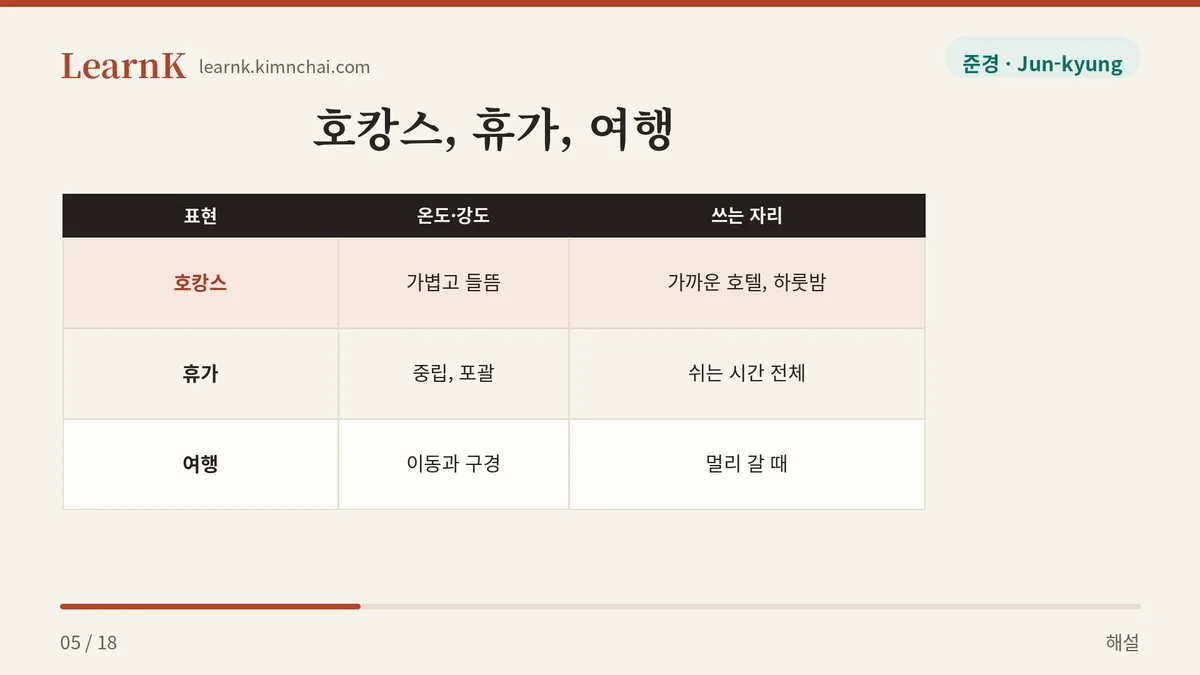
| Expression | Tone / intensity | Where it’s used |
|---|---|---|
| 호캉스 (hokangseu) | Light and giddy, a touch of bragging | Peers, social media, hotel ads. Not for formal reports or older relatives |
| 호텔에서 쉬다 (hotereseo swida) | Neutral, explanatory | Anywhere. Safe with older relatives and in official settings |
| 휴가 (hyuga) | Neutral, broad | Anywhere. Says nothing about place or length |
| 여행 (yeohaeng) | Presumes travel and sightseeing | For going far. Doesn’t suit a single hotel night |
As the table shows, 호캉스 (hokangseu) is a kind of 휴가 (hyuga), not a synonym for it. 휴가 (hyuga) refers to the time off; 호캉스 (hokangseu) refers to how you spend it. That’s why 휴가 언제야? (hyuga eonjeya?), “When’s your vacation?” works with anyone, while 호캉스 언제야? (hokangseu eonjeya?) only makes sense between people who have already decided they’re going to a hotel.
Cultural Background — The Summers Are Hot and the Leave Is Short
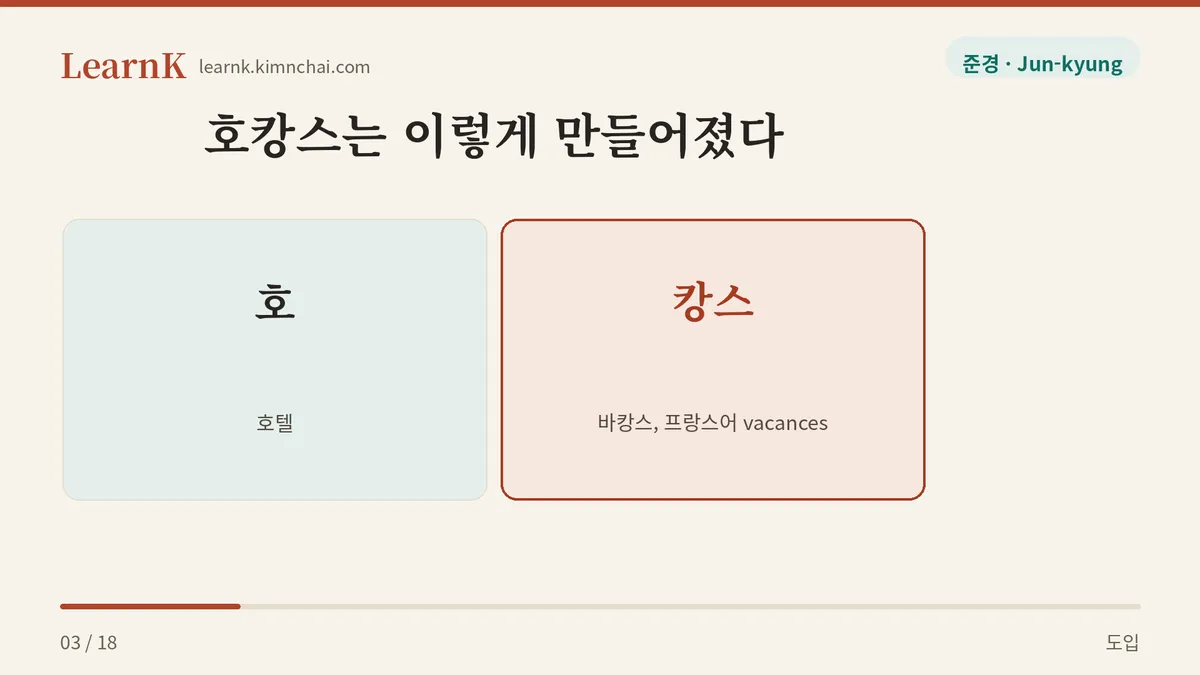
호캉스 (hokangseu) is built by joining 호 (ho), the first syllable of 호텔 (hotel), to 캉스 (kangseu), the back half of 바캉스 (bakangseu). 바캉스 (bakangseu) is a loanword from the French vacances, and it has long meant “summer vacation” in Korea. So 호캉스 (hokangseu) is basically “a vacances spent at a hotel,” compressed into three syllables. That -캉스 (-kangseu) fragment turns out to be highly productive: swap the front piece and new words keep appearing — spend the whole day at a shopping mall and it’s 몰캉스 (molkangseu); rest while doing nothing but reading and it’s 북캉스 (bukkangseu); work remotely from the hotel and it’s 워캉스 (wokangseu). It stopped being one coinage and became a machine for stamping out coinages.
Behind the word’s spread lies the reality of the Korean workplace. At many companies it’s hard to string annual leave into a long block, and in peak summer every domestic tourist spot is jammed with people and cars. On top of that, Korea in July and August is humid and hot. On a day when the afternoon high hits 35°C, more and more people choose lying in an air-conditioned room thirty minutes away by subway over driving three hours to a crowded beach. Around 2020, when overseas travel became difficult, this choice became essentially the only option, and the word 호캉스 (hokangseu) exploded in use — then stuck around afterward, out of habit.
The scene has become a cliché in Korean variety shows and dramas, too: someone sprawled across a hotel bed in a robe, eating a cup ramyeon bought at a convenience store instead of ordering room service — the contrast between booking an expensive room and eating the cheapest possible food is the joke. Drama characters worn down by work often say something like 아무 데도 안 가고 호텔에서 이틀만 자고 싶다 (amu dedo an gago hoterreseo iteulman jago sipda) — “I don’t want to go anywhere; I just want to sleep at a hotel for two days.” In the end, the feeling this expression carries is a single one: not wanting to go somewhere, but wanting to disappear from where you are for a little while.
Social media grew the word as well. The night view out the hotel window, the breakfast tray set on the bed, the sky reflected in the pool water — a 호캉스 (hokangseu) is a vacation that photographs well. So hotels now sell “photogenic rooms” as a product outright. It’s a rare case of a single expression reshaping the form of consumption itself.
Today’s Quiz
Which of the following would be hard to call a 호캉스 (hokangseu)?
- Checking into a downtown hotel on Saturday afternoon, playing in the pool, and leaving Sunday midday.
- Going to a resort in Gangwon-do for a company workshop, sitting in meetings for two days, and coming back.
- For a wedding anniversary, a couple spending one night at a hotel forty minutes from home by car and having breakfast there.
Answer: 2
Simply having stayed at a hotel or resort doesn’t make it a 호캉스 (hokangseu). In number 2, the purpose is work, not rest, and it isn’t time you chose for yourself. A 호캉스 (hokangseu) has to contain all three: to rest, on my own terms, briefly. Numbers 1 and 3 are both close by and clearly for rest, so both count. For the record, if you want to talk about a situation like number 2, you’d just say 워크숍 다녀왔어요 (weokeusyop danyeowasseoyo), “I went to a workshop” — and if you stayed on alone for one extra day after the meetings ended, that one day can absolutely be called a 호캉스 (hokangseu).
Definitions and example sentences are from the National Institute of Korean Language’s Basic Korean Dictionary (krdict.korean.go.kr); that portion of this post, including our translations, is licensed under CC BY-SA 2.0 KR.