회빙환 (hoebinghwan) — Regression, Possession, Reincarnation: Stories About Living Life Over Again
회빙환
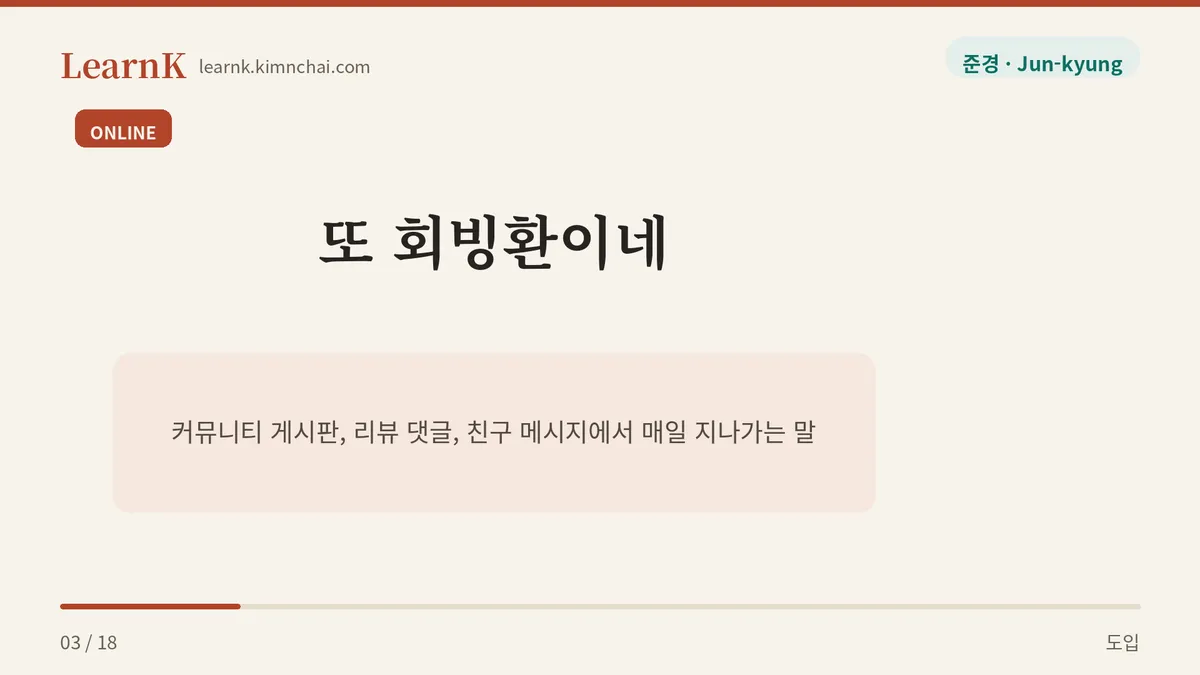
회빙환 (hoebinghwan) is a single word that bundles three others together — 회귀 (hoegwi, regression), 빙의 (bingui, possession), and 환생 (hwansaeng, reincarnation). It covers any story device in which the main character dies or fails catastrophically and then gets to live life over from the very beginning. If you keep up with Korean dramas or webtoons, this word is almost impossible to dodge these days. On community boards, in review comments, in the messages you trade with friends — “또 회빙환이네” (“another hoebinghwan story”) scrolls past you several times a day. You won’t find it in a Korean dictionary, and yet every Korean knows exactly what it means. Words like this are the very center of the real Korean that lives outside the textbook.
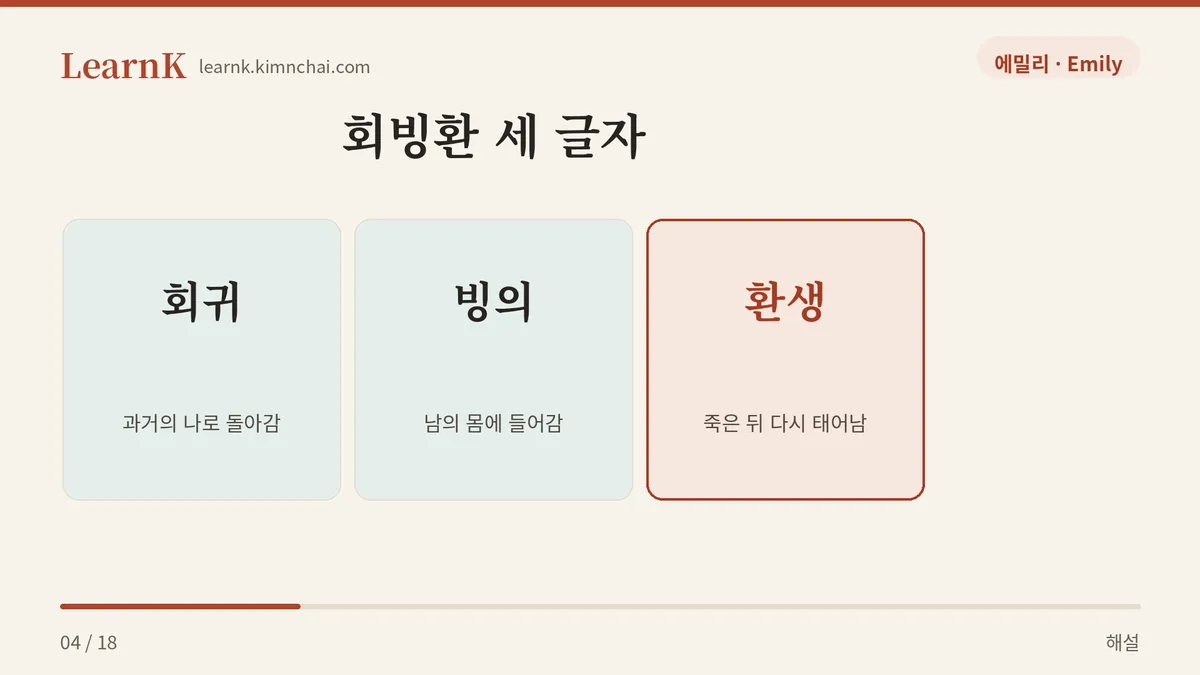
Pull the three syllables apart and the meaning comes into focus.
회귀 (hoegwi) is “returning.” At the moment the main character dies or their life collapses, they go back to their own younger self. The body and the name are the same; only the memories belong to the future. Picture being twenty years old again while carrying the memories of a forty-year-old.
빙의 (bingui) is “entering.” Your mind moves into someone else’s body. The stories where you wake up as a side character in the novel you were reading belong to this branch. Since the body has changed, the name, the family, and the bank balance are all somebody else’s too.
환생 (hwansaeng) is “being born again.” After you die, you start a whole new life as a newborn baby. Unlike 회귀 (hoegwi), time flows forward; unlike 빙의 (bingui), the body is your own from the start.
All three share one thing: a second chance. That’s exactly why readers went to the trouble of bundling them into one word. The temperature of the word, on the other hand, is fairly light. It isn’t academic or broadcast vocabulary — it’s closer to a genre term readers and viewers coined for use among themselves. So it feels natural between friends or online, but out of place in a report or a news article.
Seeing It in Real Conversation
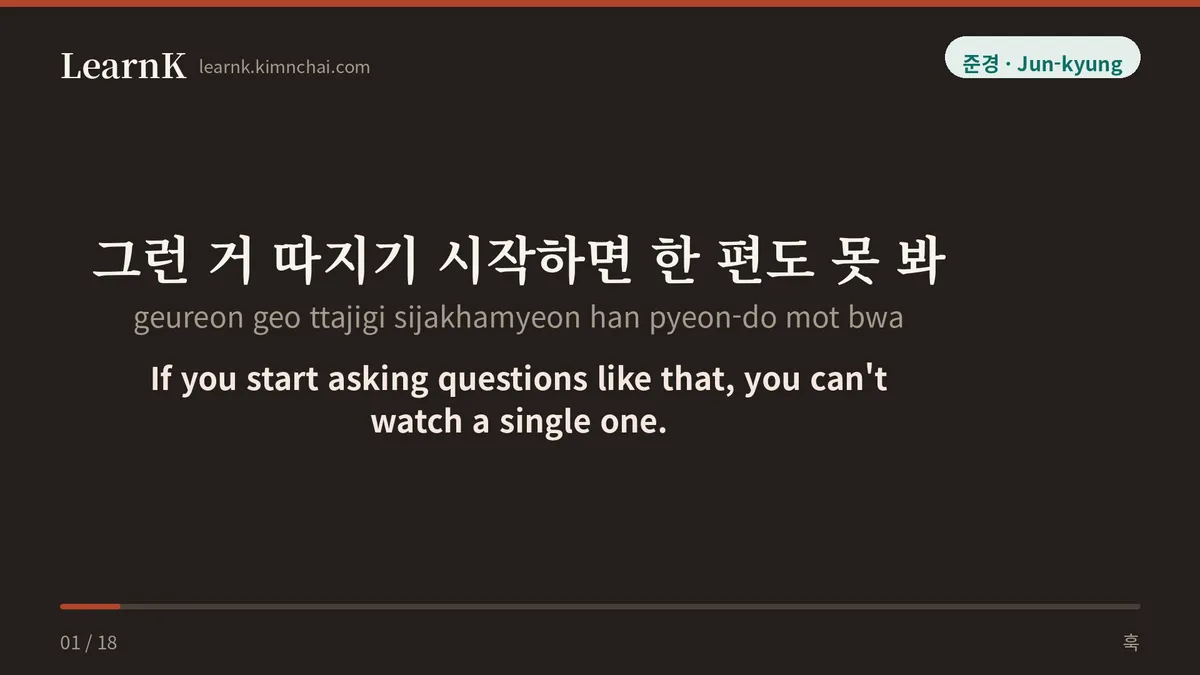
Setting: The subway home on a Friday evening. The two of them have just barely gotten seats and are each looking at their phones.
Jun-kyung: 뭐 봐? 아까부터 화면을 안 넘기네. What are you reading? You haven’t scrolled this whole time.
Emily: 웹소설. 근데 이것도 또 회빙환이야. 이번 주에만 세 편째. A web novel. But this one’s another hoebinghwan story too. Third one just this week.
Jun-kyung: ㅋㅋ 요즘은 그거 아니면 잘 안 팔린대. Haha, apparently nothing else sells these days.
Emily: 회귀는 그렇다 쳐. 근데 빙의는 좀 이상하지 않아? 남의 몸에 들어갔는데 카드 비밀번호를 어떻게 알아? Regression I can accept. But possession is weird, right? You wake up in someone else’s body — how do you know their PIN?
Jun-kyung: 야, 그런 거 따지기 시작하면 회빙환은 한 편도 못 봐. Hey, if you start asking questions like that you can’t watch a single hoebinghwan story.
Emily: 하긴. 그냥 봐야겠다. Fair enough. I’ll just keep reading.
Using It This Way Sounds Off
✗ (in materials for a planning meeting) 본 작품은 회빙환 구조를 채택하였습니다. ✓ (in materials for a planning meeting) 본 작품은 회귀·빙의·환생 서사 구조를 채택하였습니다. → “This work adopts a 회귀·빙의·환생 (hoegwi·bingui·hwansaeng) narrative structure.” Because readers made the short form up themselves, it sounds like slang in a formal document. In official settings, spelling out all three words is the safe choice.
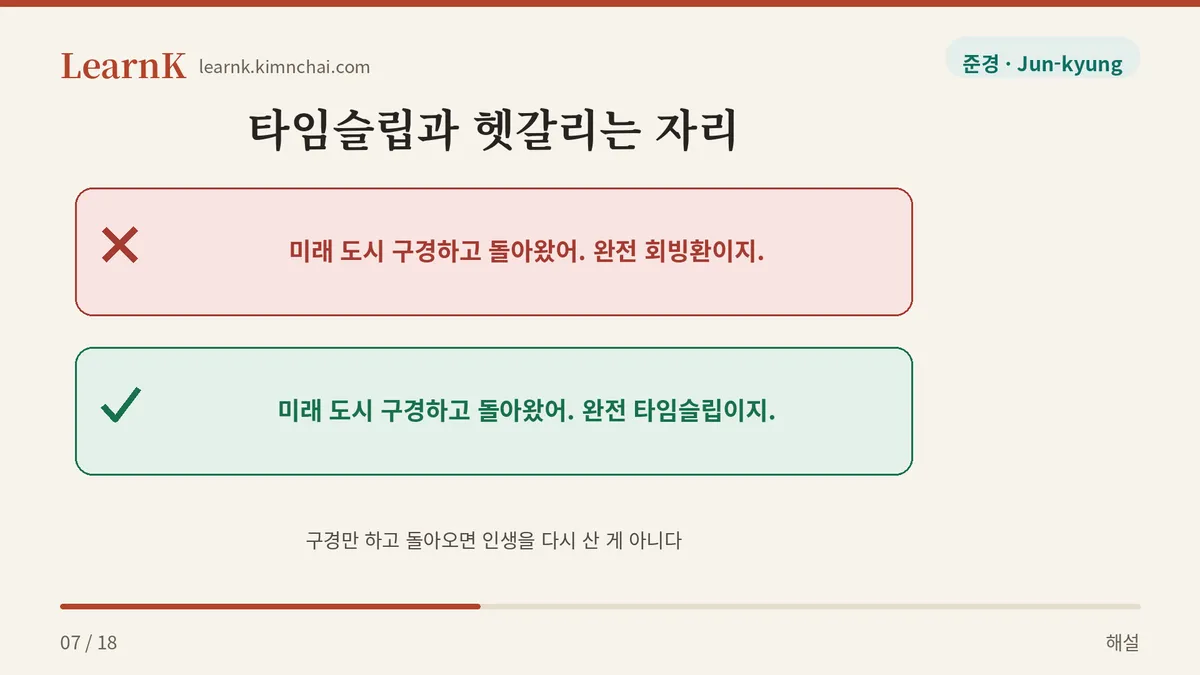
✗ 주인공이 미래 도시로 갔다가 원래 시대로 돌아오는 이야기야. 완전 회빙환이지. ✓ 주인공이 미래 도시로 갔다가 원래 시대로 돌아오는 이야기야. 완전 타임슬립이지. → “It’s a story where the main character goes to a future city and then comes back to their own era. Total 타임슬립 (taimseullip, time slip).” This is a common misunderstanding. Not everything involving time travel is 회빙환 (hoebinghwan). The key isn’t the travel — it’s living your own life over again. If they only sightsee and come home, that’s a time slip.
Example Sentences by Situation
① Picking a weekend drama with a friend
요즘 볼 만한 거 없어? 회빙환 말고. (yojeum bol manhan geo eopseo? hoebinghwan malgo.) Anything good to watch these days? Something that isn’t a hoebinghwan story.
This means you’ve seen so many that you’re sick of them. The line doesn’t carry “that genre is bad” so much as the fatigue of “it’s everywhere.”
② Explaining your taste at a book club (polite speech)
제가 회빙환을 좋아하는 이유는 인생을 한 번 더 살아 보는 상상 때문이에요. (jega hoebinghwan-eul joahaneun iyuneun insaeng-eul han beon deo sara boneun sangsang ttaemun-ieyo.) The reason I like hoebinghwan stories is the fantasy of getting to live life one more time.
You’re among people you’ve just met, so the sentence takes polite endings — but the word itself stays as is. In a setting where everyone is talking about their hobbies, it sounds perfectly natural.
③ Leaving a one-line review after finishing a drama
뻔한 회빙환 클리셰인데도 끝까지 다 봤다. (ppeonhan hoebinghwan keullisye-inde-do kkeutkkaji da watda.) It’s the same old hoebinghwan cliché, but I still watched it to the end.
Putting “뻔하다” (ppeonhada, it’s predictable) right next to “끝까지 봤다” (kkeutkkaji watda, I watched it all the way through) is a very typical form of praise in Korean online reviews. You pretend to complain while actually saying you enjoyed it.
Polite vs. Casual Speech, and Similar Expressions
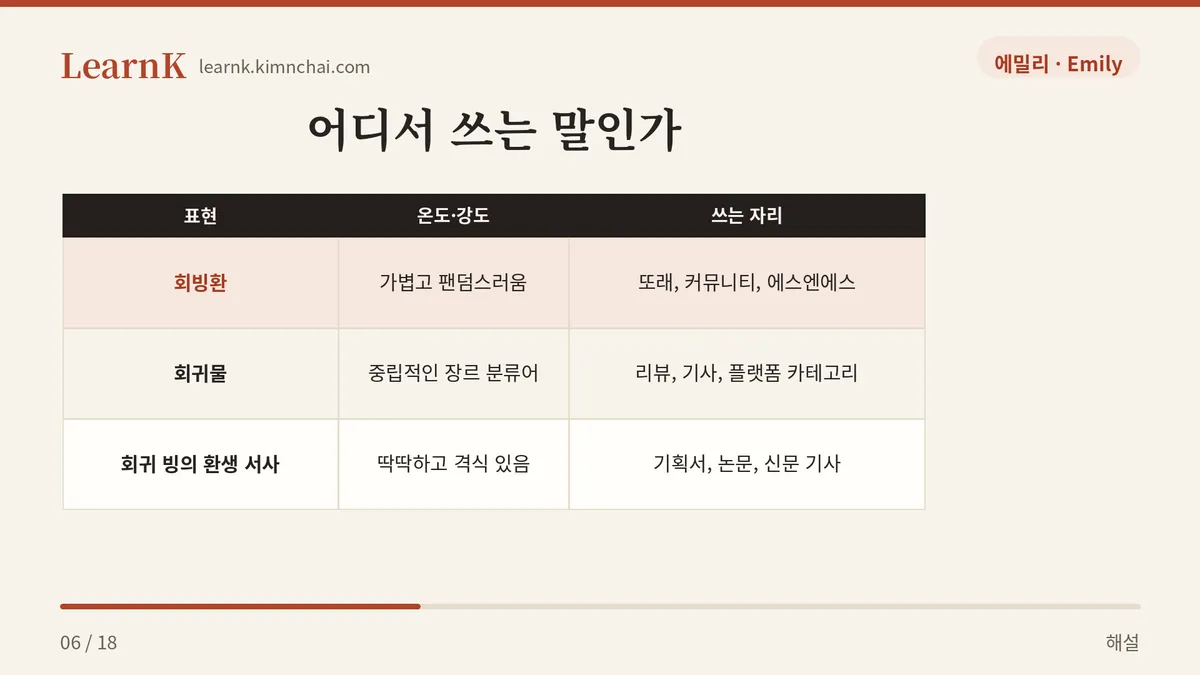
회빙환 (hoebinghwan) is a noun, so it carries no politeness level of its own. That’s decided by how you end the sentence. Casually it’s “이거 회빙환이야”, politely it’s “이거 회빙환이에요”, and if you want a bit more formality it becomes “회빙환물입니다” (“it’s a hoebinghwan-genre work”). What sets this word’s temperature isn’t the speech level but where you use it.
| Expression | Temperature / intensity | Where it’s used |
|---|---|---|
| 회빙환 (hoebinghwan) | Light, fandom-flavored | Among peers, in communities, on social media. Never in official documents |
| 회귀물 (hoegwimul) | Neutral genre label | Reviews, articles, platform categories — anywhere |
| 회귀·빙의·환생 서사 (hoegwi·bingui·hwansaeng seosa) | Stiff and formal | Proposals, academic papers, newspaper articles |
| 타임슬립 (taimseullip) | Neutral loanword | Time travel in general. A different thing from hoebinghwan |
As the table shows, the very same story has to change clothes: “회빙환이야” for a friend, “회귀 서사입니다” (hoegwi seosa-imnida, “it’s a regression narrative”) in a meeting. In Korean, choosing a word means choosing a meaning — and choosing a setting.
Cultural Background — On the Moments We Wish We Could Live Again
The way the word was built is simple: take the first syllable of each of 회귀, 빙의, and 환생 and stick them together. It’s an extremely common Korean shortening pattern, the same one behind 소확행 (sohwakhaeng, “small but certain happiness”). The term took hold among web novel and webtoon readers from the late 2010s, and by now it has crossed over into how people talk about dramas.
What’s interesting is that the three words come from completely different places. 빙의 (bingui) originally belonged to shamanic and religious vocabulary, meaning a spirit taking hold of a person. 환생 (hwansaeng) comes from the Buddhist concept of the cycle of rebirth, referring to being reborn as another living being after death. So two heavy religious terms and one ordinary Sino-Korean word got bundled into a genre label and turned into something breezy.
Why did this genre grow so large in Korea in particular? People often say it’s because this is a society with unusually sharp “moments I wish I could take back.” The day you sat the college entrance exam, the day you started your first job, the day you didn’t reach out to that one person — when life’s forks are compressed into a handful of tests and a handful of choices, the fantasy of “if I could go back to then” is always close at hand. 회빙환 (hoebinghwan) gives that fantasy the body of a story.
In dramas, the structure goes back a long way. In Secret Garden (시크릿 가든, SBS, 2010), the setup where the two leads’ souls swap bodies is often cited as the popular prototype for possession stories, and Marry My Husband (내 남편과 결혼해줘, tvN, 2024) was widely loved for its regression structure, in which the heroine goes back to the past at the brink of death and lives her life over. In a little over a decade, this device went from an unusual premise to a piece of grammar.
So when a Korean says “또 회빙환이네” (“another hoebinghwan story”), it’s worth watching their face. It sounds like they’re bored — but usually it’s the face of someone who says they’re bored and keeps watching anyway.
Today’s Quiz
Which of the following is not a 회빙환 (hoebinghwan) story?
- A main character who gets fired from their company opens their eyes and finds they’ve gone back to being a twenty-year-old college freshman.
- A main character who dies in a car accident is reborn as a baby in a different family and lives a new life.
- A main character time-travels to a future city, looks around, and returns safely to their own era.
See the answer
Answer: 3
Number 3 does involve moving through time, but the character isn’t living their own life over — they just went for a visit, which makes it a 타임슬립 (taimseullip, time slip). Number 1 is 회귀 (hoegwi), and number 2 is 환생 (hwansaeng). Remember that the core of 회빙환 (hoebinghwan) isn’t “time travel” but “living life over again.”