회귀 (hoegwi) — Why Do Drama Leads Keep Going Back to the Past?
회귀 (hoegwi)
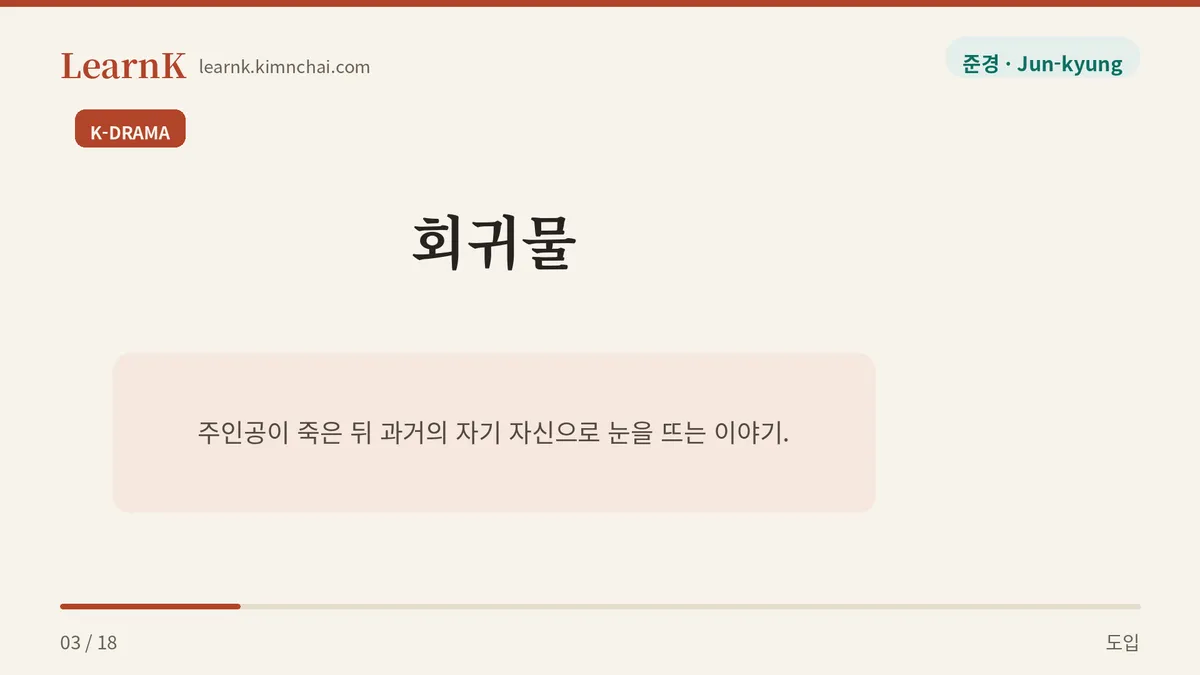
회귀 (hoegwi) means going all the way around and arriving back where you started. Watch Korean dramas these days and there is no avoiding this word. The lead dies unfairly, opens their eyes, and is lying on their own bed ten years in the past — in Korea, this kind of story has a genre name all its own: 회귀물 (hoegwimul). Subtitles usually render it as time regression or going back in time, but the word was never reserved for time travel. Salmon returning to the river where they were born is 회귀 (hoegwi). The earth circling the sun once and arriving back at the same spot is 회귀 (hoegwi) too.
The heart of this word is that one full lap. It is not simply turning around and heading back — the picture is of completing an entire orbit and touching the starting point again. That is why 회귀 (hoegwi) always drags time and distance along with it. You would not use it for running to the convenience store and coming back five minutes later.
The second thing to know is the temperature. 회귀 (hoegwi) is a Sino-Korean word, and a written-register one. It lives in news reports, research papers, documentary narration, and genre labels. Text a friend on KakaoTalk that you are about to 회귀하다 (hoegwi-hada) and it reads as a joke.
The third thing is nuance. When it is used about time, 회귀 (hoegwi) often takes on a negative tint. When 과거로의 회귀 (gwageo-ro-ui hoegwi), a regression to the past, appears in a newspaper, it is almost never praise — it is criticism, because something that should have moved forward has gone backward instead. Attach it to nature or to roots, though — the 회귀 (hoegwi) of salmon, 회귀 (hoegwi) to one’s hometown — and it turns warm. Same word; what is doing the returning flips the temperature.
Checking it in the National Institute of Korean Language dictionary
회귀 (hoegwi) 「noun」 한 바퀴를 돌아 제자리로 돌아오거나 돌아감. [en] return; regression — An act of going or coming back to where one is after going around. [ja] かいき【回帰】 — 一回りして元の位置や状態に戻ったり、それを繰り返したりすること。 [es] regreso — Acción ir o volver al lugar donde uno estaba antes de emprender el viaje. [zh] 回归,返回 — 转一圈后回到原位。 — National Institute of Korean Language, Basic Korean Dictionary (krdict.korean.go.kr)
The dictionary carries no Portuguese gloss. For reference, our own rendering would be something like [pt] regresso, retorno — that single line is our translation, not dictionary material.
Below are real usage examples exactly as the dictionary lists them, each with a note on the kind of place that sentence comes from.
극우파 세력들은 과거의 전통과 영광을 강조하면서 국가가 강력한 권력을 가졌던 시절로 회귀해야 한다고 주장했다. Far-right factions emphasized the traditions and glories of the past and argued that the nation must regress to the era when it held overwhelming power. — National Institute of Korean Language, Basic Korean Dictionary (krdict.korean.go.kr)
This is the kind of sentence you would find on the politics page of a newspaper or in a current-affairs book. It is the usage where the negative nuance mentioned above shows up most clearly. What is regressing here is not a person but the condition of a country, and the writer plainly does not think well of that backward step.
연구원들의 조사에 의하면 이 강에 방류된 연어들 중 많은 수가 다시 회귀한 것으로 밝혀졌다. According to the researchers’ survey, it was found that a large number of the salmon released into this river had returned. — National Institute of Korean Language, Basic Korean Dictionary (krdict.korean.go.kr)
This time it is the 회귀 (hoegwi) of nature documentaries and science articles. In Korean textbooks, salmon and 회귀 (hoegwi) travel together as practically one unit. That trajectory — heading out to sea, circling for years, then coming back precisely to the river of one’s birth — is the archetype of the one full lap this word draws.
절을 지나서 산꼭대기까지 갔다가 다시 출발점으로 회귀를 할 거야. We will pass the temple, go all the way up to the peak, and then loop back to the starting point. — National Institute of Korean Language, Basic Korean Dictionary (krdict.korean.go.kr)
A rare spoken-style example. Someone is explaining a hiking course, and the word holds up because it is a several-hour round trip that returns to its own starting point. The reason it does not feel awkward despite the casual speech is that the condition — one full lap back to where you began — fits exactly.
과거로의 회귀. 고향으로의 회귀. A regression to the past. / A return to one’s hometown. — National Institute of Korean Language, Basic Korean Dictionary (krdict.korean.go.kr)
These are the short phrases the dictionary lists alongside the definition. Set the two side by side and the difference in nuance is right there on the surface. The first is usually criticism; the second is usually longing. Whatever you place in front of 회귀 (hoegwi) sets the temperature of the sentence.
Seeing it in a real conversation
The scene: 1 a.m., the living room of Jun-kyung’s apartment. The closing credits have just rolled on the final episode of a regression drama they have been binge-watching for twelve hours straight.
에밀리: 아 뭐야, 결국 또 처음으로 돌아가는 거야? What? So it just goes back to the beginning again?
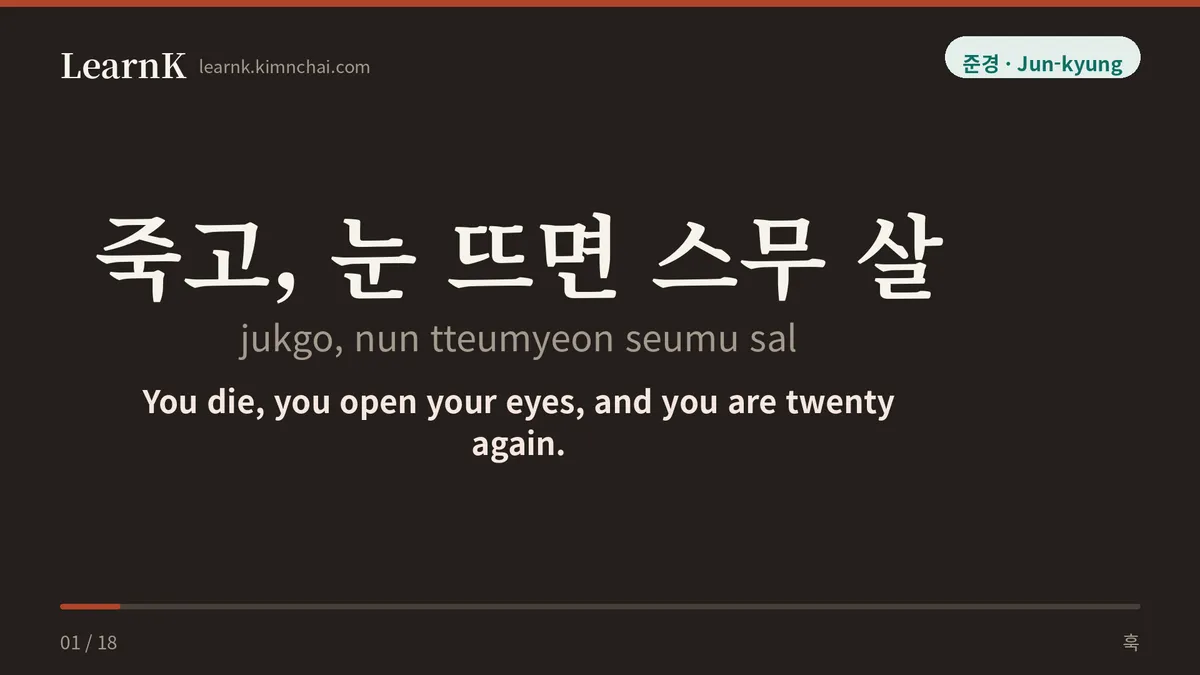
준경: 그게 회귀물 국룰이잖아. 죽고, 눈 뜨면 스무 살. That is the standard rule of the regression genre. You die, you open your eyes, and you are twenty again.
에밀리: 근데 난 좀 부럽더라. 나도 한국 처음 왔던 그때로 회귀하고 싶어. Honestly though, I envy it. I want to go back to when I first came to Korea.
준경: 진짜? 돌아가면 뭐 다르게 할 건데? Really? What would you do differently if you went back?
에밀리: 음… 생각해 보니까 똑같이 살 것 같은데. Hmm… now that I think about it, I would probably live exactly the same.
준경: 봐, 그래서 주인공들도 회귀하고 더 고생하는 거야. See? That is exactly why the leads suffer even more after they regress.
This is where it sounds off
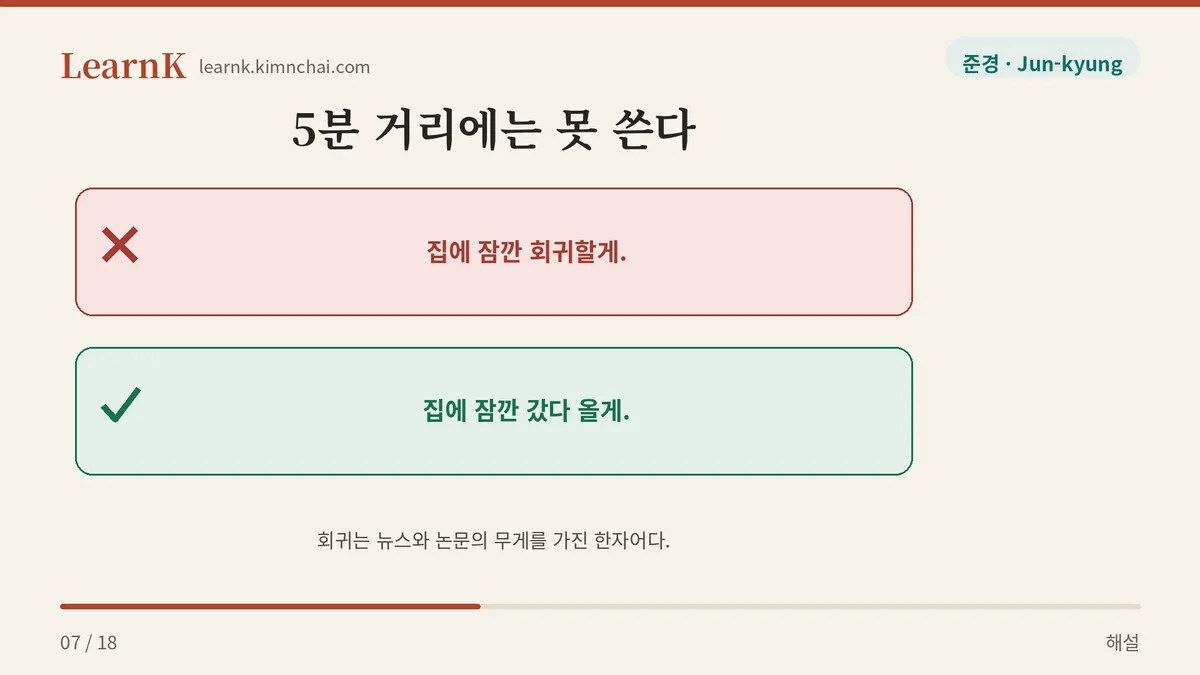
✗ (to a friend, outside a convenience store) 나 지갑 놓고 왔다. 집에 잠깐 회귀할게. I left my wallet behind. I shall briefly regress to my residence. ✓ (to a friend) 나 지갑 놓고 왔다. 집에 잠깐 갔다 올게. I left my wallet behind. I will just run home and be right back. → 회귀 (hoegwi) is a Sino-Korean word with the weight of news reports and academic papers. Load it onto a five-minute round trip and it does not sound serious — it sounds like you are trying to be funny.
✗ (to a friend you have not seen in ages) 우리 사이, 예전으로 회귀하자. Let us regress our relationship to its former state. ✓ (to a friend you have not seen in ages) 우리 예전처럼 지내자. Let us be like we used to be. → 회귀 (hoegwi) is for big things going backward: eras, systems, conditions. Aim it at feelings between two people and it sounds less like making up and more like reading out a contract clause — cold.
Example sentences by situation
1. In a fashion magazine article — the classic sentence for when trends have come full circle and an old style is back. There is no negative nuance here.
올해 흐름은 90년대 감성으로의 회귀다. (Olhae heureum-eun gusip-nyeondae gamseong-euro-ui hoegwi-da.) This year’s trend is a return to nineties sensibility.
2. As a two-hour meeting winds down — every agenda item has been circled, and the conclusion has landed right back where it started. Because the setting is formal, the Sino-Korean word actually sounds natural.
논의가 다시 원점으로 회귀했습니다. (Nonui-ga dasi wonjeom-euro hoegwi-haetseumnida.) The discussion has returned to square one.
3. Trading drama opinions with a friend — 회귀 (hoegwi) on its own is stiff, but once it hardens into genre vocabulary like 회귀물 (hoegwimul) or 회귀 설정 (hoegwi seoljeong), it survives perfectly well in casual spoken Korean. This is the usage learners will run into most often.
이 드라마 회귀 설정이 좀 억지스럽지 않아? (I deurama hoegwi seoljeong-i jom eokjiseureopji ana?) Isn’t the regression premise in this drama a bit of a stretch?
Polite and casual forms, plus similar expressions
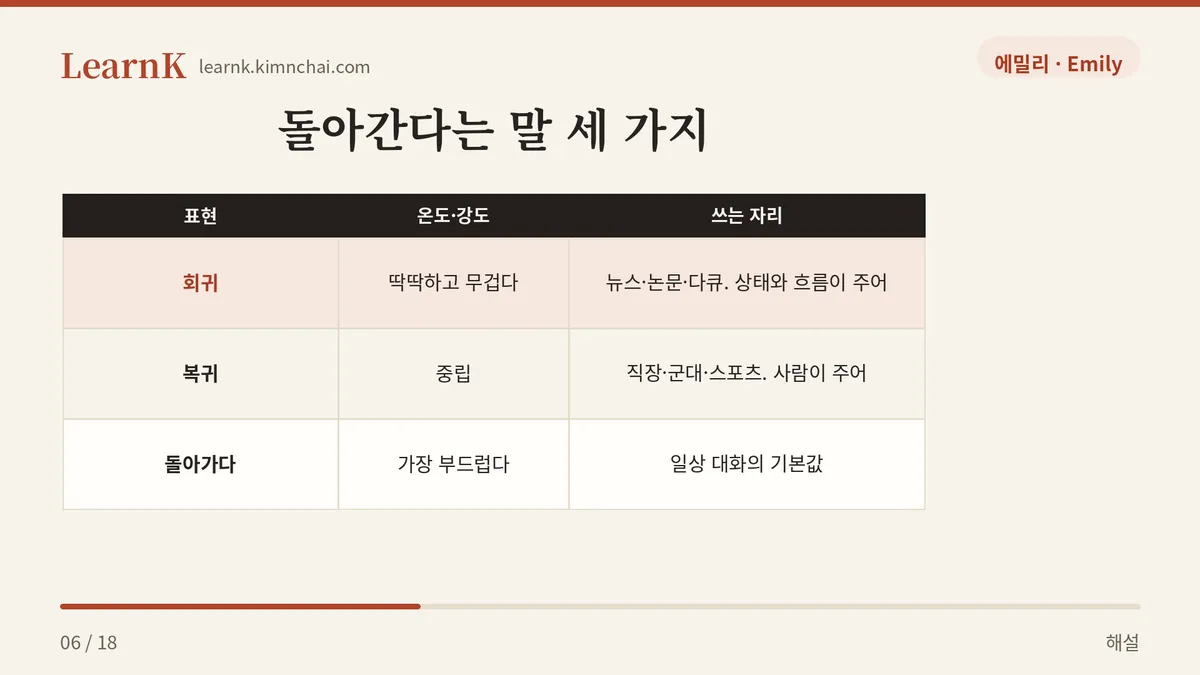
In polite speech it becomes 회귀했습니다 (hoegwi-haetseumnida), and in casual speech 회귀했어 (hoegwi-haesseo). That said, the casual verb form is almost never used in practice; among friends you can assume it shows up only as a noun chunk, like 회귀물 (hoegwimul).
| Expression | Temperature and intensity | Where it lives |
|---|---|---|
| 회귀 (hoegwi) | Stiff and heavy. Attached to time, it carries a critical edge | News, papers, documentaries. Also as a drama genre name |
| 복귀 (bokgwi) | Neutral. States only the fact of returning to one’s original place | Work, the military, sports: 현업 복귀, 부상 복귀 |
| 귀환 (gwihwan) | Dramatic, epic | 무사 귀환, 영웅의 귀환. News headlines and fantasy |
| 돌아가다 (doraga-da) | Completely neutral, the softest of all | Anywhere. The default for everyday conversation |
Many learners mix up 회귀 (hoegwi) and 복귀 (bokgwi). 복귀 (bokgwi) is stepping back into your own position, so its subject is usually a person; 회귀 (hoegwi) is a state or a current flowing back to its original point, so its subject is usually an abstract noun. An athlete rejoining a team is 복귀 (bokgwi); a clock running backward is 회귀 (hoegwi).
Cultural background — the fantasy of one more try
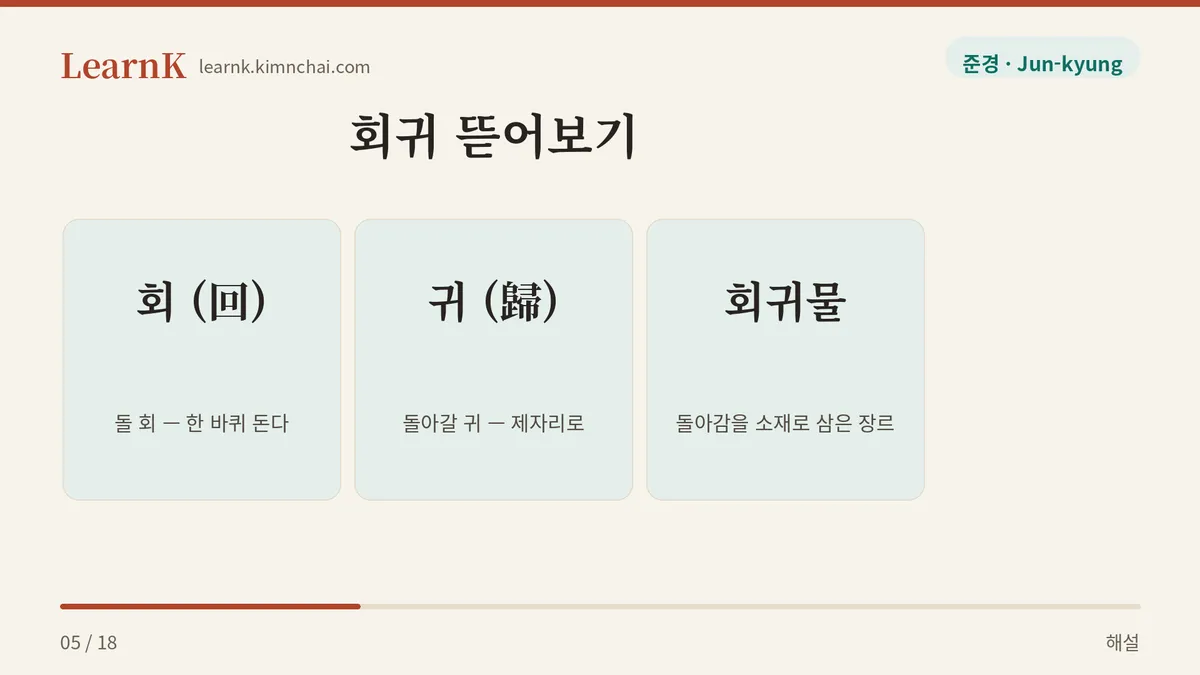
Look at the Chinese characters and you can see why this word feels so round. 회(回) means to turn, and 귀(歸) means to go back. Both characters mean returning, so the word simply stacks them. The year it takes the earth to circle the sun and arrive back in place is called 회귀년 (hoegwinyeon, 回歸年), the tropical year, and the Tropic of Cancer and Tropic of Capricorn drawn on world maps — 북회귀선 (bukhoegwiseon) and 남회귀선 (namhoegwiseon) — use the same characters, because the sun climbs to that latitude and then turns back down.
In the 2020s, this word took on an entirely new life. 회귀물 (hoegwimul) started in web novels and crossed over into television, and in the process 회귀 (hoegwi) became both a dictionary entry and a piece of genre slang that twenty-year-old viewers use every day. The show most often named as the flagship example, 《재벌집 막내아들》 (Reborn Rich, JTBC, 2022), is about a secretary who spends his life cleaning up after a chaebol family, dies, is reborn as the youngest grandson of that same family, and lives the future he already knows all over again from the start. Online, these premises get bundled together as 회빙환 (hoebinghwan) — 회귀 (hoegwi, regression), 빙의 (bing-ui, possession), and 환생 (hwansaeng, reincarnation).
Why did this genre explode so spectacularly in Korea in particular? The explanation you hear most often is that there is a widely shared sense that a single college entrance exam, a single job hunt, a single first workplace can hold your life in its grip for a very long time afterward. People who know there is no rewind button watch stories about rewinding. That is why the hero of a regression story does not gain superpowers — they just get to live once more, and even that looks like the biggest wish in the world.
Meanwhile, on the politics pages, the very same word still carries the opposite weight. Writing that some institution has 회귀했다 (hoegwi-haetda) — regressed to the past — is not a diagnosis but a verdict. A word that makes your heart flutter in a drama turns chilly in an article. Know that drop in temperature and you can watch Korean news and Korean variety shows on the same day without getting confused.
Today’s quiz
Which of the following is the most natural place to use 회귀?
- (to a friend) 나 편의점 갔다가 5분 뒤에 ____할게.
- (a news anchor) 물가가 다시 작년 수준으로 ____했습니다.
- (on the phone with your mom) 엄마, 나 이제 집에 ____해.
The answer is number 2. 회귀 (hoegwi) belongs to the written register of news and research papers, and it suits a large current that goes all the way around and touches its original point again. Numbers 1 and 3 involve short distances and comfortable settings, so 갔다 올게 (gatda olge) and 들어가 (deureoga) are what sound natural. If you picked number 3, you already understand the meaning exactly — now you just need to match the temperature.
Definitions and example sentences are from the National Institute of Korean Language’s Basic Korean Dictionary (krdict.korean.go.kr); that portion of this post, including our translations, is licensed under CC BY-SA 2.0 KR.