혹시 (hoksi), That One Little Word — Korean's First Step Toward Bringing Something Up Gently
혹시
Spend even a single day in Korea and you’ll hear this word dozens of times. “혹시 시간 괜찮으세요?” (Do you have a moment, by any chance?), “혹시 여기 자리 있나요?” (Is this seat taken, by any chance?), “혹시 지금 통화 괜찮아?” (Can you talk right now, by any chance?) — whether it’s a request or a question, Korean speakers love to slip the single word 혹시 (hoksi) onto the very front of a sentence before they get started. When you’re not certain but want to check carefully, when you want to bring something up without putting pressure on the other person, these two syllables sit up front like a cushion.
Meaning and Nuance
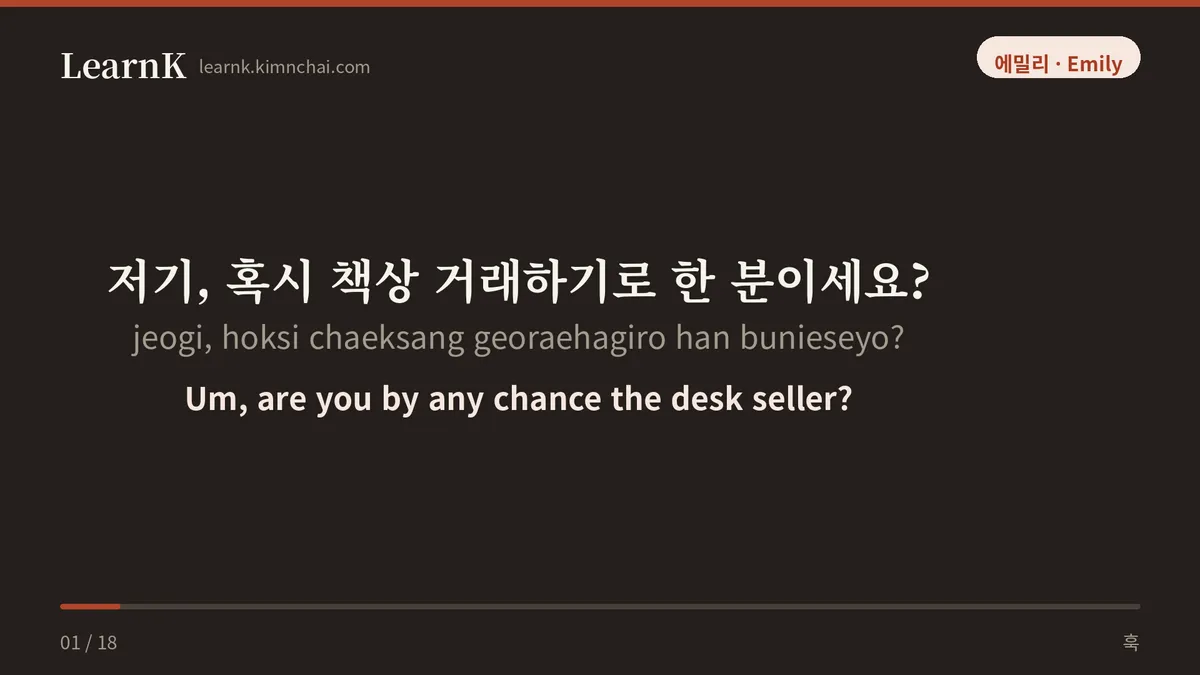
The heart of 혹시 is not stating things as fact. It’s close to English “by any chance,” but in actual use it’s far broader and softer than that. It splits roughly into three strands.
- ① A careful question or request: as in “혹시 이거 도와줄 수 있어?” (Could you help me with this, by any chance?), it lays the groundwork ahead of time that it’s okay to say no. This is the most common use.
- ② A hypothetical “just in case”: as in “혹시 비가 오면 우산 챙겨.” (In case it rains, grab an umbrella.), it means “it probably won’t happen, but just in case.”
- ③ Confirming a guess: as in “혹시… 저 아세요?” (Do you… happen to know me?), it’s used to gently ask about something you already suspect.
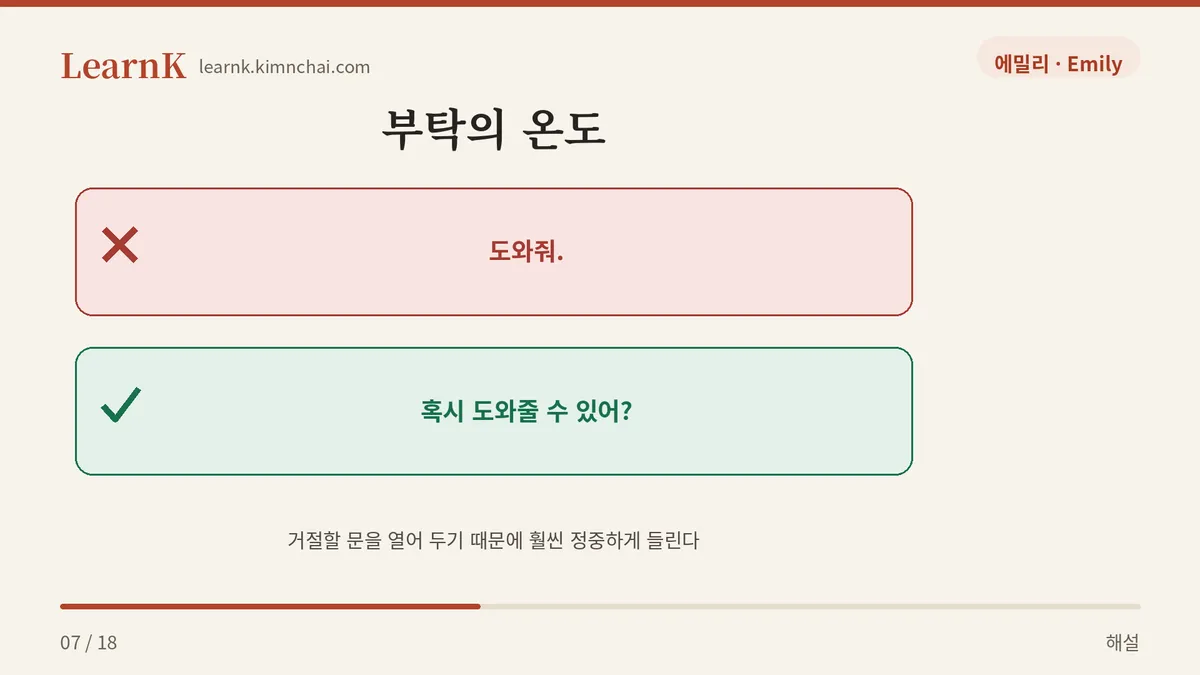
In terms of tone, 혹시 is a signal of humility and consideration. The very same request sounds far more polite as “혹시 도와줄 수 있어?” (Could you help me, by any chance?) than as a flat “도와줘” (Help me). That’s because it leaves the door open for the other person to answer “안 돼” (No, I can’t).
Checking the National Institute of Korean Language Dictionary
The National Institute of Korean Language’s Basic Korean Dictionary explains 혹시 with four meanings.
혹시 (adverb)
- It’s unlikely, but just in case. (by any chance)
- By some chance, accidentally. (accidentally)
- As guessed, perhaps. (maybe)
- A word used when you think something is so but aren’t sure, and hesitate to say it. (by any chance) — National Institute of Korean Language, Basic Korean Dictionary (krdict.korean.go.kr)
Shall we also look at the real example sentences the dictionary provides?
- 이번 주 토요일에 혹시 시간 괜찮으면 영화 보러 안 갈래?
- 혹시 내 과제 좀 도와줄 수 있니?
- 언니, 혹시 도서관이 몇 시에 개관하는지 알아?
- 선생님, 강아지가 몸을 심하게 긁어요. 혹시 피부에 문제가 있을까요?
- 혹시 운동화같이 편한 구두는 없나요? — National Institute of Korean Language, Basic Korean Dictionary (krdict.korean.go.kr)
The first sentence is a scene of gently asking someone out on a date. Paired with “괜찮으면” (if it’s okay with you), it lets the other person turn it down without any pressure. The second is bringing up a favor with a friend, and the third softens a question by attaching it to the front when asking for information. The fourth is carefully voicing a worry to a vet, and the fifth is a scene of asking a shop clerk about an item. All five sentences would still make sense without 혹시, but the moment it’s attached, the words become that much more polite and careful.
Seeing It in Real Conversation
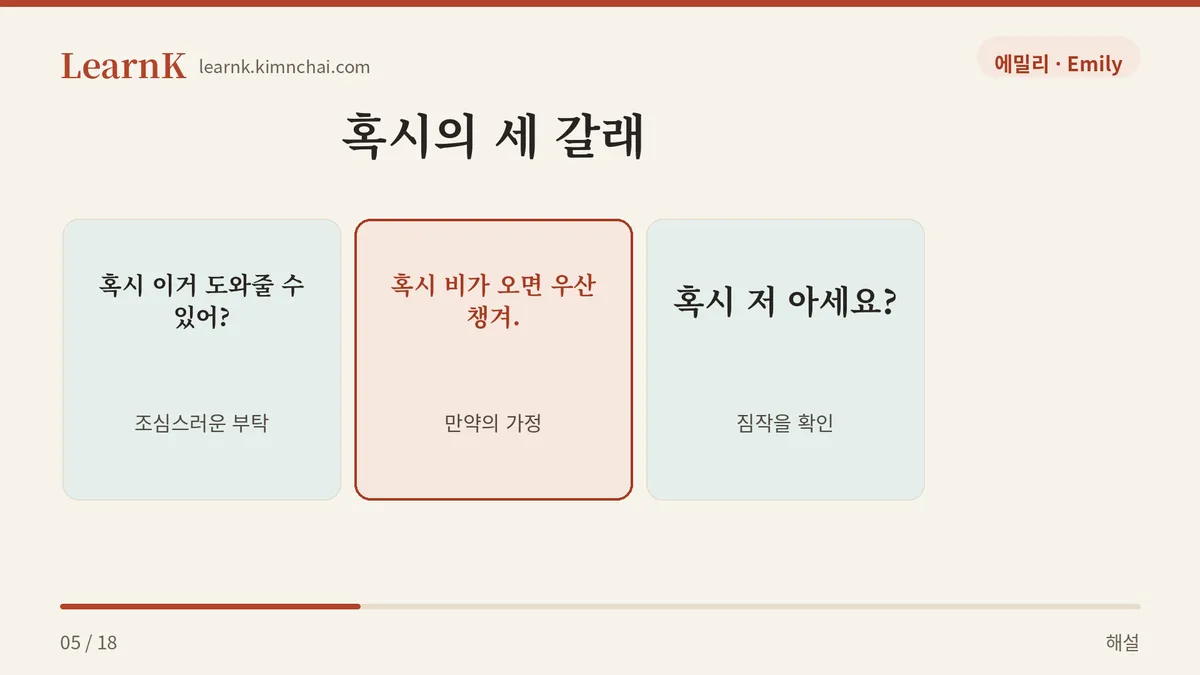
Scene: Saturday afternoon, in front of an apartment complex. Two people who agreed to buy and sell a desk through a secondhand deal look around, unable to recognize each other.
에밀리: 저기, 혹시 책상 거래하기로 한 분이세요? Um, are you by any chance the person I’m buying the desk from?
준경: 아, 네! 맞아요. 에밀리 님이시죠? 생각보다 일찍 오셨네요. Oh, yes! That’s me. You’re Emily, right? You came earlier than I expected.
에밀리: 네, 근처에서 볼일 보고 왔어요. 근데 혹시 흠집 있다던 데가 여기예요? Yeah, I was running errands nearby. By the way, is this the spot you said had a scratch?
준경: 맞아요, 여기 모서리. 티 안 나죠? 쓰는 데 전혀 지장 없어요. Yep, this corner. Barely shows, right? It won’t get in the way at all.
에밀리: 오, 진짜 멀쩡하네요. 그럼 이대로 가져갈게요. 혹시 봉투 같은 거 있으세요? 나사가 몇 개 빠져서요. Oh, it really is fine. I’ll take it as is, then. Do you happen to have a bag or something? A few screws came loose.
준경: 아 잠깐만요, 차에 하나 있을 거예요. 갖다 드릴게요. Oh hang on, I think I’ve got one in the car. Let me grab it for you.
Walking up to a stranger and speaking to them for the very first time — a secondhand-deal meeting spot is exactly 혹시’s home turf. Even the line “당근이세요?” (Are you the Karrot person?) really starts out as “혹시 당근이세요?” (Are you the Karrot person, by any chance?). Since you’re not sure, you knock on the door carefully — but politely.
Example Sentences by Situation
Situation 1 — Looking for an outlet seat at a café. Your laptop battery is dead, and as it happens the person next to you is sitting right by an outlet.
혹시 (hoksi) 이 콘센트 안 쓰시면 잠깐 써도 될까요? (hoksi i konsenteu an sseusimyeon jamkkan sseodo doelkkayo?)
Instead of asking outright “can I use it,” putting 혹시 up front means that even if the other person answers “제가 쓸 건데요” (Actually, I’m going to use it), neither of you feels awkward.
Situation 2 — When a face you haven’t seen in ages looks familiar but you’re not sure. At a reunion, you run into someone who looks familiar but whose name you can’t recall.
혹시 (hoksi) 저 기억하세요? 저 고등학교 같은 반이었던 민준인데요. (hoksi jeo gieokhaseyo? jeo godeunghakgyo gateun banieotdeon minjunindeyo.)
When you have a guess but aren’t certain (dictionary meanings ③ and ④), this is the classic use of 혹시 to gently open a confirmation.
Formal/Casual Speech and Similar Expressions
혹시 itself is an adverb with no separate formal or casual form, so you use it freely to match the sentence that follows.
- Formal: 혹시 실례지만 성함이 어떻게 되세요? (Excuse me, but might I ask your name, by any chance?)
- Casual: 야, 혹시 너 내 충전기 봤어? (Hey, did you happen to see my charger?)
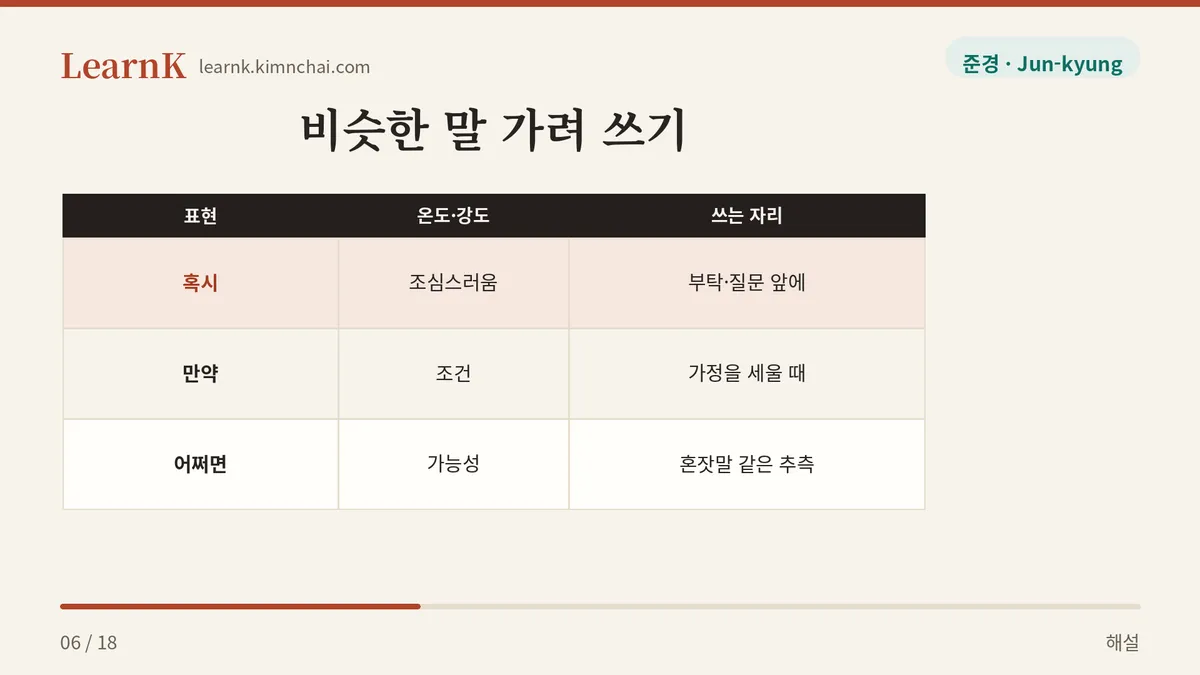
Similar words include 만약 (manyak), 어쩌면 (eojjeomyeon), and 혹시나 (hoksina). 만약 puts its weight on condition, so it’s used for hypotheticals as in “만약 늦으면 먼저 가” (If I’m late, go on ahead). 어쩌면 focuses on possibility, closer to talking to oneself, as in “어쩌면 안 올지도 몰라” (Maybe he won’t come). 혹시나 emphasizes 혹시, carrying an even stronger tinge of hope or worry. For careful questions and requests, 혹시 is still the most natural choice.
Cultural Background — A Word That Leaves Room to Refuse
Korean has unusually well-developed devices for showing consideration for the other person’s face, and 혹시 is the star player among them. Rather than throwing out a request point-blank, if you pause a beat with “혹시 …,” the listener gains room to say no and the speaker keeps their politeness intact. In a drama’s unrequited-love scene, when the main character carefully asks their crush out on a date, that opening line almost always begins with “혹시 이번 주말에…” (By any chance, this weekend…) for the very same reason. It’s not that they lack certainty — they deliberately take a step back out of consideration for the other person.
Closing Quiz
You want to borrow a friend’s notes. Which sentence is the most polite and natural?
- (A) 노트 빌려줘. (Lend me your notes.)
- (B) 혹시 노트 좀 빌려줄 수 있어? (Could you lend me your notes, by any chance?)
- (C) 만약 노트 좀 빌려줄 수 있어? (If could you lend me your notes?)
The answer is (B). For a careful request, what fits is the cushion of consideration 혹시, not 만약, which means “condition.” (A) gets the meaning across but is a bit blunt.
Definitions and example sentences are from the National Institute of Korean Language’s Basic Korean Dictionary (krdict.korean.go.kr); that portion of this post, including our translations, is licensed under CC BY-SA 2.0 KR.