홀가분하다 (holgabunhada): The Word for When a Weight Slides Off Your Shoulders
Walking out of the exam hall right after finishing a big test, looking around your empty room after wrapping up a move that dragged on for two months, finally taking care of something that had been nagging at you — there’s a phrase Koreans blurt out almost without realizing it. “Ah, 홀가분하다 (holgabunhada).” Today we’ll take a deep look at this expression, the perfect thing to say when the weight pressing down on your shoulders quietly disappears.
홀가분하다 (holgabunhada)
홀가분하다 (holgabunhada) is an adjective that describes the state of feeling light and at ease because something that had been bothering you or weighing on you is now gone. The heart of this word lies in the idea that “something was there, and then it went away.” It’s not a comfort that was always there — it’s the lightness that arrives after a burden, a worry, or an obligation that had been pressing on you is lifted. That’s why this expression always carries a nuance of relief, that sense of “it’s finally over.”
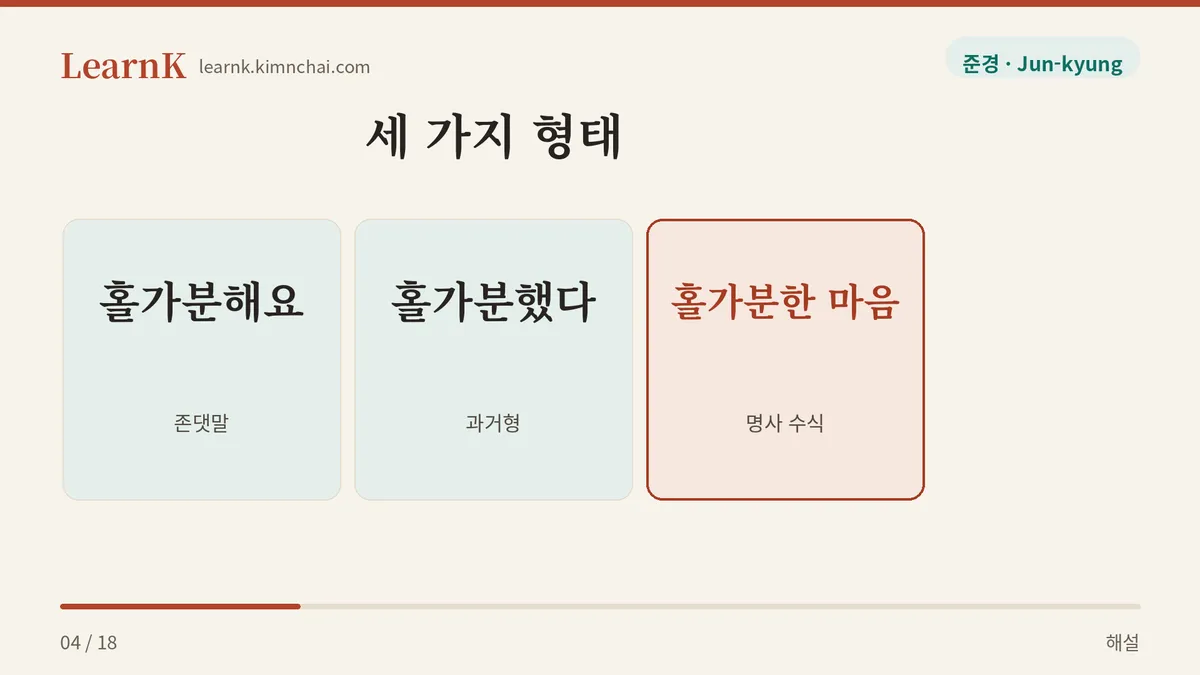
When you conjugate it, the polite form is ‘홀가분해요 (holgabunhaeyo)’, the past tense is ‘홀가분했다 (holgabunhaetda)’, and to modify a noun you say something like ‘홀가분한 마음 (holgabunhan maeum)’. As for the subject, it often takes things that can feel weight, like ‘마음 (maeum, heart/mind), 기분 (gibun, mood), 몸 (mom, body), 손 (son, hands)’.
Checking the National Institute of Korean Language Dictionary
First, let’s check the definition from the national institution’s dictionary.
홀가분하다 「adjective」 Feeling light and comfortable, without being bothered or troubled by anything. [en] lighthearted; carefree — Feeling light and comfortable without being burdened or bothered by something. [ja] 気楽だ — 気を使ったり面倒なことがなく、気持ちが軽く楽である。 [es] despreocupado — Que se siente ligero y cómodo sin tener que responsabilizarse o molestarse por nada. [zh] 轻快,轻便 — 不费心或烦心,感觉轻松舒适。 — National Institute of Korean Language, Basic Korean Dictionary (krdict.korean.go.kr)
(A Portuguese translation isn’t listed in the dictionary, so for the convenience of learners we’ve added our own — despreocupado; aliviado: sentir-se leve e à vontade, livre de preocupações ou incômodos. our own translation)
Let’s also look at the actual example sentences the dictionary provides.
- 응. 그동안 면접 준비하느라 아무것도 못 했는데 끝나니까 너무 홀가분하다.
- 한결 홀가분하다.
- 손이 홀가분하다.
- 마음이 홀가분하다.
- 기분이 홀가분하다. — National Institute of Korean Language, Basic Korean Dictionary (krdict.korean.go.kr)
Let me unpack what situation each example is describing.
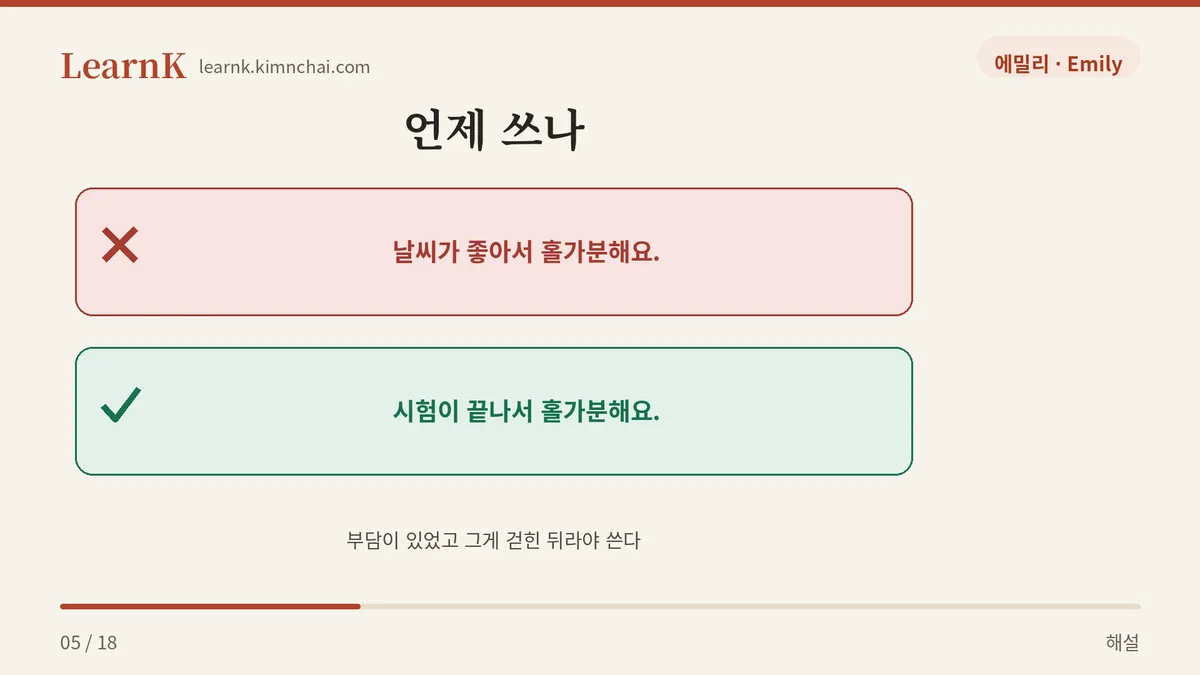
- 면접 준비하느라 … 끝나니까 너무 홀가분하다 (myeonjeop junbihaneura … kkeunnanikka neomu holgabunhada) — For weeks you were so weighed down by the big burden of a job interview that you couldn’t even touch anything else, and only once that schedule was over did your shoulders finally feel lighter. This is the most classic moment for using ‘홀가분하다’.
- 한결 홀가분하다 (hangyeol holgabunhada) — ‘한결 (hangyeol)’ means “much more than before.” It says that after shedding one of your worries, you feel noticeably lighter than you did before.
- 손이 홀가분하다 (son-i holgabunhada) — A state where your hands are free because there’s no longer any load to carry or things to look after. It shows that the word can be used not just for the heart but also for physical lightness.
- 마음이 홀가분하다 (maeum-i holgabunhada) — The most common form, describing a worry that had been sitting on your heart now gone.
- 기분이 홀가분하다 (gibun-i holgabunhada) — Used when, rather than a specific worry, your overall mood itself has become fresh and light.
Seeing It in a Real Conversation
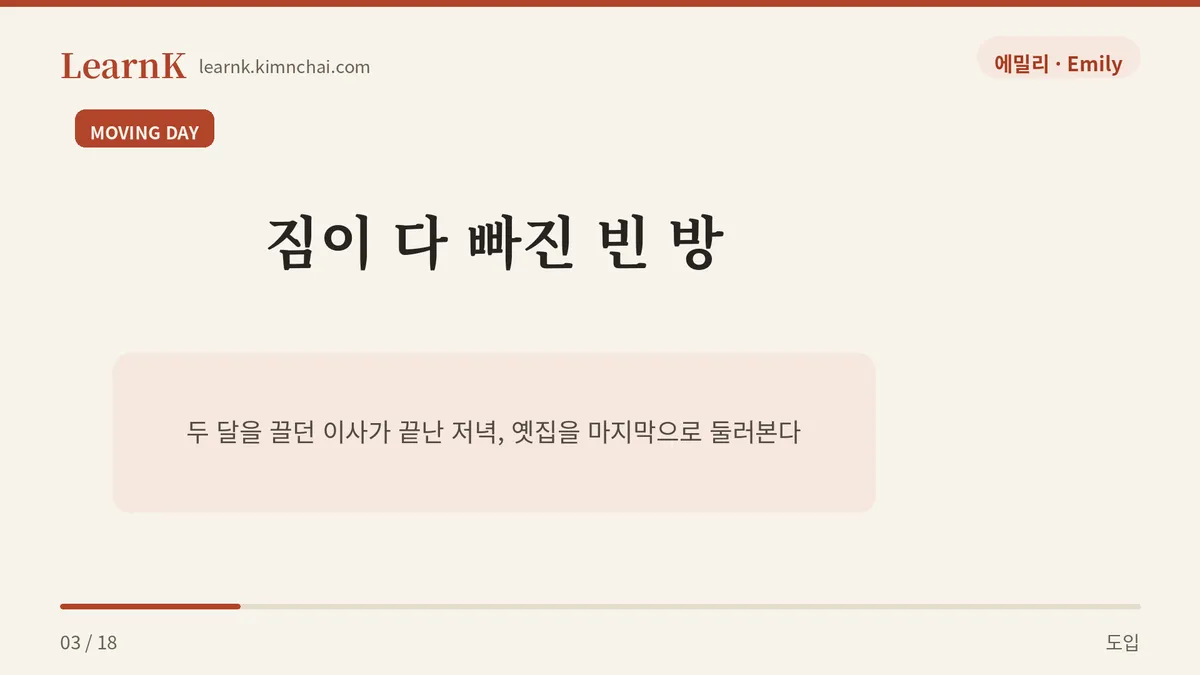
Situation: The evening of the day they finished a move that had dragged on for two months. They’re taking one last look around the old, now-emptied apartment.
Jun-kyung: 휴, 드디어 다 뺐다. 짐 진짜 많더라. Phew, we finally got everything out. There really was so much stuff.
Emily: 그러니까. 근데 짐 다 나가니까 방이 원래 이렇게 넓었나 싶다. 나 지금 완전 홀가분해. Right? But now that everything’s gone, I can’t believe how big the room is. I feel so light and free right now.
Jun-kyung: 하긴, 너 이 짐 때문에 몇 주 내내 스트레스였잖아. True, you were stressed for weeks because of all this stuff.
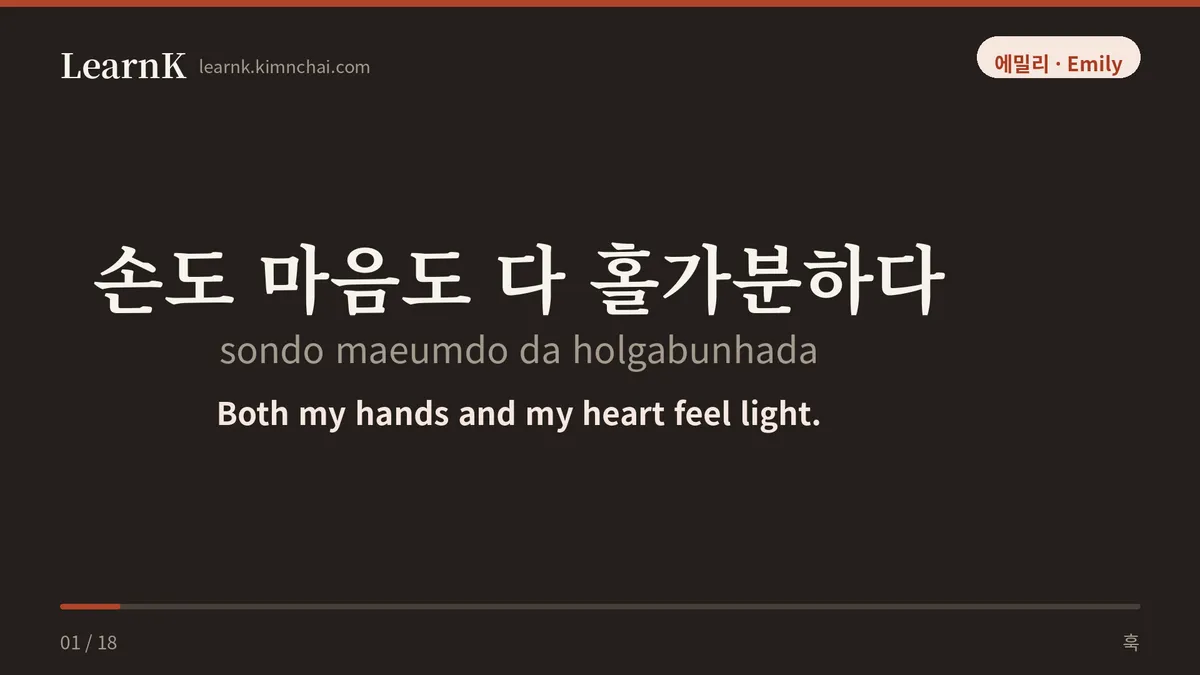
Emily: 말도 마. 버릴 거 싹 버리고 나니까 손도 마음도 다 홀가분하다. Don’t even get me started. Now that I’ve thrown out everything I needed to, both my hands and my heart feel light.
Jun-kyung: 그 마음 알지. 이럴 땐 뭐다? 짜장면 시켜야지. I know that feeling. And what do you do at times like this? Order jjajangmyeon, of course.
Emily: 콜! 이사하고 먹는 짜장면이 제일 맛있어. Deal! Jjajangmyeon after moving is the best.
Example Sentences by Situation
So you can put it to use right away, here are three situations I’ve made up myself.
- After finishing chores you’d been putting off — “미뤄 뒀던 설거지랑 빨래까지 다 하고 나니까 마음이 홀가분하네요. (mieodwotdeon seolgeojirang ppallaekkaji da hago nanikka maeum-i holgabunhaneyo.)” That refreshing feeling after dealing with something that had been an eyesore for days.
- After clearing up a misunderstanding — “친구랑 쌓였던 오해를 풀고 나니 한결 홀가분해졌어요. (chinguran ssayeotdeon ohaereul pulgo nani hangyeol holgabunhaejyeosseoyo.)” It’s also very natural to use when the burden in a relationship has lifted.
- After making a big decision — “고민하던 걸 드디어 결정했더니 속이 다 홀가분해요. (gomin-hadeon geol deudieo gyeoljeong-haetdeoni sog-i da holgabunhaeyo.)” The moment the weight of a choice you’d been putting off is finally cleared away.
Formal and Casual Speech, and Similar Expressions
The polite forms are 홀가분해요 (holgabunhaeyo) / 홀가분합니다 (holgabunhamnida), and the casual forms are 홀가분해 (holgabunhae) / 홀가분하다 (holgabunhada). It’s especially common to use it as an exclamation to yourself, as in “아, 홀가분하다 (Ah, holgabunhada).”
It’s also good to learn some expressions that are similar but have a different flavor.
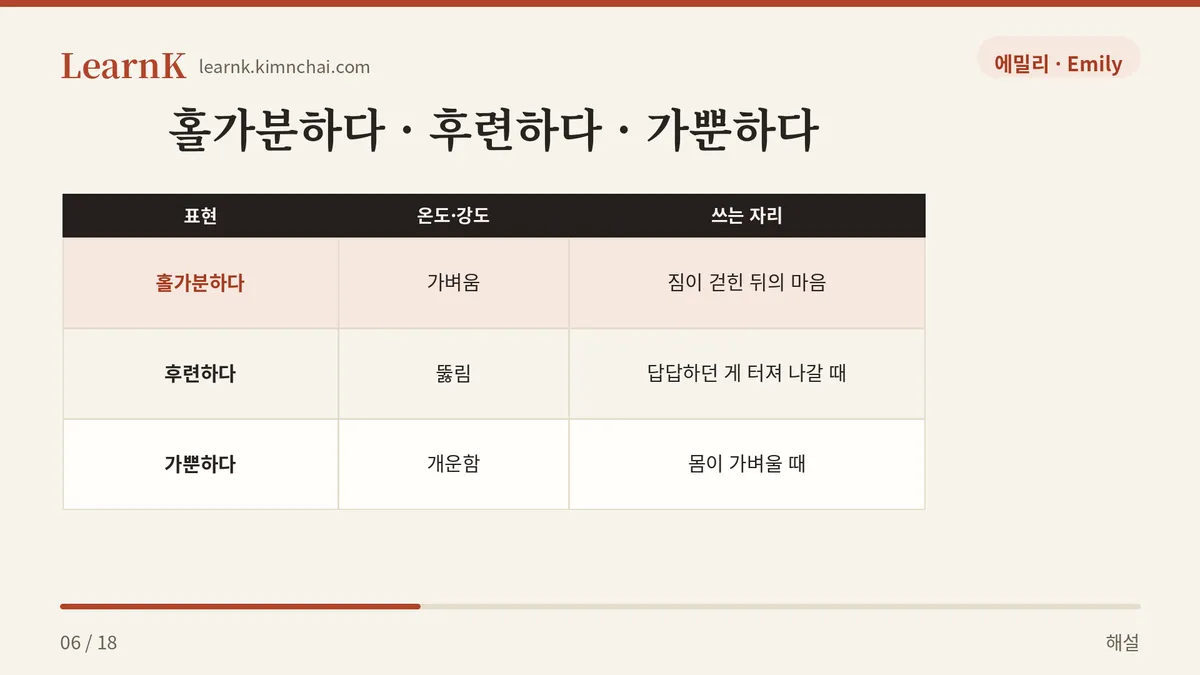
- 후련하다 (huryeonhada) — The refreshed feeling of something stuffy suddenly bursting open. If ‘홀가분하다’ is about “lightness,” then ‘후련하다’ is closer to “a release.”
- 가뿐하다 (gappunhada) — The feeling of your body being refreshed and light. It’s used more often for your physical state than for your heart.
- 시원하다 (siwonhada) — The satisfying thrill when a stuck situation gets resolved. It’s stronger in intensity and bigger in emotion than 홀가분함 (holgabunham).
Cultural Background
In Korean dramas, there’s a scene that comes up often: a character who has finally let out a long-held secret or conflict gazes out the window with a look that says “now I can finally breathe,” feeling 홀가분한. Rather than quoting an actual line word-for-word, let me describe the situation: the emotion of the moment when someone who had been carrying a burden all alone finally sets it down is exactly what this word captures. In everyday life, too, it’s the phrase you’ll hear most after those “you’re only free once it’s over” kinds of things — exams, presentations, moving, medical appointments — so the next time you face one of those situations, try letting it out yourself.
Closing Quiz
What’s the most natural word to fill in the blank below?
“한 달 동안 준비한 시험이 오늘 다 끝났어. 이제 마음이 정말 ______.”
① 답답해 ② 홀가분해 ③ 긴장돼 ④ 아쉬워
The answer is ② 홀가분해 (holgabunhae). After all, it expresses the lightness that comes after a burden has disappeared. I hope that today, a moment comes when you finish one of the things weighing on your shoulders and get to say “홀가분하다”!
Definitions and example sentences are from the National Institute of Korean Language’s Basic Korean Dictionary (krdict.korean.go.kr); that portion of this post, including our translations, is licensed under CC BY-SA 2.0 KR.