이불킥 (ibulkik) — The Memory That Makes You Kick Off Your Blanket at Night
Midnight. You turned off the light and lay down. And of course, that is exactly the moment it comes back to you — the joke you cracked all by yourself at a company dinner three years ago, and those three seconds when nobody laughed. Your legs tense up before you can stop them, and the blanket gets shoved down to your feet. 이불킥 (ibulkik) is the word for precisely this: kicking off your blanket in bed because an embarrassing memory has resurfaced — or the embarrassing incident itself, if it is cringey enough to cause that.
People learning Korean usually laugh the first time they meet this word. Instead of explaining the feeling of embarrassment with a long line of adjectives, it shows you how that feeling bursts out of the body, in a single motion. And once they have laughed, they realize something — this is a feeling they already knew, long before they ever started learning Korean.
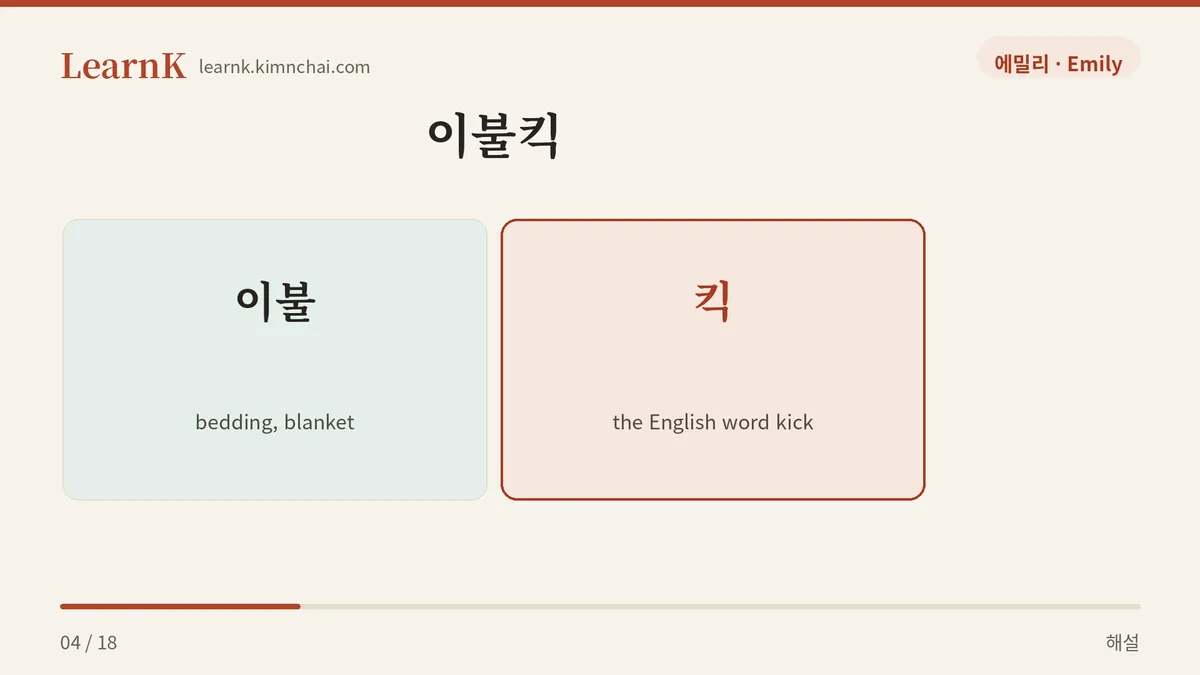
이불킥 (ibulkik)
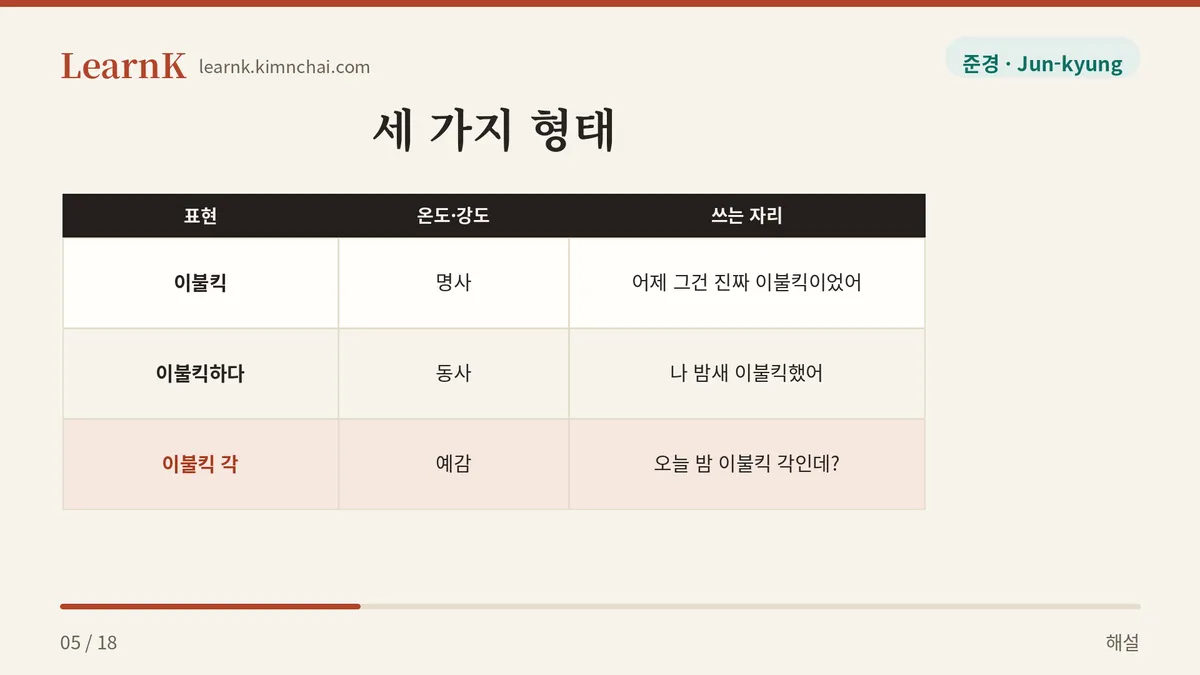
It is 이불 (ibul, bedding, blanket) stuck straight onto the English word kick, so the meaning is exactly what it says. It is not standard Korean with a dictionary entry; it is a coinage that took hold on the internet and in everyday conversation. In actual use, it splits into three forms.
- 이불킥 (ibulkik) — a noun. It refers to the incident itself. “어제 그건 진짜 이불킥이었어. (eoje geugeon jinjja ibulkigieosseo.)” — That thing yesterday was a real blanket-kicker.
- 이불킥하다 (ibulkikhada) — a verb. It means you spent the night that way. “나 밤새 이불킥했어. (na bamsae ibulkikhaesseo.)” — I was kicking my blanket all night.
- 이불킥 각 (ibulkik gak) — 각 (gak) is internet-speak for the sign or setup that something is headed a certain way. “이거 오늘 밤 이불킥 각인데? (igeo oneul bam ibulkik gaginde?)” means the night hasn’t even arrived yet and you can already feel it coming.
Three conditions hold the nuance in place.
First, it is almost always used on yourself. Attach it to someone else’s mistake and it stops being comfort and turns into teasing. This word belongs to the person doing the cringing.
Second, it is only for embarrassment where nobody got hurt. You don’t use it when money was at stake or when someone was wounded. It is for things that cost nothing and only make your own face burn — calling someone by the wrong name, saying hello to someone who doesn’t recognize you, sending a reply to the wrong person. That is the size of the incident.
Third, there has to be a time lag. The heart of 이불킥 (ibulkik) is not the incident but the replay. Being embarrassed right there on the spot is simply 민망하다 (minmanghada). Hours, days, in bad cases years later, when you are lying down alone and that scene comes back like a tape rewinding — that gap in time is what makes this word special.
See It in a Real Conversation
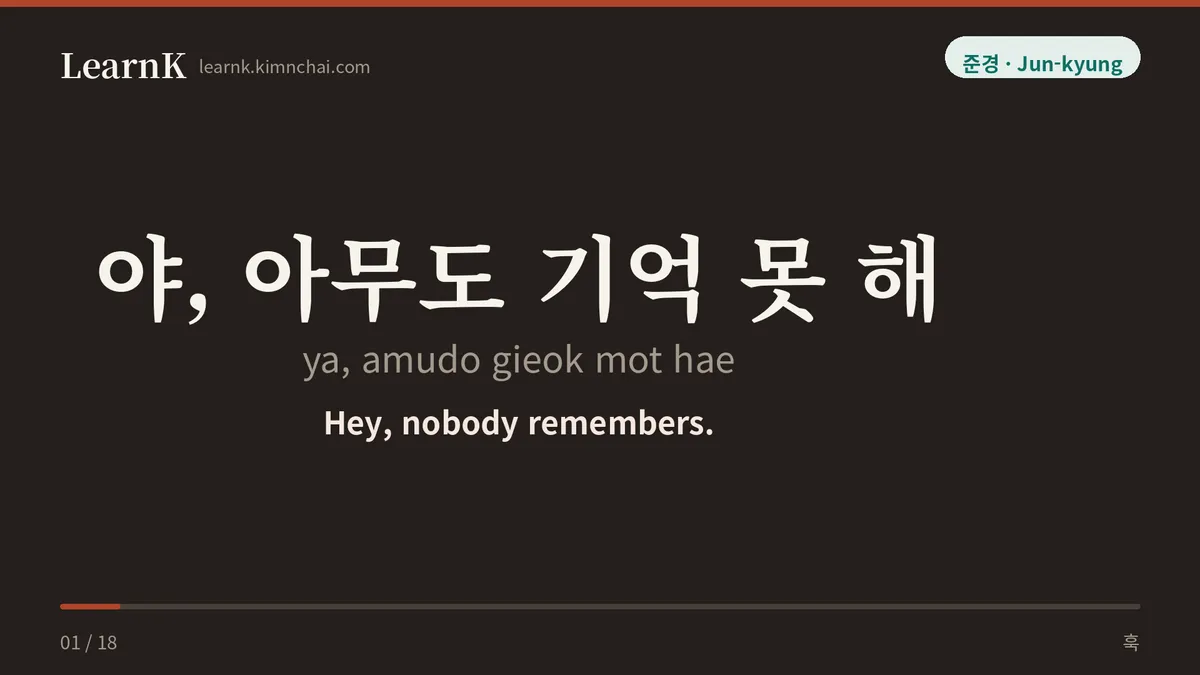
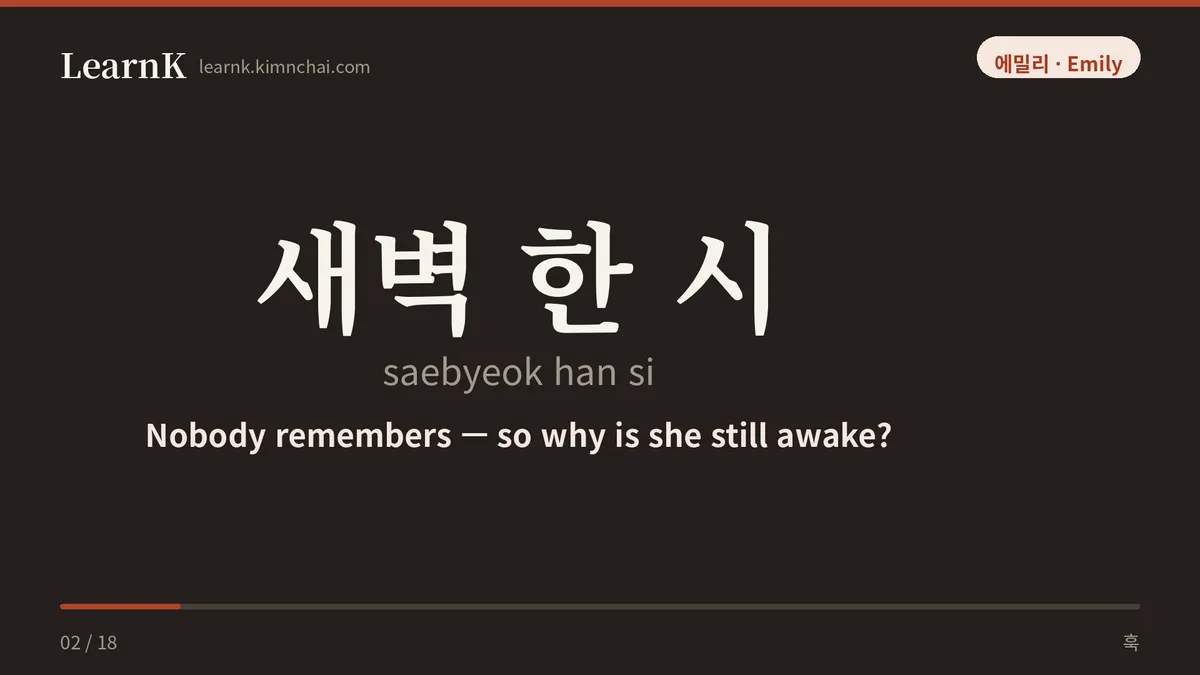
Scene: One in the morning. Emily calls Jun-kyung, who has just gotten under the covers.
에밀리: 자? …미안, 나 잠이 안 와서. Are you asleep? …Sorry, I just couldn’t fall asleep.
준경: 아니, 안 자. 왜, 무슨 일 있어? No, I’m up. What’s up — something wrong?
에밀리: 나 아까 발표할 때 부장님을 “선배님”이라고 불렀어. 아 진짜 이불킥 각이야. During my presentation earlier I called the department head “sunbae.” Ugh, this is total blanket-kick material.
준경: 야, 아무도 기억 못 해. 그런 건 너만 십 년 간직하는 거야. Hey, nobody remembers. You’re the only one who’ll hang onto that for ten years.
에밀리: 아니거든? 눈만 감으면 계속 그 장면이야. No way. Every time I close my eyes, there’s that scene again.
준경: 나도 어제 이불킥했어. 엘리베이터에서 모르는 사람한테 손 흔들었잖아. 우리 그냥 자자. I kicked my blanket last night too. I waved at a complete stranger in the elevator. Let’s just go to sleep.
Where It Sounds Off
✗ (To your department head, in a meeting) 부장님, 어제 제 보고는 정말 이불킥이었습니다. (bujangnim, eoje je bogoneun jeongmal ibulkigieotseumnida.) ✓ (To a colleague at your own level) 야, 나 어제 보고 진짜 이불킥이었어. (ya, na eoje bogo jinjja ibulkigieosseo.) → Because it is slang born on the internet, in a formal setting it lands as a joke rather than as genuine reflection. In front of someone senior to you, “면목이 없습니다 (myeonmogi eopsseumnida)” is the safe choice.
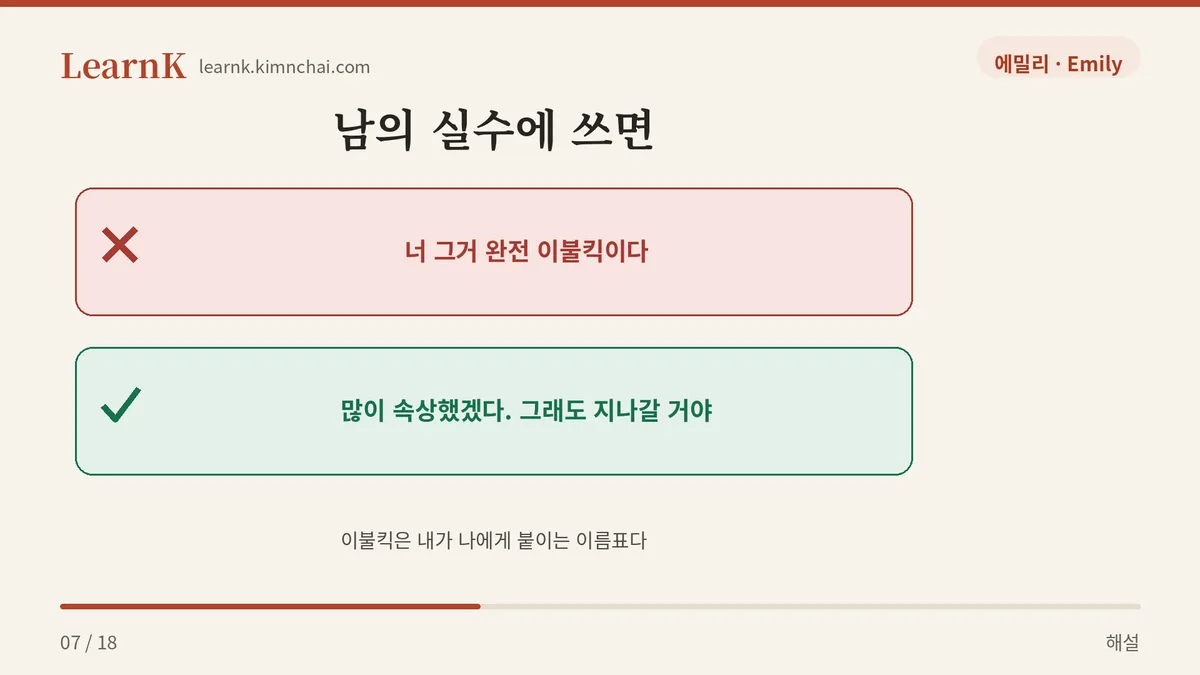
✗ (When a friend has made a big mistake and is in trouble) 너 그거 완전 이불킥이다. (neo geugeo wanjeon ibulkigida.) ✓ (Same situation) 많이 속상했겠다. 그래도 지나갈 거야. (mani soksanghaetgetda. geuraedo jinagal geoya.) → 이불킥 (ibulkik) is a label you put on yourself. Put it on someone else and it comes out meaning “your embarrassment is entertainment to me,” and using it for something that caused real damage makes light of the whole matter.
Example Sentences by Situation
① When you get your group chats mixed up
You meant to send a message complaining about a friend — and sent it to the group chat that friend is in. You deleted it right away, but the “1” (the unread marker) was already gone.
어제 단톡방에 메시지 잘못 보낸 거 생각나서 밤새 이불킥했어. (eoje dantokbange mesiji jalmot bonaen geo saenggangnaseo bamsae ibulkikhaesseo.) I kicked my blanket all night remembering the message I sent to the wrong group chat.
② The morning after a company dinner
Last night the mood was great, so you never let go of the microphone. This morning you open your phone’s photo album and there are twelve videos.
어제 영상 보지 마. 오늘 밤 이불킥 각이야. (eoje yeongsang boji ma. oneul bam ibulkik gagiya.) Don’t watch yesterday’s videos. Tonight is going to be a blanket-kick night.
③ When something from years ago suddenly surfaces
Nothing in particular happened, but the second you lie down to sleep, the scene of you tripping in your middle-school classroom starts playing.
갑자기 10년 전 일이 떠올라서 이불킥했잖아. (gapjagi sim nyeon jeon iri tteoollaseo ibulkikhaetjanha.) Something from ten years ago popped into my head and I ended up kicking my blanket.
Polite vs. Casual Speech, and Similar Expressions
이불킥 (ibulkik) was born in casual-speech territory, so polite-form versions of it sound awkward. If you really want to use one, something like “어제 일 때문에 이불킥했어요 (eoje il ttaemune ibulkikhaesseoyo)” works with people your own age or a senior you’re close to — but when formality is required, you’re better off switching to the expressions on the right side of the table below.
| Expression | Temperature / intensity | Where it’s used |
|---|---|---|
| 이불킥 (ibulkik) | Strong and comical. Embarrassment you suffer through alone | Peers, social media. Not with superiors or in formal settings |
| 흑역사 (heungnyeoksa) | Strong. An entire past you wish you could erase | Peers, social media. Used for longer stretches of time |
| 손발이 오그라들다 (sonbari ogeuradeulda) | Strong. Can be used about other people’s stuff too | Peers. When you see or hear something cringeworthy |
| 민망하다 (minmanghada) | Medium. The embarrassment you feel right on the spot | Anywhere. Natural in polite speech too |
| 부끄럽다 (bukkeureopda) | Neutral | Anywhere. Perfectly fine in formal settings |
For the very same night, to a friend it becomes “나 어제 이불킥했어 (na eoje ibulkikhaesseo),” and to your boss it becomes “어제는 제가 좀 경솔했습니다 (eojeneun jega jom gyeongsolhaetseumnida).” Choosing the word is, in effect, setting the distance between you and the other person.
Cultural Background — Emotions Drawn with the Body
Korean has many idioms that sketch an emotion as a physical movement. Laugh too hard and your 배꼽 빠지다 (baekkop ppajida, 배꼽이 빠진다 — “your belly button falls out”); see something cringey and 손발이 오그라들다 (sonbari ogeuradeulda — “your hands and feet curl up”); get furious enough and 속이 터지다 (soki teojida — “your insides burst”). 이불킥 (ibulkik) belongs to the same lineage. The difference is that those older expressions are long-established idioms, while 이불킥 (ibulkik) is a recent coinage that fastens the English kick onto 이불 (ibul), a native Korean word. It is also evidence that Korean’s way of building new vessels for new feelings is still very much alive.
Part of why this word spread so widely is that we live in an age that keeps records. Mistakes used to live only in the memories of the people who were there; now they live in the group chat, in the photo album, in the video on someone else’s phone. So 이불킥 (ibulkik) is also the name we’ve given to the embarrassment of an era that doesn’t forget.
At the same time, there is something oddly warm about this word. When a cast member on a variety show watches old footage and buries their face in their hands, the word flashes across the screen in big subtitle letters. Which is to say: it lives in the place where you laugh it off with “same here,” not in the place of serious self-reproach. When a friend says “나 어제 이불킥했어 (na eoje ibulkikhaesseo),” Koreans usually answer like this — “야, 아무도 기억 못 해 (ya, amudo gieok mot hae),” hey, nobody remembers. And truly, nobody does. That we know this and still kick the blanket off again tonight is why this word has stayed so well loved.
Today’s Quiz
Emily mistook the person in front of her on the subway for a friend and tapped them on the shoulder. The face that turned around belonged to a total stranger. That night, which message would be the most natural one for Emily to send Jun-kyung?
- 오늘 지하철에서 너 완전 이불킥이더라. (oneul jihacheoreseo neo wanjeon ibulkigideora.) — You were a total blanket-kicker on the subway today.
- 오늘 지하철에서 실수한 거 생각나서 이불킥하는 중이야. (oneul jihacheoreseo silsuhan geo saenggangnaseo ibulkikhaneun jungiya.) — I’m kicking my blanket right now thinking about the slip-up I made on the subway today.
- 부장님, 오늘 지하철에서 이불킥했습니다. (bujangnim, oneul jihacheoreseo ibulkikhaetseumnida.) — Sir, I kicked my blanket on the subway today.
Answer: number 2. Number 1 pins the word on someone else, which turns it into teasing, and number 3 is the awkward combination of slang packed into a formal sentence aimed at a superior. 이불킥 (ibulkik) is a word for the night, for being alone, and for yourself.
The definitions, example sentences, and dialogue in this post are all original writing of our own. 이불킥 (ibulkik), the expression covered in this installment, is not a headword in the National Institute of Korean Language’s Basic Korean Dictionary (krdict.korean.go.kr), so no dictionary citation is included.