일코 (ilko) — The Art of Tucking Your Fandom Out of Sight for a While
일코
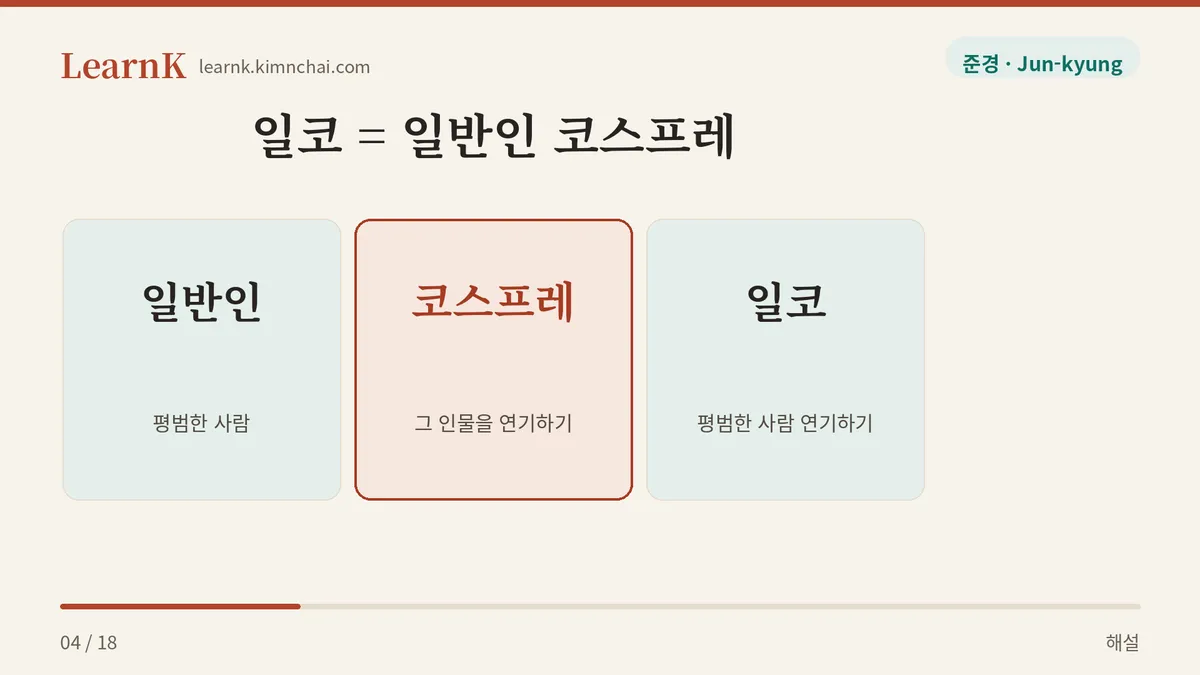
일코 (ilko) is short for 일반인 코스프레 (ilbanin koseupeure), or ‘ordinary-person cosplay.’ It means being someone who is completely obsessed with something while acting in front of other people like a perfectly normal person who couldn’t care less — giving nothing away. Shoving your light stick deep into a paper bag. Not letting your face move a millimeter when your bias’s name comes up in a meeting. Switching your phone’s lock screen back to the default wallpaper only when you’re out to lunch with coworkers. All of that effort is 일코.
What makes the word so much fun is that 일코 is not something you do because you don’t care. It’s the exact opposite. You like it so much that pulling that feeling out just anywhere would mean explaining far too much, so you fold it away for a little while. That’s why 일코 always carries a bit of tension and a bit of comedy at the same time. It isn’t a secret that ruins you if you’re caught — it’s a secret that’s funny if you’re caught.
The usage splits like this:
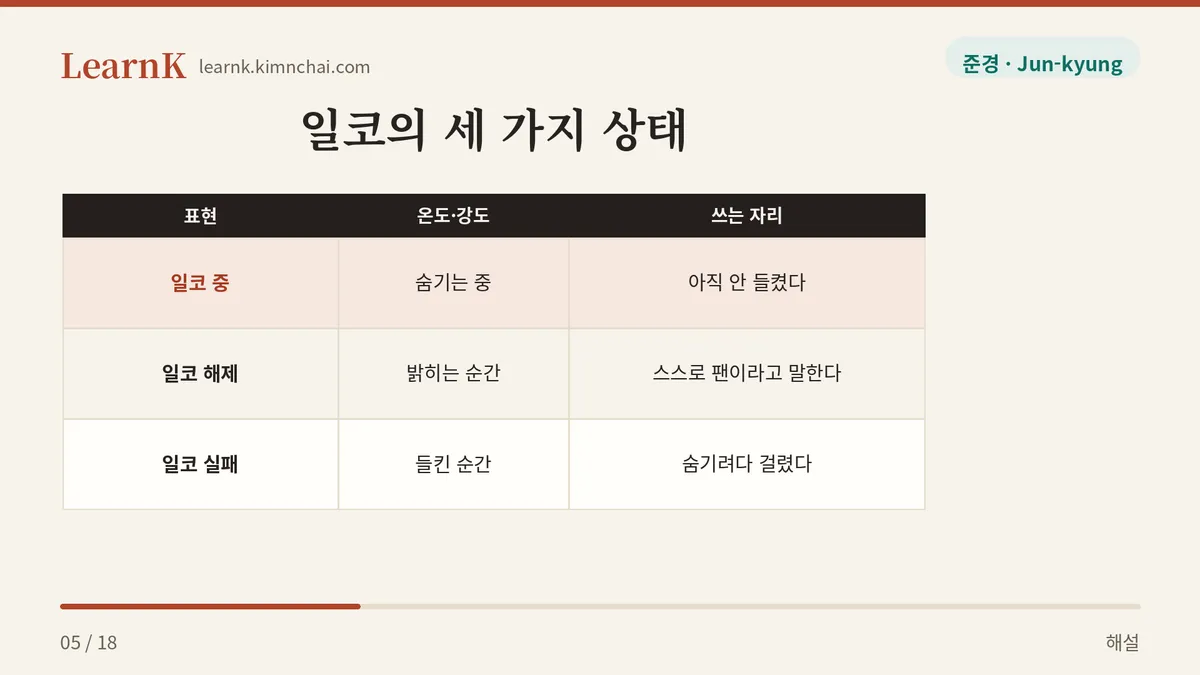
- 일코하다 (ilko-hada) — to hide that you’re a fan and act like an ordinary person
- 일코 중 (ilko jung) — currently in hiding
- 일코 해제 (ilko haeje) — to stop hiding and let it be known that you’re a fan
- 일코 실패 (ilko silpae) — to try to hide it and get busted
The nuance is light and playful. It lands most naturally when friends toss it at each other as teasing, and it actually turns awkward if you say it with a straight, serious face. It’s also worth remembering that this word grew up in internet communities and on social media, so you’ll almost never see it in a report or in a formal setting.
Seeing It in Real Conversation
Scene: The subway home on a Friday evening. Emily is standing there hugging a huge paper bag.
Jun-kyung: 야, 에밀리. 가방에서 삐져나온 거… 그거 응원봉 아니야? Hey, Emily. That thing sticking out of your bag… isn’t that a light stick?
Emily: 어? 아… 이거 조카 선물이야. 조카. Huh? Oh… it’s a present for my niece. My niece.
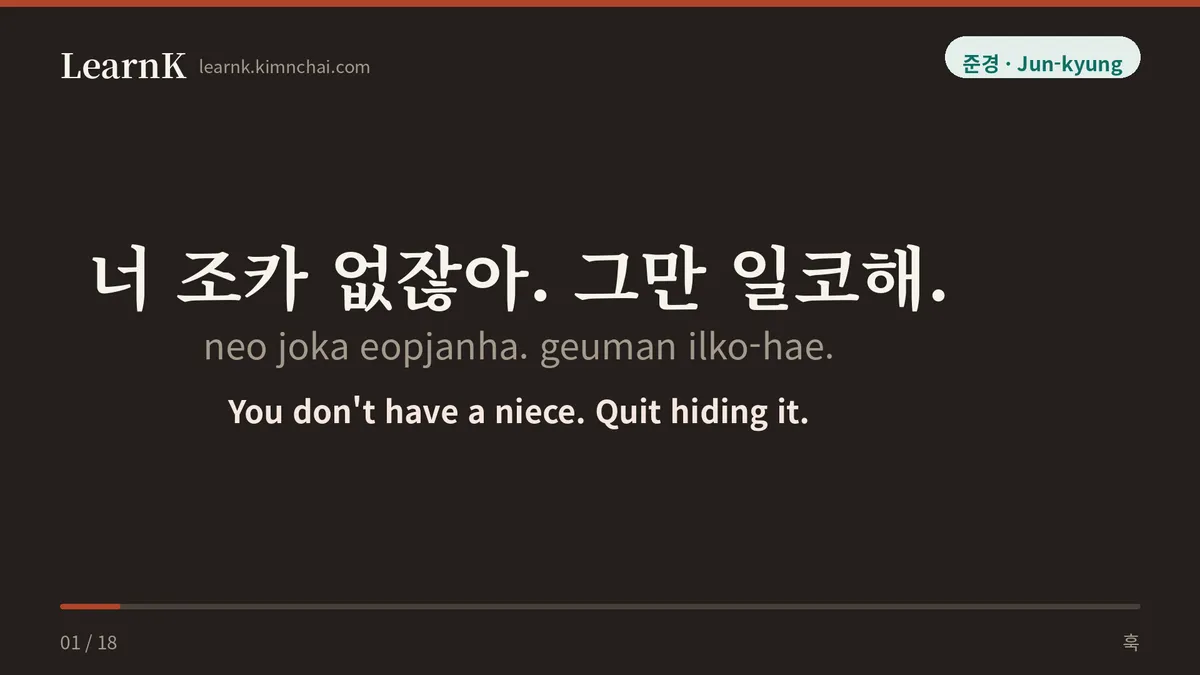
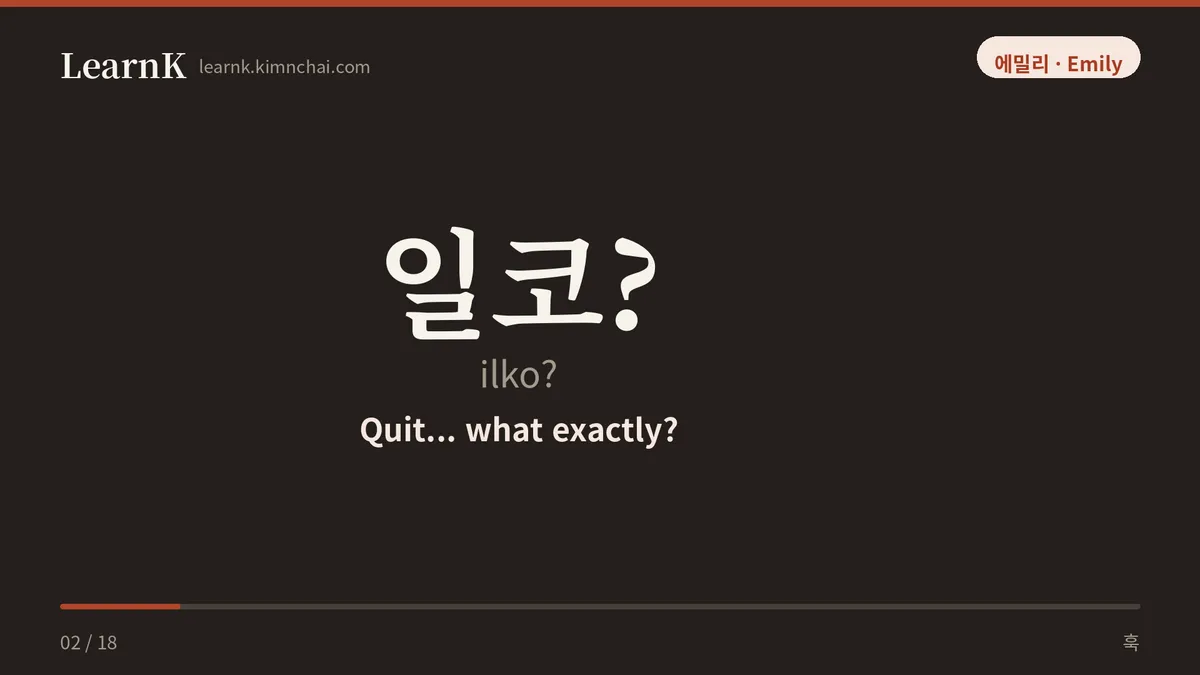
Jun-kyung: 너 조카 없잖아. 그만 일코해. 아까 회의 때 콘서트 얘기 나오니까 귀 쫑긋하더라. You don’t have a niece. Quit hiding that you’re a fan. Your ears perked right up when the concert came up in the meeting.
Emily: 아, 들켰네. 회사에서는 일코하는 게 편해서 그래. 팀장님 알면 일 년 내내 놀릴걸. Ugh, busted. It’s just easier to keep it under wraps at work. If the team lead found out he’d tease me all year.
Jun-kyung: 놀리긴. 나도 어제 그 팀 앨범 두 장 샀어. Tease you? I bought two copies of that group’s album yesterday.
Emily: 뭐?! 야, 일코는 네가 나보다 훨씬 심했네. What?! You’ve been hiding it way harder than I have.
It Sounds Off If You Use It Like This
✗ (to someone you’ve just met for the first time) 혹시 일코 중이세요? Are you in fan-hiding mode, by any chance? ✓ (to a close friend) 너 회사에서는 일코하는구나? So you go into fan-hiding mode at work, huh? → This is a joke that assumes the other person is a fan, so between people who aren’t comfortable with each other yet it comes off as rude. The humor of this word only works when you already know each other.
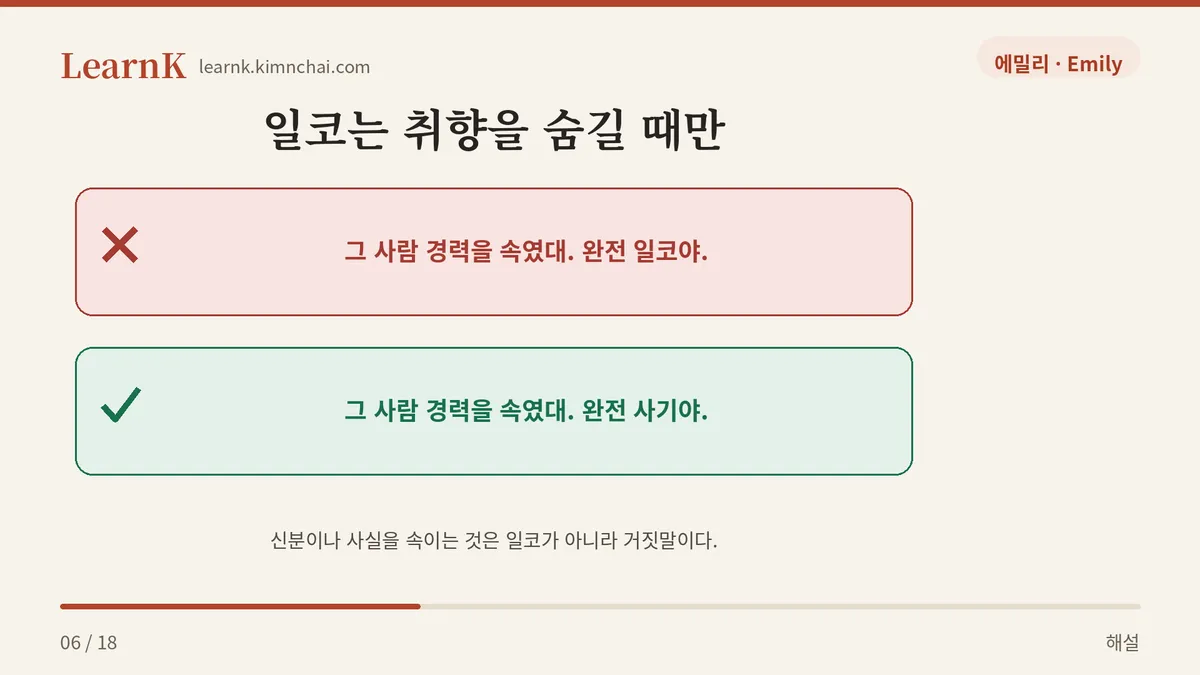
✗ 그 사람 경력을 속였대. 완전 일코야. I heard they lied about their work history. Total 일코. ✓ 그 사람 경력을 속였대. 완전 사기야. I heard they lied about their work history. Total fraud. → 일코 attaches only to hiding your tastes. Lying about your identity or the facts isn’t 일코 — it’s just lying. Mixing the two turns a light joke into an accusation against someone.
Example Sentences by Situation
1. The photocard tucked behind your work badge Three years at the company without giving off a single hint — and then you drop your ID badge in front of the elevator, and the photocard tucked behind it slides out onto the floor right along with it.
삼 년 동안 일코했는데 사원증 하나 때문에 끝났어. (sam nyeon dongan ilko-haenneunde sawonjeung hana ttaemune kkeutnasseo.) I kept it hidden for three years, and one ID badge ended it.
2. At the holiday dinner table Normally this person goes to concerts and buys merch — but with all the relatives gathered, they’ve decided not to bring up their hobby at all.
저는 명절에만 일코해요. 큰아버지한테 설명하려면 한 시간 걸리거든요. (jeoneun myeongjeore-man ilko-haeyo. keunabeoji-hante seolmyeong-haryeomyeon han sigan geolligeodeunyo.) I only hide it during the holidays. Explaining it to my uncle would take an hour.
3. First meetup of a new fan club After going around hiding it, you finally meet people with the same taste and can come clean with an easy heart. In moments like this, ‘해제 (haeje)’ gets used almost like a formal declaration.
오늘부로 일코 해제합니다. 저 십 년 차 팬이에요. (oneulburo ilko haeje-hamnida. jeo sim nyeon cha paen-ieyo.) As of today I’m done hiding it. I’ve been a fan for ten years.
Polite/Casual Forms and Similar Expressions
Purely in terms of form, making a polite version is easy. Just change the ending: 일코해요 (ilko-haeyo), 일코합니다 (ilko-hamnida). But the word itself is slang, so slapping a polite ending on it doesn’t suddenly make it appropriate for a job interview or a formal meeting. It’s polite slang, not public-facing language.
| Expression | Tone & intensity | Where it’s used |
|---|---|---|
| 일코 (ilko) | Light and playful | Among peers, in fan communities, on social media. Rarely used with people senior to you |
| 덕밍아웃 (deokmingaut) | Declarative, slightly dramatic | For pointing to the exact moment you reveal you’re a fan |
| 숨덕 (sumdeok) | A calm description of a state | For referring to the hiding person themselves |
| 티 안 내다 (ti an naeda) | Neutral | Anywhere. Safe even in front of people senior to you |
일코 해제 (ilko haeje) and 덕밍아웃 (deokmingaut) overlap in meaning but differ in texture. 일코 해제 puts its weight on ‘I’m going to stop hiding,’ so it feels like quietly taking the costume off; 덕밍아웃 feels like loudly announcing ‘from now on, I’m out.’ The safest expression for learners is 티 안 내다 (ti an naeda). You can use it anywhere, and it doesn’t care about the other person’s age or rank.
Cultural Background — Playing the Role of an Ordinary Person
This is a word where the way it was built is the meaning. ‘일반인 (ilbanin)’, ordinary person, plus ‘코스프레 (koseupeure)’, cosplay. 코스프레 came into Korean from the Japanese コスプレ, itself a mash-up of the English words costume and play, and it refers to dressing up as a manga or game character and acting that character out. So if you unpack 일코 literally, it means ‘playing the role of an ordinary person.’ That inverted idea — a fan cosplaying not as a character but as a normal person — is the core joke of the word.
There was a time when this word was genuinely necessary. In the 2000s, the very labels for someone deeply into a particular thing were close to insults, and admitting your hobby easily invited a ‘you’re still into that at your age?’ So instead of folding their affection away entirely, people chose to switch it on and off depending on the place. Off at work, on at the weekend concert venue.
The atmosphere has changed a lot since then. On variety shows, actors and athletes proudly bring up the groups they love, and those moments get a ‘that’s so cool’ reaction. Fandom has come up into the daylight. And yet the word 일코 hasn’t disappeared. That’s because the office and the holiday dinner table are still the places where the explaining goes on too long. The very fact that this word has survived is itself a story about how, in Korean society, the places where you can bring out your tastes and the places where you fold them away are still separated.
Today’s Quiz
Emily has never once brought up her favorite singer in front of her coworkers, but after work she happily gives her friends a full concert recap. Which sentence describes this situation most naturally?
- 에밀리는 회사에서 일코 실패했다. (Emily failed at hiding it at work.)
- 에밀리는 회사에서 일코 중이다. (Emily is in fan-hiding mode at work.)
- 에밀리는 회사에서 일코 해제했다. (Emily stopped hiding it at work.)
Answer: 2. She hasn’t been caught yet and is still hiding it, so ‘일코 중 (ilko jung)’ is correct. Option 1 is for when you try to hide it and get found out, and option 3 is for when you reveal you’re a fan yourself. If a coworker discovers the photocard behind Emily’s ID badge the next day — then you can finally use sentence 1.
Definitions and example sentences are from the National Institute of Korean Language’s Basic Korean Dictionary (krdict.korean.go.kr); that portion of this post, including our translations, is licensed under CC BY-SA 2.0 KR.