인정 (ㅇㅈ): The Two Syllables Koreans Fire Off When They Totally Agree
인정 (ㅇㅈ)
When a friend casually tosses out “요즘 여름 진짜 너무 덥지 않냐? (isn’t the summer way too hot these days?)”, you don’t need a long sentence to agree. Just two syllables and you’re done. 인정 (injeong). It’s one of the most common ways Koreans say “same here” in chat windows, comment sections, and everyday conversations among friends these days. Watch enough Korean content and you’ll see “인정!” or its consonant-only form ㅇㅈ (i-j) flashing across subtitles and chats — but the plain meaning alone doesn’t capture the feel of this word. Today, let’s really dig into where this expression shows up and what emotion it carries.
Meaning and Nuance
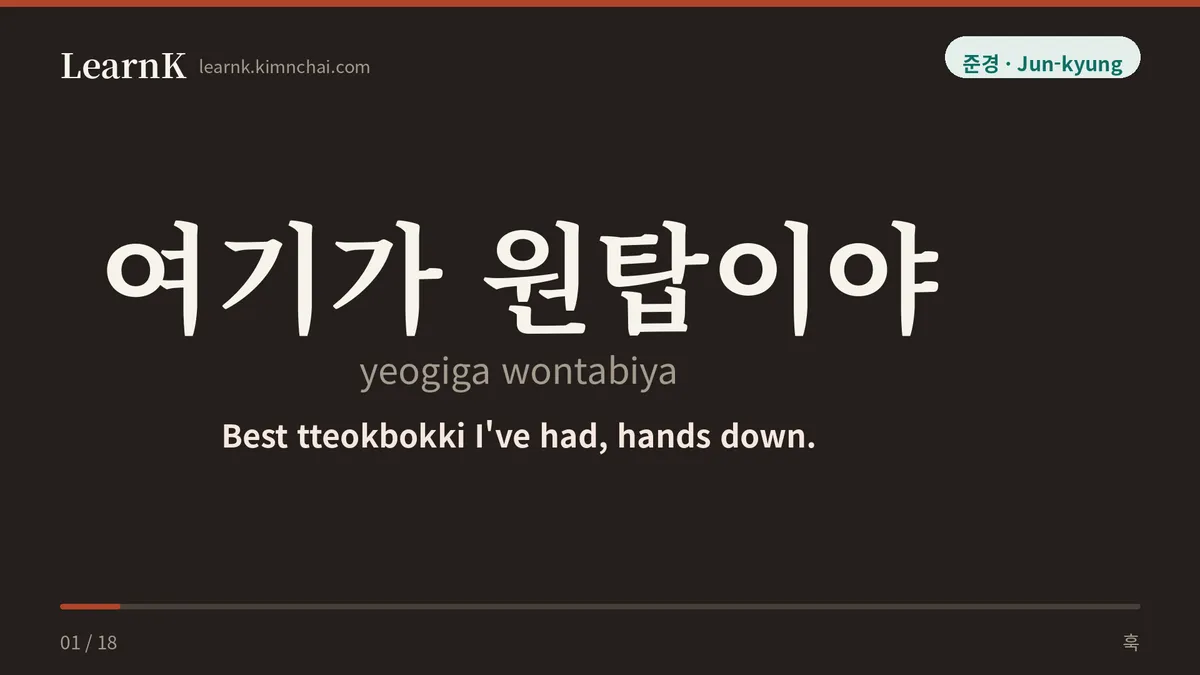
인정 (injeong) originally comes from the Sino-Korean word 認定, meaning “to accept something as a fact or a given state.” In phrases like “학력을 인정받다 (to have one’s education recognized)” or “실력을 인정하다 (to recognize someone’s skill),” it’s actually a pretty serious word. But once it crosses into slang, the nuance gets a lot lighter. It becomes an exclamation of strong agreement — “You’re a hundred percent right, I completely feel you.” In English, it’s close to “Facts.”, “For real.”, or “No cap.”
The key is strong agreement. It’s a notch stronger than a plain “응, 맞아 (eung, maja / yeah, true).” It bursts out almost like an exclamation when something is so obvious there’s no room to argue. In chat, it’s written as the consonant-only ㅇㅈ (i-j), and if you want to emphasize it, you double it up as ㅇㅈㅇㅈ (ij-ij). On the flip side, when you don’t agree, you fire back with ㄴㅈ (n-j) — short for 노인정 (no-injeong / “no injeong”). Knowing that 인정 and 노인정 travel as a set will make them much easier to catch in the wild.
Seeing It in a Real Conversation
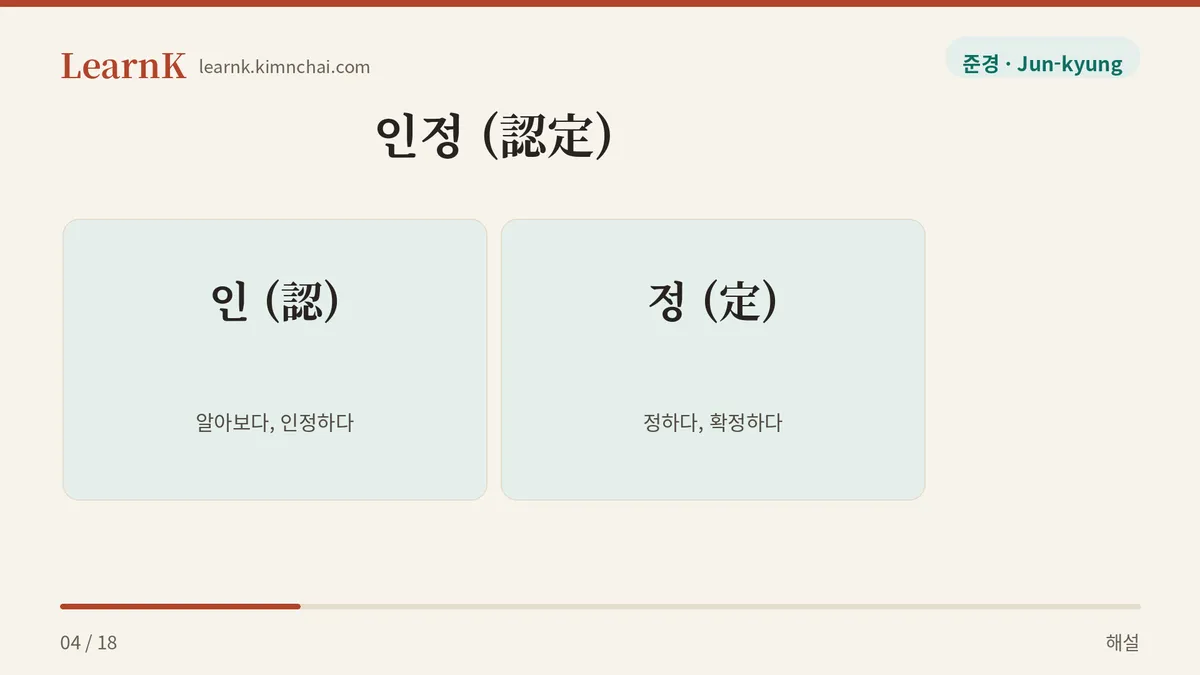
Scene: Class at the academy just ended, and there’s a new tteokbokki place in the neighborhood. The two have just swallowed their first bite.
Jun-kyung: 와, 여기 물건이다. 지금까지 먹은 떡볶이 중에 여기가 원탑이야. Whoa, this place is the real deal. Best tteokbokki I’ve had, hands down.
Emily: 인정. 국물이 안 달고 딱 매콤하네. 계속 손이 가. Agreed. The sauce isn’t sweet, just the right spicy. I keep going back for more.
Jun-kyung: 그치? 근데 튀김은 좀 눅눅하지 않아? Right? But the fried stuff is a little soggy, no?
Emily: 어어, 그건 좀… 튀김은 저 앞 분식집이 훨씬 낫지. Yeah, that part… the place up front does the fried snacks way better.
Jun-kyung: ㅇㅈㅇㅈ. 튀김은 거기가 국룰이지. For real, for real. That spot’s the standard for fried snacks.
Emily: ㅋㅋ 아저씨가 줄임말은 또 왜 이렇게 잘 써. Haha, why’s a middle-aged guy so good with the slang?
Example Usage by Situation
1. Backing up a friend’s complaint When a friend says “월요일 아침은 진짜 세상에서 제일 힘든 것 같아 (Monday mornings really feel like the hardest thing in the world),” you don’t need a long comforting speech — one word does it. 완전 인정 (wanjeon injeong) — sticking “완전 (wanjeon / totally)” in front turns it into “I feel that so hard.”
2. Showing agreement in an online comment If someone comments “이 장면이 이 드라마의 명장면 (this scene is the drama’s iconic moment)” under a video, you’ll see a string of ㅇㅈ (i-j) or 개인정 (gae-injeong) replies piling up beneath it. “개- (gae-)” is a hot intensifying prefix these days meaning “super, totally,” so “개인정 (gae-injeong)” means “I seriously agree.”
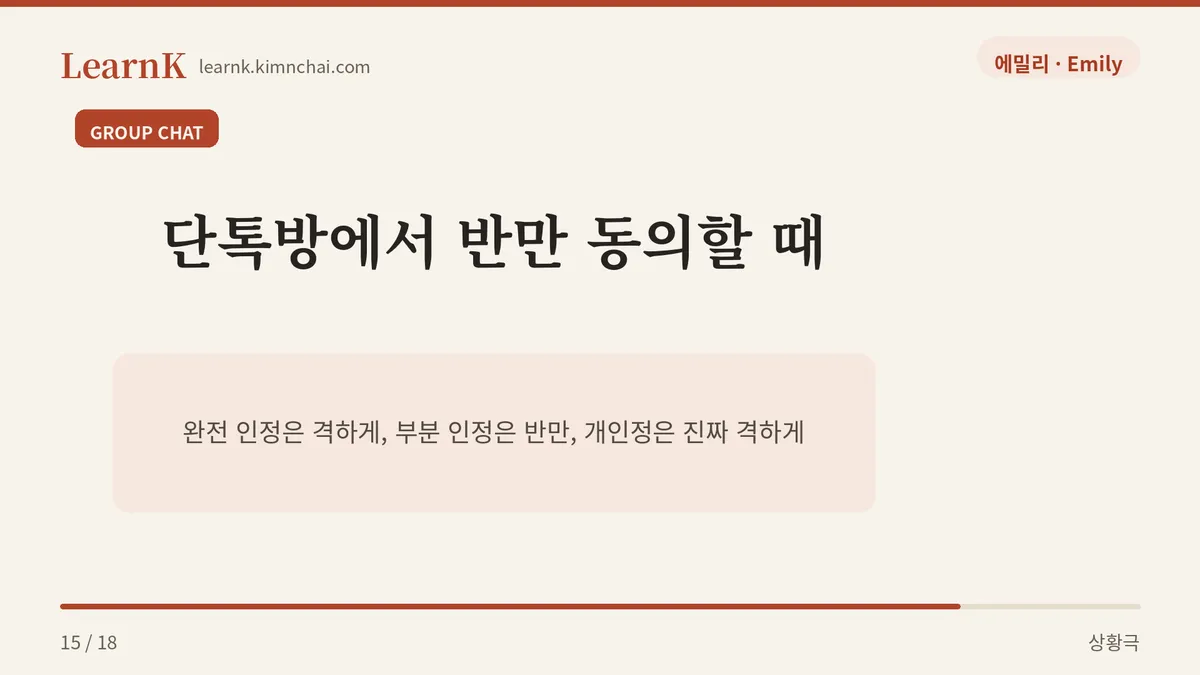
3. Agreeing only halfway When it’s too iffy to agree completely, you say 부분 인정 (bubun injeong / partial injeong). It carries the nuance of “You’ve got a point, but not entirely.”
Formal vs. Casual Speech, and Similar Expressions
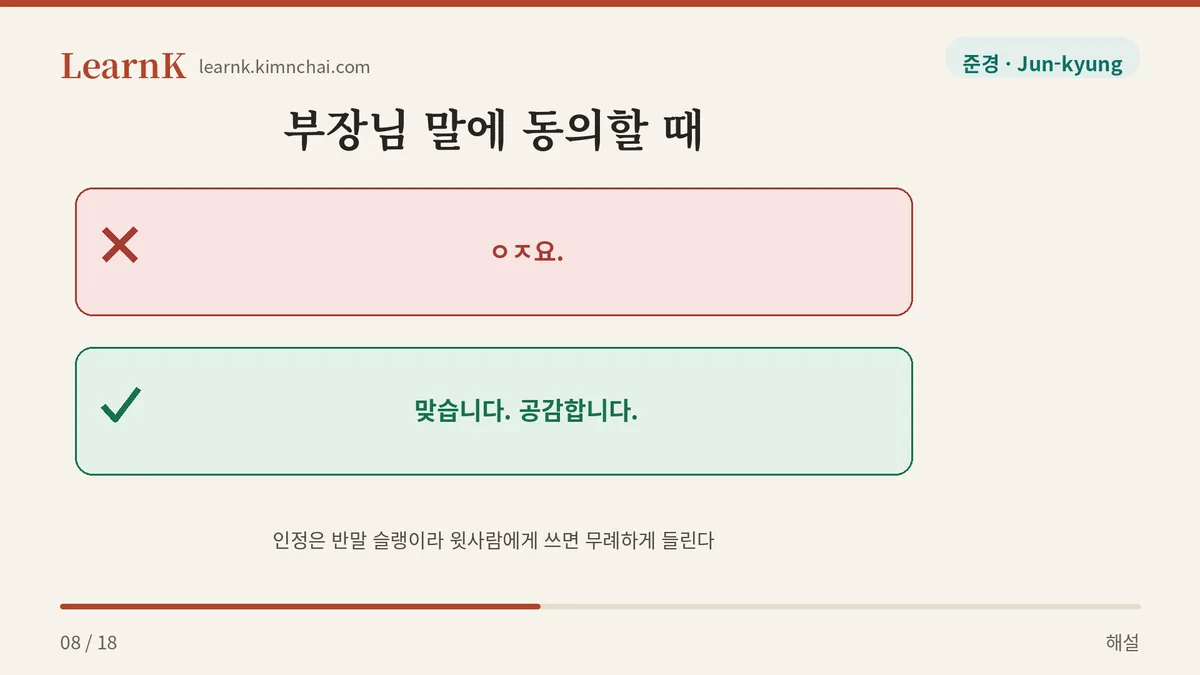
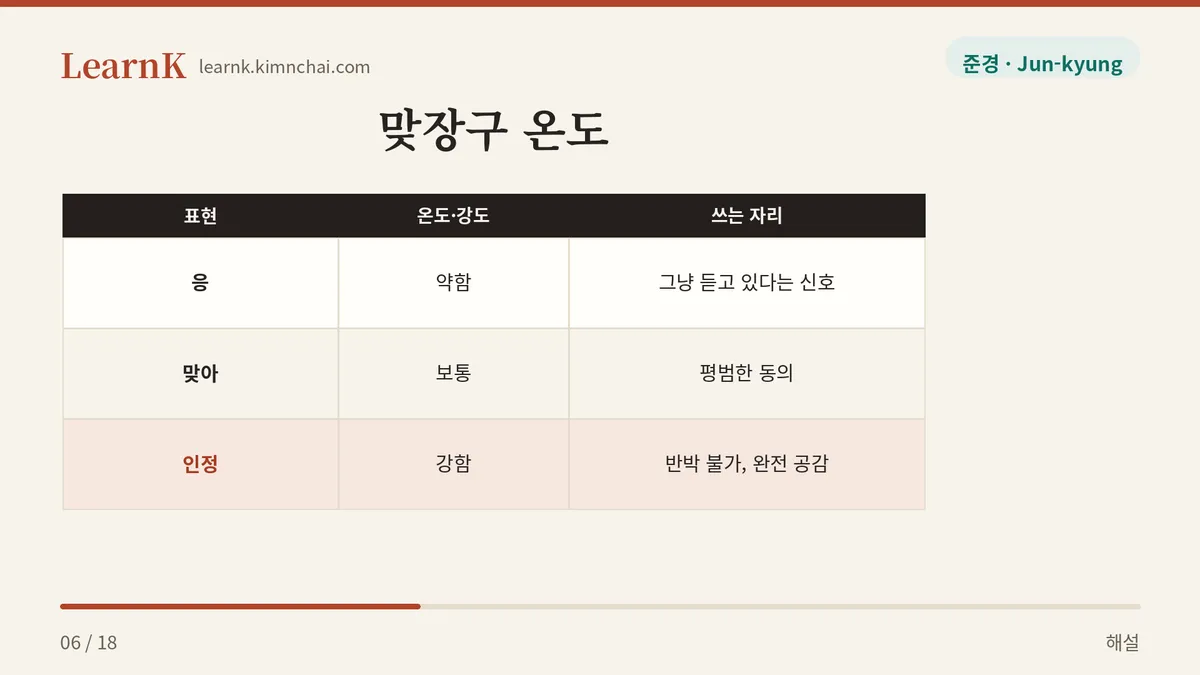
인정 (injeong) is fundamentally casual slang used between friends. You wouldn’t say “ㅇㅈ요” to a senior or in a formal setting. To express agreement to a boss, you’d drop the slang and switch to crisp, formal speech like 맞습니다 (matseumnida / that’s correct) or 공감합니다 (gonggamhamnida / I agree). Similar casual expressions among friends include 그니까 (geunikka / “exactly,” short for 그러니까), 맞말 (matmal / “true words”), and 팩트 (paekteu / fact). Lined up by intensity, they get progressively stronger: “응 (eung) → 맞아 (maja) → 인정 (injeong) → 개인정 (gae-injeong).”
Cultural Background
인정 / ㅇㅈ exploded in popularity when smartphone chat culture met 초성체 (chosseongche) — the habit of writing with only the first consonants of each syllable. It found its place alongside things like ㅋㅋ (laughter) and ㅇㅋ (okay), part of a broader trend of conveying emotion with the fewest possible finger taps. On variety shows, too, the moment a cast member strongly agrees, a big “인정!” often pops up on screen. It started as internet slang for teens and twentysomethings, but now even people in their late thirties — like Jun-kyung — use it casually in everyday life. That’s how thoroughly it’s seeped across generations to become a national go-to for agreement.
Closing Quiz
A friend says “치킨은 역시 시켜 먹는 게 제일 맛있어 (chicken really does taste best when you order it in).” How would you fire back “totally agree!” in a two-syllable slang word?
Answer: 인정 (injeong) — and if you’re chatting, you can just type ㅇㅈ!