Inseong-nollan — The Word Koreans Ask About Before Talent
인성논란
인성논란 (inseong-nollan) means an incident in which word spreads that someone’s character and attitude were bad, and the public starts arguing loudly about what kind of person they really are. Picture this: you’re deep into a drama starring an actor you like, and suddenly a news alert pops up on your phone — an eyewitness says he screamed at a staff member on set. The comment section explodes, screenshots circulate through online communities, and within a day his agency posts an official statement. The single word Koreans use for this whole situation is 인성논란 (inseong-nollan).
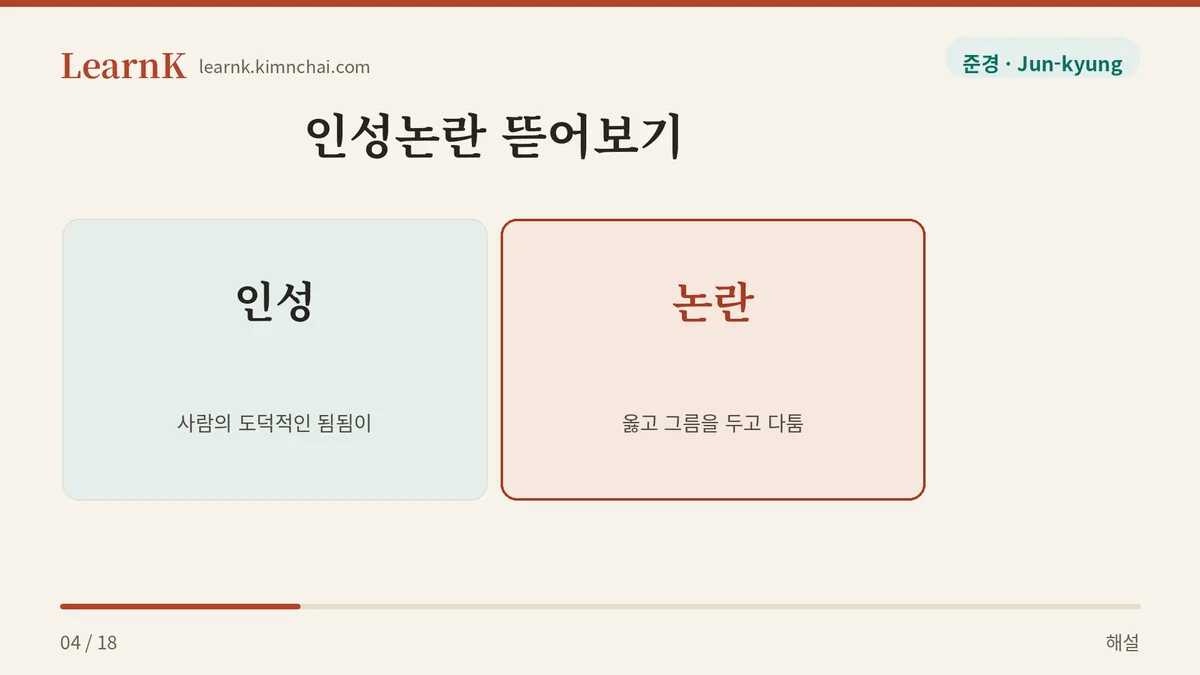
If you follow Hallyu, you’ve almost certainly seen this word in entertainment news more than once. And yet it’s hard to find in a dictionary. That’s because it’s a relatively new compound, made by sticking together 인성 (人性, inseong) and 논란 (論難, nollan). So plenty of learners can guess the meaning but have no feel for its temperature. This word is far heavier than it looks.
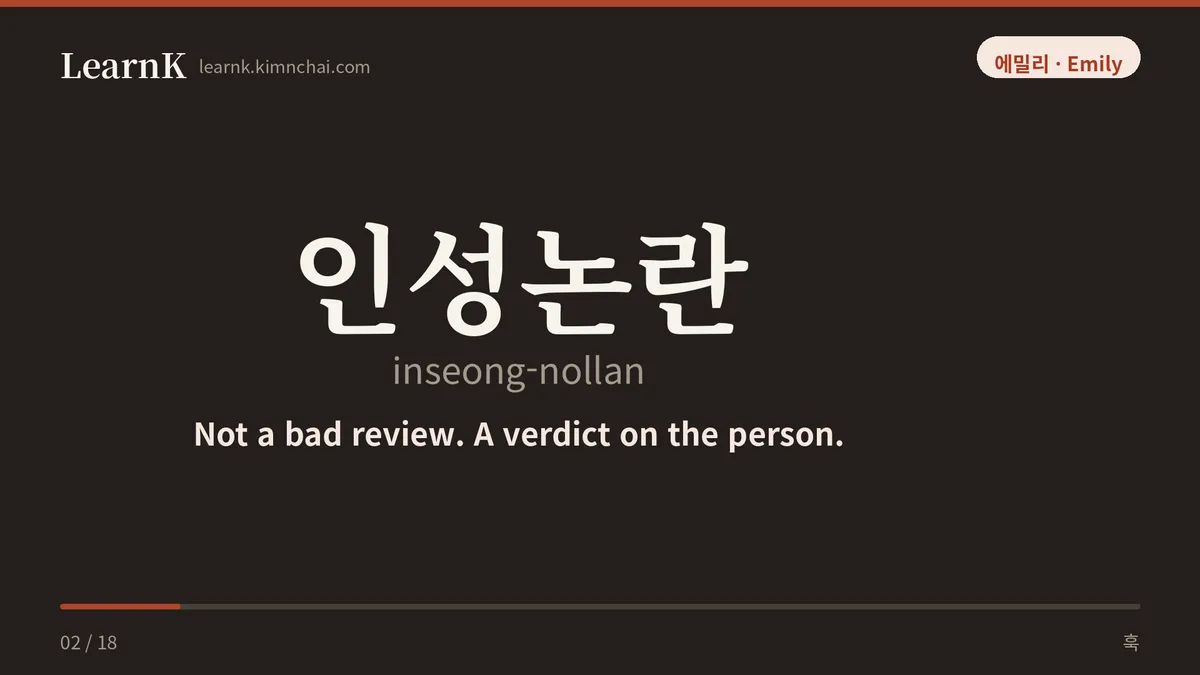
Why so heavy? In Korean, 인성 (inseong) isn’t simply “personality.” 성격 (seonggyeok) is temperament — quiet, outgoing — with no good or bad attached. 인성 (inseong), on the other hand, points to your moral makeup. Do you greet people? How do you treat someone in a weaker position than you? Are you the same person after the camera turns off? So when an 인성논란 (inseong-nollan) breaks out, what the public is putting on trial isn’t one mistake — it’s the person. An acting-ability controversy takes aim at your skill as an actor; an 인성논란 (inseong-nollan) takes aim at your qualifications as a human being. That’s exactly why it lingers next to an actor’s name long after the noise dies down.
Grammatically it’s a noun, and it almost always shows up paired with one of a few verbs. 인성논란이 터지다 (inseong-nollan-i teojida) — the feeling of something suddenly bursting into flames. 인성논란에 휘말리다 (inseong-nollan-e hwimallida) — the feeling of being dragged in regardless of your own wishes. 인성논란이 있다 (inseong-nollan-i itda) — a flat, matter-of-fact way of noting it as past history. Learn just these three and you’ll understand 90 percent of the sentences in these articles.
Seeing It in a Real Conversation
Scene: Saturday night, the living room at Jun-kyung’s place. The drama they’ve been watching cuts to a commercial break, and Emily glances down at her phone.
Emily: 야, 잠깐만. 지금 이 배우 인성논란 떴는데? Hey, hold on. The actor we’re watching just blew up in a character controversy.
Jun-kyung: 또? 무슨 일인데. Again? What happened?
Emily: 스태프한테 소리질렀다는 목격담. 벌써 캡처 돌아다녀. A witness says he yelled at a staff member. Screenshots are already going around.
Jun-kyung: 아 진짜… 나 이 사람 팬이었는데. 이러면 드라마 보기가 좀 그래. Ugh, seriously… I was a fan of his. Now it feels weird to keep watching.
Emily: 그니까. 연기는 잘하는데 인성논란 한 번 터지면 끝이잖아. Right? He’s a great actor, but once a character controversy hits, it’s over.
Jun-kyung: 근데 목격담 하나로 판단하기엔 좀 이르지 않나? Still, isn’t it a bit early to judge from one account?
When It Sounds Off
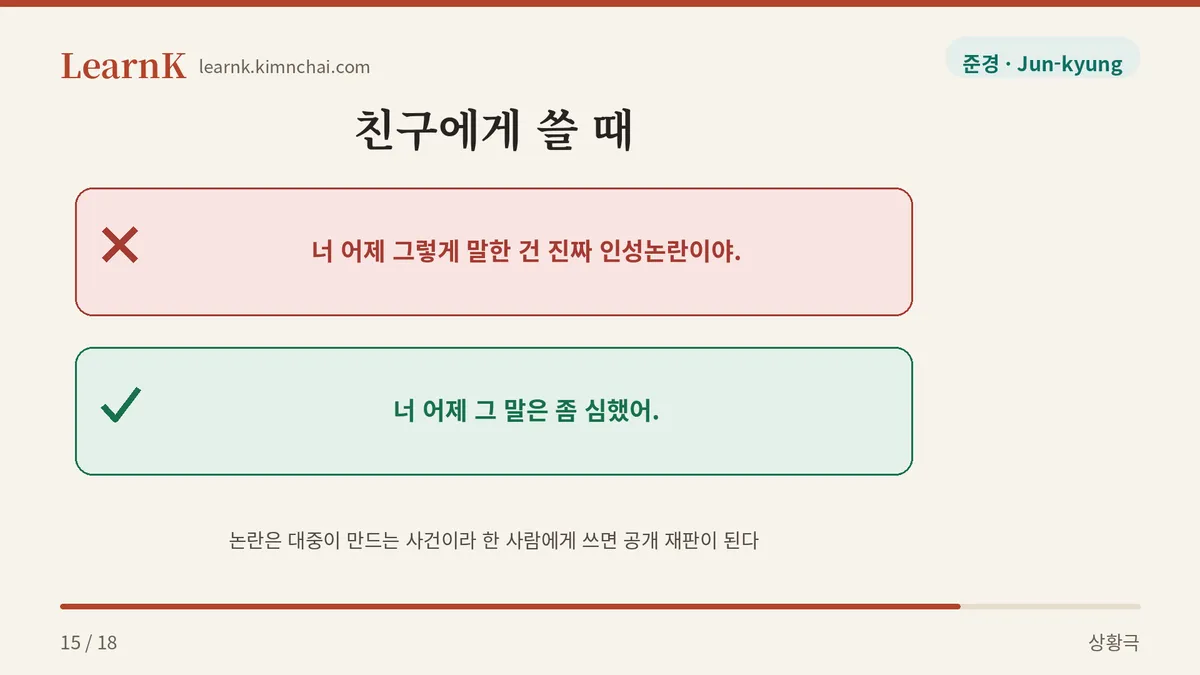
✗ (to a friend’s face) 너 어제 그렇게 말한 건 진짜 인성논란이야. (neo eoje geureoke malhan geon jinjja inseong-nollan-iya.) ✓ (to a friend’s face) 너 어제 그 말은 좀 심했어. (neo eoje geu mareun jom simhaesseo.) — “What you said yesterday was a bit much.” → A 논란 (nollan) is something the public creates. Aiming it at one friend standing right in front of you turns a small slip into a public trial, and it damages the relationship. That said, it’s perfectly natural when you’re joking about yourself — 나 방금 인성논란 터질 뻔했네 ㅋㅋ (na banggeum inseong-nollan teojil ppeonhaenne kk), “I almost had a character controversy just now lol.”
✗ (to your boss in a meeting) 그 거래처 이사님, 인성논란 좀 있으신 것 같아요. (geu georaecheo isanim, inseong-nollan jom isseusin geot gatayo.) ✓ (to your boss in a meeting) 그 거래처 이사님, 저희 팀을 대하는 태도가 좀 아쉬웠습니다. (geu georaecheo isanim, jeohui timeul daehaneun taedoga jom aswiwotseumnida.) — “The director at that client company — his attitude toward our team left something to be desired.” → This word grew up in news articles and online communities, so in a formal setting it sounds flippant, like gossip. On top of that, a 논란 (nollan) is an event other people create, so even bolting on the honorific 있으시다 (isseusida) still leaves it sounding off.
Example Sentences by Situation
1. Telling a friend about an article you read yesterday
어제 그 아이돌 인성논란 터졌대. (eoje geu aidol inseong-nollan teojyeotdae.) → “Apparently that idol’s character controversy blew up yesterday.” 터지다 (teojida) paints the picture of something bursting like a bomb — sudden and spreading fast. Dropping the particle 이 (i) and saying 인성논란 터졌대 (inseong-nollan teojyeotdae) is much closer to how people actually speak. The ending -대 (-dae) is a casual ending used when passing along something you heard from someone else.
2. Praising an actor with a long career
그 배우는 인성논란 한 번 없이 20년을 버텼어. (geu baeuneun inseong-nollan han beon eopsi isimnyeoneul beotyeosseo.) → “That actor has lasted twenty years without a single character controversy.” This is a fun usage — a negative word deployed as praise. In Korean showbiz, saying someone went twenty years without an 인성논란 (inseong-nollan) reads as higher praise than complimenting their talent. This one sentence tells you everything about what Korean fandom values.
3. Reading the news or an agency statement
소속사는 인성논란에 대해 사실무근이라고 밝혔다. (sosoksaneun inseong-nollan-e daehae sasilmugeun-irago balhyeotda.) → “The agency stated that the character controversy is entirely baseless.” 사실무근 (sasilmugeun) is a Sino-Korean word meaning “without any factual basis,” and it shows up in entertainment articles almost like a formula. 소속사 (sosoksa) is the agency an artist belongs to, and 밝혔다 (balhyeotda) means “stated officially.” Memorize this sentence pattern whole and controversy articles get much faster to read.
Formal, Casual, and Similar Expressions
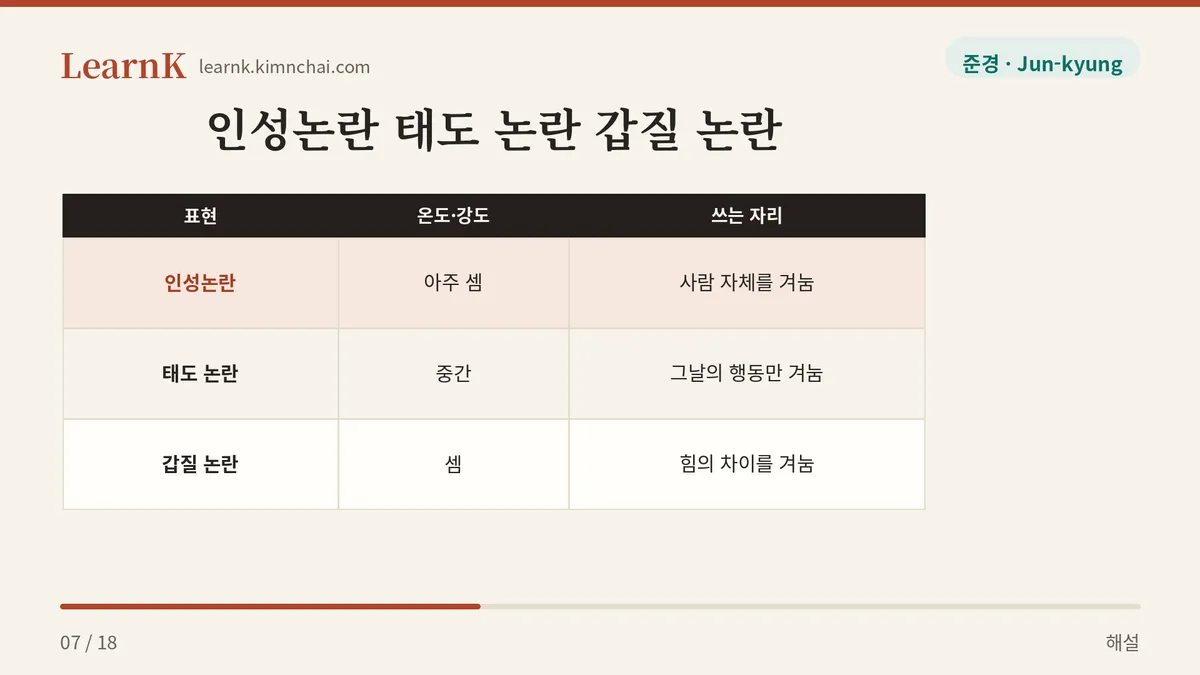
인성논란 (inseong-nollan) is a noun, so it has no honorific form of its own. Politeness gets decided at the end of the sentence. To a friend it’s 인성논란 터졌어 (inseong-nollan teojyeosseo); to an elder, or in news-style writing, it becomes 인성논란이 있었다고 합니다 (inseong-nollan-i isseotdago hamnida).
| Expression | Temperature & Intensity | Where It’s Used |
|---|---|---|
| 인성논란 (inseong-nollan) | Very strong. Aims at the person themselves | Entertainment news, online communities, fan conversations. Never used directly to someone you know |
| 태도 논란 (taedo nollan) | Medium. Aims only at that day’s behavior | Articles and reviews. One notch softer than 인성논란 |
| 갑질 논란 (gapjil nollan) | Strong. Aims at the power gap | When someone in a superior position — a boss, a customer — abuses that power |
| 됨됨이 (doemdoemi) | Neutral, literary | The speech and writing of older generations. Used for both good and bad character |
| 인성이 좋다 (inseong-i jotda) | Warm praise | Anywhere in daily life. The most common use of 인성 |
Call the same incident a 태도 논란 (taedo nollan) and it ends at “guess they were in a bad mood that day.” Call it an 인성논란 (inseong-nollan) and it becomes a verdict: that’s who they always were. Look at which word a headline chose and you can read the outlet’s stance too.
Cultural Background — What Gets Asked Before Talent
The word-building is simple: 인성 (人性, a person’s character) and 논란 (論難, arguing over right and wrong), stuck together as-is. But the weight those two characters carry in Korea doesn’t travel well through translation alone. Korean schools have a formal curriculum called 인성교육 (inseong-gyoyuk, character education), and corporate hiring includes the 인성면접 (inseong-myeonjeop, character interview). The premise that you look at the person before you look at the skills is baked into the institutions. So saying someone’s 인성 (inseong) is a problem is less a performance review than a check on their basic qualifications.
That’s also why the word comes up so relentlessly in the entertainment world. Actors and idols don’t just sell their work — they sell endorsements and an image along with it. So fans want to verify not only what happens on stage but what the person is like after the camera shuts off. The look on their face toward fans at the airport, the tone they use with staff, whether they crouch down to a child’s level at a fan signing — these pile up under the name 목격담 (mokgyeokdam, eyewitness accounts). Enough good ones and you get a reputation as an 인성 좋은 배우 (inseong joeun baeu, an actor with good character); one bad one bursts and you get an 인성논란 (inseong-nollan).
The shadow side is just as real. A single unverified anonymous post can shake a person’s career, and even if it turns out years later to have been a misunderstanding, the controversy is still what surfaces first in search results. So these days Koreans tend to add a note of caution even as they use the word — 좀 더 지켜봐야지 (jom deo jikyeobwayaji, “let’s wait and see a bit more”), 한쪽 얘기잖아 (hanjjok yaegijana, “that’s only one side of the story”). Jun-kyung’s last line in the conversation above hits exactly that temperature.
There are dramas that tackle exposés and trial-by-public-opinion in the entertainment industry head-on. Celebrity (《셀러브리티》, Netflix, 2023), which portrays the underside of the influencer world, puts at the center of its story how a person’s image can be built overnight and collapse overnight. If you can watch something like that and have the word 인성논란 (inseong-nollan) come to mind, you’ve understood not just its meaning but its weight.
Today’s Quiz
A singer you’ve been a fan of for years has worked for twenty years without a single bad rumor. You want to tell a friend about it as a compliment. Which sentence is the most natural?
- 그 가수는 인성논란이 참 좋아. (geu gasuneun inseong-nollan-i cham joa.)
- 그 가수는 인성논란 한 번 없이 20년을 활동했어. (geu gasuneun inseong-nollan han beon eopsi isimnyeoneul hwaldonghaesseo.)
- 그 가수님은 인성논란이 있으세요. (geu gasunimeun inseong-nollan-i isseuseyo.)
The answer is 2. An 인성논란 (inseong-nollan) is itself a negative event, so it can’t attach directly to 좋다 (jotda, “to be good”) the way option 1 does — the phrase that pairs with 좋다 is 인성이 좋다 (inseong-i jotda). Option 3 states something that isn’t true, and since a 논란 (nollan) is an event created by the public, it also clashes with the honorific ending -으세요 (-euseyo). Pair it with 없이 (eopsi, “without”) as in option 2, and you can turn a negative word into the highest praise there is — a sentence that captures exactly how Korean fandom talks.
Definitions and example sentences are from the National Institute of Korean Language’s Basic Korean Dictionary (krdict.korean.go.kr); that portion of this post, including our translations, is licensed under CC BY-SA 2.0 KR.