이생망 (isaengmang) — Four Syllables That Toss Out “This Life Is Ruined” Like a Joke
이생망 (isaengmang)
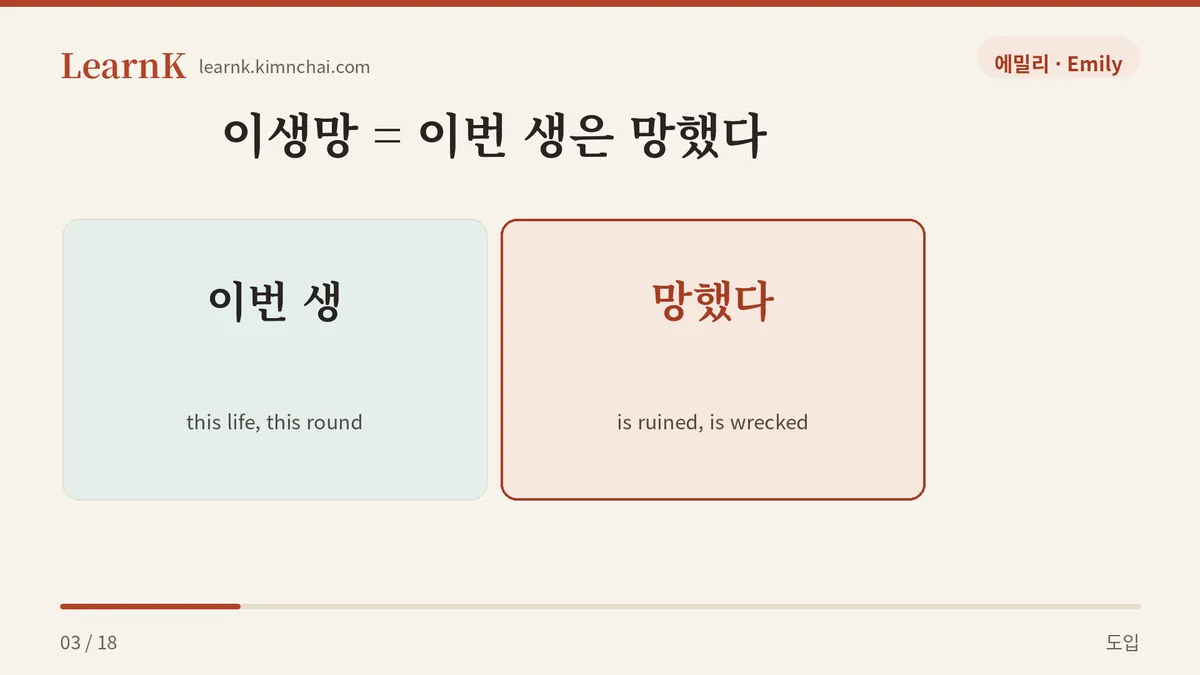
이생망 (isaengmang) is a four-syllable shortening of 이번 생은 망했다 (ibeon saeng-eun manghaetda), “this life of mine is ruined” — meaning this go at life is already wrecked beyond saving. Koreans toss the word out on the night they check an exam score, on the morning they open their bank app one day after payday, on the afternoon they walk out of a salon with five centimeters more cut off than they asked for. 이생망 (isaengmang) — a word that stakes an entire life on one sentence, and yet the moments where it actually gets said are almost always this small.
So the phrase has a mismatch built into it: the weight and the temperature don’t line up. Read the letters alone and it’s nearly a farewell note; listen to the delivery and it’s a smiling complaint. This is exactly the spot where Korean slang confuses learners the most. The meaning is strong but the intensity is mild; the sentence is despair but the face is laughing. Miss that gap and you slip in both directions — using it lightly when something genuinely serious has happened, or taking it gravely when it was a joke.
Start with this: exaggeration is the default setting. People who have truly let go of their lives rarely say this. Being able to say 이생망 out loud means you still have enough room left to turn your own situation into a joke. So the real meaning is usually an over-the-top translation of “I’m pretty upset right now,” and listeners take it that way.
That said, it isn’t 100% a joke either. The word started spreading widely online in the mid-2010s, and it spread alongside talk of jobs you can’t land and housing prices that keep climbing. So there’s a thin layer of genuine resignation at the bottom of it. That’s why, when a friend says 이생망, Koreans laugh but still ask once: “왜, 무슨 일 있어?” (“Why, did something happen?”) Both sides know it might be a signal borrowing the form of a joke.
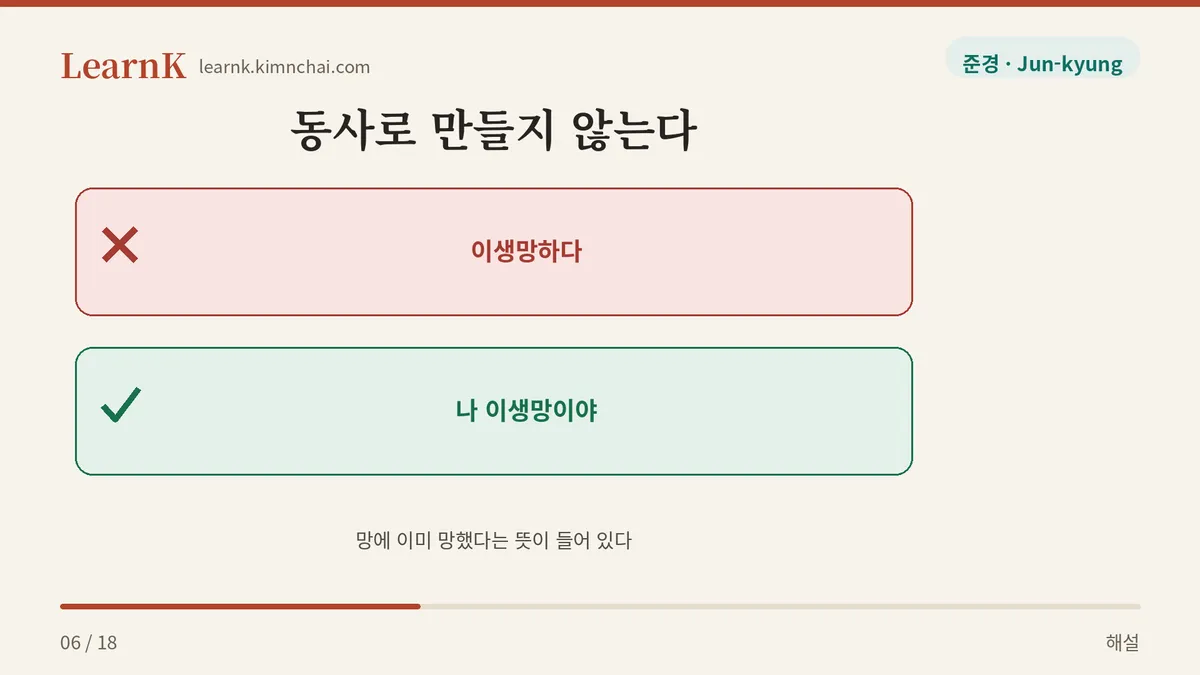
The forms are simple. You can use it like a predicate, as in 나 이생망이야 (na isaengmang-iya), or as a noun chunk, as in 완전 이생망 (wanjeon isaengmang). These days 이생망 각이다 (isaengmang gag-ida) is common too, where 각 (gak) is a slang word meaning “it’s shaping up to go that way.” What you don’t do is turn it into a verb like 이생망하다 (isaengmang-hada) — 망 (mang) already contains the sense of “ruined,” so the verb doubles up.
Seeing It in Real Conversation
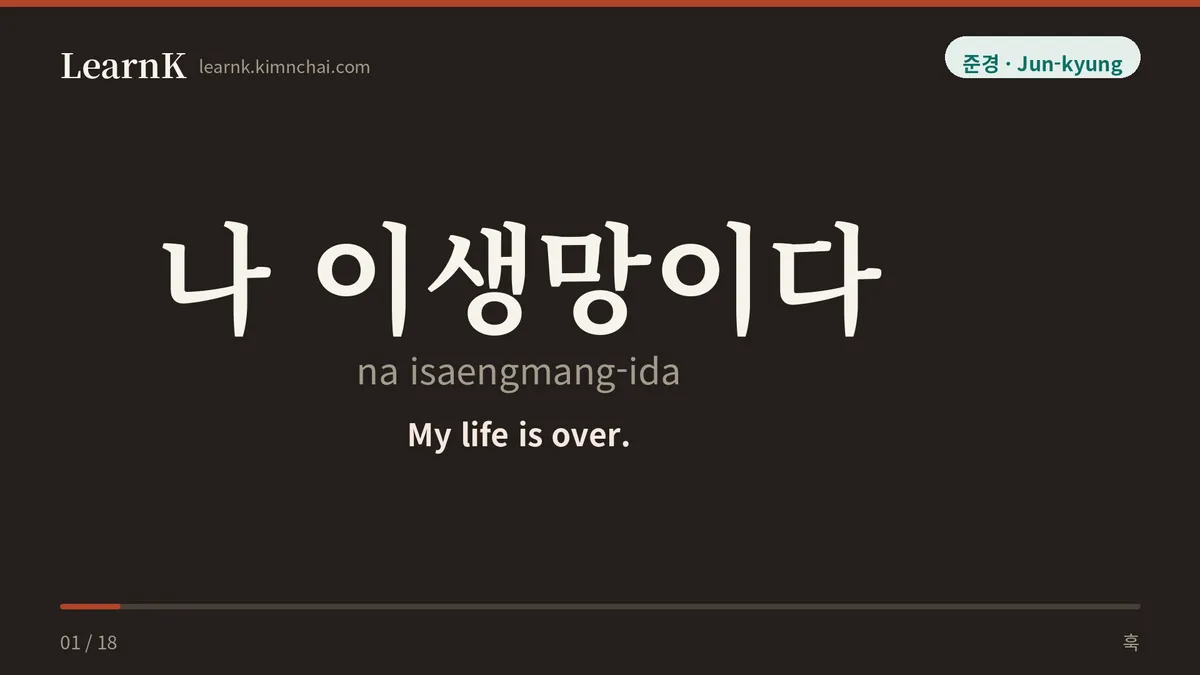
Situation: Out on the street, having just stepped out of the salon. Jun-kyung’s hair came out a good three centimeters shorter than he asked for.
Jun-kyung: 아 진짜… 나 이생망이다. 이 머리로 월요일에 발표해야 돼. Ugh, seriously… my life is over. I have to give a presentation with this hair on Monday.
Emily: 야, 머리 때문에 이생망까지 가? 좀 짧긴 한데 시원해 보여. Hey, you’re going all “my life is ruined” over a haircut? It’s a bit short, but it looks refreshing.
Jun-kyung: 시원한 게 문제가 아니라 귀가… 귀가 다 보이잖아. It’s not about looking cool, it’s my ears… you can see my whole ears.
Emily: 2주면 자라. 우리 팀장님은 1년 내내 그 머리인데 아무도 안 봐. It’ll grow back in two weeks. Our team lead has that same cut all year and nobody notices.
Jun-kyung: 위로가 안 되는데 그거. That is not comforting at all.
Emily: 진짜 이생망은 나야. 나 여기 오는 길에 지갑 잃어버렸어. The real “life is ruined” here is me. I lost my wallet on the way over.
Jun-kyung: …야, 그건 진짜 망한 거네. 카드부터 정지시켜. …Okay, that one’s an actual disaster. Cancel your cards first.
Using It This Way Sounds Off
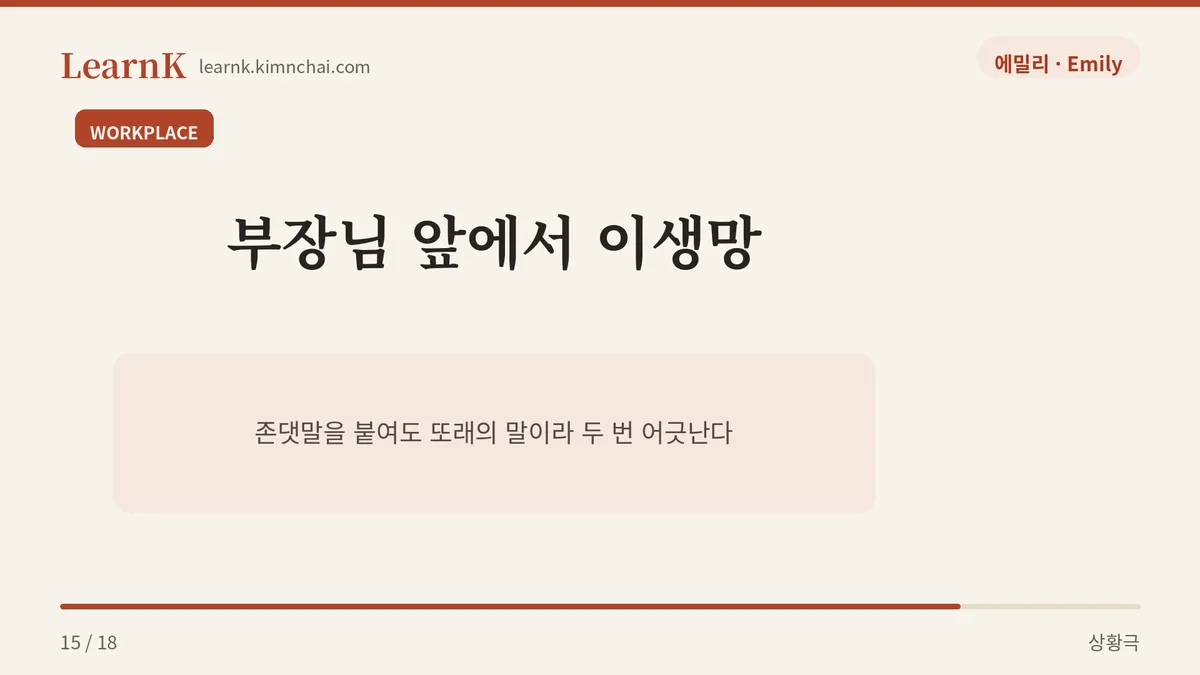
✗ (to your team lead) 팀장님, 저 이번 인사고사 이생망이에요. (timjang-nim, jeo ibeon insagosa isaengmang-ieyo.) ✓ (to a coworker) 나 이번 인사고사 이생망이야. (na ibeon insagosa isaengmang-iya.) → It’s abbreviated slang, so in front of someone senior to you it misses twice. It comes off as too casual, and at the same time it stakes your whole life on a company performance review, which adds an awkward weight. With a superior, something like “이번엔 결과가 좀 아쉬웠습니다 (ibeonen gyeolgwaga jom aswiwotseumnida)” — “The results were a bit disappointing this time” — is the safe choice.
✗ (to a friend who has just told you about their divorce) 너 이생망이네. (neo isaengmang-ine.) ✓ (in that same moment) 야, 뭐라도 좀 먹자. 나와. (ya, mworado jom meokja. nawa.) — “Hey, let’s go eat something. Come on out.” → 이생망 is a word you only use about yourself. Attach it to someone else’s life and it stops being a joke and becomes a verdict. When the other person is genuinely going through something hard, the polite move is to keep this phrase out of your mouth.
Example Sentences by Situation
1. Telling a friend your test result came out one level below the one you were aiming for
아 나 5급 떴어. 이생망이야. (a na o-geup tteosseo. isaengmang-iya.) Ugh, I got level 5. My life is over.
The setup: you prepped for six months aiming for level 6, and level 5 came out. You know perfectly well that level 5 is a good result too. Saying 이생망 while knowing that is precisely where this expression lives. It isn’t real despair — it’s a way of processing the drop between expectation and outcome as a laugh.
2. When your card bill clears the day after payday and your balance is empty
월급 들어온 지 하루 만에 통장이 텅 비었어. 완전 이생망. (wolgeup deureoon ji haru mane tongjangi teong bieosseo. wanjeon isaengmang.) My account was empty one day after payday. Total life-is-over.
One of the most common places this phrase shows up in Korea is the day after payday. Adding 완전 (wanjeon), “totally,” in front makes the joking tone stronger. It looks like emphasis, but what it actually does is flag “I’m not being serious right now.”
3. When you order fried chicken at 2 a.m. on day three of your diet
다이어트 3일 차에 새벽 치킨. 나 이생망 각이다. (daieoteu samil chae saebyeok chikin. na isaengmang gag-ida.) Day three of my diet and I’m ordering fried chicken at 2 a.m. I’m headed straight for life-is-over.
This means you haven’t crashed yet, but you’re headed that way. 이생망 각 (isaengmang gak) talks about a premonition, not a result. It fits especially well in things you mutter to yourself or post on social media.
Polite vs. Casual Speech, and Similar Expressions
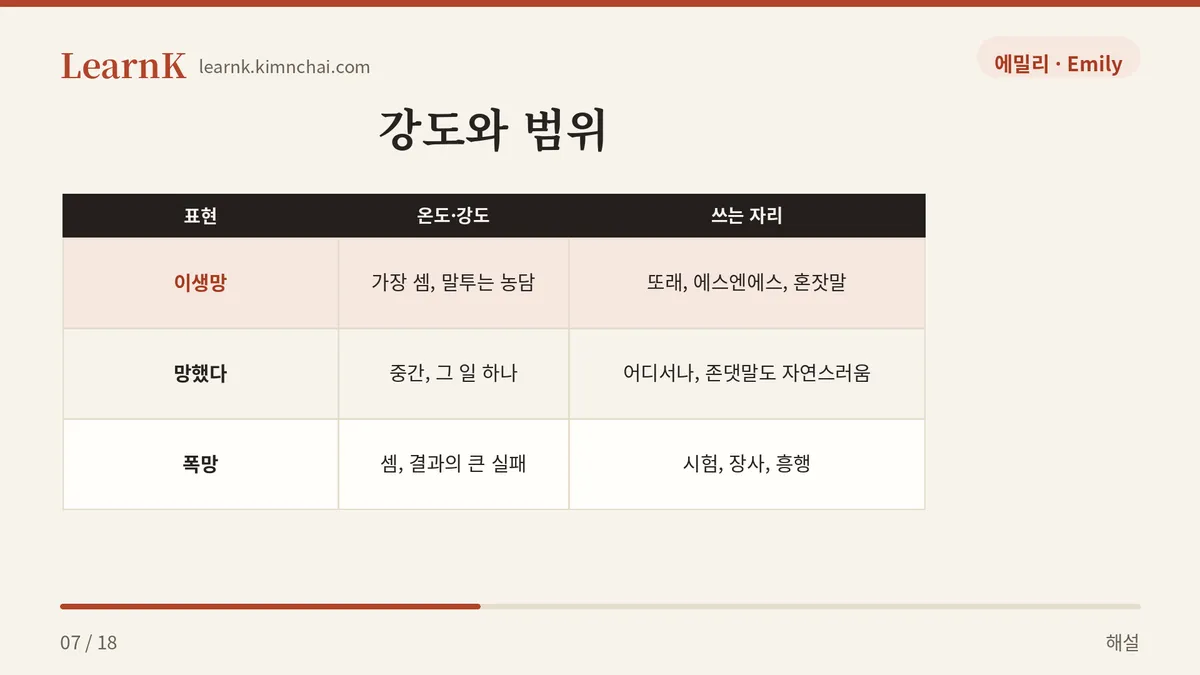
이생망 was born in casual-speech territory. 이생망이야 (isaengmang-iya) is the basic form, and grammatically you can build a polite version like 이생망이에요 (isaengmang-ieyo). But the people that form suits are people not far off from you in age — a close senior at school, say, or an easygoing coworker. Sticking a polite ending on it does not make it a word you can use in front of a department head or an older adult. It isn’t the ending that’s the issue; the word itself belongs to your own age group.
Line it up against similar expressions and the intensity differences come into focus.
| Expression | Tone & intensity | Where it’s used |
|---|---|---|
| 이생망 (isaengmang) | Strongest. Stakes your whole life, but the delivery is a joke | With peers, on social media, muttered to yourself. Not with seniors. Rude if applied to someone else |
| 망했다 (manghaetda) | Middle. Only that one thing is ruined | Anywhere. Polite forms like “망했어요 (manghaesseoyo)” sound natural too |
| 폭망 (pokmang) | Strong. The outcome was a major failure | Peers, social media. Attaches to outcomes like exams, business, box office |
| 노답 (nodap) | Strong. Resignation — “there’s no answer” | Peers. Used about a person, it edges toward an insult |
The most practical difference is scope. With 망했다 and 폭망, that thing is ruined; with 이생망, my life is ruined because of that thing. So right after a presentation goes badly, “발표 망했어 (balpyo manghaesseo)” is the accurate line, while “발표 때문에 이생망이야 (balpyo ttaemune isaengmang-iya)” is a joke with exaggeration mixed in. Automatically discounting that exaggeration as you listen is basic grammar in Korean peer conversation.
Cultural Background — The Phrase That Reaches for the Next Life
The word formation is transparent: 이생망 ← 이번 생은 망했다. But the part worth noticing isn’t 망 (mang); it’s 이번 생 (ibeon saeng), “this life.” Why bring up 생 (生), a lifetime, at all?
Everyday Korean jokes bring up 다음 생 (daeum saeng), “the next life,” all the time. People say things like “다음 생에는 건물주로 태어나야지 (daeum saeng-eneun geonmuljuro taeeonayaji)” — “Next life, I’m being born as a building owner” — or “다음 생에 만나자 (daeum saeng-e mannaja),” “Let’s meet in the next life,” with no relation to religion at all. The notion of lives following one after another survives inside idiom quite separately from anyone’s faith. 이생망 flips that frame toward pessimism: a joke that says this round is a write-off, so I’ll wait for the next one. Which is why the expression carries a strange sort of ease along with the resignation. It’s the word of someone who can still imagine a next round.
The same frame has been used in the opposite direction, too. The drama 《이번 생은 처음이라》 (Ibeon Saeng-eun Cheoeumira) (tvN, 2017), known in English as Because This Is My First Life, has a title saying that this life isn’t ruined — you’re just clumsy at it because it’s your first. It came out right around the time 이생망 was everywhere, so putting the two side by side shows you what words Koreans in their twenties and thirties were using to handle their own circumstances in that era.
There’s a bit of conversational etiquette here as well. When someone says 이생망, Koreans usually don’t get solemn about it. They take it once with “왜? 무슨 일이야? (wae? museun iriya?)” — “Why? What happened?” — and if it’s nothing serious, they laugh it off together. Lecturing at that point with “you shouldn’t say things like that” kills the mood. Conversely, if the other person’s voice really has sunk, the right move is not to treat it as a joke but to ask one more time. Using this expression properly also means being able to hear which of those two it is.
Today’s Quiz
Which of the following uses 이생망 most naturally?
- (to your team lead) 팀장님, 저 이번 인사고사 이생망이에요. (timjang-nim, jeo ibeon insagosa isaengmang-ieyo.) — “Team lead, my performance review this time is a life-is-over.”
- (to a friend) 나 방금 새로 산 노트북에 커피 쏟았어. 이생망이야. (na banggeum saero san noteubuge keopi ssodasseo. isaengmang-iya.) — “I just spilled coffee on my brand-new laptop. My life is over.”
- (to a friend who has just told you about their divorce) 너 이생망이네. (neo isaengmang-ine.) — “Your life is ruined, huh.”
The answer is number 2. Spilling coffee on a laptop you just bought is genuinely a big deal, but it isn’t life-ending, and processing that gap as a joke is exactly where 이생망 belongs. Number 1 misses twice: it uses slang with someone senior to you, and it stakes your life on a company evaluation. Number 3 attaches the phrase to someone else’s life, which makes it a verdict rather than a joke. 이생망 is always a word you use about your own life only.
Definitions and example sentences are from the National Institute of Korean Language’s Basic Korean Dictionary (krdict.korean.go.kr); that portion of this post, including our translations, is licensed under CC BY-SA 2.0 KR.