Jachebalgwang — The Word for Someone Who Shines Without Any Lighting
자체발광
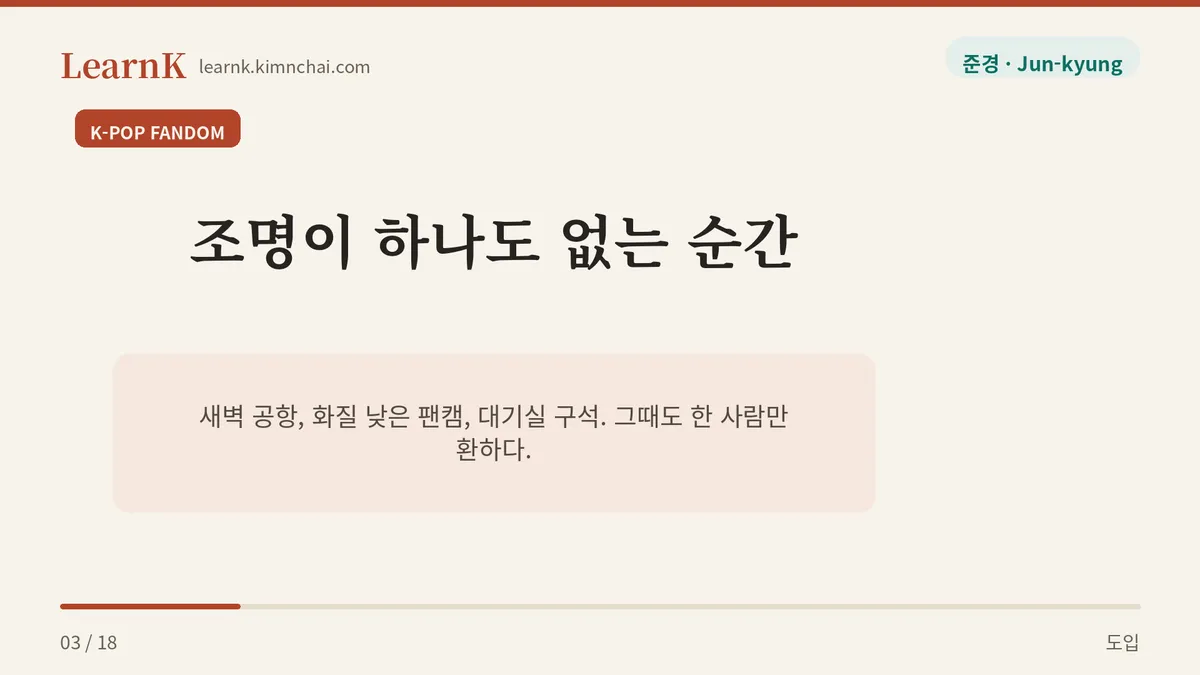
자체발광 (jachebalgwang) means “to give off light on one’s own.” It’s the word you reach for when a person looks bright and eye-catching all by themselves — no lighting, no makeup, no photo editing involved. Of course anyone looks good under concert lights. But sometimes there’s that one person who still looks lit up in a 5 a.m. airport photo, in a grainy fancam, or in the corner of a waiting room where nobody has aimed a single light. That’s the moment Korean K-pop fans pull this word out.
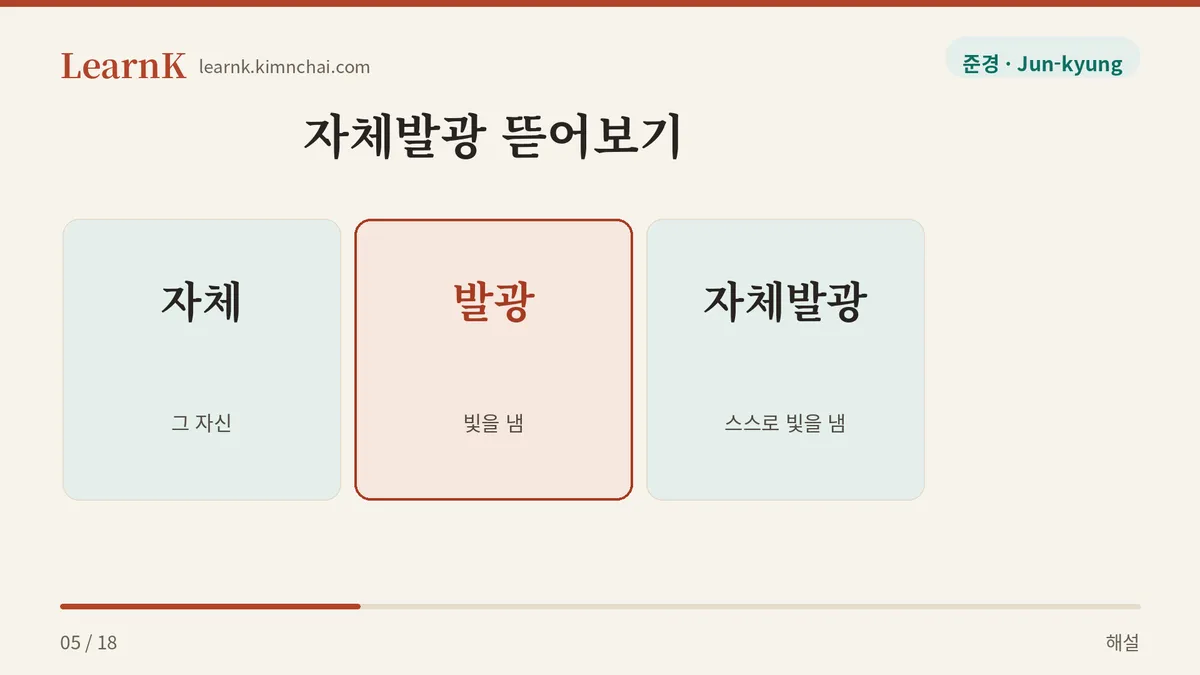
It wasn’t originally a word for people. 자체 (jache) means “itself,” and 발광 (balgwang) means “emitting light.” Stick them together and 자체발광 describes the property of an object producing light on its own instead of reflecting light from outside — a term used for displays and fluorescent materials. Today’s usage takes that exact structure and moves it onto a person. So the core of this word isn’t “pretty.” It’s “the light doesn’t come from outside — it comes from inside that person.” Keep that distinction in mind and every misuse example below will click in one line.
The tone is bright and light. It’s less a serious compliment than an admiring exclamation you make knowing full well it’s an exaggeration. That’s why it thrives between friends, among fans, and in social media comments, and almost never appears in official settings or formal writing. Grammatically it’s a noun, but in real use it attaches like a predicate — 자체발광이다 (jachebalgwangida), 자체발광이었다 (jachebalgwangieotda), 자체발광이네 (jachebalgwangine). The verb form 자체발광하다 (jachebalgwanghada) is reserved for machines and materials; it’s rarely used for people.
And it isn’t only about looks, either. It’s also used for someone whose face is full of life, someone whose eyes sparkle when they talk about their work, or someone with such good energy that being next to them brightens you up too. This extended usage comes back later in the “cultural background” section.
A Real Conversation
Scene: Two hours before the concert, in the merch line outside the venue. They’ve been standing in the blazing August sun for three hours now.
Jun-kyung: 야, 우리 지금 세 시간째 서 있는 거 알아? 나 얼굴 다 녹았어. Hey, do you realize we’ve been standing here for three hours? My face has completely melted.
Emily: 나도. 근데 저기 봐, 맨 앞줄 사람들은 왜 저렇게 멀쩡해? Same. But look over there — why do the people at the front still look totally fine?
Jun-kyung: 그러게. 저 사람들은 뭐… 자체발광인가. Right? What are they, glowing on their own or something.
Emily: 아까 안에서 리허설 소리 났을 때 다들 표정 봤어? 갑자기 눈이 반짝하더라. Did you see everyone’s face when the rehearsal sound leaked out earlier? Their eyes just lit up.
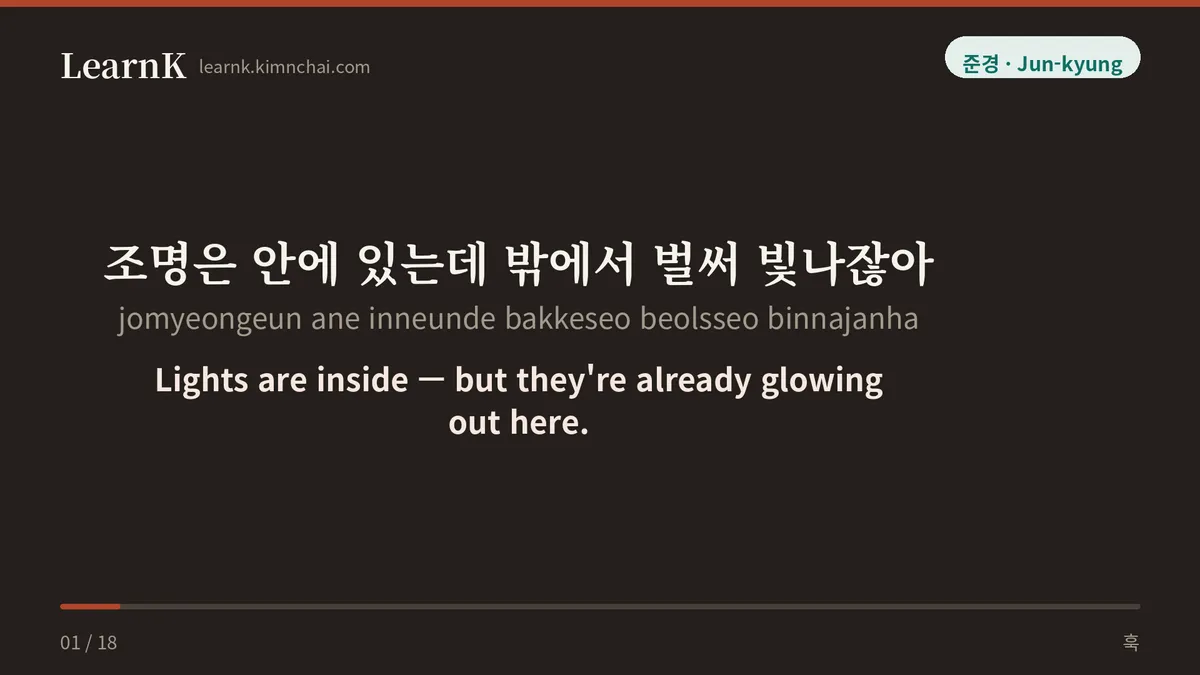
Jun-kyung: 그게 자체발광이지. 조명은 안에 있는데 밖에서 벌써 빛나잖아. That’s what jachebalgwang is. The lights are inside, but they’re already glowing out here.
Emily: 야, 그 말 공연 끝나고 다시 하자. 그땐 우리도 자체발광일걸. Hey, let’s revisit that after the show. By then we’ll be glowing too.
This Sounds Off
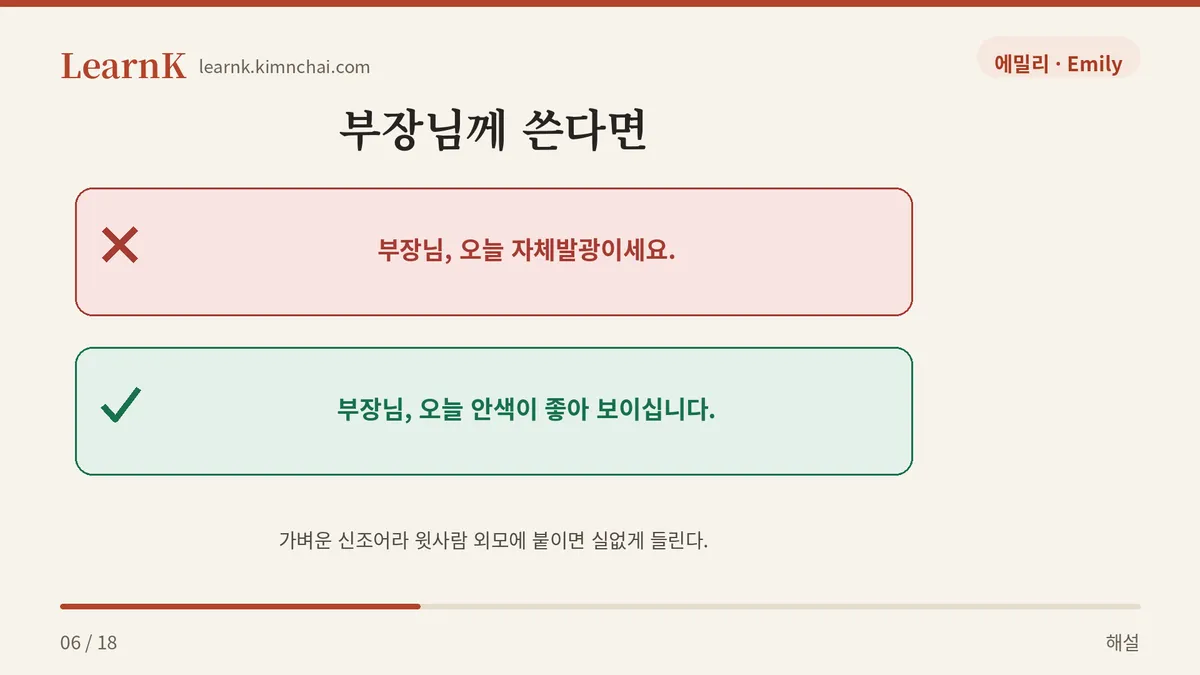
✗ (to your boss) 부장님, 오늘 자체발광이세요. (“Sir, you’re self-luminous today.”) ✓ (to a friend) 야, 너 오늘 자체발광이다. (“Hey, you’re totally glowing today.”) → The grammar is fine; the setting is wrong. It’s a light, almost-slang expression, and on top of that it comments on someone’s appearance — so aimed at an elder or a workplace superior, it lands as either silly or uncomfortably personal. With someone above you, “오늘 안색이 좋아 보이십니다 (oneul ansaegi joa boisimnida)” — “You’re looking well today” — is the safe choice.
✗ 오늘 화장이 진짜 잘 먹었어. 나 완전 자체발광이야. (“My makeup went on so well today. I’m totally self-luminous.”) ✓ 오늘 화장이 진짜 잘 먹었어. 거울 보고 나도 놀랐잖아. (“My makeup went on so well today. Even I was surprised when I looked in the mirror.”) → This time it’s not the setting but the meaning that’s off. 자체발광 means “glowing even without being dressed up,” so using it about a carefully made-up result makes the word contradict itself. To a Korean speaker’s ear, something just doesn’t add up.
Example Sentences by Situation
1. Looking at travel photos a friend sent you
야, 이거 필터도 안 썼다며? 완전 자체발광이네. (ya, igeo pilteodo an sseotdamyeo? wanjeon jachebalgwangine.) Hey, you said you didn’t even use a filter? You’re totally glowing on your own.
The fact that there was no editing has to come first for this word to carry its full weight. “필터도 안 썼는데 (pilteodo an sseonneunde)” — “and you didn’t even use a filter” — is exactly what establishes that the light isn’t coming from outside. Here 완전 (wanjeon) doesn’t mean “completely” so much as “seriously, so” — a colloquial intensifier.
2. Watching a low-quality fancam together
화질이 이렇게 깨졌는데도 저 사람만 보이는 거 진짜 자체발광 맞다. (hwajiri ireoke kkaejyeonneundedo jeo saramman boineun geo jinjja jachebalgwang matda.) Even with the video this pixelated, that’s the only person I can see — definitely self-luminous.
This is the most typical fandom usage. The worse the conditions (resolution, lighting, distance), the more convincing the word becomes. The 맞다 (matda) at the end carries the nuance of confirming that “this expression fits perfectly.”
3. Noticing the vibe of a friend you haven’t seen in a while
너 요즘 무슨 좋은 일 있지? 얼굴에 자체발광 켜졌어. (neo yojeum museun joeun il itji? eolgure jachebalgwang kyeojyeosseo.) Something good’s going on with you lately, right? Your face has its own light switched on.
Here it’s used about energy and expression rather than looks. 켜졌어 (kyeojyeosseo) means “it’s been switched on,” like a lamp — and because the expression comes from light in the first place, it connects this naturally. It’s a variation Korean speakers love to use.
Polite and Casual Forms, and Similar Expressions
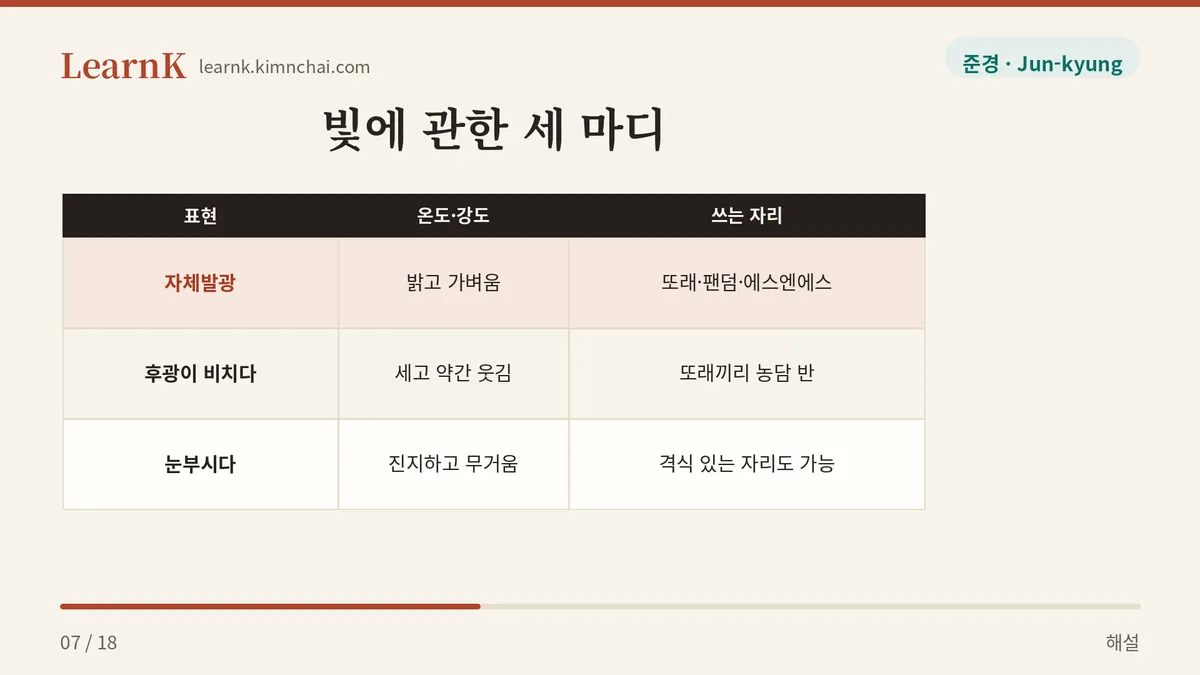
In polite speech it becomes 자체발광이세요 (jachebalgwangiseyo) or 자체발광이시네요 (jachebalgwangisineyo). The forms exist, but as we saw above, there’s almost nowhere to actually use them. A senior who’s close to your age and easy to talk to is about the limit.
| Expression | Tone & intensity | Where it’s used |
|---|---|---|
| 자체발광 (jachebalgwang) | Bright and light. Admiration you know is an exaggeration | Peers, fandoms, social media. Not for elders |
| 후광이 비치다 (hugwangi bichida) | Stronger and a bit funny. Jokingly deifying | Among peers. Half sincere, half teasing |
| 눈부시다 (nunbusida) | Serious and weighty | Fine even in formal settings. Also used in written style |
| 빛나다 (bitnada) | Neutral. Fits any situation | Anywhere — speeches, articles, everyday talk |
후광 (hugwang) refers to the halo painted behind a saint’s head in religious art. So “후광이 비친다 (hugwangi bichinda)” pictures light wrapping around the person from outside, while “자체발광” pictures light leaking out from within. The directions are exact opposites. Using these two distinctly makes you sound like someone whose Korean has come a long way.
Cultural Background — From Displays to People
There’s an interesting story behind how this word moved onto people. 자체발광 was originally a technical and scientific term meaning “the property of emitting light on one’s own.” Some screens need light shone at them from outside to be visible; in others, each individual pixel produces its own light — and this word described the latter.
Korean K-pop fandom borrowed that structure wholesale. Idols on stage are always bathed in hundreds of lights. So the moments fans genuinely marvel at are the ones without lighting — the airport arrivals hall, a candid waiting-room snapshot, a low-resolution direct cam — and for describing someone who still looks unusually bright in those moments, this word fit perfectly. There simply wasn’t another single word that could hold the meaning “it’s not thanks to the lighting.”
By now it has spread well beyond fandom, and it’s also used to mean “a person who gives off their own light without being cowed,” regardless of appearance. That’s the sense the 2017 MBC drama Radiant Office (《자체발광 오피스》) used in its title. It’s a story about job seekers who keep getting rejected but refuse to be discouraged, and here 자체발광 points to attitude, not a face. That’s why, if you ask a Korean about this word, they split into people who think of idols and people who think of that drama.
So if someone in Korea tells you “너 오늘 자체발광이다 (neo oneul jachebalgwangida),” it might mean you look especially good today, or it might mean you seem to be in great spirits lately. Both are good things, so just smile. The most Korean response is something like “에이, 뭘~ (ei, mwol~)” — “Oh, come on~“
Today’s Quiz
Which of these three sentences uses 자체발광 unnaturally?
- 조명도 없는데 저 사람만 환해 보여. 진짜 자체발광이다. (“There’s no lighting at all, but that person alone looks bright. Seriously self-luminous.”)
- 오늘 두 시간 걸려서 화장했거든. 완전 자체발광이지? (“I spent two hours on my makeup today. Totally self-luminous, right?”)
- 너 요즘 뭐 좋은 일 있어? 얼굴에 자체발광 켜졌는데. (“Something good going on lately? Your face has its own light switched on.”)
See the answer
The answer is number 2. 자체발광 means “shining on your own even without being dressed up,” so it doesn’t attach to a result you spent two hours creating. Number 2 would sound more natural as “오늘 화장 진짜 잘 먹었지? (oneul hwajang jinjja jal meogeotji?)” — “My makeup went on really well today, didn’t it?” Number 1 is the most typical usage, since the condition of there being no lighting comes first, and number 3 is the extended usage applied to energy and expression rather than appearance — also perfectly natural.
Definitions and example sentences are from the National Institute of Korean Language’s Basic Korean Dictionary (krdict.korean.go.kr); that portion of this post, including our translations, is licensed under CC BY-SA 2.0 KR.