자취 (jachwi) — What's Left Behind After Something Disappears
자취
자취 (jachwi) means a mark or trace that something has left behind. The little snack shop in the alley you walked past for ten years closes one day, and all that’s left where the sign used to hang is a square patch of soot — a Korean will look at that square and say 여기 가게가 있던 자취가 남았네 (yeogi gagega itdeon jachwiga namanne), “there’s a trace left of the shop that used to be here.” 자취 (jachwi) isn’t a word for an object sitting in front of you; it’s a word for the empty place something left behind after it was already gone.
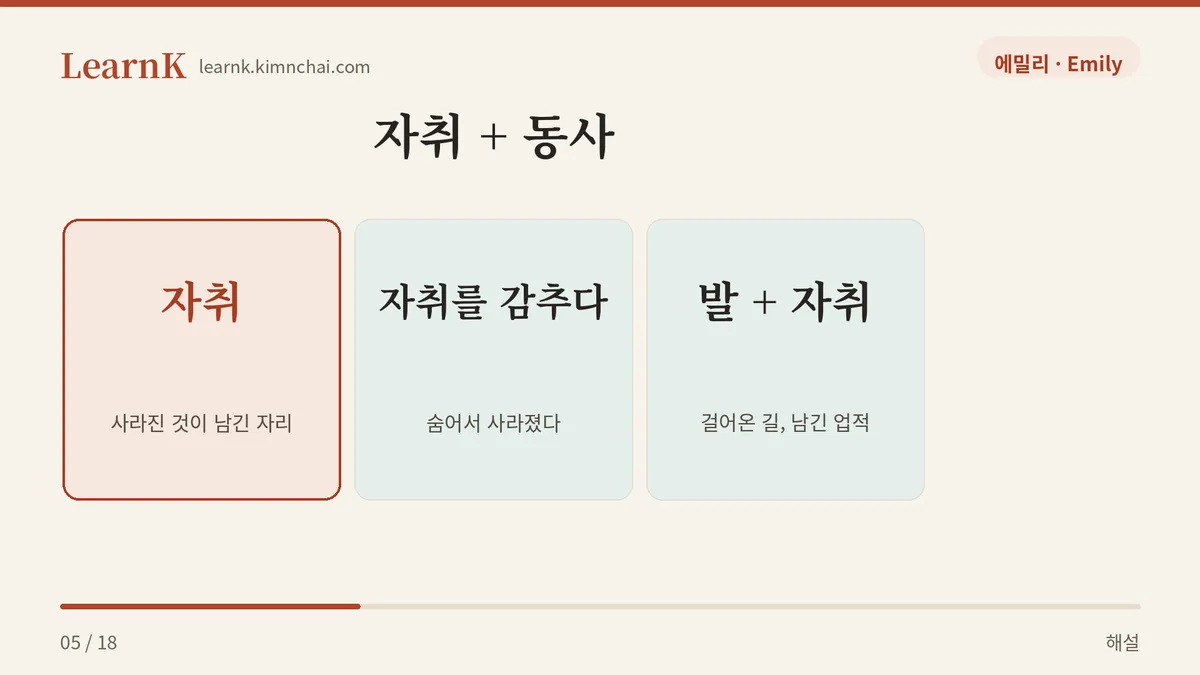
That’s why this word almost always shows up paired with disappearance. The form you’ll meet most often is 자취를 감추다 (jachwireul gamchuda). Literally it’s “to hide one’s traces,” but in practice it stretches much wider than that. You use it when a person cuts off contact and vanishes, when the mosquitoes drop away at the end of summer, when the payphones in your neighborhood disappear one by one. Two things are essential: it was there and now it’s gone, and you can go looking and still have no idea where it went. It isn’t simply “not there” — the frustration of the person doing the looking is baked into the word.
There’s also a direction that runs the opposite way. 발자취 (baljachwi) is 발 (bal, “foot”) + 자취 (jachwi) — the marks you leave as you walk — and it’s used for the path a person has walked through life, or for what they built along the way. So the same word attaches both to “something gone that we miss” and “something left behind that we’re proud of.” What sets the temperature isn’t the word but the verb that follows it — with 감추다 (gamchuda) it becomes disappearance; with 남기다 (namgida) or 더듬다 (deodeumda) it becomes 발자취 (baljachwi), a legacy.
One thing to flag in advance. In the dictionary examples below you’ll also see expressions like 자취 생활 (jachwi saenghwal) and 자취하다 (jachwihada) — these are a different word that just happens to sound the same. It’s the single biggest tripwire for learners, so we’ll handle it separately in the cultural background at the end.
Checking It in the National Institute of Korean Language’s Dictionary
자취 (jachwi) 「Noun」 A mark or trace that something has left. [en] trace; aftermath — A mark or trace that something has left. [ja] あと【跡】。あとかた【跡形】。なごり【名残】 — 何かが残した表示や痕跡。 [es] rastro, huella, vestigio — Marca o vestigio que ha dejado algo. [zh] 痕迹,踪迹,踪影 — 某物留下的标记或形迹。 — National Institute of Korean Language, Basic Korean Dictionary (krdict.korean.go.kr)
The word to watch in that definition is 남긴 (namgin), “left behind.” A 자취 (jachwi) only comes into existence after something has passed through. That’s why the English equivalents include not just trace but aftermath — “what remains afterward.” The dictionary carries no Portuguese translation, so we supplied our own — rastro, vestígio, marca (this line is our translation, not the dictionary’s).
자취를 감추다. (jachwireul gamchuda.) “To vanish without a trace.” 그는 사고가 있던 그날 이후로 자취를 감추고 다시는 나타나지 않았다. (geuneun sagoga itdeon geunal ihuro jachwireul gamchugo dasineun natanaji anatda.) “Ever since the day of the accident he vanished without a trace and never appeared again.” — National Institute of Korean Language, Basic Korean Dictionary (krdict.korean.go.kr)
The first line is this word’s signature idiom (jachwireul gamchuda). The second sentence shows you how much weight that idiom actually carries. Notice the condition attached to the front — 사고가 있던 그날 이후로 (sagoga itdeon geunal ihuro), “ever since the day of the accident.” This isn’t someone stepping out for a minute; it’s someone who cut off a whole chapter of their life and disappeared. 자취를 감추다 (jachwireul gamchuda) belongs to disappearance of that magnitude.
경찰이 단속에 나서자 공갈치며 주민들을 괴롭히던 폭력배가 자취를 감추었다. (gyeongchari dansoge naseoja gonggalchimyeo jumindeureul goerophideon pongnyeokbaega jachwireul gamchueotda.) “Once the police launched a crackdown, the gangsters who had been threatening and harassing residents vanished without a trace.” — National Institute of Korean Language, Basic Korean Dictionary (krdict.korean.go.kr)
Here the sense of “they dodged and hid” is unmistakable. There’s a cause — the crackdown — and because of it they hid themselves on purpose. This is the type you’ll run into most often in news articles, so if you’re studying Korean through Korean news, this is a sentence worth memorizing whole.
걸어온 발자취. (georeoon baljachwi.) “The path one has walked; one’s footsteps.” — National Institute of Korean Language, Basic Korean Dictionary (krdict.korean.go.kr)
The temperature here is completely different from the two examples above. The moment 걸어온 (georeoon, “walked”) attaches to it, 자취 stops being something lost and becomes something accumulated (baljachwi). You’ll hear it at retirement ceremonies, in eulogies, in company anniversary videos: 고인이 걸어온 발자취 (goini georeoon baljachwi, “the path the departed walked”), 우리가 걸어온 발자취 (uriga georeoon baljachwi, “the path we’ve walked”). It’s formal, and a little solemn.
나는 자취 생활을 할 때 거의 매일 건건이로만 밥을 먹었다. (naneun jachwi saenghwareul hal ttae geoui maeil geongeoniroman babeul meogeotda.) “When I was living on my own, I ate almost every meal with nothing but a scrap of side dish.” — National Institute of Korean Language, Basic Korean Dictionary (krdict.korean.go.kr)
Here’s the word that sounds identical but means something entirely different. The 자취 생활 (jachwi saenghwal) in this sentence has nothing to do with traces — it means living away from home on your own and cooking your own meals. 건건이 (geongeoni) is an old-fashioned word for the meager little side dish you scrape together when you have nothing decent to eat with your rice, so the whole sentence paints a picture of “living alone and eating however I could.” We’ll pick the distinction apart in the cultural background.
See It in a Real Conversation
Situation: Saturday afternoon, in front of an apartment complex’s main gate, where they’d arranged to meet for a secondhand sale. The meeting time was twenty minutes ago.
Emily: 오빠, 이 사람 20분째 안 와. 톡도 안 읽어. He’s twenty minutes late and he’s not even reading my messages.
Jun-kyung: 어제 돈부터 보냈다고 하지 않았어? Didn’t you say you sent the money first, yesterday?
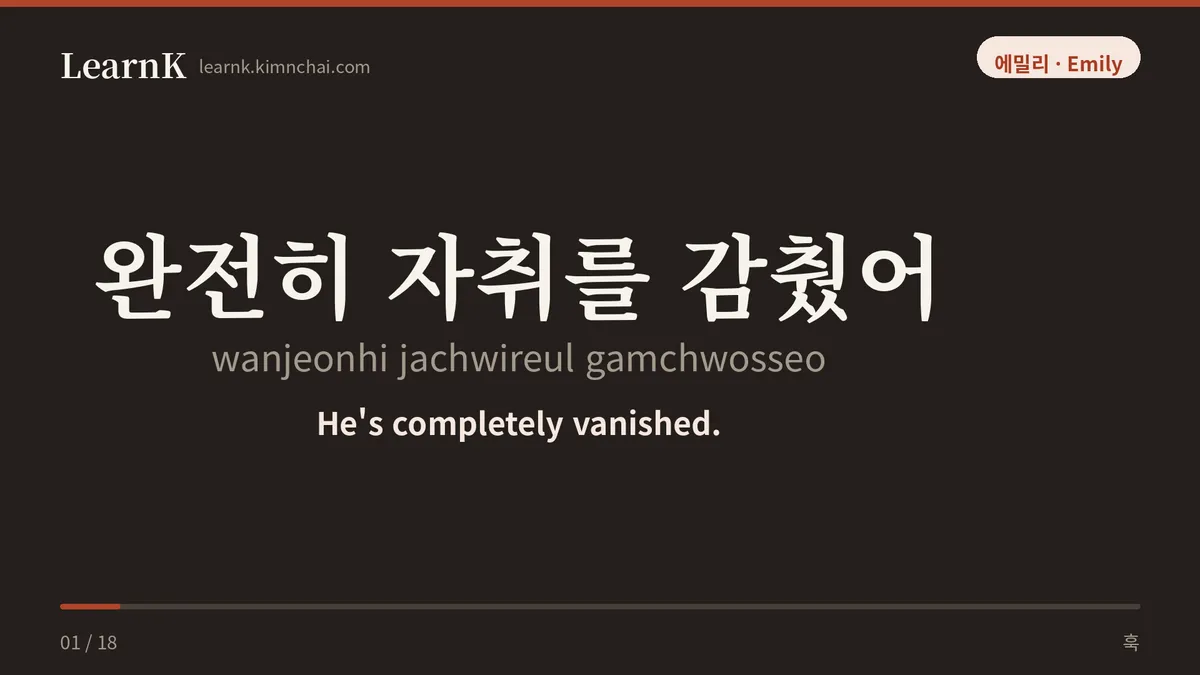
Emily: 응… 입금하자마자 답이 뚝 끊겼어. 완전히 자취를 감췄어. Yeah… the replies stopped the second I paid. He’s completely vanished.
Jun-kyung: 프로필 사진도 내렸네. 이거 계획적인데. He took down his profile photo too. This was planned.
Emily: 나 반년 동안 자취하면서 아낀 돈이란 말이야. 배달도 안 시키고 계란만 부쳐 먹었는데. That’s money I saved up over six months living on my own. I didn’t even order delivery — just fried eggs.
Jun-kyung: 야, 그건 다른 자취고… 아무튼 캡처 다 챙겨. 지금 경찰서 가자. Hey, that’s a different word… anyway, save all the screenshots. Let’s go to the police station now.
These Uses Sound Off
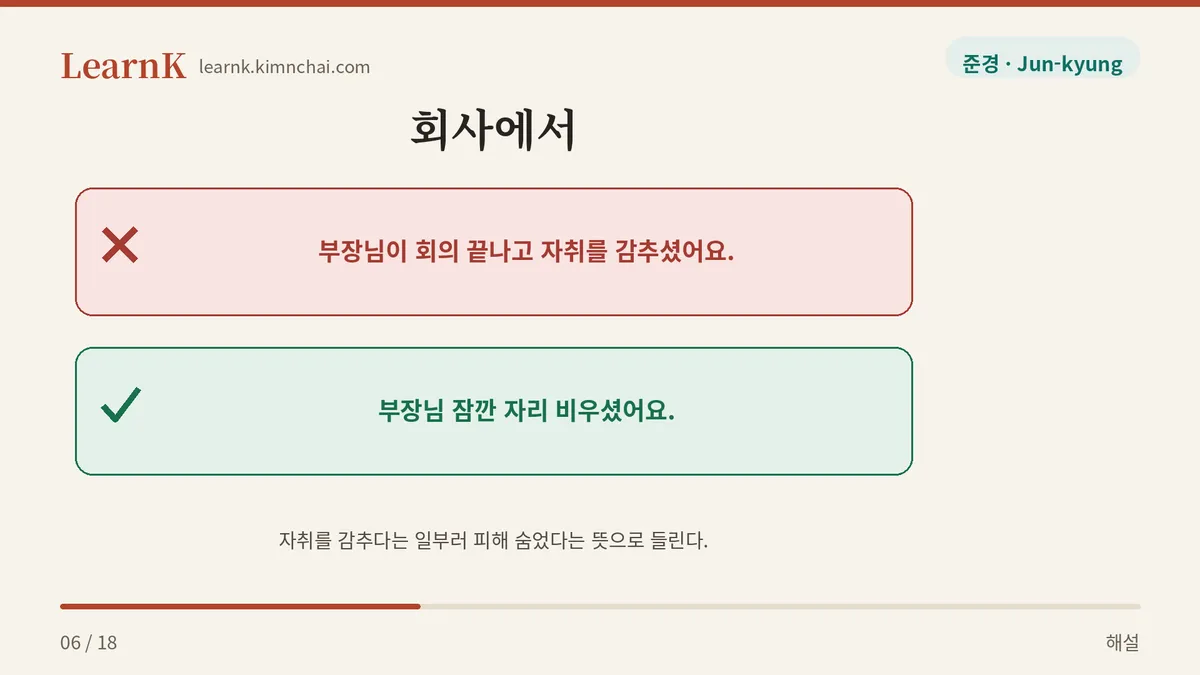
✗ (At work) 부장님이 회의 끝나고 자취를 감추셨어요. (bujangnimi hoeui kkeutnago jachwireul gamchusyeosseoyo.) — “The manager vanished without a trace after the meeting.” ✓ (At work) 부장님 잠깐 자리 비우셨어요. (bujangnim jamkkan jari biusyeosseoyo.) — “The manager stepped away for a moment.” → 자취를 감추다 (jachwireul gamchuda) carries the nuance of “deliberately dodging and hiding.” Say it about someone who went to the restroom or stepped out briefly and it lands as a jab: “he dumped his work on us and ran.”
✗ (To family) 할머니가 마트에 가셨다가 자취를 감추셨어요. (halmeoniga mateue gasyeotdaga jachwireul gamchusyeosseoyo.) — “Grandma went to the store and vanished without a trace.” ✓ (To family) 할머니가 마트에 가셨는데 연락이 안 돼요. (halmeoniga mateue gasyeonneunde yeollagi an dwaeyo.) — “Grandma went to the store and we can’t reach her.” → The more genuinely worried you are, the more you should avoid this phrase. 자취를 감추다 (jachwireul gamchuda) contains the image of “hiding oneself on purpose,” so using it about an elderly person who might be lost or hurt sends completely the wrong message.
Example Sentences by Situation
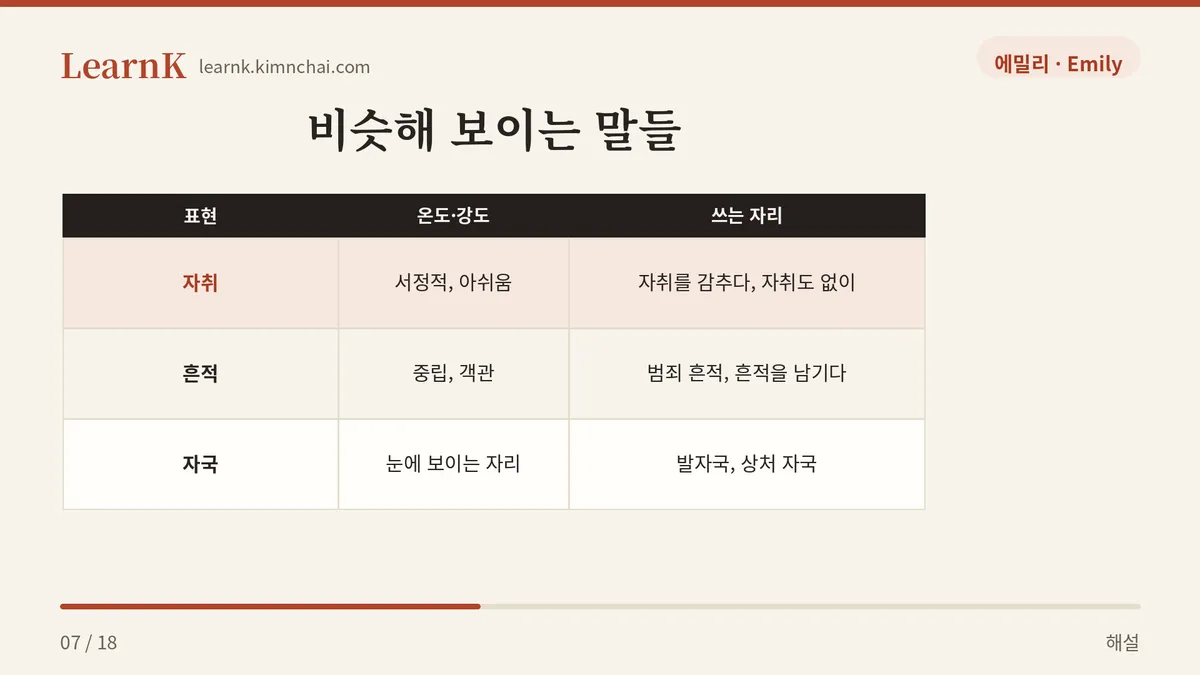
1. When a shop you’d gone to for years disappears
대학교 앞에서 이십 년 하던 그 국숫집이 겨울 사이에 자취도 없이 사라졌다. (daehakgyo apeseo isip nyeon hadeon geu guksujibi gyeoul saie jachwido eopsi sarajyeotda.) “That noodle shop that had been in front of the university for twenty years vanished without a trace over the winter.”
자취도 없이 (jachwido eopsi) is an adverbial expression meaning “without leaving behind a single trace.” You use it when something disappears wholesale — no sign left, not even a farewell note taped to the door. It’s steeped in a sense of loss, which is why it turns up so often when people post about their neighborhood on social media.
2. When a symptom or a phenomenon goes away
약을 먹고 한숨 자고 났더니 두통이 자취를 감췄다. (yageul meokgo hansum jago natdeoni dutongi jachwireul gamchwotda.) “I took some medicine and had a nap, and my headache had vanished without a trace.”
It works perfectly well for non-human things too. Pain, mosquitoes, trends, rumors — anything that “you look up one moment and it’s gone” fits. Used this way, it carries relief rather than frustration.
3. When you talk about the path a person has walked
이 전시는 한 도예가가 오십 년간 남긴 발자취를 한자리에 모았습니다. (i jeonsineun han doyegaga osip nyeongan namgin baljachwireul hanjarie moatseumnida.) “This exhibition gathers in one place the footsteps a ceramic artist left over fifty years.”
This is the formal register of exhibition blurbs, documentary narration, and retirement speeches. Tell a friend 네 발자취 (ne baljachwi, “your footsteps”) and it’s so grandiose it comes off as a joke, so pick your moment.
Politeness Levels and Similar Expressions
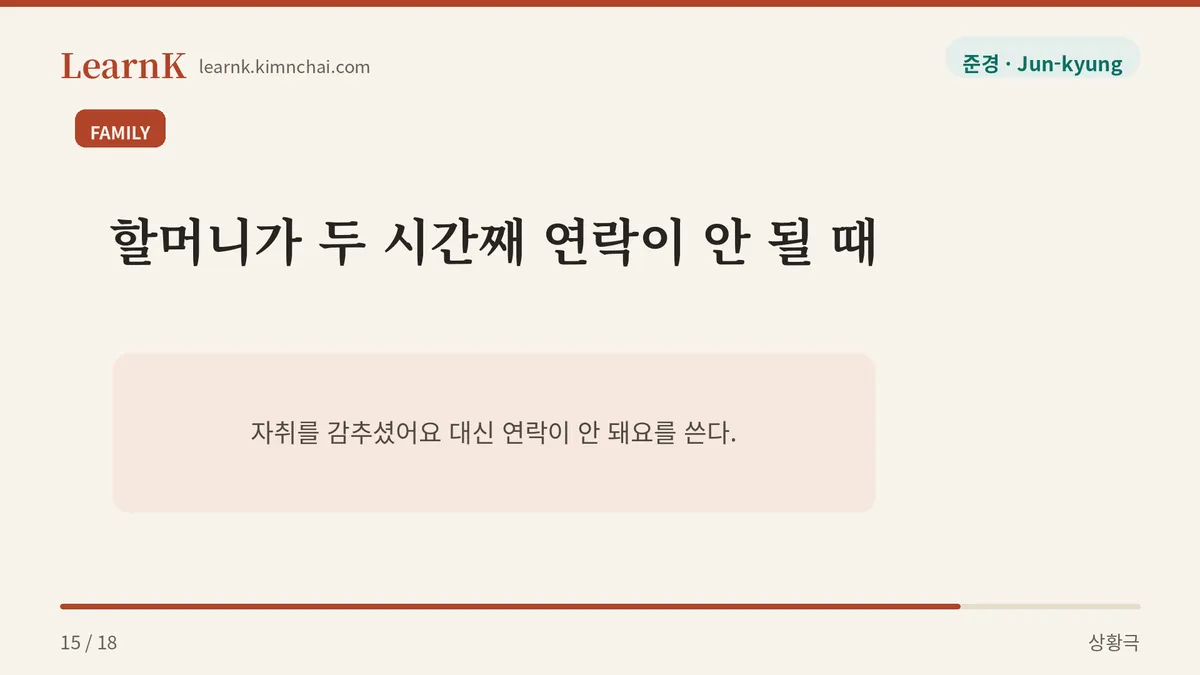
자취 (jachwi) itself is a noun, so it has no honorific form of its own — the level is decided by the verb you pair it with. Casual speech is 자취를 감췄어 (jachwireul gamchwosseo), general polite speech is 자취를 감췄어요 (jachwireul gamchwosseoyo), and formal speech is 자취를 감추었습니다 (jachwireul gamchueotseumnida). If the person who disappeared is your senior you can raise it to 자취를 감추셨다 (jachwireul gamchusyeotda), but as we saw above the phrase itself isn’t a kind one, so in practice it rarely gets used that way.
Lining it up against its lookalikes makes its territory clear.
| Expression | Tone & intensity | Where it’s used |
|---|---|---|
| 자취 (jachwi) | Lyrical, steeped in regret | Talking about something that’s gone. 자취를 감추다, 자취도 없이 |
| 흔적 (heunjeok) | Neutral, objective | Anywhere. 범죄 흔적, 흔적을 남기다 — plain statements of fact |
| 자국 (jaguk) | A visible, physical mark | Concrete marks: 발자국, 상처 자국, 얼룩 자국 |
| 종적 (jongjeok) | Stiff, literary; people only | News and investigations. 종적을 감추다, 종적이 묘연하다 |
Even for the same scene, 범인의 흔적을 찾았다 (beomine heunjeogeul chatatda, “we found the culprit’s traces”) is a factual report, while 범인이 자취를 감췄다 (beomini jachwireul gamchwotda, “the culprit vanished without a trace”) is a description of a disappearance. What’s left on the wall is a 자국 (jaguk); the past event that mark tells you about is the 자취 (jachwi).
Cultural Background — Two Kinds of 자취
Korean has two 자취 (jachwi) that sound the same. The one meaning “trace” is a native Korean word with no Chinese characters behind it, and the compound 발 (bal) + 자취 (jachwi) = 발자취 (baljachwi) shows off that old root. The 자취 Emily used in the conversation, on the other hand, is a Sino-Korean word: 自炊 (自 ja, “oneself” + 炊 chwi, “to cook rice”), literally “cooking one’s own meals.” So 자취하다 (jachwihada) doesn’t just mean living alone — it means “having left home and feeding yourself with your own two hands.” That’s exactly why the dictionary examples come garnished with humble food talk: fried eggs, steamed egg, 건건이 (geongeoni).
This second 자취 is a major pillar of Korean youth culture. Students who come from the provinces to university in Seoul and can’t get a dorm room rent a 자취방 (jachwibang) near campus, and they’re called 자취생 (jachwisaeng). Asking someone how many years they’ve been 자취-ing is a joking way of asking how good their cooking is, and the dictionary example 그는 자취 생활 십 년 만에 살림에는 귀신이 다 되었다 (geuneun jachwi saenghwal sim nyeon mane sallimeneun gwisini da doeeotda, “after ten years living on his own he’d become a wizard at housekeeping”) captures that feeling exactly. In Korean dramas, that shot of a young person sitting in a cramped studio apartment with a single ramyeon pot in front of them is almost always depicting this kind of 자취 생활 (jachwi saenghwal).
The first 자취, by contrast, is the language of historical dramas and the news. A vanished assassin, a shuttered shop, an alley erased by redevelopment — all of them 자취를 감추다 (jachwireul gamchuda). And years later, the documentary that looks back at that same spot reaches for the word 발자취 (baljachwi) again. Korean, it turns out, uses the same word to speak of what’s been lost and to honor what’s been left behind.
Today’s Quiz
Which of the following uses 자취를 감추다 (jachwireul gamchuda) unnaturally?
- 장마가 그치자 그 많던 모기가 자취를 감췄다. (jangmaga geuchija geu manteon mogiga jachwireul gamchwotda.) — “Once the rainy season ended, all those mosquitoes vanished without a trace.”
- 그 가수는 데뷔 삼 년 만에 방송에서 자취를 감췄다. (geu gasuneun debwi sam nyeon mane bangsongeseo jachwireul gamchwotda.) — “Three years after debuting, that singer vanished from TV without a trace.”
- 부장님이 커피 사러 나가셔서 잠깐 자취를 감추셨어요. (bujangnimi keopi sareo nagasyeoseo jamkkan jachwireul gamchusyeosseoyo.) — “The manager went out for coffee, so he’s vanished without a trace for a bit.”
The answer is number 3. 자취를 감추다 (jachwireul gamchuda) carries the weight of “disappeared in a way that leaves you unable to tell where they went,” so applying it to someone who stepped out for a coffee turns into a jab implying they hid on purpose. What you want there is 잠깐 자리 비우셨어요 (jamkkan jari biusyeosseoyo, “he stepped away for a moment”). It only sounds natural, as in 1 and 2, when a person or a phenomenon really has gone unseen for a good while.
Definitions and example sentences are from the National Institute of Korean Language’s Basic Korean Dictionary (krdict.korean.go.kr); that portion of this post, including our translations, is licensed under CC BY-SA 2.0 KR.