잘 먹었습니다 (jal meogeotseumnida) — The Thank-You Koreans Say When They've Finished a Meal
When Koreans finish eating at a restaurant and stand up to leave, or set down their spoon after being treated to a meal at a friend’s house, they say this one line almost automatically: 잘 먹었습니다 (jal meogeotseumnida). Watch enough K-dramas and you’ll keep running into the scene where a character empties their rice bowl, says this, and gives a little bow. Today, let’s take a close look at this expression, which holds the whole spirit of Korean food culture.
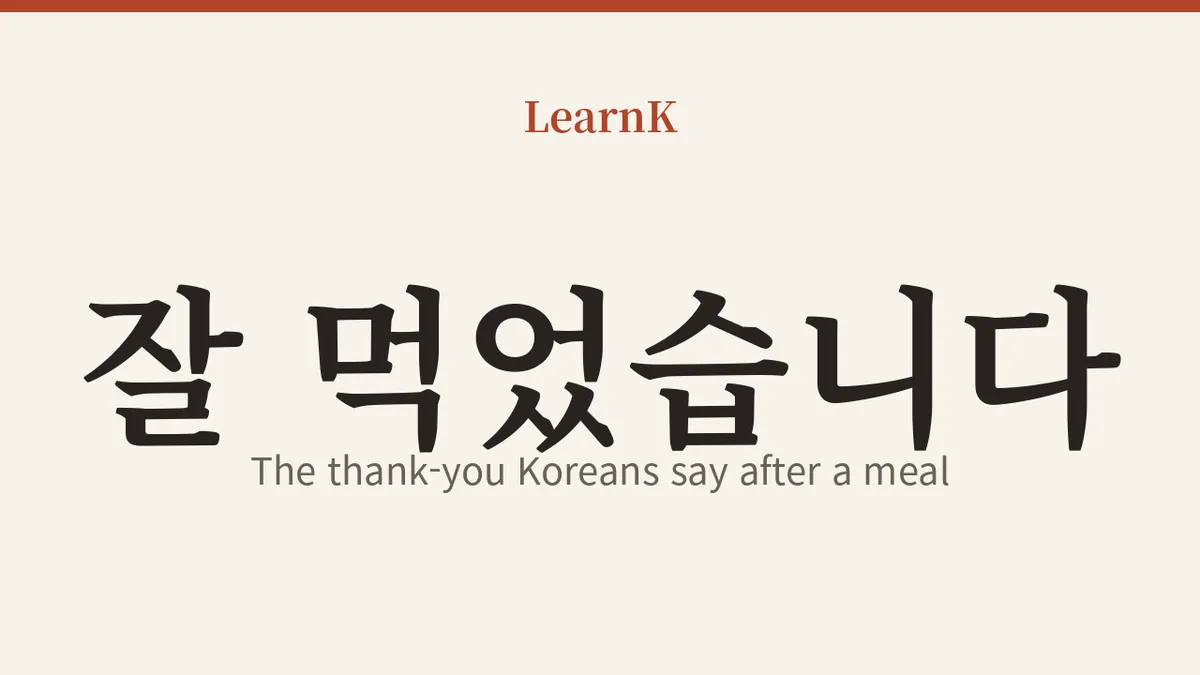
잘 먹었습니다 (jal meogeotseumnida)
Word for word, 잘 먹었습니다 (jal meogeotseumnida) translates as “I ate well.” But the actual nuance isn’t a simple statement of fact — it’s much closer to a thank-you: “That was delicious, thank you.”
Here’s how it breaks down. 잘 (jal) is an adverb meaning “well, satisfyingly,” and 먹었습니다 (meogeotseumnida) is the polite past-tense form of the verb 먹다 (meokda), “to eat.” In other words, it’s used at the point where the meal is already over, which makes it the partner of 잘 먹겠습니다 (jal meokgetseumnida, “I’ll eat well”), the phrase you say as you begin eating. Before the meal, 겠 (future/intention); after the meal, 었 (past) — remember just this one pair and you’ve already learned half of Korean table etiquette.
The key nuance is gratitude toward the person who put the food in front of you. That’s why it comes up far more often when someone else has paid or cooked for you than when you’re eating alone — it’s aimed at that person.
Example sentences by situation
① To a senior colleague who picked up the check at a restaurant
“선배님, 오늘 정말 잘 먹었습니다 (jal meogeotseumnida). 다음엔 제가 살게요!” “Thank you so much for the meal today, seonbae. Next time it’s on me!”
Thanking the person who covered the bill while naturally locking in the next get-together — an extremely common scene in Korea.
② After eating a home-cooked meal made by a friend’s mother
“어머니, 반찬이 너무 맛있어서 밥 두 그릇 먹었어요. 잘 먹었습니다!” “The side dishes were so good I had two bowls of rice. Thank you for the meal!”
Here you’re cheerfully expressing thanks for the care that went into hosting you. In this kind of situation it sounds much more natural when paired with a compliment like “it was delicious.”
③ Getting up from the table as a company dinner wraps up
“부장님, 잘 먹었습니다. 조심히 들어가세요.” “Thank you for the meal, sir. Get home safely.”
A set phrase in Korean workplace culture that delivers thanks for the food and a goodbye all at once.
Seeing it in a real conversation
Scene: The evening of Emily’s moving day. Newspaper is spread out among the moving boxes, and they’ve just finished the jjajangmyeon they ordered in.
Jun-kyung: 아 배불러. 이사엔 역시 짜장면이지. Ugh, I’m stuffed. Jjajangmyeon really is the move on moving day.
Emily: 그치? 오늘 진짜 고마워. 너 없었으면 나 아직 냉장고랑 씨름하고 있었어. Right? Thanks so much for today. Without you I’d still be wrestling with the fridge.
Jun-kyung: (그릇 밀어놓고 허리 꾸벅) 사장님, 잘 먹었습니다. 다음 이사 때도 꼭 불러 주십시오. (pushes the bowl aside, bows deeply) Thank you for the meal, boss. Please call me for your next move too.
Emily: 뭐야 ㅋㅋ 갑자기 왜 존댓말이야. What—haha, why are you suddenly being all formal?
Jun-kyung: 얻어먹었으면 이 정도는 해야지. 밥 사준 사람 앞에서 그냥 일어나면 좀 그렇잖아. Hey, if someone treats you, you gotta do at least this much. Just getting up and leaving would be kind of rude.
Emily: 하긴. 나도 처음엔 “고마워”만 했는데, 요즘은 자동으로 나와. 잘 먹었어, 이렇게. True. At first I’d just say “thanks,” but these days it comes out automatically—like, “that was a great meal.”
Polite and casual forms, plus similar expressions
You can dial the level of formality up or down depending on who you’re speaking to.
- 잘 먹었습니다 (jal meogeotseumnida) — the most formal version. For elders and superiors, people you’re meeting for the first time, and official occasions.
- 잘 먹었어요 (jal meogeosseoyo) — a softer polite form. For a close senior or an older acquaintance.
- 잘 먹었어 (jal meogeosseo) — casual speech. For friends or people younger than you.
A similar expression is 맛있게 먹었습니다 (masitge meogeotseumnida) / 맛있게 먹었어요 (masitge meogeosseoyo), which leans a bit more on the taste as a compliment. On the other hand, be careful not to confuse it with 잘 먹겠습니다 (jal meokgetseumnida), the greeting you say before eating. Before the meal, it’s 겠; after the meal, it’s 었.
Cultural background
In Korea, this greeting isn’t just a habit — it’s the etiquette of a culture built around eating together. Older or more senior people often pick up the bill, so if the person who was treated doesn’t express thanks, it can come across as rude. K-dramas frequently include a scene where a hard-up main character is treated to one warm meal and says this line with tears welling up — that’s how deeply the Korean feeling of 정 (jeong), the affection built by sharing food, is soaked into this expression. It’s also a warm, practical phrase you can toss lightly to the restaurant staff on your way out.
Wrap-up quiz
Which of the following is the greeting you say before you start eating, to express your gratitude?
- 잘 먹었습니다 (jal meogeotseumnida)
- 잘 먹겠습니다 (jal meokgetseumnida)
- 맛있게 먹었어요 (masitge meogeosseoyo)
The answer is #2, 잘 먹겠습니다 (jal meokgetseumnida). If it has 겠 (future/intention), it’s before the meal; if it has 었 (past), it’s after the meal. You’ve got the two straight now, right?