Jamanchu: Not a Blind Date, but a 'Natural Encounter' — Modern Korean Dating in a Single Word
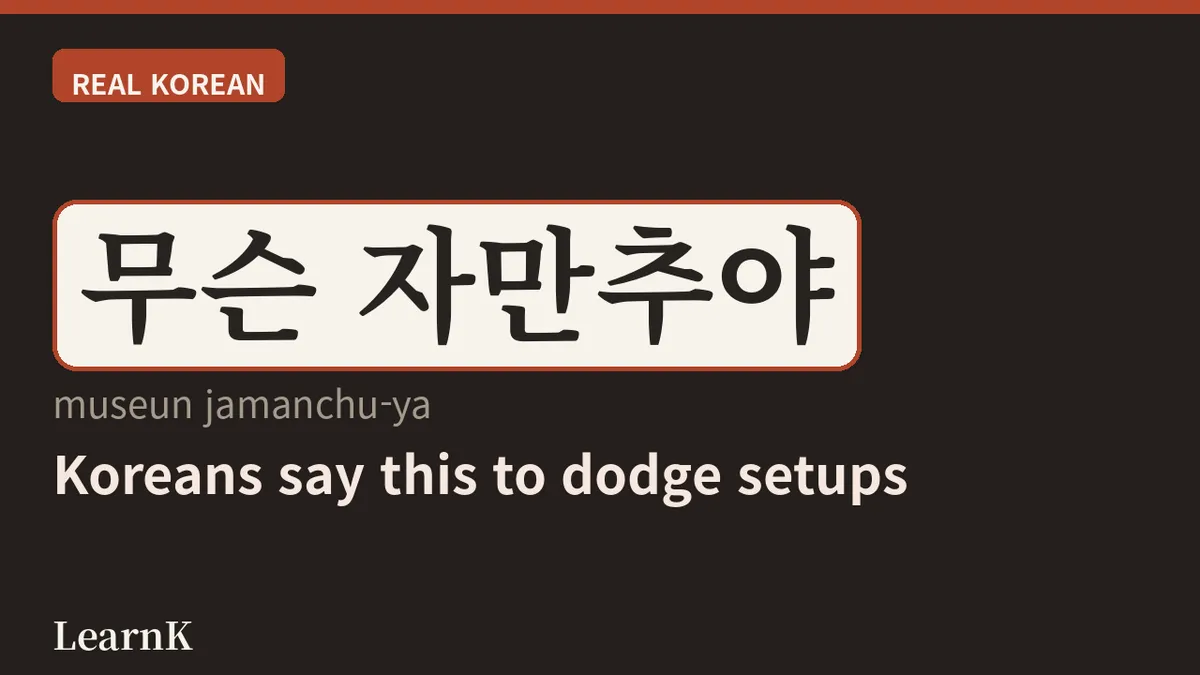
자만추
When you watch Korean dramas, you see so many scenes where two people bump into each other by chance at a café, or cross paths a few times in the same club and fall in love. In real life, though, plenty of couples meet through a blind date (a set-up arranged by friends) or a dating app. There’s a piece of slang that neatly captures the difference between these two ways of starting a relationship, and that’s today’s expression: 자만추 (jamanchu). When a friend asks, “How do you want to meet someone?” you can answer in a single word — “난 자만추” (“I’m a jamanchu person”). Among Koreans in their 20s and 30s, almost everyone knows this buzzword.
Meaning and Nuance
자만추 (jamanchu) is short for 자연스러운 만남 추구 (jayeonseureoun mannam chugu). Taken literally, it means “pursuing (추) a natural (자) encounter (만)” — in other words, pursuing a natural meeting. So rather than a situation deliberately set up for the sake of dating, like a blind date or an app, it refers to an attitude of hoping that a connection will arise naturally within your everyday life — through school, work, a hobby group, or a chance moment.
Make sure to learn the opposite too. 인만추 (inmanchu) stands for 인위적인 만남 추구 (inwijeogin mannam chugu) — “pursuing an artificial meeting.” It describes the attitude of someone willing to actively create the opportunity, through a blind date or an app. Recently, people have taken it one step further with a joking variation, 아만추 (amanchu), meaning you’ll meet just about anyone. All three words share the same “~만추” rhythm, so they’re easy to memorize as a set.
In terms of nuance, 자만추 gives off the vibe of a “laid-back, romantic idealist,” while 인만추 suggests an “efficient, proactive realist.” It’s not really about which is right — it’s a light, witty way to introduce your own dating style.
Example Sentences by Situation
Situation 1 — Chatting with friends about your dating style
나는 원래 자만추 스타일이라 소개팅은 잘 안 나가. (naneun wonlae jamanchu style-ira sogaeting-eun jal an naga.) “I’m a jamanchu type by nature, so I don’t really go on blind dates.”
Here you’re gently turning down a blind-date offer while explaining your preference: “I’m the type who waits for a natural connection.”
Situation 2 — Giving a perpetually single friend some down-to-earth advice
자만추 좋은데, 집이랑 회사만 왔다 갔다 하면서 무슨 자만추야? (jamanchu joeunde, jib-irang hoesa-man watda gatda hamyeonseo museun jamanchu-ya?) “Jamanchu is fine and all, but how can you have a ‘natural encounter’ when you just shuttle between home and work?”
This is a very common teasing jab: “You say you’re waiting for a natural meeting, but you don’t even have any chance to meet new people.”
Situation 3 — A couple who met on an app tweaking their story
사실 앱에서 만났는데, 부모님한텐 그냥 자만추였다고 했어. (sasil app-eseo mannanneunde, bumonim-hanten geunyang jamanchu-yeotdago haesseo.) “Honestly we met on an app, but I told my parents it was just a jamanchu — that we met naturally.”
Here someone is a little embarrassed about meeting on an app and covers by saying they “met naturally.” There’s a subtle hint here that, depending on the generation, a 자만추 is seen as a more “respectable” way to meet.
Formal vs. Casual Speech, and Similar Expressions
Because 자만추 is itself a noun, you can naturally switch between formal and casual speech just by changing the predicate at the end of the sentence.
- Casual: 나 자만추야. (na jamanchu-ya.) — “I’m a jamanchu person.”
- Polite: 저는 자만추예요. (jeoneun jamanchu-yeyo.) — “I’m a jamanchu person.”
Just remember that 자만추 is slang used among friends, peers, and on social media. With a boss at work or an older person you’re meeting for the first time, it’s safer to spell it out, as in “저는 자연스러운 만남을 선호하는 편이에요” (“I tend to prefer meeting people naturally”). Expressions with a similar flavor include 친구에서 애인으로 (chingu-eseo aein-euro) — “from friends to lovers,” for people who become a couple after knowing each other a long time — and 인연 (inyeon), a native-Korean-sounding word for a fateful meeting or relationship, which captures the idea of a natural connection.
Cultural Background
Behind the “자만추 vs. 인만추” divide lies the gap between a reality where dating apps and blind dates have become the norm, and the lingering fantasy of “still wanting to meet someone by destiny, just like in the dramas.” In fact, most first encounters in Korean romance dramas are absurdly coincidental. You bump into someone on the street, that someone turns out to be your new boss at work, and then you discover they live right next door… This kind of “fated coincidence” is exactly the fantasy of an ideal 자만추.
우리, 어디서 본 적 있지 않아요? (uri, eodiseo bon jeok itji anhayo?) “Haven’t we met somewhere before?”
— A line like this represents the classic “jamanchu-style” first-meeting scene that gets replayed, with variations, in the opening episode of countless Korean dramas. Because it’s not so easy in real life, people often laugh and say, “드라마는 다 자만추” — “In dramas, everyone meets by jamanchu.”
Today’s Quiz
A friend asks, “소개팅 하나 해줄까?” (“Want me to set you up on a blind date?”), but you want to reply that you’d rather meet someone naturally. What’s the buzzword that goes in the blank below?
“고맙지만 난 ______ 스타일이라 소개팅은 좀….” (“Thanks, but I’m more of a ______ type, so a blind date is kind of….”)
(Answer: 자만추 (jamanchu) — 자연스러운 만남 추구, “pursuing a natural encounter”!)