정주행 (jeongjuhaeng): How to 'Run' a Drama from the First Episode to the Last
On a weekend morning, tucked under your blanket with the remote in hand, have you ever made this resolution? “Today, I’m finishing this whole drama!” Watching a 20-episode series in order, from episode 1 to the finale, all in a day or two — every K-drama fan falls into this delightful marathon at least once, and Korean has a single word for it: 정주행 (jeongjuhaeng). Today, let’s dig deep into this expression, which pops up hundreds of times a day in the social media posts and comment sections of Korean-culture fans.
정주행
정주행 (jeongjuhaeng) was originally a traffic term meaning that a car or bicycle runs correctly in the set direction. It comes from the Chinese characters ‘바를 정 (正, correct)’ + ‘달릴 주 (走, run)’ + ‘갈 행 (行, go)’ — that is, ‘moving forward in the right direction.’ Its opposite is 역주행 (yeokjuhaeng), running backward.
But as this word crossed over into the world of dramas, webtoons, and YouTube, its meaning expanded. Today, 정주행 refers to watching a piece of content from the first episode to the last, in order, without stopping. It’s the closest expression to the English ‘binge-watching.’ There are two key nuances. First, you watch in order (hence the ‘정,’ meaning ‘correct’). Second, there’s the immersive feeling of watching it all in one continuous stretch.
For example, discovering an already-completed hit drama late and binge-watching it through the night is a classic case of 정주행. The word fits best when there’s that sense of running through it carefully from the very beginning, without skipping any episodes.
Example Sentences by Situation
Situation 1 — When a friend recommends a drama
이 드라마 진짜 재밌대. 이번 주말에 정주행 (jeongjuhaeng) 하려고! (This drama is supposedly really good. I’m going to binge-watch (jeongjuhaeng) it this weekend!)
Here, you’re talking about your plan to binge-watch, over the weekend, a completed drama a friend recommended. It’s most often used together with ‘하다,’ in the form 정주행하다 (jeongjuhaenghada).
Situation 2 — The day after pulling an all-nighter
어제 16부작 드라마를 하룻밤에 정주행 (jeongjuhaeng) 했더니 눈이 너무 아파요. (I binge-watched (jeongjuhaeng) a 16-episode drama in a single night yesterday, and now my eyes really hurt.)
This means you watched an entire series in one all-nighter. Here, it also carries a slightly regretful nuance of ‘I got so absorbed that I overdid it.’
Situation 3 — Announcing your resolution before you even start
시즌 2 나오기 전에 시즌 1부터 다시 정주행 (jeongjuhaeng) 할 거예요. (Before Season 2 comes out, I’m going to binge-watch (jeongjuhaeng) it all over again from Season 1.)
This is when you rewatch a show from the beginning to refresh your memory ahead of a new season. ‘다시 정주행’ (binge-watch again) is a natural combination that emphasizes rewatching.
Comparing Formal/Casual Speech and Similar Expressions
Even with the same meaning, the form changes depending on your tone.
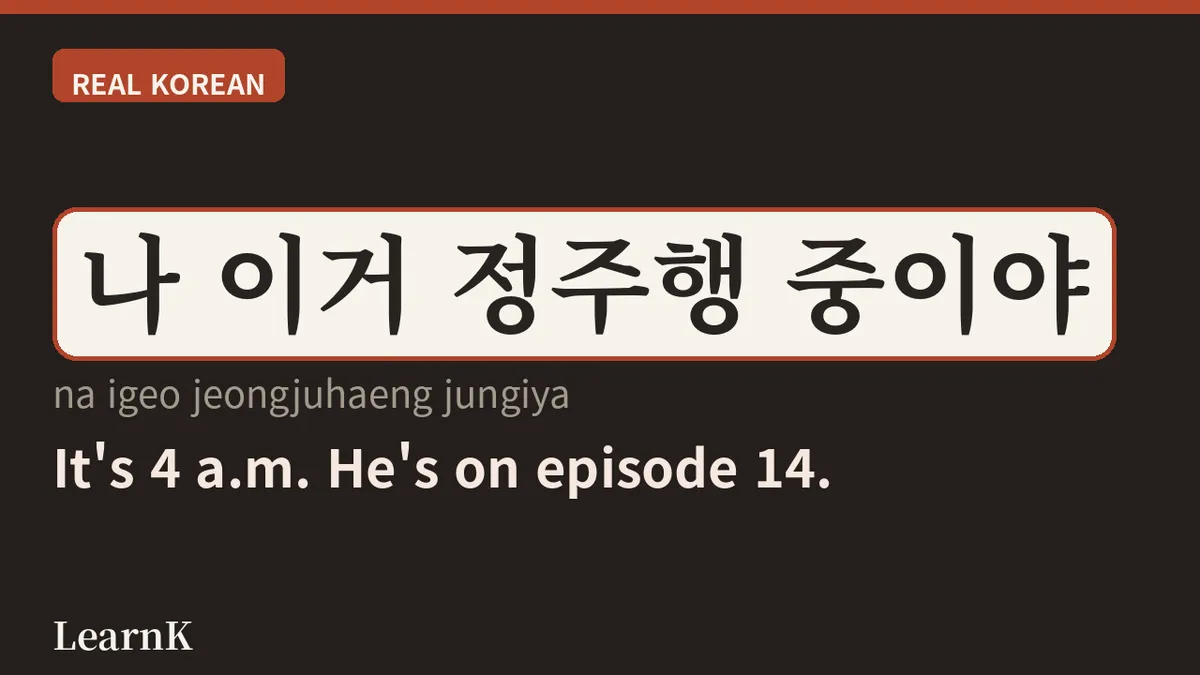
- Casual: 나 이거 정주행 중이야. (na igeo jeongjuhaeng jungiya.) — Relaxed, between friends.
- Formal: 저 요즘 그 드라마 정주행하고 있어요. (jeo yojeum geu drama jeongjuhaenghago isseoyo.) — In a polite situation.
Let’s also learn some similar expressions. 몰아보다 (moraboda) is a native Korean expression meaning ‘to watch many episodes all at once.’ It means almost the same thing as 정주행, but the sense of going strictly in order from episode 1 is weaker. On the other hand, 역주행 (yeokjuhaeng), mentioned earlier, isn’t really used for dramas — it’s mainly used to describe the phenomenon of an old song belatedly regaining popularity. If 정주행 is ‘watching in order,’ then 역주행 is ‘surging in popularity by going against the flow.‘
Cultural Background — Why Does Korea Love ‘정주행’?
Most Korean dramas have a self-contained structure of 16 to 20 episodes. Because the story is tightly woven from beginning to end, binge-watching it all at once after it’s finished — 정주행 — actually gives a stronger sense of immersion than waiting for one episode each week. As OTT platforms took hold, this culture grew explosively.
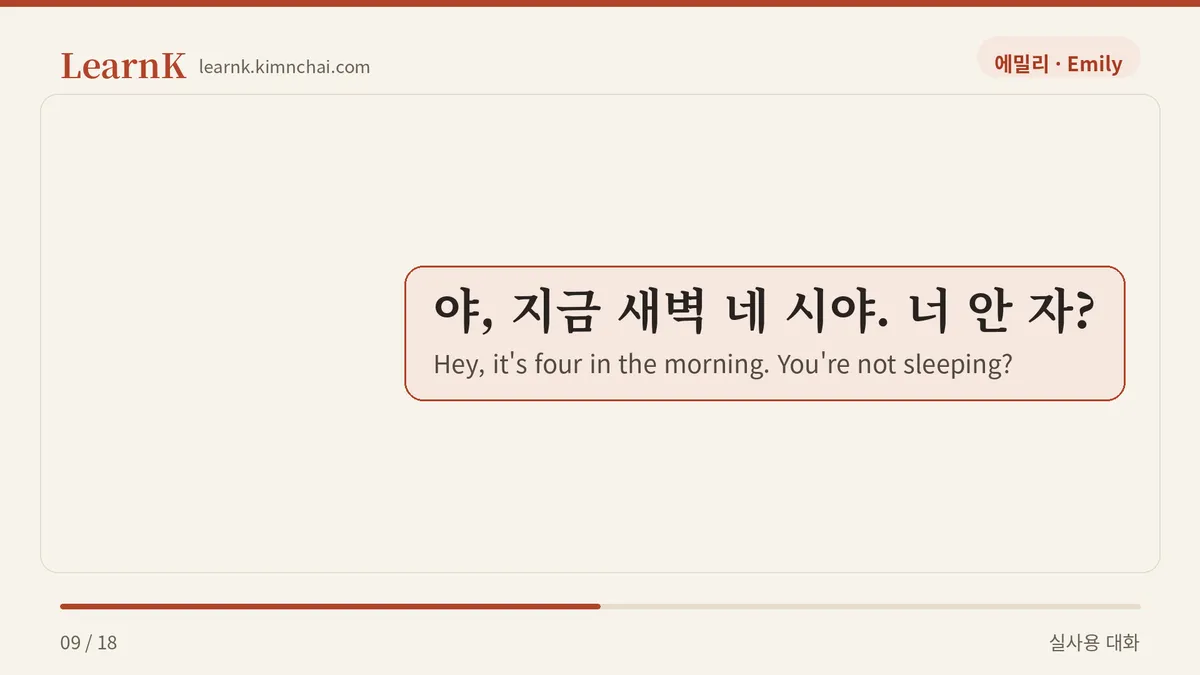
Scenes where a character in a drama is up all night obsessed with something and then shows up the next day looking exhausted are very familiar to Korean viewers. That moment when a friend asks, “너 또 밤새웠지? (You pulled another all-nighter, didn’t you?)” — you could say it wittily captures the everyday life of a 정주행러 (a person who binge-watches).
Closing Quiz
A friend says, “이 드라마 완결됐대. 나 오늘부터 1화부터 쭉 본다! (This drama is finished. Starting today, I’m watching it all the way through from episode 1!)” What single word most naturally describes this situation?
① 역주행 (yeokjuhaeng) ② 정주행 (jeongjuhaeng) ③ 운전 (unjeon)
The answer is ② 정주행 (jeongjuhaeng). That feeling of running from episode 1, in order, without stopping — which drama is on your 정주행 list tonight?