정줄놓 (jeongjulnoh) — Ever Let Go of the String Holding Your Mind?
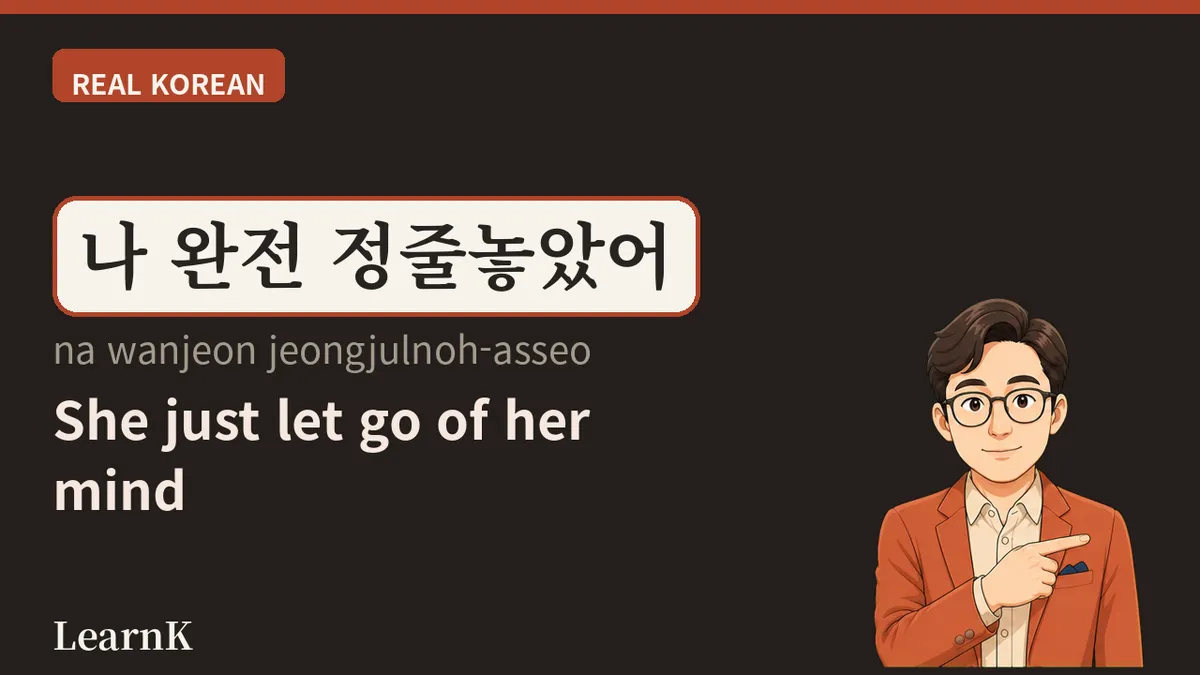
When you doze off on the subway, open your eyes, and the station name outside the window is one you’ve never seen before. When you open the fridge and forget why you opened it. In those moments Koreans grin and say this. That’s exactly what we’re learning today.
정줄놓
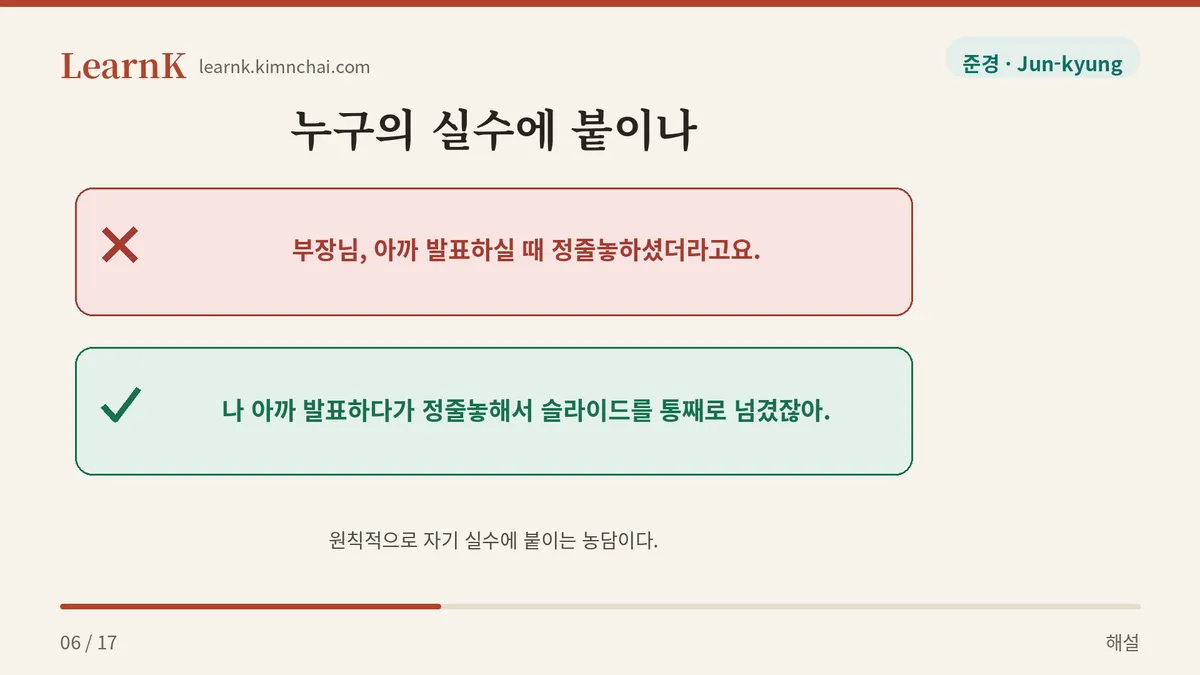
정줄놓 (jeongjulnoh) is the shortened form of 정신줄을 놓다 (jeongsinjureul nota), literally “to let go of the string that holds your mind.” It means going blank or losing your judgment, as if the cord tethering your mind slipped out of your hand. A morning when you’re not fully awake, the afternoon after an all-nighter, laughing so hard you can’t breathe, the second your favorite singer steps onto the stage — those few seconds, or few hours, when reason briefly leaves the room: Korean packs all of it into these three syllables.
What matters most is the temperature of the word. 정줄놓 is not criticism — it’s self-deprecation. Most of the time you pin it on yourself. You send the wrong file to a meeting, smack your forehead, and say ‘아 나 오늘 진짜 정줄놓이네 (a na oneul jinjja jeongjulnoh-ine)’. Remember this first: it is not a word for a serious mental state, but a light word used only for the size of blankness you can laugh off.
Its part of speech is flexible. Used like a noun it becomes 완전 정줄놓이야 (wanjeon jeongjulnoh-iya); used like a verb, 정줄놓했어 (jeongjulnoh-haesseo), or, keeping the original shape of the phrase, 정줄 놓았어 (jeongjul noasseo). All three sound natural, and the younger the speaker, the more likely they are to use the first two. There’s also a way to answer back in the opposite direction. Picturing yourself grabbing the dropped string again, you say 정줄 잡다 (jeongjul japda), or, more generally, 정신 차리다 (jeongsin charida).
Seeing It in a Real Conversation
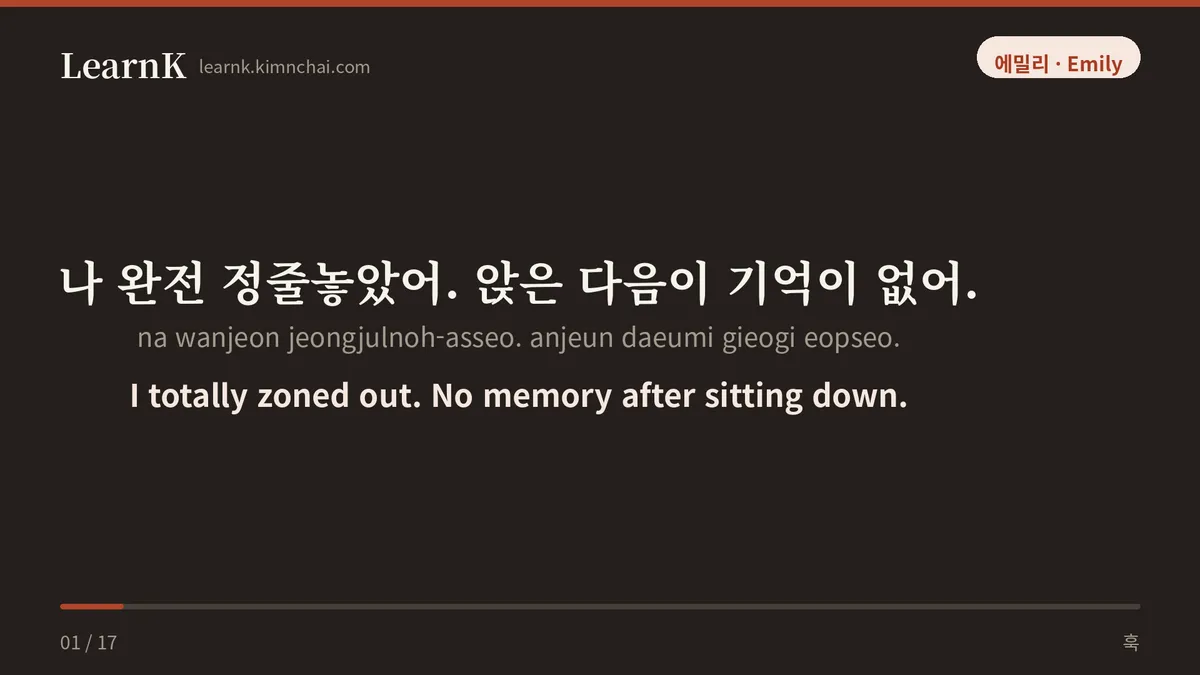
Situation: 11 p.m. on a Friday, on the subway. Both of them nodded off the moment they sat down, and when they open their eyes the station name outside the window is unfamiliar.
Jun-kyung: 어…? 야, 여기 어디야. 우리 두 정거장 지났는데? Huh…? Hey, where are we? We’ve gone two stops past.
Emily: 헐, 진짜네. 나 완전 정줄놓았어. 앉은 다음이 기억이 없어. Whoa, you’re right. I totally zoned out. I don’t remember anything after sitting down.
Jun-kyung: 나도. 둘이 나란히 앉아서 정줄놓하고 있었네. Me neither. The two of us were sitting there side by side, completely out of it.
Emily: 이번 주에 야근을 며칠 했더라… 몸이 먼저 꺼졌나 봐. How many nights did I work late this week… I guess my body just shut down first.
Jun-kyung: 일단 내리자. 반대편 열차 아직 있어. …야, 가방! Let’s get off first. There’s still a train going the other way. …Hey, your bag!
Emily: 아 맞다. 나 아직 정줄 못 잡았나 봐. Oh right. I guess I still haven’t gotten my head back on straight.
Take a close look at that last line. Emily picked up the original image inside 정줄놓 — the 줄, the “string” — and answered with 정줄 못 잡았다 (jeongjul mot jabatda), “I haven’t caught the string yet.” Flipping a word back on itself like this is very common wordplay, and being able to do it naturally is a sign your Korean has really ripened.
This Would Sound Off
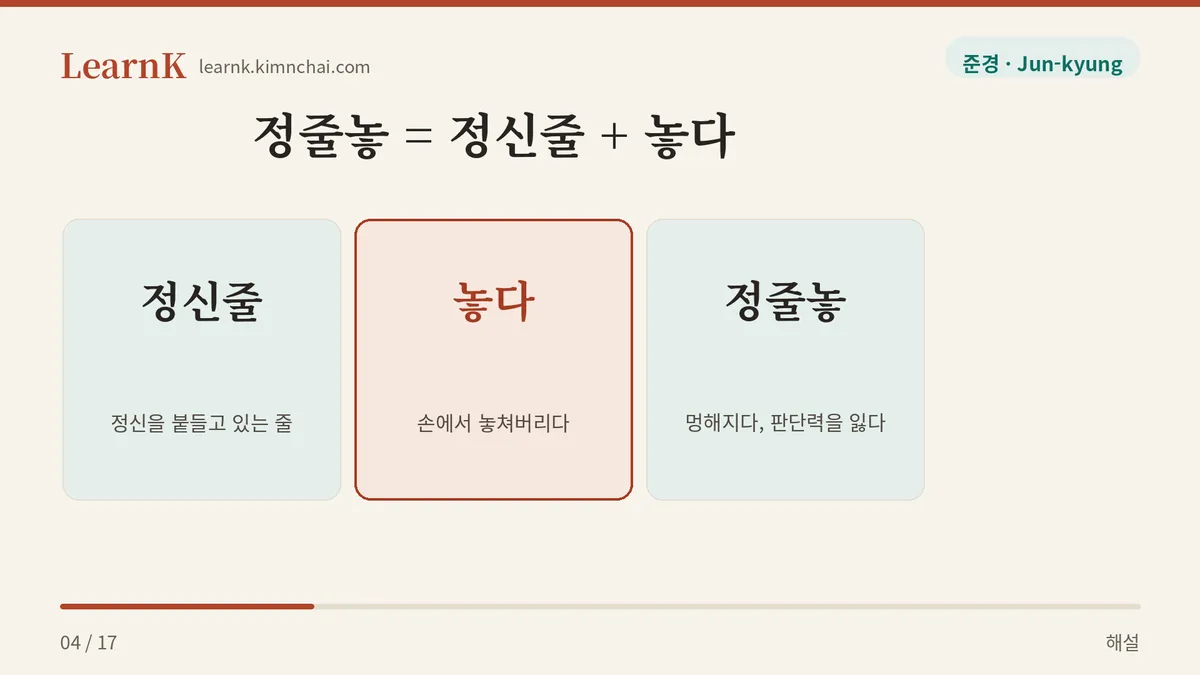
✗ (To your department head after a meeting) 부장님, 아까 발표하실 때 정줄놓하셨더라고요. (bujangnim, akka balpyohasil ttae jeongjulnoh-hasyeotdeoragoyo.) Sir, you were completely out of it during your presentation earlier. ✓ (To a coworker) 나 아까 발표하다가 정줄놓해서 슬라이드를 통째로 넘겼잖아. (na akka balpyohadaga jeongjulnoh-haeseo seullaideureul tongjjaero neomgyeotjana.) I spaced out in the middle of my presentation and skipped a whole slide. → Pointing at someone else’s slip-up with 정줄놓 — and a superior’s, no less — comes out sounding close to “you were out of your mind.” As a rule, this word is a joke you aim at your own mistakes. The only time you can aim it at someone else is when the two of you are close enough to tease each other freely.
✗ (To a friend sitting there stunned after hearing about an accident) 너 지금 완전 정줄놓이네. (neo jigeum wanjeon jeongjulnoh-ine.) You’re completely out of it right now. ✓ (Same situation) 너 많이 놀랐구나. 좀 앉아 있어. (neo mani nollatguna. jom anja isseo.) That must have been a real shock. Sit down for a bit. → Saying this to someone genuinely dazed by shock turns their state into a light joke. 정줄놓 is only for the kind of blankness you’ll be able to laugh about together later. In heavy moments, it’s better to set this word down entirely.
Example Sentences by Situation
① The morning after an all-nighter On a day when an exam or a deadline left you with only two or three hours of sleep, your body made it to work but your head hasn’t arrived yet. This is where 정줄놓 shows up most often.
어제 두 시간밖에 못 잤어. 오전 내내 정줄놓이야. (eoje du siganbakke mot jasseo. ojeon naenae jeongjulnoh-iya.) I only slept two hours last night. I’ve been completely out of it all morning.
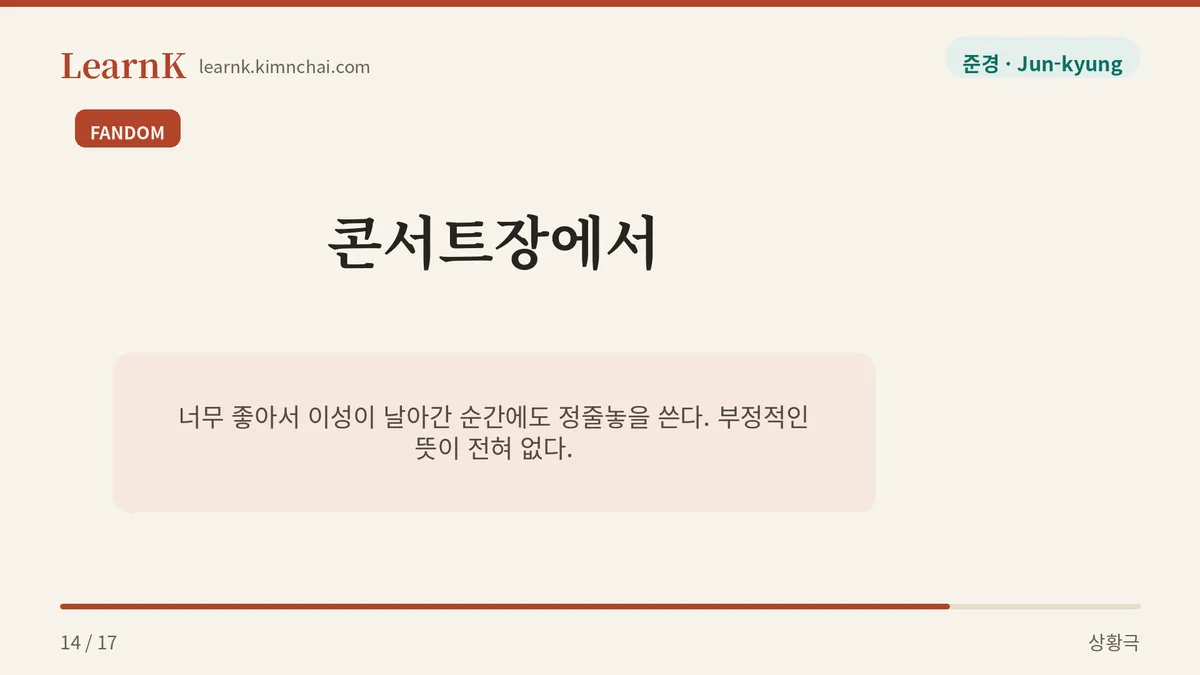
② At your favorite singer’s concert If you’re a Hallyu fan, this usage is a must-know. Korean also uses 정줄놓 for the moment when something is so good that your reason flies out the window. There’s nothing negative about it at all — it actually reads as the highest compliment: “it was that good.”
무대에 나오는 순간 정줄 놓았어. 그다음은 기억이 안 나. (mudaee naoneun sungan jeongjul noasseo. geudaeumeun gieogi an na.) The moment they came out on stage I lost it. I don’t remember anything after that.
③ In the middle of housework Your hands are moving but your head isn’t keeping up, so you put something down in a completely wrong place. This is what you say when you find it later and laugh to yourself.
어제 정줄놓하고 리모컨을 냉장고에 넣어놨더라. (eoje jeongjulnoh-hago rimokeoneul naengjanggoe neoeonwatdeora.) Yesterday I totally spaced out and left the remote in the fridge.
Politeness Levels and Similar Expressions
정줄놓 was born as internet slang, so the word itself carries the temperature of 반말 (banmal), casual speech. Even if you build a polite sentence around it, the lightness of the word stays put. ‘제가 정줄놓해서 그랬어요 (jega jeongjulnoh-haeseo geuraesseoyo)’ is fine with an easygoing senior colleague or a coworker you’re close to, but you don’t use it in a job interview or any formal setting where you need to apologize. In those situations, switch to something like 제가 잠깐 정신이 없었습니다 (jega jamkkan jeongsini eopseotseumnida).
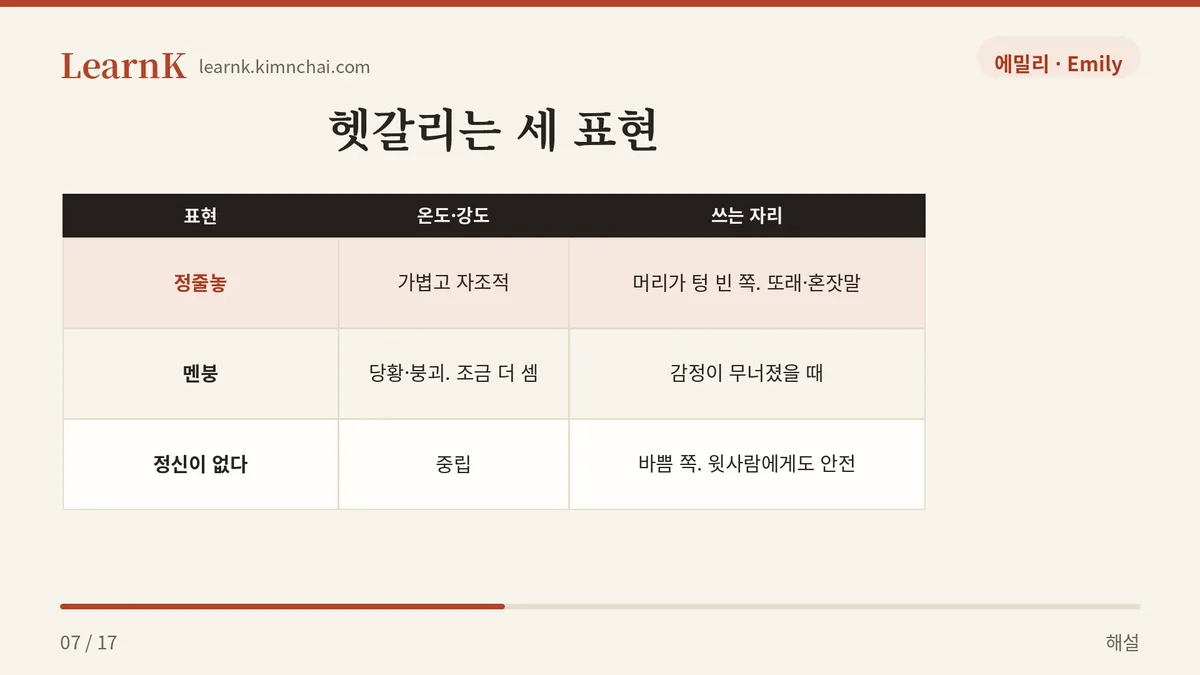
| Expression | Temperature / Intensity | Where to use it |
|---|---|---|
| 정줄놓 (jeongjulnoh) | Light and self-deprecating | With peers, on social media, muttering to yourself. Mostly about yourself |
| 멘붕 (menbung) | Panic and collapse. A bit stronger | With peers, on social media. When your emotions have caved in |
| 넋이 나가다 (neoksi nagada) | Neutral to heavy | Anywhere. Works for genuine shock too |
| 정신이 없다 (jeongsini eopda) | Neutral. Leans toward “busy” | Safe even with people above you |
| 정신 차리다 (jeongsin charida) | The opposite direction. Pulling yourself together | Anywhere |
The one that’s easiest to mix up is the difference from 정신이 없다 (jeongsini eopda). 정신이 없다 is also widely used to mean “I’m swamped, I have too much to do,” but 정줄놓 carries no sense of busyness at all. 정줄놓 is on the empty side. It’s not that your head is too full to function — it’s that your head has gone completely blank.
Cultural Background — The String Tied to Your Mind
Look at the picture inside the word. You don’t simply lose your mind — you let go of a 줄 (jul), a string. Korean imagines the mind as a cord held in your hand. Hold on and it’s yours; open your fingers and it flies off on its own. That’s why the opposite isn’t “to get it back” but 잡다 (japda), “to grab it.” For a learner, remembering this one image is enough to make 정줄놓, 정줄잡, and 정신 차리다 arrive as a single bundle.
In terms of form, 정줄놓 is a textbook contraction produced by Korean internet culture — the trick of pressing a long description into three syllables. 멘붕 (menbung), meaning a mental breakdown, is the star player of the same family. These words were born on internet message boards, but they’ve since moved fully into TV-show subtitles and everyday conversation. Watch enough Korean variety shows and you’ll often see ‘정줄놓’ pop up in giant letters across the screen the instant a cast member’s face goes blank. Within the distinctly Korean grammar of variety subtitles — where the captions speak the characters’ inner thoughts for them — this word is an extremely handy tool.
So why is the expression this widespread? Because in a society where late nights at the office, cramming for exams, and company dinners that run until dawn are ordinary life, “having lost hold of your mind” isn’t a special event — it’s a weekly experience. That’s why there’s almost no self-reproach in the word. It’s closer to a greeting: a way of confirming to each other that you’re both exhausted, and laughing it off. If someone opens with ‘어제 정줄놓해서… (eoje jeongjulnoh-haeseo…)’, there’s no need to go serious and worry about them. A simple ‘나도 요즘 그래 (nado yojeum geurae)’ — “same here lately” — sets the temperature of the conversation exactly right.
Today’s Quiz
Which of the following is the most appropriate situation for using 정줄놓?
- A professor you respect briefly loses their train of thought during a lecture, and a student mentions it to the professor
- Your friend has just heard about a serious accident and is sitting there without a word
- You came to school after gaming all night and walked toward the window instead of the classroom door
See the answer
Answer: 3
정줄놓 is a word for ① yourself and ② the size of blankness you can laugh off. Number 3 satisfies both conditions — saying 나 오늘 진짜 정줄놓이다 (na oneul jinjja jeongjulnoh-ida) fits perfectly.
Number 1 uses it to point at a superior’s mistake, so it sounds rude. In number 2, the other person is genuinely in shock, and laying this word on top of it makes light of what they’re feeling. In that case, ‘많이 놀랐구나 (mani nollatguna)’ — “that must have been a shock” — is the right call.
The definitions, example sentences, and dialogue in this post are all original work written by us. 정줄놓 (jeongjulnoh), today’s expression, is not a headword in the National Institute of Korean Language’s Basic Korean Dictionary (krdict.korean.go.kr), so it is explained here on the basis of actual usage, without quoting the dictionary.