정략결혼 (jeongnyak-gyeolhon) — The Marriage Made by Calculation, Not Love
정략결혼 (jeongnyak-gyeolhon)
정략결혼 (jeongnyak-gyeolhon) means a marriage arranged not out of two people’s affection, but for the benefit of families, companies, or political powers. Pictured: a chairman’s office walled in glass, and a father sliding a single document across the desk toward his son. “Set up the meeting with her family next month.” The son lifts his head. “Why should I?” Instead of answering, the father looks out the window — and anyone who’s watched twenty or so Korean dramas already knows exactly which word follows this scene.
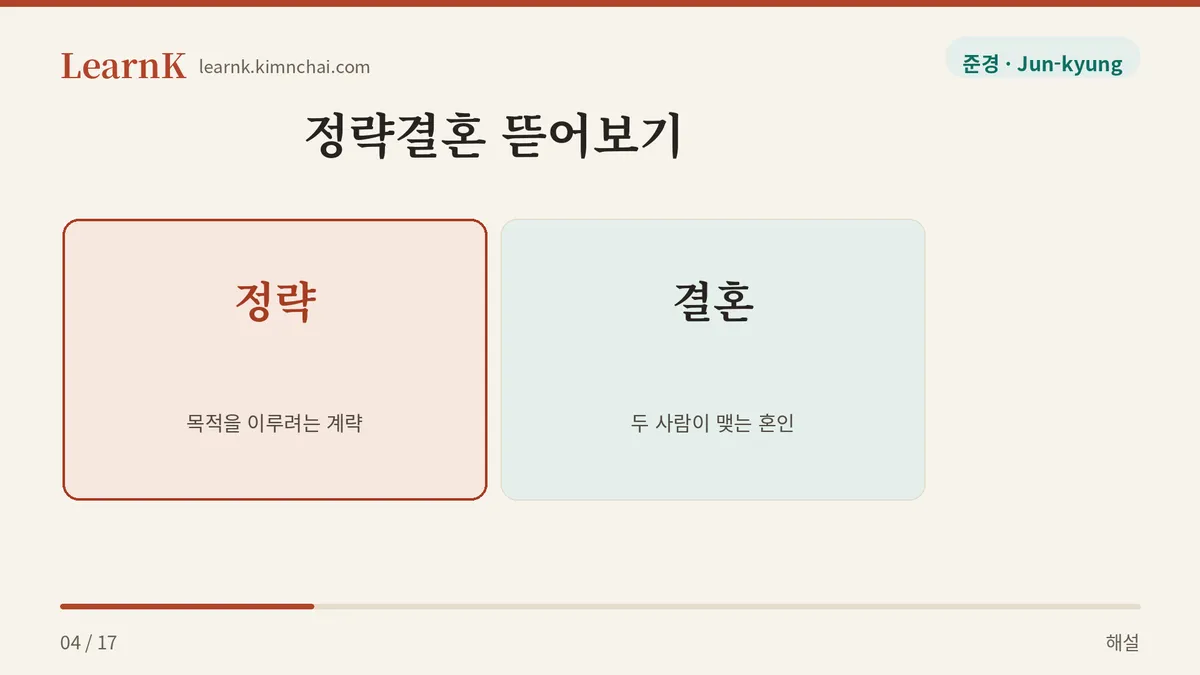
The weight of this word doesn’t sit on the 결혼 (gyeolhon, “marriage”) at the back — it sits on the 정략 (jeongnyak) stuck to the front. 정략(政略) is a Sino-Korean word meaning a scheme or a political maneuver aimed at getting what you want. So 정략결혼 means using marriage not as the happy ending of love, but as a means to an end. The two people standing at the ceremony aren’t the leads of the story; they’re the hands signing a contract. And it isn’t pronounced the way it’s spelled — it rolls out closer to [정냑껼혼] (jeong-nyak-kkyeol-hon).
The nuance is unmistakably negative. In Korean, this word is almost always used from one step back. It’s essentially unheard of for the people actually getting married to introduce their own wedding by saying, “저희 정략결혼이에요” (“Ours is a marriage of strategy”). Usually it’s a third party lowering their voice, or a drama character spitting it out while lamenting their own situation. The moment the word leaves your mouth, a verdict has already been handed down: there is no heart in that marriage. The word that sits on the opposite side is 연애결혼 (yeonae-gyeolhon) — a marriage between two people who fell for each other.
Let’s See It in a Real Conversation
Setting: Saturday afternoon, the reception after a senior coworker’s wedding. Buffet plate in hand, you’ve just barely claimed a spot at a corner table.
준경: 야, 아까 신랑 아버지 봤어? 인사하러 온 사람만 스무 명이야. Hey, did you see the groom’s father earlier? Twenty people came just to greet him.
에밀리: 어쩐지. 옆 테이블에서 아까부터 정략결혼이니 뭐니 하더라. That explains it. The next table’s been going on about it being a marriage of strategy or whatever.
준경: 에이, 요즘 세상에 무슨. 그냥 양쪽 집이 다 사업하니까 나오는 소리야. Come on, in this day and age? People just say that because both families are in business.
에밀리: 근데 신부 아까 눈 빨갛던데. 나만 좀 그랬나? But the bride’s eyes were red earlier. Was it just me who noticed?
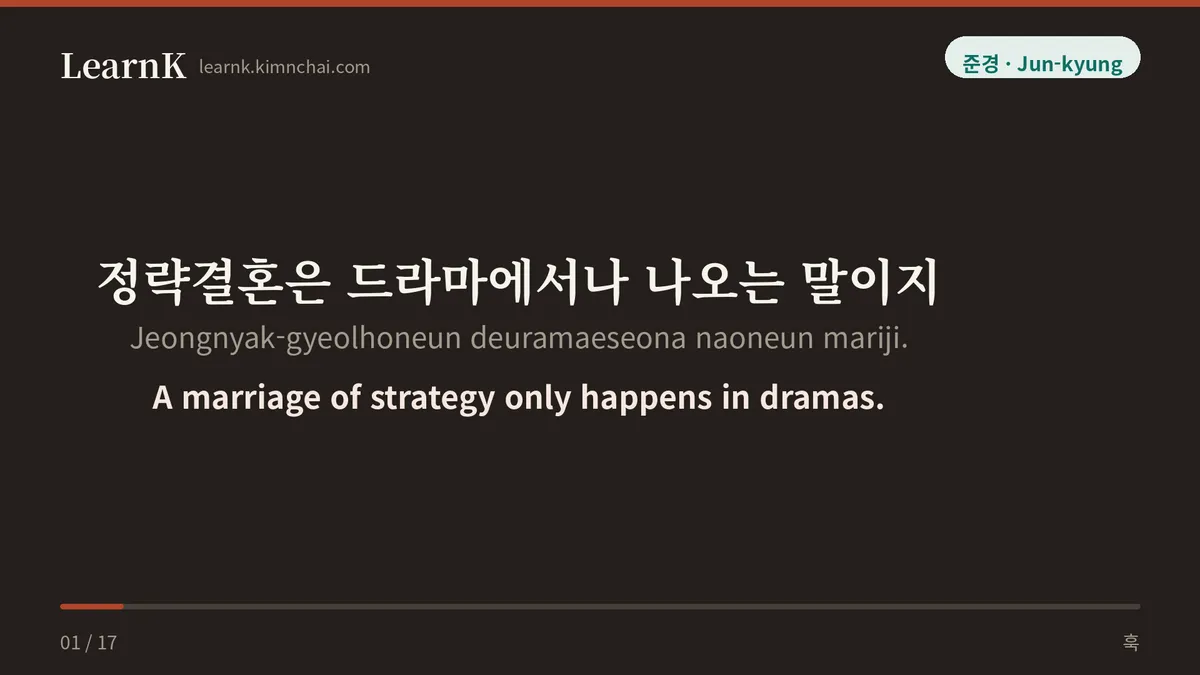
준경: 그건 결혼식 날엔 다 울어. 정략결혼은 드라마에서나 나오는 말이지. Everyone cries on their wedding day. A marriage of strategy is something you only hear about in dramas.
에밀리: 그런가. 한국 산 지 15년인데 이런 건 아직도 잘 모르겠어. Maybe. I’ve lived in Korea 15 years and I still can’t read these things.
Using It This Way Sounds Off
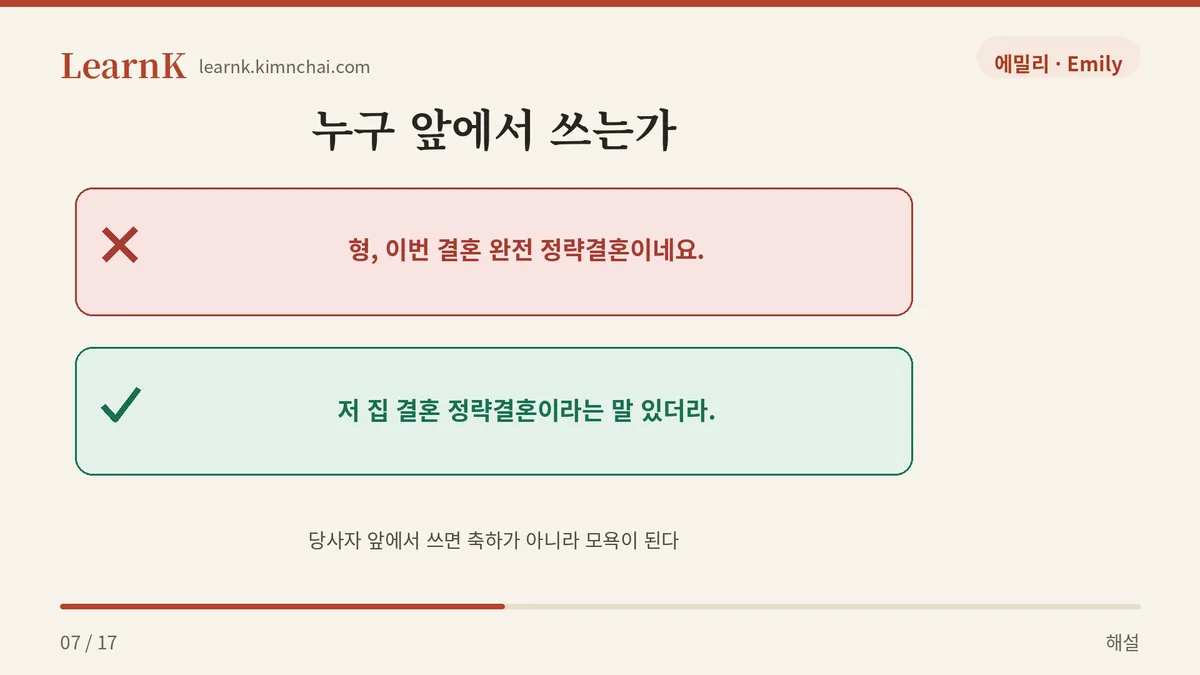
✗ (to the groom himself) 형, 이번 결혼 완전 정략결혼이네요. 축하드려요. “Hyung, this wedding of yours is a total marriage of strategy. Congratulations.” ✓ (between friends, once you’ve moved somewhere else) 저 집 결혼 정략결혼이라는 말 있더라. “People are saying that family’s wedding is a marriage of strategy.” → Built into this word is the verdict “there’s no real feeling between you two.” Wrapping it in polite speech doesn’t help one bit. Say it in front of the people getting married and it stops being congratulations and becomes an insult.
✗ 부모님이 소개해 주셔서 만났어요. 저희 정략결혼했어요. “We met because our parents introduced us. Ours was a marriage of strategy.” ✓ 부모님 소개로 만났어요. / 중매로 만났어요. “We met through our parents.” / “We were set up by a matchmaker.” → Meeting through an introduction or a matchmaking date is 중매결혼 (jungmae-gyeolhon), not 정략결혼. 정략결혼 isn’t a question of who introduced you — it’s a question of what someone was trying to gain. If no exchange of interests is riding on the marriage as a condition, this word doesn’t apply.
Example Sentences by Situation
① Watching a drama together, when the plot gets predictable
요즘 드라마는 죄다 정략결혼 얘기더라. (Yojeum deuramaneun joeda jeongnyak-gyeolhon yaegideora.) Every drama these days is about a marriage of strategy.
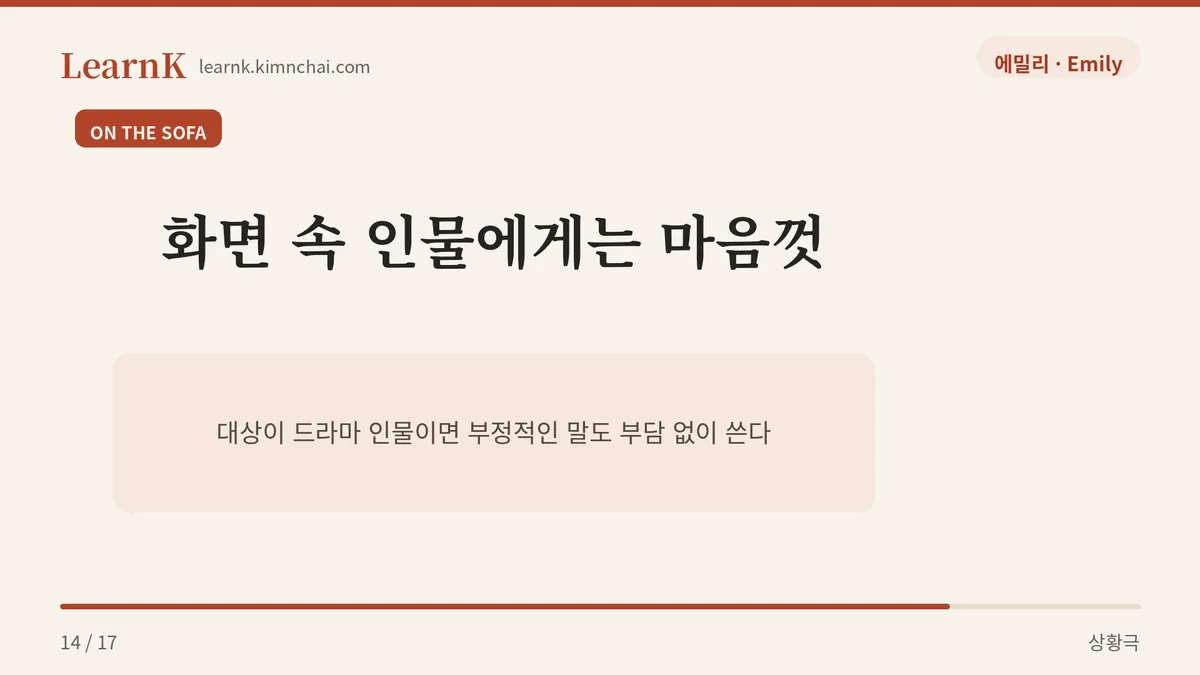
This is where Koreans actually use the word most. The target isn’t someone in front of you — it’s a character on the screen. In this setting, even though it’s a negative word, you can use it freely.
② Talking about the news or history
그 혼인은 사실상 두 나라의 정략결혼이었다. (Geu honineun sasilsang du naraui jeongnyak-gyeolhonieotda.) That marriage was, in effect, a political alliance between the two countries.
It pairs beautifully with 사실상 (sasilsang, “in effect / for all practical purposes”). That’s the go-to combination for saying that something looked like a marriage on the surface but had a different real purpose. It shows up constantly when explaining royal and aristocratic marriages.
③ Defending your own marriage (in the negative)
저희는 정략결혼이 아니라 연애결혼입니다. (Jeohuineun jeongnyak-gyeolhoni anira yeonae-gyeolhonimnida.) Ours wasn’t an arranged deal — we married for love.
This denial is just about the only time the people actually married will use the word themselves. It also signals that they’re aware of the whispering around them — so even in polite speech, there’s an edge underneath.
Politeness Levels and Similar Expressions
정략결혼 is a noun, so there’s no honorific built into the word itself. Only the sentence ending changes — 정략결혼이야 (jeongnyak-gyeolhoniya) / 정략결혼이에요 (jeongnyak-gyeolhonieyo) / 정략결혼이라고 하더군요 (jeongnyak-gyeolhonirago hadeogunyo). But switching to polite speech doesn’t erase the rudeness. With this word, the problem isn’t your tone — it’s the room you’re standing in.
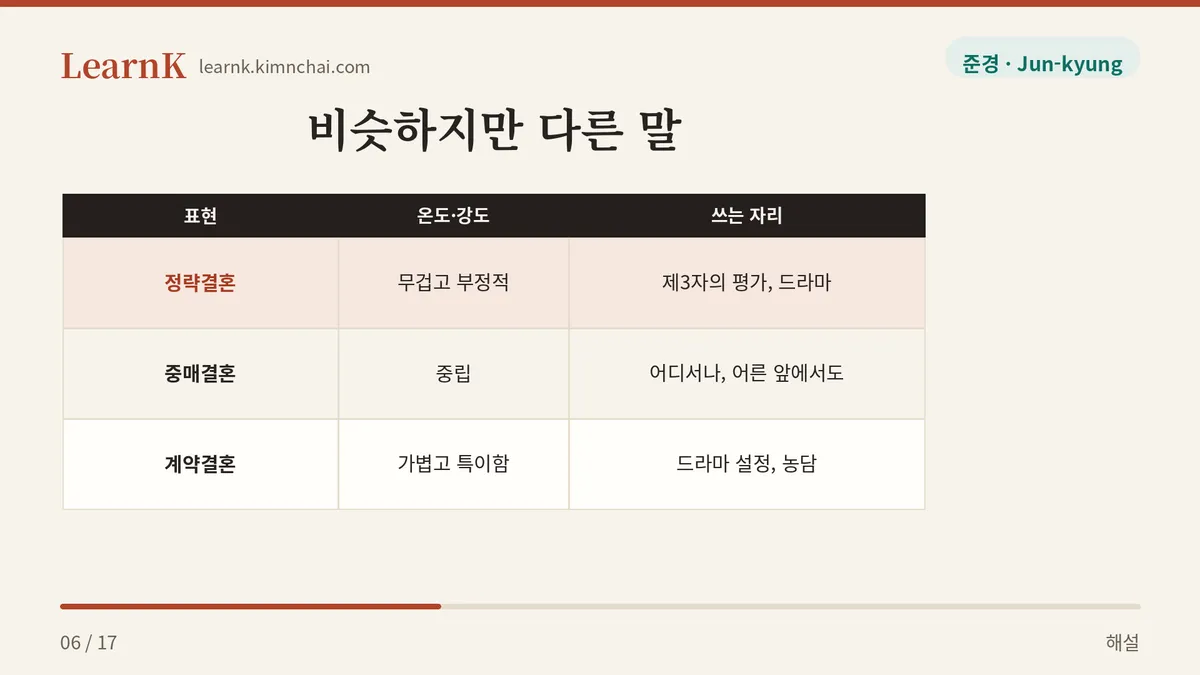
| Expression | Temperature & intensity | Where it’s used |
|---|---|---|
| 정략결혼 (jeongnyak-gyeolhon) | Heavy and negative. The verdict “there’s no heart in it” is already baked in | Third-party judgments, dramas, articles. Taboo in front of the couple |
| 중매결혼 (jungmae-gyeolhon) | Neutral. Conveys only the fact that someone introduced them | Anywhere. Comfortable even in front of elders |
| 계약결혼 (gyeyak-gyeolhon) | Light and unusual. A marriage with a set term and conditions | Drama premises, jokes among friends |
| 위장결혼 (wijang-gyeolhon) | Strongly negative. Carries a whiff of illegality | News, courtrooms. Not something to throw around in everyday conversation |
The easiest one to mix up is how far 정략결혼 sits from 중매결혼. 중매결혼 describes the method of meeting; 정략결혼 describes the purpose of the marriage. If a matchmaker introduced you and you genuinely came to like each other, that’s 중매결혼 — not 정략결혼.
Cultural Background — A Word That Came Down from the Chairman’s Office to the Living Room
정략결혼 wasn’t originally a word for the home. It belonged to history books and the politics pages: a term for royal houses and aristocrats sending their children into another family to seal an alliance. The marriages of the Joseon royal court, and European royal houses stitching borders together through weddings — that’s this word’s native territory.
What brought it down into the living room was the rise of dramas set in 재벌 (jaebeol) conglomerate families. Works like Boys Over Flowers (꽃보다 남자, KBS2, 2009), The Heirs (상속자들, SBS, 2013), and Reborn Rich (재벌집 막내아들, JTBC, 2022) contain almost without exception the same structure. The adults calculate the interests of two houses and pick a match; the young lead falls in love with someone outside that calculation. The side the audience roots for is always love, never the calculation — and so 정략결혼 is positioned as the wall the drama must tear down. Those dozens of dramas did their part in hardening this word into something negative in Korean.
So here’s exactly where this word sits for a learner. Living in Korea, you will almost never have occasion to use it in a real situation. Instead, you’ll run into it endlessly — in drama subtitles, in entertainment articles, and in the whispering at the next table over at a wedding reception. It’s less a word to say than a word you need to understand when you hear it.
Today’s Quiz
Which of the following would be hardest to call a 정략결혼?
① A marriage between a chairman’s son and a company president’s daughter, finalized as a condition of the two groups’ merger ② A royal marriage in which a princess was married off to secure an alliance with a neighboring country ③ A marriage that happened after three years of dating someone your parents introduced you to ④ A marriage to a creditor’s son in exchange for reducing your father’s debt
See the answer
Answer: ③
A parental introduction was merely the occasion for meeting; if three years of dating connected the two people’s hearts, that’s both 중매결혼 (jungmae-gyeolhon) and 연애결혼 (yeonae-gyeolhon). In ①, ②, and ④, an interest — a merger, an alliance, a debt — is riding on the marriage as a condition. The line that defines 정략결혼 isn’t “who introduced them,” but “what was given and received through the marriage.”