정색하다 (jeongsaekhada) — The Moment a Smiling Face Freezes in One Second
정색하다
정색하다 (jeongsaekhada) means to freeze a smiling or relaxed face in an instant and put on a sharp, stern expression. The spot where this word shows up in Korean conversation is almost fixed — it’s the moment when jokes are flying back and forth and one person suddenly stops laughing.
Picture a group of friends together, teasing each other and laughing. Someone adds one more line, and that line happens to land exactly on the other person’s sore spot. The smile is gone in one second. The gaze locks straight ahead, the corners of the mouth drop, the voice falls half a step. The table that was loud a moment ago goes quiet. Korean has a single word for that one second: 정색 (jeongsaek).
The reason foreign learners find this word difficult isn’t that the meaning is hard. It’s that 정색하다 points to a change, not a state. The face of someone who was solemn from the start isn’t 정색. The word attaches only at the point where a smiling face — or a blank face — changes. That’s why it travels almost as one body with the adverb 갑자기 (gapjagi), “suddenly.” It’s no accident that when the dictionary picked exactly one representative example sentence, the one it picked was “갑자기 정색하다.”
And the nuance isn’t single either. 정색하다 has two faces. One is the chillier side. When someone says “야, 왜 정색해?” (“Hey, why the sudden stone face?”), 정색 is closer to “the expression that kills the mood,” a signal meaning “I’m not laughing right now.” It’s the side that leaves the speaker feeling embarrassed. The other side is neutral — in fact, closer to sincerity. If you say “걔가 정색하고 부탁하더라” (“She asked me with a completely straight face”), it means she stripped out every trace of joking and spoke from the heart. The first 정색 pushes the other person away; the second one steps toward them. Same expression, opposite direction. Telling these two faces apart is the goal of today’s post.
Checking with the National Institute of Korean Language Dictionary
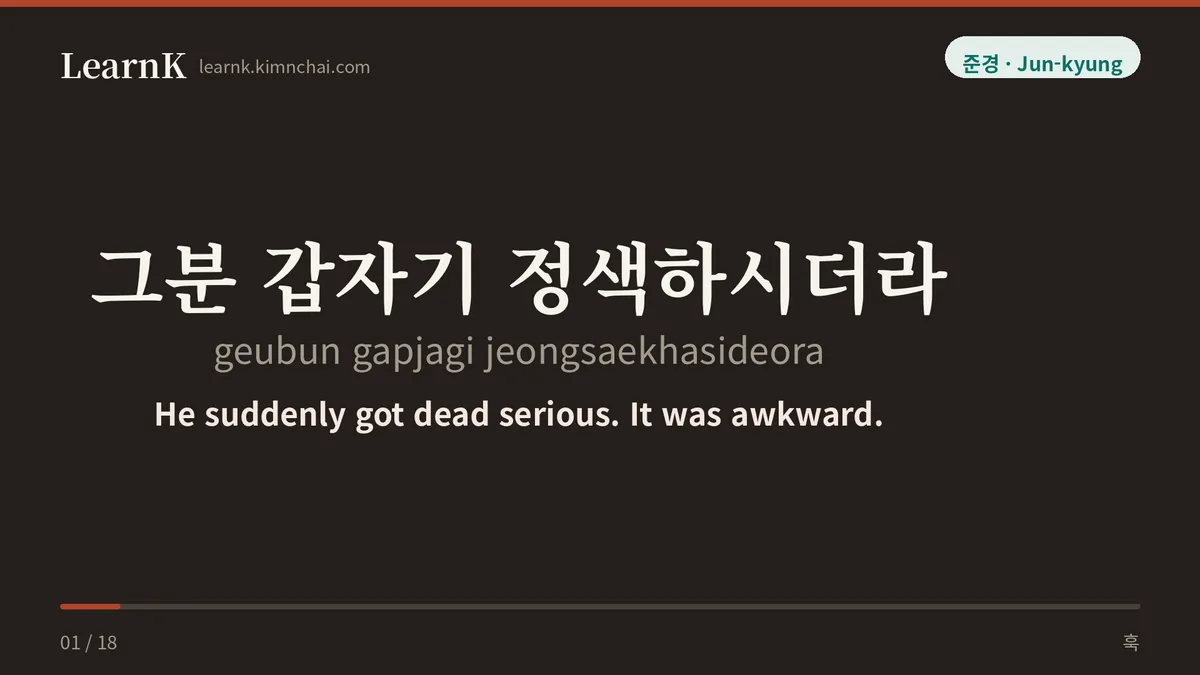
First, here is exactly how the national institution’s dictionary defines the word.
정색하다 (jeongsaekhada) 「verb」
얼굴에 날카롭고 엄격한 표정을 나타내다. (To show a sharp, strict expression on one’s face.)
[English] have a serious look on one’s face — To have a sharp, strict look on one’s face.
[Japanese] まがおになる【真顔になる】。しんけんなかおをする【真剣な顔をする】。ひらきなおる【開き直る】 — 鋭くて厳格な顔つきをする。
[Spanish] ponerse serio — Mostrar un semblante serio y penetrante.
[Chinese] 板着脸,一本正经 — 脸上露出敏锐严肃的表情。
— National Institute of Korean Language, Basic Korean Dictionary (krdict.korean.go.kr)
The word to watch in that definition is 날카롭고 (nalkaropgo), “sharp.” Not merely “strict,” but “sharp and strict.” This isn’t a face that has sunk into heaviness; it’s a face with an edge on it. That one-word difference becomes the borderline with 진지해지다 (jinjihaejida), which we’ll come to later.
Line the translations up side by side and the nuance gets sharper still. The Chinese “板着脸” draws a picture of stiffening your face like a board, and it’s interesting that the Japanese includes 真顔になる (“to become your true face”) — the sense of taking off the smile and returning to your bare face. The ponerse in the Spanish “ponerse serio” is a verb of change, “to become ~.” Note that all three languages rendered it as a transition, not a state.
Note: this dictionary entry carries no Portuguese translation. If we had to find an equivalent for Portuguese-speaking learners, ficar sério or fechar a cara would come close — but let us be clear that these two are our own translations, not from the dictionary.
The dictionary offers exactly one usage example.
갑자기 정색하다. (To suddenly put on a stern face.)
— National Institute of Korean Language, Basic Korean Dictionary (krdict.korean.go.kr)
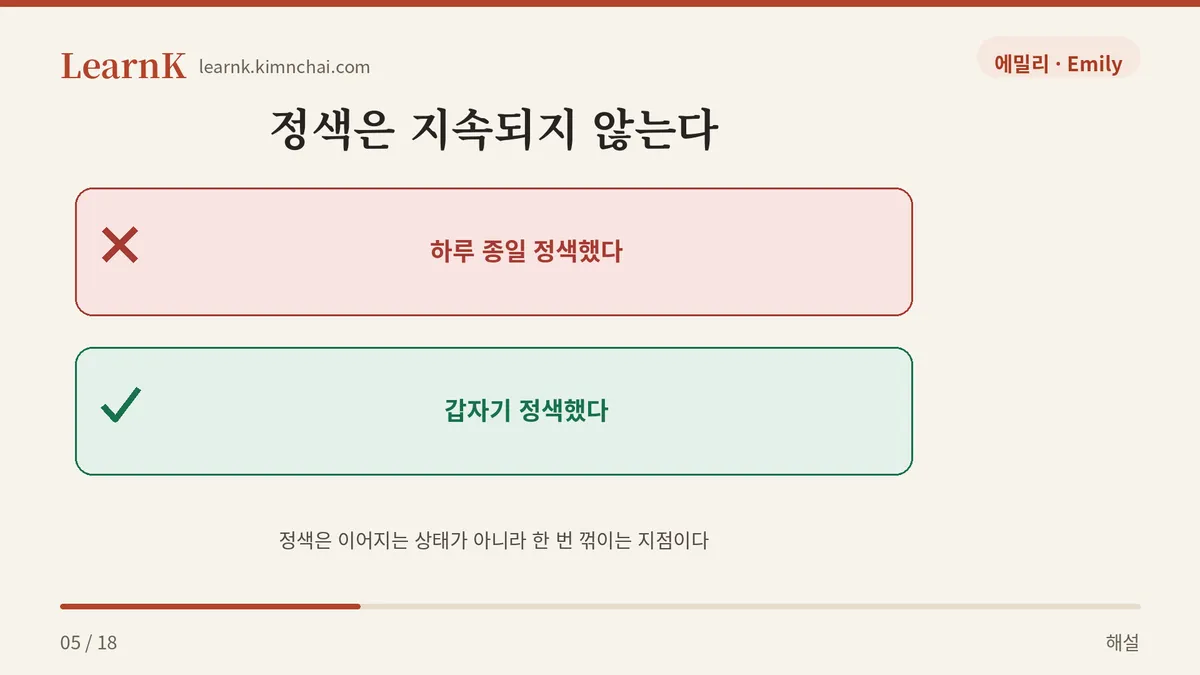
Only one example may look disappointing, but in truth that short line tells you almost everything about the word’s character. As we noted above, 정색하다 is a verb that points to a change, and that change usually happens without warning. That’s why 갑자기 is attached to the single example the dictionary chose. In real conversation too, it appears overwhelmingly often alongside words of sudden reversal — “그러다가 정색하더라” (“and then he went cold on us”), “갑자기 정색해서 놀랐어” (“she suddenly went stone-faced and it startled me”). Conversely, stretching it over a long span, as in “하루 종일 정색했다” (“he was stone-faced all day”), sounds awkward. 정색 isn’t a state that continues; it’s the single point where something snaps.
Seeing It in a Real Conversation
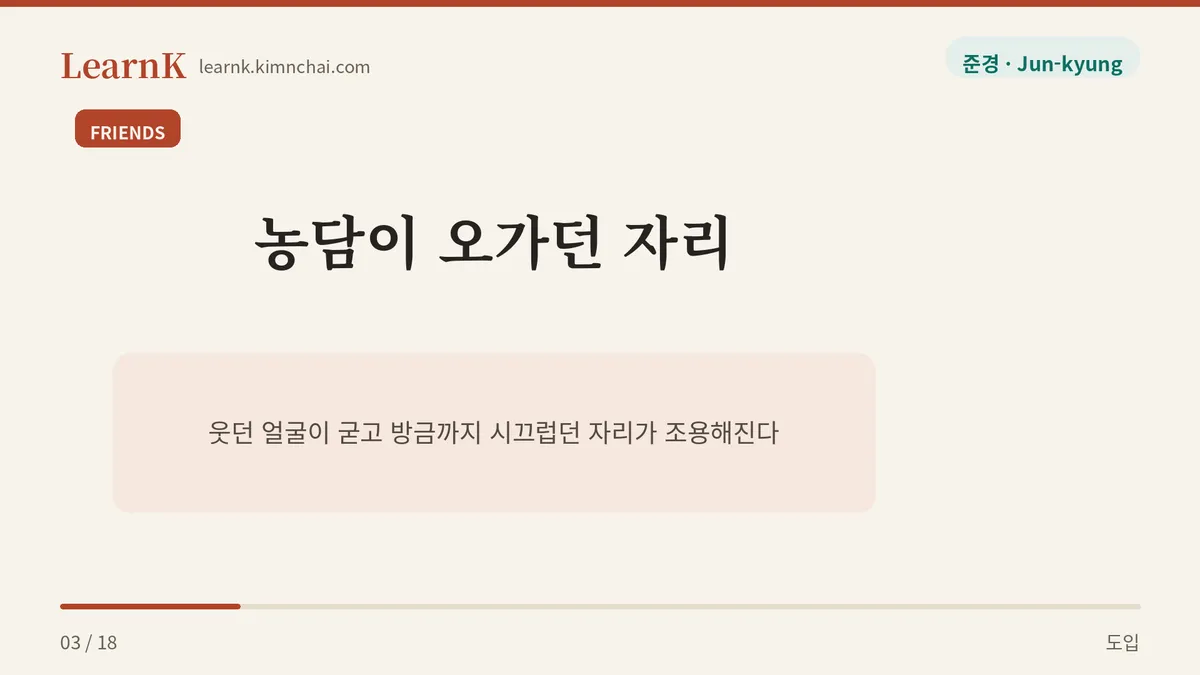
Situation: In front of an apartment complex, the meeting spot for a secondhand sale. The seller has just handed over the bike and left.
Jun-kyung: 아까 오천 원만 깎아 달라니까 그분 갑자기 정색하시더라. 나 좀 무안했잖아. When I asked him to knock off just 5,000 won, he suddenly got dead serious. It was pretty awkward for me.
Emily: 그러게. 표정이 확 굳던데. 나 순간 우리가 뭐 잘못한 줄 알았어. Right? His face hardened instantly. For a second I thought we’d done something wrong.
Jun-kyung: 근데 너도 만만치 않아. 지난주에 내가 네 김치찌개 좀 짜다고 했을 때 너도 정색했잖아. But you’re no better. Last week when I said your kimchi stew was a bit salty, you got all serious too.
Emily: 야, 그건 정색할 만했지. 세 시간 끓인 거였다고. Hey, that one deserved a straight face. I simmered that for three hours.
Jun-kyung: 알았어, 알았어. 미안. 또 정색한다, 또. Okay, okay. Sorry. There you go with the serious face again.
Emily: 아니거든? 이건 그냥 내 원래 얼굴이거든. I am not. This is just my regular face, thank you.
정색하다 appears five times in this conversation, and the form is different every time. 정색하시더라 (jeongsaekhasideora) is the form for reporting someone else’s action with honorifics; 정색했잖아 (jeongsaekhaetjana) is casual speech that drags up something the listener already knows; 정색할 만했지 (jeongsaekhal manhaetji) is self-defense meaning “I had good reason to.” The last one, “또 정색한다,” uses the present tense to point at what’s happening right in front of you — which gives it a teasing feel.
This Sounds Off
✗ 신부님이 미사 내내 정색하고 기도하셨다. ✓ 신부님이 미사 내내 진지한 얼굴로 기도하셨다. (The priest prayed with a serious face throughout the Mass.) → 정색 doesn’t attach to occasions that were solemn to begin with. 정색하다 points to the moment when a light atmosphere snaps, so using it for a setting that was heavy from the start produces the odd picture of “wait, why did he suddenly get angry?”
✗ (to your team lead in a meeting) 팀장님, 왜 정색하세요? ✓ (to your team lead in a meeting) 제가 말을 좀 심하게 했나 봅니다. 죄송합니다. (“I think I went too far with what I said. I’m sorry.”) → The grammar is perfectly fine. The problem is the setting. “왜 정색하세요?” points at the other person’s expression and delivers a verdict: “you’re overreacting right now.” Used toward someone senior to you, it sounds like shifting the blame instead of apologizing. This line is safe only among peers or people junior to you — and even then, only with someone who’ll laugh it off.
Example Sentences by Situation
1. When a joke crosses the line — the chilly kind of 정색
회식 자리에서 누가 팀장님 연애사를 꺼냈거든. 그때 팀장님이 정색하셔서 (jeongsaekhasyeoseo) 테이블이 5초 동안 조용했어.
(Someone brought up the team lead’s love life at the company dinner. He went stone-faced, and the table was silent for five seconds.)
This is when something started for laughs touches a place it shouldn’t have. Here, 정색 is saying “stop” with the face instead of the mouth. Korean speakers read this signal faster than they read any line of dialogue.
2. When asking sincerely — the kind of 정색 that steps toward you
처음엔 장난인 줄 알았는데, 걔가 정색하고 (jeongsaekhago) 다시 묻더라. 그제야 진심인 걸 알았어.
(At first I thought she was kidding, but she asked again with a completely straight face. Only then did I realize she meant it.)
The 정색하고 + verb pattern works like an adverb, meaning “with all the joking stripped away.” 정색하고 말하다 (to say it straight), 정색하고 묻다 (to ask straight), 정색하고 부탁하다 (to ask a favor straight) — in this shape the negative temperature almost entirely disappears and only the weight of sincerity remains. This is the usage learners miss most often.
3. When you’re smoothing over your own expression
나 아까 좀 정색했지 (jeongsaekhaetji)? 미안, 그 얘긴 내가 좀 예민해서.
(I got a bit stone-faced back there, didn’t I? Sorry — I’m a little sensitive about that topic.)
In Korean it’s common to acknowledge your own 정색 and apologize for it, because both sides know that a single expression changed the air in the room. Memorize this sentence whole and you’ll be able to gently walk back a moment you got wrong.
Polite and Casual Forms, and Neighboring Expressions
In casual speech you’ll use 정색해 (jeongsaekhae), 정색하네 (jeongsaekhane), and 정색했잖아 (jeongsaekhaetjana). In polite speech, 정색하세요 (jeongsaekhaseyo) and 정색하셨어요 (jeongsaekhasyeosseoyo), and when reporting someone else’s behavior, 정색하시더라고요 (jeongsaekhasideoragoyo) sounds natural. That said, as we saw above, asking a senior directly “왜 정색하세요?” is risky regardless of the grammar. It’s safest to remember the honorific forms as mainly for describing a third party who isn’t in the room.
Set the word next to its look-alike neighbors and the boundaries get clear.
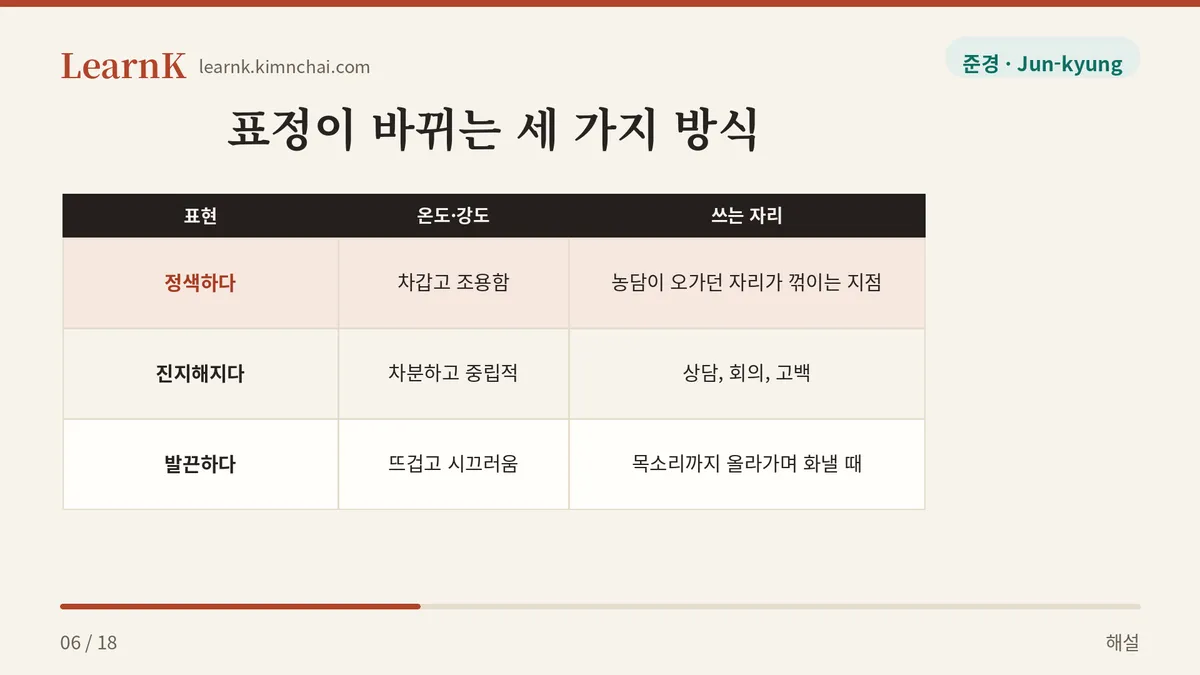
| Expression | Temperature & intensity | Where it fits |
|---|---|---|
| 정색하다 (jeongsaekhada) | Laughter cuts off dead. Momentary, with an edge | A setting where jokes were flying. The point where the expression snaps |
| 진지해지다 (jinjihaejida) | Weight settles in calmly. Neutral | Counseling, meetings, confessions. No negative nuance |
| 표정이 굳다 (pyojeong-i gutda) | Frozen. Flustered or displeased | On hearing something unexpected. More reaction than intention |
| 발끈하다 (balkkeunhada) | Anger flares up. The hottest of the four | Getting angry with the voice rising too |
The difference among these four comes down to temperature and volume. 진지해지다 can even be warm, and it doesn’t get loud. 정색하다 is cold but likewise quiet — the essence of 정색 is silence. 발끈하다 is hot and loud. 표정이 굳다 is when the face reacts first without you intending it, so it’s more passive than 정색. That’s why “걔 발끈했어” and “걔 정색했어” paint completely different scenes: the first is a scene where voices rose, the second a scene that suddenly went quiet.
Cultural Background — The Signal That the Joking Is Over
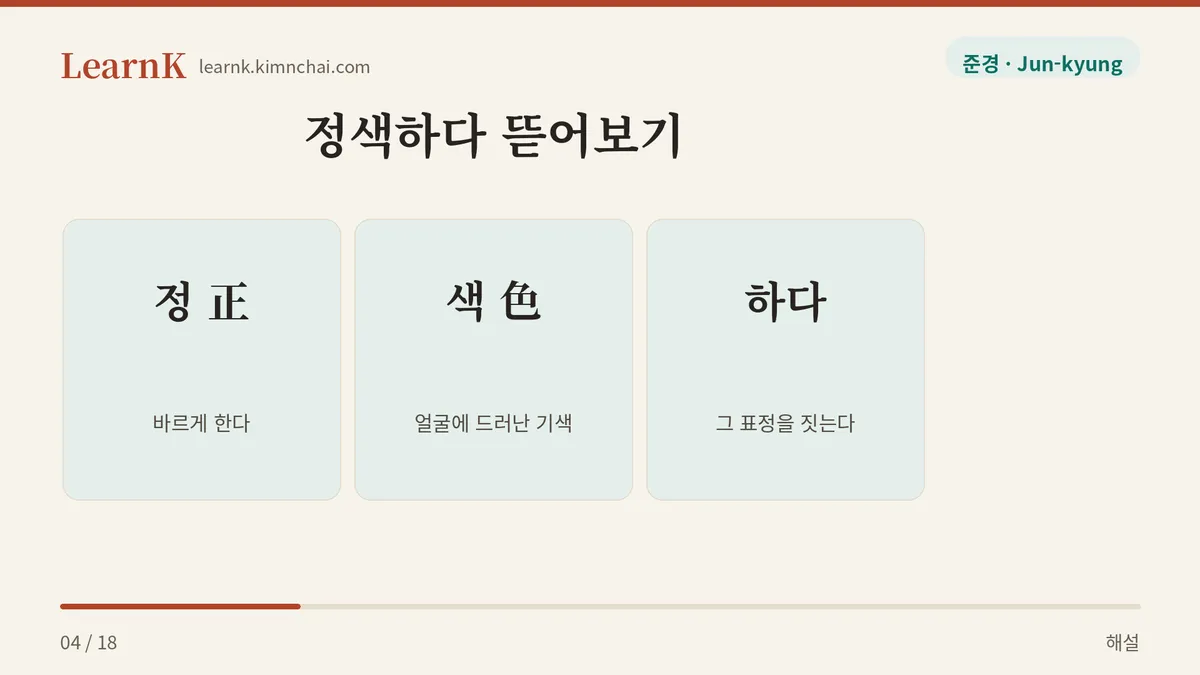
정색 (jeongsaek) is a Sino-Korean word: 正 (jeong, “to set right”) and 色 (saek, “color”) — literally, “to set the color of one’s face right.” Here “색” doesn’t mean color but the mood showing on a face. The picture is of straightening out an expression that had come loose — and interestingly, in modern Korean this “setting right” is not used as praise. Straightening a face that was smiling amounts to a declaration that you are ending the fun in this room.
In Korean conversational culture, joking is often used as a tool for measuring relational distance. The closer you are, the harder you tease, and taking the teasing is itself proof of intimacy. The trouble is that the line sits in a different place for every person. If you draw that line with words — “그 얘긴 하지 마세요” (“please don’t bring that up”) — the room turns heavy and the person who spoke is badly embarrassed. So Korean speakers use their faces instead of their words. 정색 is the quietest and yet the most unmistakable stop signal there is.
This instinct shows up even more sharply in online conversation. It’s one reason Korean messenger chats are so heavily sprinkled with ‘ㅋㅋ’, tildes (~), and emoji. Letters have no face, so if you send a bare “알겠습니다.” (“Understood.”) with no decoration at all, the person on the other end reads it as 정색. This is a language where “알겠습니다” and “알겠습니다ㅎㅎ” register at completely different temperatures. Plenty of people even add “정색 아님” or “정색한 거 아니야” (“not being cold, I promise”) just to head off the misunderstanding. In Korean dramas, too, 정색 is usually handled through direction rather than dialogue — a character is laughing, the camera stays on the face, only the expression drains away, and the background music cuts out. Before the next line arrives, the viewer already knows the relationship has changed.
That’s why, for someone learning Korean, this word is worth more than a single vocabulary item. Recognizing 정색하다 means reading the moment the other person drew a line — and not missing that moment is the skill that protects relationships in Korean conversation.
Today’s Quiz
A friend teases you in fun, and you drop your smile and say quietly, “그만해.” (“Stop it.”) Your voice didn’t rise, but the mood went cold. Which sentence describes this situation most accurately?
- 걔가 갑자기 발끈했어.
- 걔가 갑자기 정색했어.
- 걔가 갑자기 진지해졌어.
Answer: 2. The smiling face hardened in an instant, the volume didn’t go up, and the air turned cold — all three conditions of 정색 are met. Option 1, 발끈하다, is when the voice rises and anger bursts out into the open, so it doesn’t fit “quietly.” Option 3, 진지해지다, carries weight but no coldness, so it can also be used for warm scenes like counseling or a confession. Here there’s a chill that cracks the relationship, so 2 is the precise choice.
Definitions and example sentences are from the National Institute of Korean Language’s Basic Korean Dictionary (krdict.korean.go.kr); that portion of this post, including our translations, is licensed under CC BY-SA 2.0 KR.