직관 (jikgwan) — The Day You Finally See With Your Own Eyes a Stage You'd Only Watched on a Screen

직관
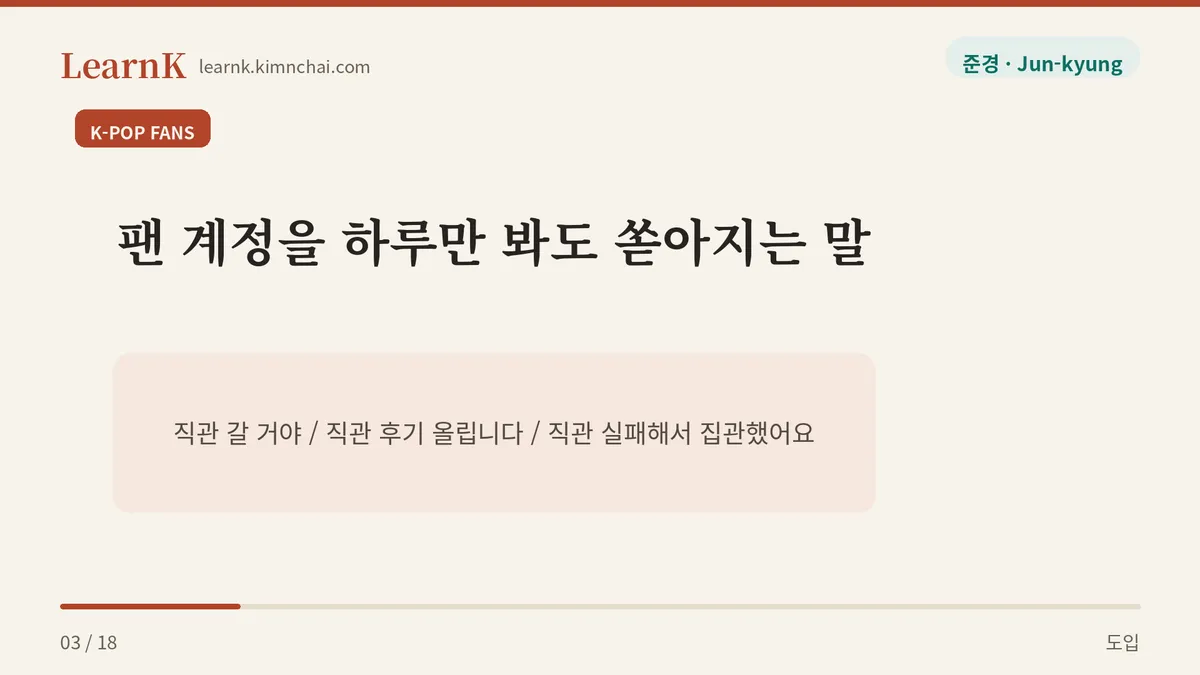
직관 (jikgwan) means the act of grasping something the moment you encounter it, without going through any process of thinking — in other words, “intuition.” Open the National Institute of Korean Language’s dictionary and that one meaning is all you’ll find. But spend a single day scrolling through K-pop fan accounts and the word comes pouring out of a completely different place. “나 이번엔 꼭 직관 갈 거야 (na ibeonen kkok jikgwan gal geoya),” “직관 후기 올립니다 (jikgwan hugi ollimnida),” “직관 실패해서 집관했어요 (jikgwan silpaehaeseo jipgwanhaesseoyo).”
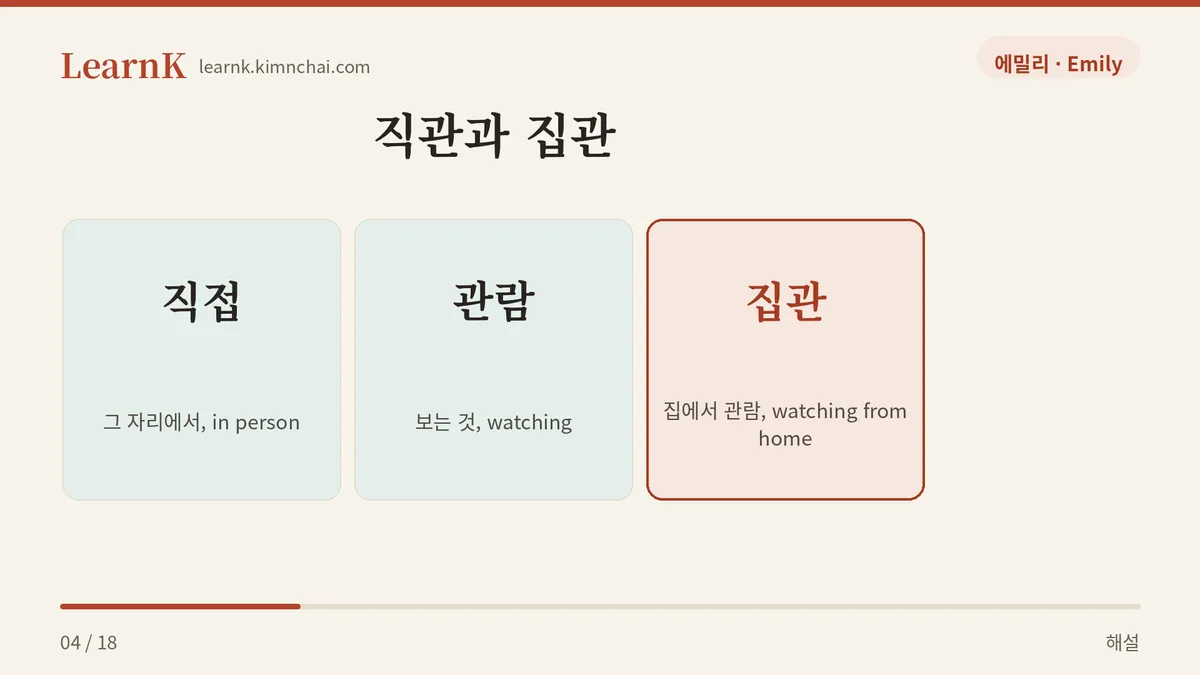
The 직관 (jikgwan) here is short for 직접 관람 (jikjeop gwallam), “watching in person.” Not through a screen, but right there, seeing the stage with your own two eyes. A stage you’ve streamed a hundred times and a stage you’ve seen once from the very last seat on the third floor are completely different events to a fan, and the fandom needed a word to mark that difference. So Korean now houses two 직관s spelled exactly alike — 直觀, the one printed in the dictionary, and the abbreviation that hasn’t made it in yet.
Their temperatures are wildly different. Dictionary 직관 is stiff and analytical. It shows up in classrooms and meeting rooms, and usually alongside a word of caution, as in “직관에만 의존하지 말고 (jikgwane-man uijonhaji malgo),” “don’t rely on intuition alone.” Fandom 직관, on the other hand, is a mix of excitement and quiet bragging. “나 직관했어 (na jikgwanhaesseo)” isn’t information, it’s a boast, and the listener answers reflexively with “좋겠다 (jotgetda),” “lucky you.” The words that attach to it are set, too — 직관 가다 (jikgwan gada), 직관하다 (jikgwanhada), 직관 성공 (jikgwan seonggong), 직관 후기 (jikgwan hugi). And its partner word is 집관 (jipgwan), watching from home.
Checking the National Institute of Korean Language Dictionary
Let’s start with the definition compiled by the national institute. Only the one meaning below is listed.
직관 (jikgwan) (noun) The action of grasping something right away upon encountering it, without going through a process of thinking. — National Institute of Korean Language, Basic Korean Dictionary (krdict.korean.go.kr)
The multilingual equivalents the same dictionary provides help pin down the range of the meaning.
[en] intuition — The state of understanding something right away without having to go through the thinking process. [ja] ちょっかん【直観】。ちょっかく【直覚】 — 思考の過程を経ず、物事に接して瞬間的にその本質をとらえる作用。 [es] intuición — Percepción clara e inmediata de una idea o situación, sin necesidad de razonamiento lógico. [zh] 直观 — 指不经过思维过程,而是通过直接接触对象而获得感性认识的一种方式。 — National Institute of Korean Language, Basic Korean Dictionary (krdict.korean.go.kr)
A Portuguese equivalent isn’t listed in this dictionary. For reference it would be something like intuição, but let us note clearly that this one line is our own rendering, not dictionary material.
Here are the dictionary’s actual usage examples, carried over as they are. Where this word lives is all right there in the examples.
- 문제를 해결할 때 직관에 의존하기보다는 개념적 접근을 해야 합니다. (munjereul haegyeolhal ttae jikgwane uijonhagiboda-neun gaenyeomjeok jeopgeuneul haeya hamnida.) — When solving a problem, you should take a conceptual approach rather than relying on intuition.
- 내용 없는 사고는 공허하며, 개념 없는 직관은 맹목이다. (naeyong eomneun sagoneun gongheohamyeo, gaenyeom eomneun jikgwaneun maengmogida.) — Thought without content is empty; intuition without concepts is blind.
- 김 형사는 자신의 직관에 의존하는 비과학적 태도로 수사를 한다. (Kim hyeongsaneun jasinui jikgwane uijonhaneun bigwahakjeok taedoro susareul handa.) — Detective Kim runs his investigations with an unscientific attitude that leans on his own intuition.
- 직관으로 알다. (jikgwaneuro alda.) — to know by intuition.
- 직관에 기초하다. (jikgwane gichohada.) — to be based on intuition. — National Institute of Korean Language, Basic Korean Dictionary (krdict.korean.go.kr)
The first example is something you’d hear in a class or a work meeting. It’s advice meaning “don’t go by feel, work through the principles,” and here 직관 is positioned as something to be careful about. The second has the cadence of a philosophy text — sentences that set 직관 and 개념 (concept) up as a pair are very familiar in Korean academic writing, which is exactly how the word picked up its textbook smell. The third example shows the nuance best of all. A detective leaning on his intuition gets called “unscientific” by the dictionary example itself. In other words, dictionary 직관 always drags a shadow behind it: “without grounds.” The fourth and fifth are bare-bones collocation frames. With the particle 으로, 직관 becomes the means (직관으로 알다); with 에, it becomes the starting point and the basis (직관에 기초하다). Two frames well worth memorizing.
The fandom’s “직접 관람” 직관 isn’t in this dictionary yet. It’s new, and it’s an abbreviation. The very fact that it’s absent is information — it means the word still only circulates inside a particular crowd.
A Real Conversation
Situation: the afternoon of the concert, in the merch line outside the venue. The line wraps all the way around the building.
Jun-kyung: 야, 줄 진짜 기네. 너 몇 시부터 서 있었어? Whoa, this line is huge. What time did you get here?
Emily: 두 시. 나 3년 만에 직관이라 어제 잠도 못 잤어. Two o’clock. It’s my first time seeing them live in three years, so I couldn’t even sleep last night.
Jun-kyung: 3년? 그동안 계속 집관만 한 거야? Three years? You’ve just been watching from home this whole time?
Emily: 어, 노트북으로만. 근데 작년에 한 번 와 보고 알았어, 소리부터 완전 다르다는 거. Yeah, just on my laptop. But I came once last year and realized the sound alone is completely different.
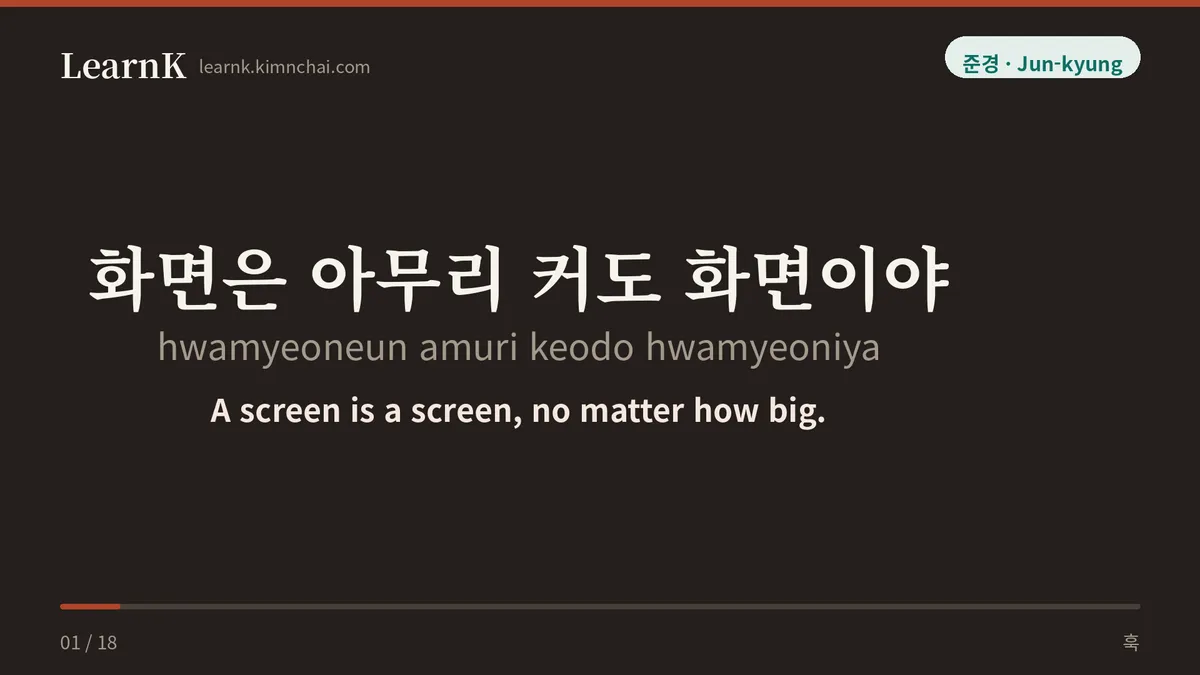
Jun-kyung: 그니까 한 번은 직관해 봐야 된다니까. 화면은 아무리 커도 화면이야. That’s why you have to see it in person at least once. A screen is a screen, no matter how big.
Emily: 인정. 다음 앙콘도 무조건 직관 갈 거야. 티켓팅부터 같이 하자. Agreed. I’m definitely going in person to the encore too. Let’s do the ticketing together.
Saying It This Way Sounds Off
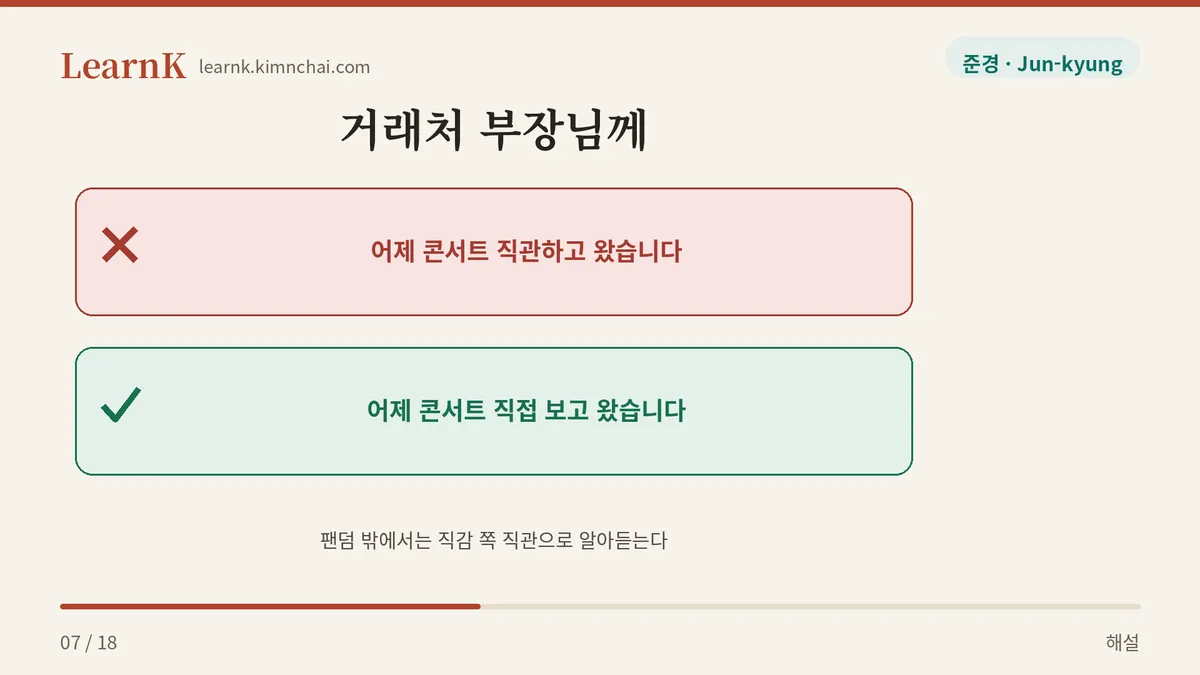
✗ (to a manager at a client company) 어제 콘서트 직관하고 왔습니다. (eoje konseoteu jikgwanhago watseumnida.) ✓ (to a manager at a client company) 어제 콘서트 직접 보고 왔습니다. (eoje konseoteu jikjeop bogo watseumnida.) → This abbreviation only works inside the fandom. Outside it, the other person will hear 직관 as the dictionary’s “intuition” and ask back, “직관을 하고 오셨다고요? (jikgwaneul hago osyeotdagoyo?)” — “You went and… intuited?” Outside fan circles, it’s safer to spell it out as 직접 보다 (jikjeop boda), “to see in person.”
✗ 팀장님은 늘 직관으로 결정하시네요. (timjangnimeun neul jikgwaneuro gyeoljeonghasineyo.) ✓ 팀장님은 감이 정확하시네요. (timjangnimeun gami jeonghwakhasineyo.) → Just as the dictionary example pinned 직관 to an “unscientific attitude,” the word still carries a whiff of “without any grounds.” Calling a superior’s judgment 직관 doesn’t land as praise; it lands as fault-finding. To compliment someone, go with 감이 좋다 (gami jota), “good instincts,” or 판단이 빠르다 (pandani ppareuda), “quick to decide.”
Example Sentences by Situation
1. Comforting a friend who lost out in ticketing
이번엔 집관하고, 다음 앙콘 때 같이 직관 가자. (ibeonen jipgwanhago, daeum angkon ttae gachi jikgwan gaja.) Let’s watch from home this time and go see it live together at the encore.
The moment right after someone strikes out in ticketing is the single most common place for comfort to pass between fans. Putting 직관 and 집관 side by side in one sentence generates the meaning “this one’s a shame, but there’s a next time” all on its own. Between fans, those two words alone explain the whole situation.
2. Writing the first line of a review after the show
3층 끝자리였는데도 직관은 직관이더라. (samcheung kkeutjariyeonneunde-do jikgwaneun jikgwanideora.) Even from the last row of the third floor, seeing it in person is seeing it in person.
The “A는 A이다” pattern means “bad conditions don’t change what something essentially is.” It’s the sentence you use when you’d been lamenting your seat and ended up satisfied anyway, and it’s extremely common as a review’s opening line.
3. Using the dictionary meaning, talking about study or work
이 문제는 직관에 맡기지 말고 하나씩 따져 보자. (i munjeneun jikgwane matgiji malgo hanassik ttajyeo boja.) Let’s not leave this problem to intuition — let’s check it one by one.
This is what you say in a study group or a meeting to mean “let’s not just guess by feel.” It has the same skeleton as the dictionary example 직관에 의존하기보다는 개념적 접근을. Outside a fandom context, 직관 usually lives in places like this.
Polite and Casual Forms, and Similar Expressions
As a verb, the forms are simple. Casual is 직관했어 (jikgwanhaesseo), polite is 직관했어요 (jikgwanhaesseoyo), and the more formal version is 직관했습니다 (jikgwanhaetseumnida). That last form, though, is only grammatically possible — in practice almost nobody says it, because any setting formal enough to require it is a setting where this abbreviation doesn’t work in the first place. In the 직관 가다 shape it softens nicely into 직관 가요 (jikgwan gayo) or 직관 가려고요 (jikgwan garyeogoyo).
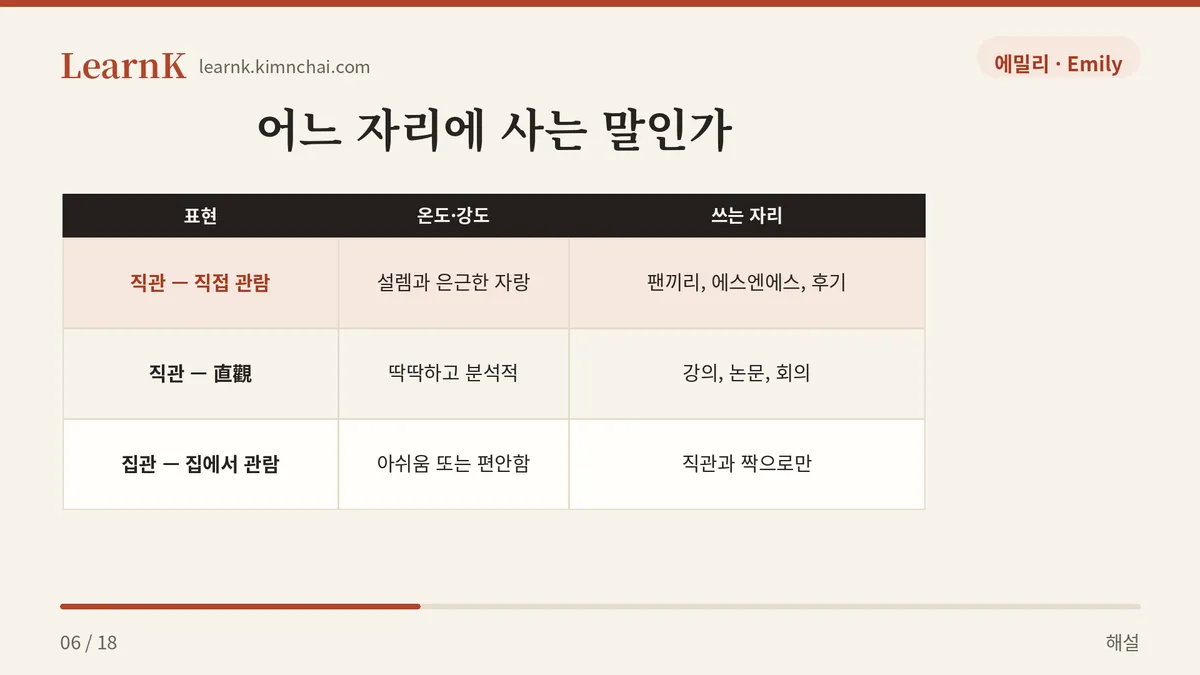
| Expression | Temperature / intensity | Where it’s used |
|---|---|---|
| 직관 (jikgwan) — 직접 관람, watching in person | excitement mixed with quiet bragging | between fans, on social media, in reviews. Not at work |
| 집관 (jipgwan) — 집에서 관람, watching from home | regret, or coziness | almost only as 직관’s partner word |
| 직관 (jikgwan) — 直觀 | stiff and analytical | lectures, papers, meetings. Rare in everyday talk |
| 직감 (jikgam) | neutral, everyday | anywhere. “직감이 왔어 (jikgami wasseo)” |
| 촉 (chok) | light and colloquial | among peers. “내 촉이 맞았지 (nae chogi majatji)” |
To move dictionary 직관 into everyday conversation, just swap in 직감 (jikgam) or 촉 (chok). “직관으로 알았어 (jikgwaneuro arasseo)” is written-register; “촉이 왔어 (chogi wasseo)” is how you talk to a friend. Go the other way and put 촉 in a presentation, and it’s far too casual.
Cultural Background — A Word Born From Three Minutes of Ticketing
The word-formation is transparent. Take the first syllables of 직접 관람 (jikjeop gwallam) and you get 직관; do the same to 집에서 관람 (jibeseo gwallam) and you get 집관. It’s the most common abbreviation method in Korean, which is why fans can guess the meaning even on first sight. It just happens to collide in spelling with the dictionary’s 直觀 despite having a different root — and the fun part is the character the two share, 直 (jik, “straight, direct”). One skips the steps of thinking and knows immediately; the other skips the step of the screen and sees directly. The picture they draw is remarkably similar.
This word didn’t start in K-pop. It hardened in baseball and soccer fandoms, distinguishing watching a broadcast from actually going to the stadium, and then crossed over into idol fandom. In crossing over, the number of settings it covers grew — concerts, music-show pre-recordings, fan meetings, awards shows. And once online concerts became routine after 2020, the partner word 집관 settled in completely. Plenty of fans now say “집관 세팅했다 (jipgwan seting-haetda)” — “I’ve got my home-viewing setup ready” — about the big screen and good speakers they’ve prepared at home.
Why does this distinction matter so much? Korean concerts usually sell out within minutes of tickets going on sale. Those few minutes of sitting at a set time with several browser windows open and clicking like a maniac have earned their own nickname: 광클 (gwangkeul), “mad clicking.” So 직관 doesn’t just mean “I went” — it also carries “I made it through that competition.” That’s why reviews so faithfully include seat numbers and photos of the view, and it’s also why fans who couldn’t go read those reviews so eagerly. For someone who missed out, the review becomes the experience secondhand.
Korean dramas feature this emotion often. Waiting up all night to get a ticket to a favorite singer’s show, or bursting into tears in front of the person who managed to get you one, is a staple scene in coming-of-age stories. Even without quoting the lines, you can probably picture it — a story structure where a single ticket serves as proof of friendship. Once you understand what 직관 means to a fan, you also understand why those scenes get treated as such a big deal.
Today’s Quiz
Your friend has just struck out in concert ticketing. Which of the following would your friend most naturally say in this situation?
- 오늘 무대 직관했어. 3층이었는데 진동이 오더라. (oneul mudae jikgwanhaesseo. samcheung-ieonneunde jindong-i odeora.) — I saw the stage in person today. I was on the third floor and I could still feel the vibrations.
- 어쩔 수 없지, 이번엔 집관해야겠다. (eojjeol su eopji, ibeonen jipgwanhaeyagetda.) — Nothing I can do — guess I’m watching from home this time.
- 내 직관으로는 이 문제를 다시 봐야 한다. (nae jikgwaneuroneun i munjereul dasi bwaya handa.) — My intuition says we need to look at this problem again.
The answer is 2. She couldn’t get a ticket, so watching at home is the only option, and the word for that situation is 집관. Number 1 is what someone who got a ticket and went to the venue would say, so the timing doesn’t fit. The 직관 in number 3 is the dictionary’s 直觀 — the “intuition” sense — so it belongs to an entirely different setting than a ticketing scramble. Same spelling, but context decides which 직관 it is: if there’s a show, a seat, or a ticket nearby, it’s 직접 관람; if there’s judgment, evidence, or reasoning nearby, it’s 直觀.
Definitions and example sentences are from the National Institute of Korean Language’s Basic Korean Dictionary (krdict.korean.go.kr); that portion of this post, including our translations, is licensed under CC BY-SA 2.0 KR.