집콕 (jipkok) — What Koreans Say on a Day They Don't Want to Leave the House
집콕 (jipkok)
집콕 (jipkok) means burrowing into your home and staying put instead of going out. There are Friday evenings when you’re not really sick and the weather isn’t especially bad, yet for some reason you just can’t face opening the front door. On days like that, the line Koreans toss into the group chat is “미안, 나 오늘 집콕할래 (mian, na oneul jipkok-hallae)” — “Sorry, I’m staying in today.” It’s less an excuse for putting off plans than a light little announcement that you’ve decided to spend the day indoors.
The key thing here is that it’s your own choice. 집콕 isn’t a state of can’t go out — it’s a state of choosing not to. That’s why the word carries a whiff of coziness before any sense of being cooped up. It comes with a whole mental picture attached: a pot of ramyeon on the stove, no shower, binge-watching a drama from under the blanket. It isn’t a word that scolds you for being lazy; it’s a word that announces you intend to enjoy being lazy — which is why the person saying it is usually smiling.
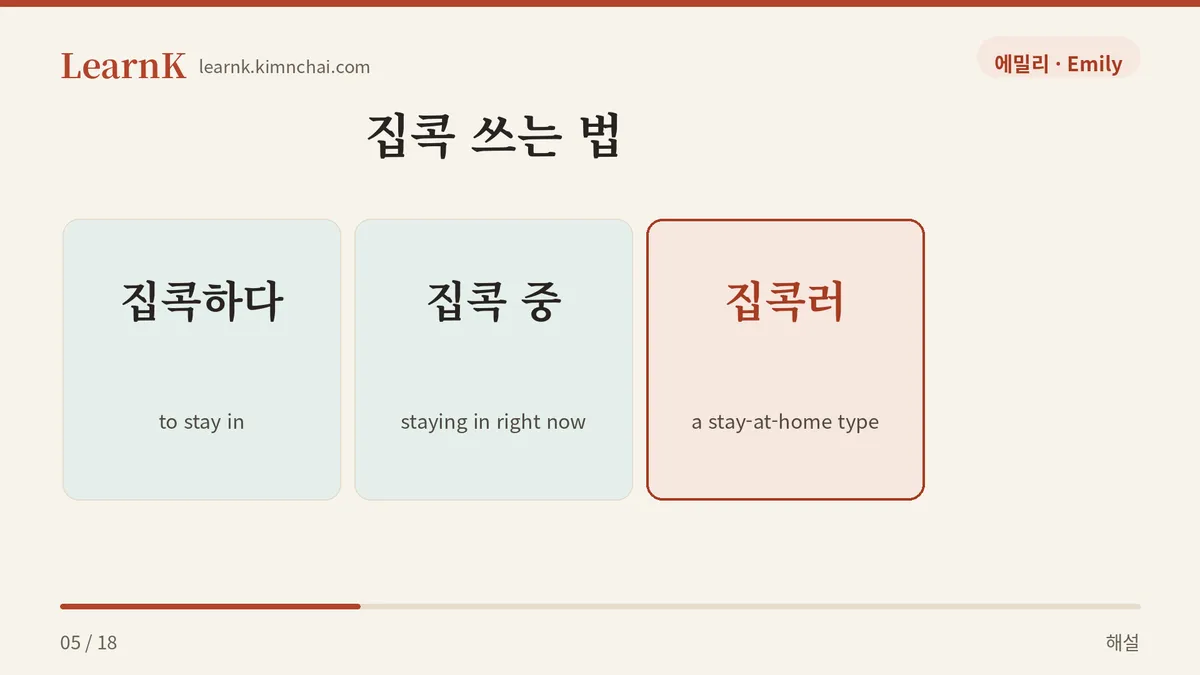
Grammatically it works like a noun. Add -하다 (-hada) to get 집콕하다 (jipkok-hada); if it’s in progress, 집콕 중 (jipkok jung); and for the kind of person who does it, 집콕족 (jipkokjok) or 집콕러 (jipkokreo). Stick it in front of cooking, exercise, or hobbies and you get easy compounds like 집콕 요리 (jipkok yori) “at-home cooking” and 집콕 운동 (jipkok undong) “at-home workout.” For a piece of new slang, it stretches remarkably well.
A real conversation
The scene: Friday evening, a typhoon in the forecast, the checkout line at the neighborhood supermarket. Two people’s carts are piled high with ramyeon and snacks.
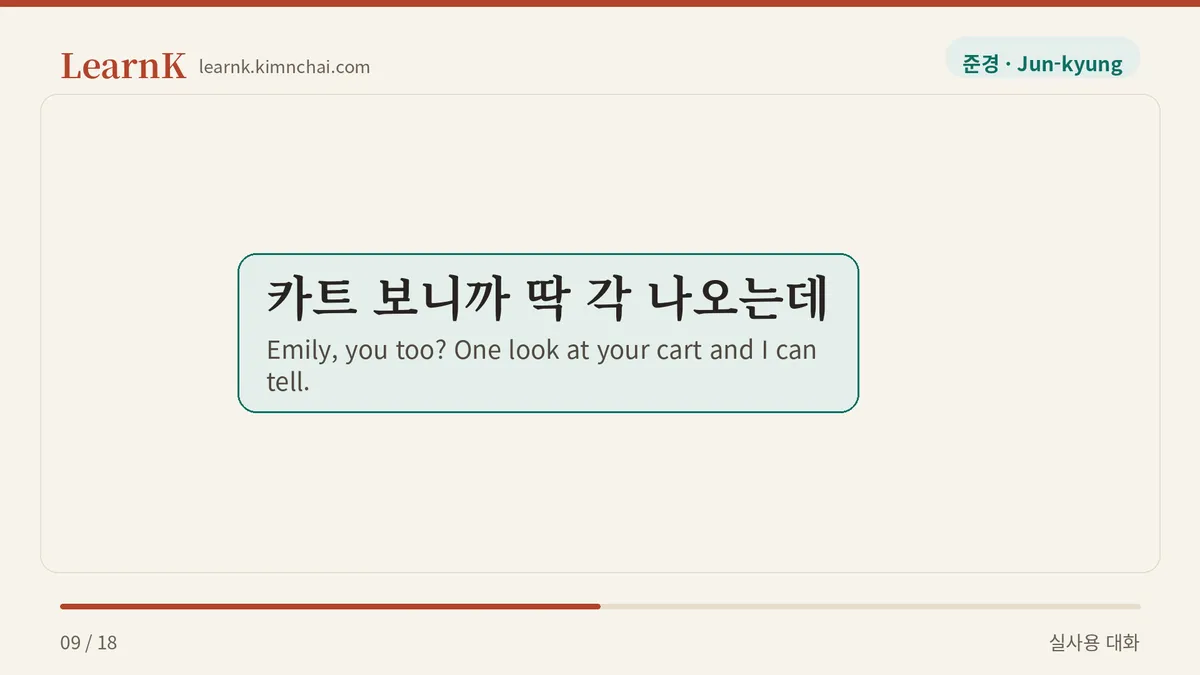
Jun-kyung: 어? 에밀리 씨도 오늘… 카트 보니까 딱 각 나오는데. Huh? Emily, you too… one look at your cart and I can tell.
Emily: ㅋㅋ 딱 걸렸다. 내일 태풍 온다길래 주말 내내 집콕하려고. Haha, busted. They said a typhoon’s coming, so I’m holing up at home all weekend.
Jun-kyung: 나도 나도. 근데 라면 여섯 개는 좀 심하지 않아? Same here. But six packs of ramyeon is a bit much, no?
Emily: 이게 다 계획이 있는 거야. 볼 것도 벌써 다 골라 놨어. There’s a whole plan behind this. I’ve already picked out everything I’m watching.
Jun-kyung: 와, 프로 집콕러네. 난 이틀 넘게 집에 있으면 좀이 쑤시던데. Wow, a pro homebody. Me, more than two days indoors and I get restless.
Emily: 그럼 일요일에 비 그치면 연락해. 그때 나갈게. Then text me Sunday if the rain lets up. I’ll come out then.
When it sounds off
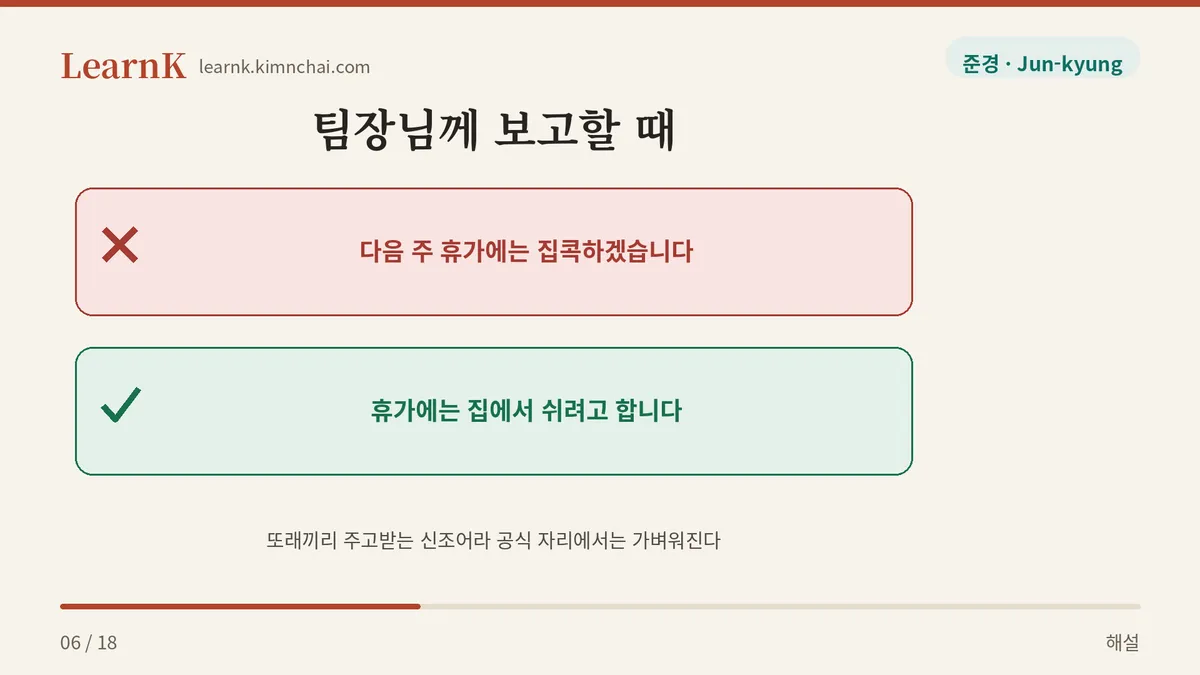
✗ (reporting to your team lead) 다음 주 휴가에는 집콕하겠습니다. (daeum ju hyugaeneun jipkok-hagetseumnida.) ✓ (reporting to your team lead) 다음 주 휴가에는 특별한 계획 없이 집에서 쉬려고 합니다. (daeum ju hyugaeneun teukbyeolhan gyehoek eopsi jibeseo swiryeogo hamnida.) — “I’m planning to rest at home next week with nothing special planned.” → The grammar is fine, but the setting is wrong. 집콕 is slang traded among peers, so in a formal report it makes you sound flippant. With someone senior to you, “집에서 쉬다 (jibeseo swida)” — “rest at home” — is the safe choice.
✗ (to an elderly neighbor who hasn’t been able to leave the house for two months after surgery) 요즘 계속 집콕하시네요. (yojeum gyesok jipkok-hasineyo.) ✓ (same situation) 두 달째 집에만 계신다면서요. 많이 답답하시겠어요. (du daljjae jibeman gyesindamyeonseoyo. mani dapdapasigesseoyo.) — “I hear you’ve been stuck at home for two months now. That must feel so confining.” → The temperature is wrong. 집콕 has that easygoing “I’m choosing not to go out” underneath it, so using it for someone shut in by illness makes light of their situation.
Example sentences by situation
1. Gently pushing back a plan
미안, 오늘은 그냥 집콕할래. 다음 주에 보자. (mian, oneureun geunyang jipkok-hallae. daeum jue boja.) Sorry, I’m just going to stay in today. Let’s meet next week.
It’s a refusal, but the other person doesn’t take it personally — because it lands as “here’s where I’m at today,” not “I don’t want to see you.” Tacking a next date onto the end makes it flow much more naturally.
2. Monday morning, when someone asks about your weekend
주말 내내 집콕했어. 밖에 한 발짝도 안 나갔다. (jumal naenae jipkok-haesseo. bakke han baljjakdo an nagatda.) I stayed in all weekend. Didn’t set one foot outside.
This is one of the most common Monday-morning answers in a Korean workplace. It’s a confession that you did nothing at all, but the word 집콕 makes it sound like a well-spent rest rather than a slump.
3. Locking in your holiday plans early
이번 연휴는 집콕이 답이다. 고속도로 보면 나갈 마음이 사라져. (ibeon yeonhyuneun jipkogi dabida. gosokdoro bomyeon nagal maeumi sarajyeo.) Staying home is the answer this holiday. One look at the highway and any urge to go out disappears.
“~이 답이다 (i dabida)” — ” is the answer” — is very common these days and pairs beautifully with 집콕. In a country where photos of gridlocked highways hit the news every holiday, this sentence needs no explanation.
Politeness levels and similar expressions
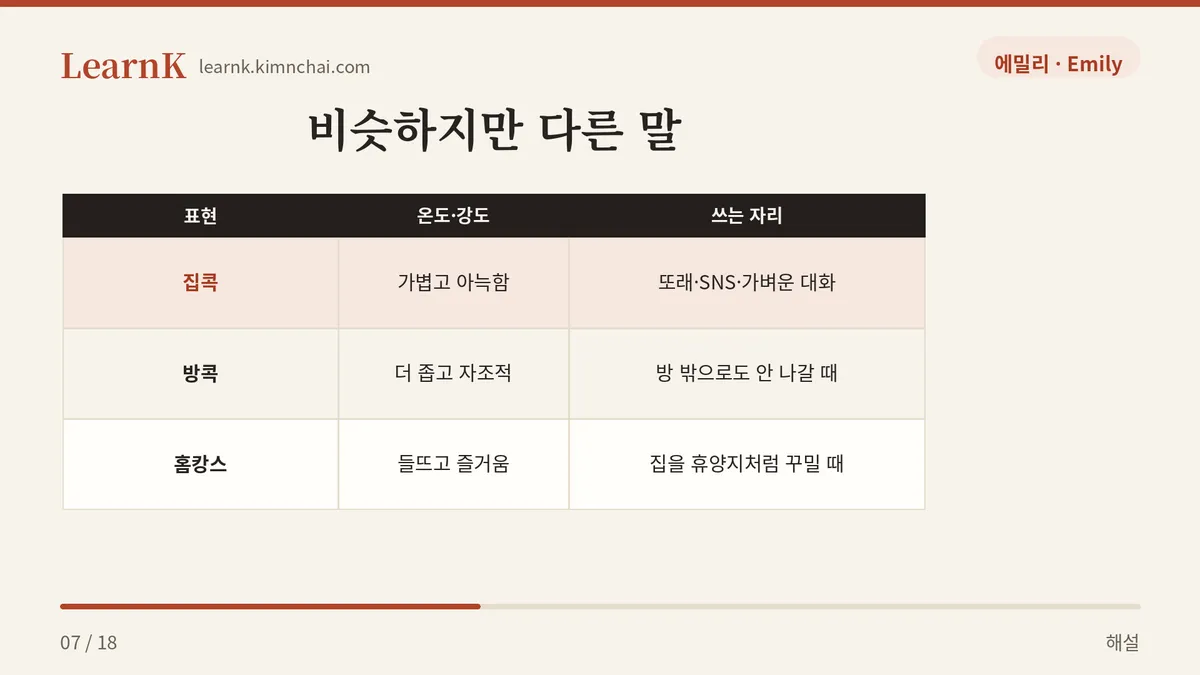
Since 집콕 is a noun, there’s nothing wrong with attaching polite endings: 집콕했어요 (jipkok-haesseoyo), 집콕합니다 (jipkok-hamnida). But raising the ending doesn’t raise the register of the word itself. “주말에 집콕했어요 (jumare jipkok-haesseoyo)” to a friendly senior colleague or an easygoing boss is fine — in a job interview or an official report, better to avoid it.
| Expression | Tone & intensity | Where it fits |
|---|---|---|
| 집콕 (jipkok) | Light and cozy, by choice | Peers, social media, casual talk. Careful with seniors |
| 방콕 (bangkok) | Narrower, more self-mocking | Joking among peers. When you don’t even leave your room |
| 홈캉스 (homkangseu) | Excited, fun | Vacation season. When you dress your home up like a resort |
| 칩거 (chipgeo) | Heavy and serious | Written language, news articles. Withdrawing from the world |
| 집에서 쉬다 (jibeseo swida) | Neutral | Anywhere. Safe with seniors too |
방콕 (bangkok) was in use before 집콕, and since it sounds exactly like the Thai capital, it gets used for wordplay all the time — “이번 휴가는 방콕이야 (ibeon hyuganeun bangkogiya)” (“This vacation, I’m going to Bangkok” / ”…I’m staying in my room”). 홈캉스 (homkangseu) blends “home” with vacances, so it’s far more active than 집콕. If 집콕 is “I’m not going out,” 홈캉스 is closer to “I’m enjoying my home.”
Cultural background — the picture of being wedged in
집콕 is built from 집 (jip), “house,” plus the adverb 콕 (kok). 콕 describes the shape of tucking your body into a tight space and not budging. The idiom 집에 콕 박혀 있다 (jibe kok bakhyeo itda) — “to be holed up at home” — came first, and 집콕 is that five-syllable phrase squeezed down to two. So when a Korean hears this word, an image of someone curled up under a blanket automatically comes with it. Remembering that picture will stick with you far longer than memorizing the definition.
The word exploded around 2020, during the pandemic. In a period when nobody could go out, compounds like 집콕 요리 (at-home cooking), 집콕 운동 (at-home workouts), and 집콕 놀이 (at-home games) were being coined almost daily. What’s interesting is that the word didn’t vanish once that period passed. If anything, its meaning shifted slightly: today it refers not to enforced isolation but to rest you’ve chosen for yourself.
The rise in people living alone is part of the backdrop too. This is a country where a show like MBC’s I Live Alone (《나 혼자 산다》, Na Honja Sanda) — which simply shows you a solo dweller’s ordinary day — has been beloved for years, so time spent inside the home reads as a lifestyle rather than something sad. When you’re watching a Korean drama and the lead spends the whole weekend lounging around the apartment, just think: Koreans have a two-syllable word for that scene, and it’s 집콕.
Today’s quiz
In which of the following situations would 집콕 sound the most out of place?
- Seeing the typhoon forecast and texting a friend “이번 주말은 집콕이다 (ibeon jumareun jipkogida)” — “This weekend I’m staying in.”
- Answering a coworker on Monday morning with “주말에 집콕했어 (jumare jipkok-haesseo)” — “I stayed in over the weekend.”
- Greeting an elderly neighbor who hasn’t been able to go out for two months after surgery with “요즘 집콕하시네요 (yojeum jipkok-hasineyo)” — “You’ve been staying in lately, haven’t you.”
- Posting photos of ramyeon and a movie on social media captioned “집콕 라이프 (jipkok raipeu)” — “stay-at-home life.”
Answer: 3. 집콕 is a light way of describing a state you’ve chosen — not going out because you decided not to. Using it for someone confined at home by illness makes light of what they’re going through. Here, “많이 답답하시겠어요 (mani dapdapasigesseoyo)” — “That must feel so confining” — is the right call.
The expression covered in this post, 집콕 (jipkok), is recent slang and is not a headword in the National Institute of Korean Language’s Basic Korean Dictionary (krdict.korean.go.kr). The definitions, example sentences, and dialogue here are therefore not drawn from the dictionary — they are all original work written for this post.