Jjamba — The Skill Time Leaves in Your Fingertips
짬바 (jjamba) is a Korean neologism for the seasoned know-how that soaks into the body of someone who has done the same work for years — in other words, the skill that comes out of experience all on its own. The moment someone’s hands move before they’ve even glanced at the manual, the moment someone finishes in three minutes what takes everyone else thirty, Koreans say, half in admiration, “역시 짬바가 다르네 (yeoksi jjamba-ga dareune)” — Yeah, the years really do show.
The places this word turns up are always the same kind of place. A mover carrying a wardrobe down the stairs by himself. A salon owner tidying up your bangs with three flicks of the scissors. Your mother getting the seasoning of a soup exactly right on the first try, no measuring cup in sight. In front of the kind of skill you can’t learn at an academy and can’t measure with a test, 짬바 (jjamba) is the word Korean speakers reach for.
짬바
짬바 (jjamba) — the practiced skill or air that naturally seeps out of someone who has been doing something for a long time.
The key isn’t “time,” it’s “what time has left behind in the body.” Someone who has done the same job for ten years but makes the same mistake every time is not said to have 짬바 (jjamba). On the flip side, someone who’s only three years in but whose hands already know where to go gets a “짬바 나온다 (jjamba naonda)” — the jjamba is showing. That’s why there’s a quiet respect built into this word. It’s recognition for skill that isn’t flashy but that nobody can imitate.
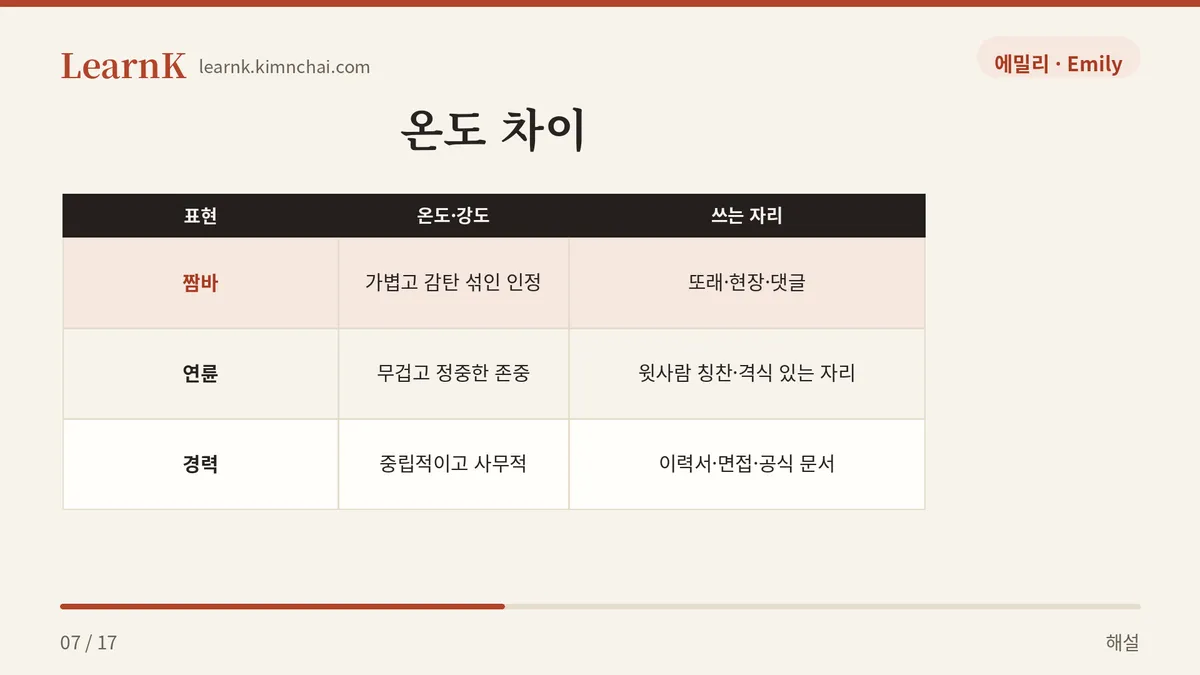
The temperature is light and warm. It’s tossed off almost like an exclamation, so it doesn’t suit formal settings. You can’t write “짬바 15년 (jjamba sibo-nyeon)” on your résumé. It lands most naturally on the job site, among peers, or in front of a screen watching a broadcast: “와, 짬바 봐라 (wa, jjamba bwara)” — Whoa, look at that jjamba.
The phrases it attaches to are pretty much fixed: 짬바가 있다 / 없다 (jjamba-ga itda / eopda), 짬바가 다르다 (jjamba-ga dareuda), 짬바 나온다 (jjamba naonda), 짬바에서 나오는 여유 (jjamba-eseo naoneun yeoyu). It pairs especially well with 나오다 (naoda, “to come out”), because the word paints a picture of skill flowing out from the inside.
Seeing It in Real Conversation
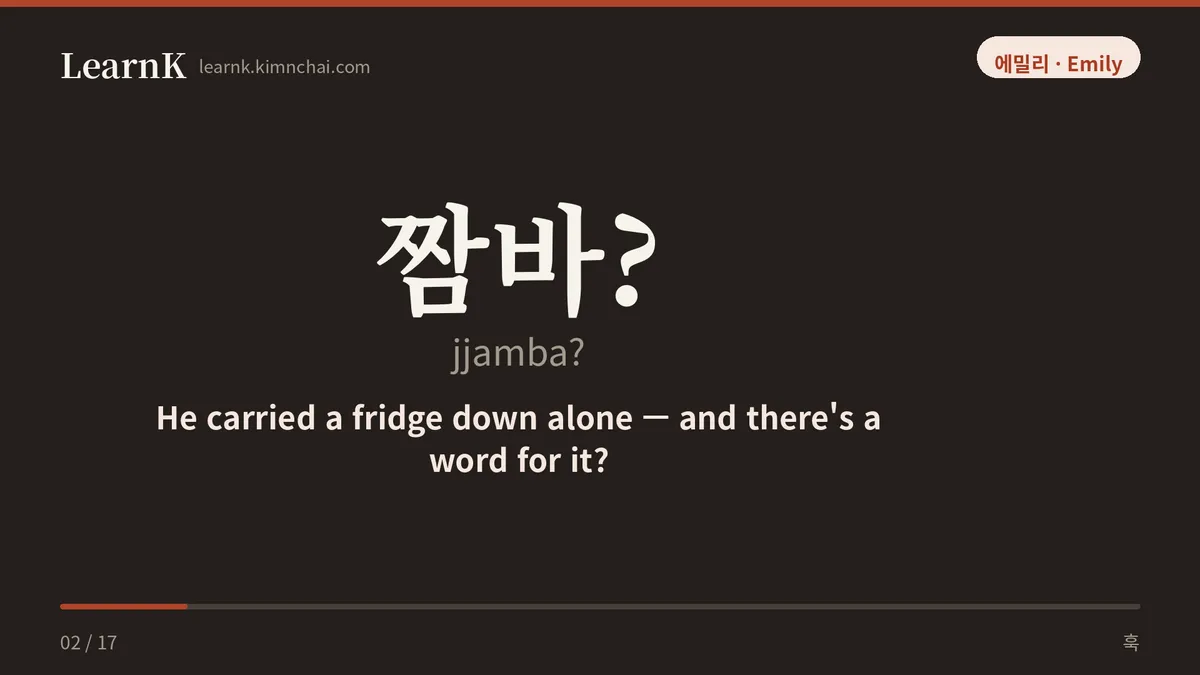
Situation: It’s Emily’s moving day. Through the window, she can see one of the movers wrap up the refrigerator by himself and carry it down the stairs.
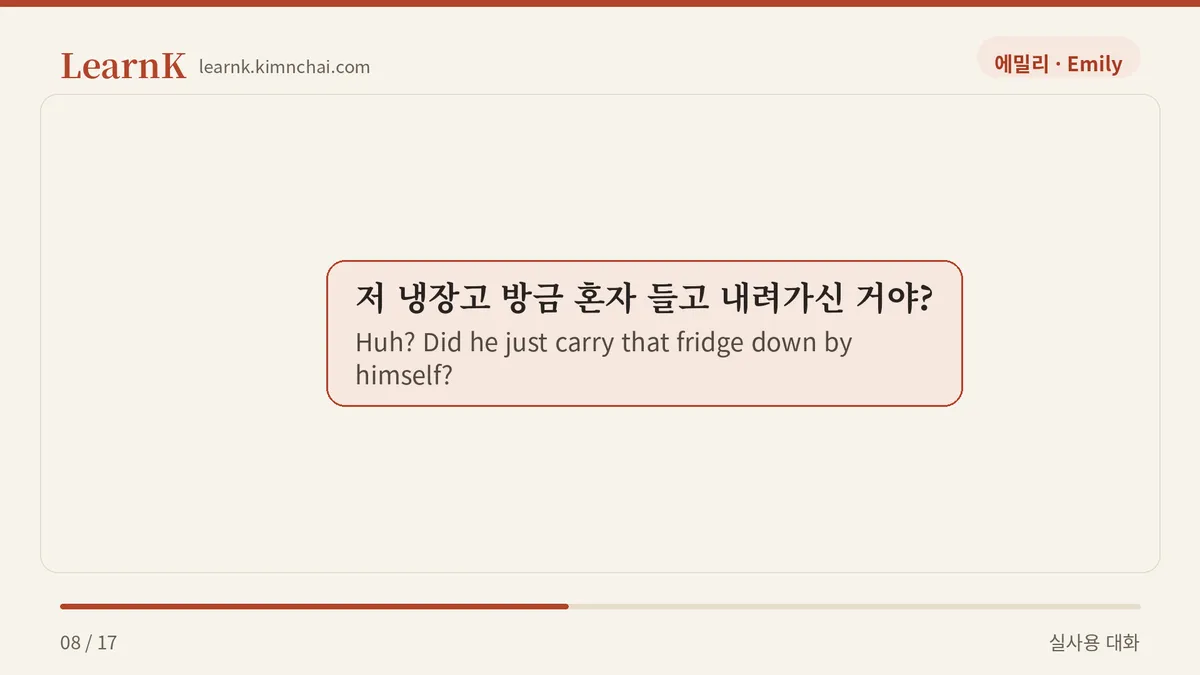
Emily: 어? 저 냉장고 방금 혼자 들고 내려가신 거야? Huh? Did he just carry that fridge down by himself?
Jun-kyung: 어. 저게 짬바야. 20년 하신 분들은 손 자체가 달라. Yeah. That’s what years of experience look like. Guys who’ve done it 20 years just move differently.
Emily: 난 아까 그릇 하나 싸는 데 십 분 걸렸는데… It took me ten minutes just to wrap one bowl earlier…
Jun-kyung: 야, 그건 당연하지. 너도 김치 담그는 건 이제 짬바 나오잖아. Come on, that’s normal. You’ve totally got the touch with kimchi now, though.
Emily: 아, 그건 인정. 3년째 담그니까 손이 알아서 가더라. Okay, I’ll give you that. Third year making it and my hands just know.
Jun-kyung: 그런 게 짬바지 뭐. 머리보다 몸이 먼저 기억하는 거. That’s exactly what jjamba is. Your body remembers before your head does.
This Sounds Off
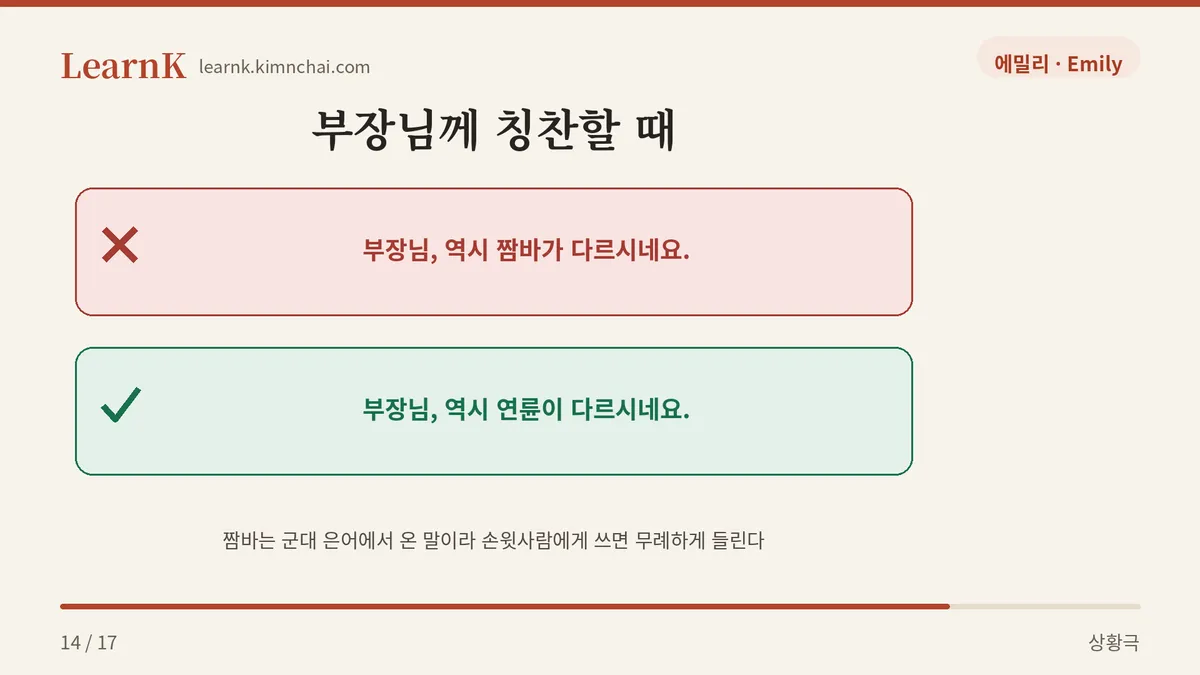
✗ (To your department head) 부장님, 역시 짬바가 다르시네요. (Bujangnim, yeoksi jjamba-ga dareusineyo.) ✓ (To your department head) 부장님, 역시 연륜이 다르시네요. (Bujangnim, yeoksi yeollyun-i dareusineyo.) → Even if you mean it as a compliment, 짬바 (jjamba) comes out of military slang, so using it straight to someone senior to you sounds like “you’ve just been around a long time,” which comes off as rude. With superiors, 연륜 (yeollyun) or 경험이 다르시다 (gyeongheom-i dareusida) is the safe choice.
✗ (In a job interview) 저는 이 분야에서 짬바가 있습니다. (Jeoneun i bunya-eseo jjamba-ga itseumnida.) ✓ (In a job interview) 저는 이 분야에서 8년간 실무를 해 왔습니다. (Jeoneun i bunya-eseo pal-nyeon-gan silmureul hae watseumnida.) → 짬바 (jjamba) is closer to something other people pin on you in admiration. Pin it on yourself in an official setting and you don’t read as skilled — you read as someone with a careless way of speaking.
Example Sentences by Situation
1. The salon you’ve been going to for over ten years — the owner runs a hand through your hair once and starts layering it without asking a single question.
“원장님이 머리 한 번 만져 보시더니 바로 아시더라. 이게 짬바구나 싶었어.” (Wonjangnim-i meori han beon manjyeo bosideoni baro asideora. Ige jjamba-guna sipeosseo.) “The owner just touched my hair once and knew right away. I thought, so this is jjamba.” → This is what you say about an instinct that needs no explanation. Here 짬바 (jjamba) points to the time spent handling thousands of customers’ heads.
2. Watching a baseball broadcast — bases loaded in the ninth, and the forty-year-old veteran pitcher’s expression doesn’t change at all.
“저 상황에서 저렇게 여유 있는 거 봐. 완전 짬바에서 나오는 배짱이지.” (Jeo sanghwang-eseo jeoreoke yeoyu inneun geo bwa. Wanjeon jjamba-eseo naoneun baejjang-iji.) “Look how calm he is in that spot. That’s pure nerve that comes out of jjamba.” → The most common usage of all, in sports broadcasts and YouTube comments. You use it when you’re pointing at an unshakable attitude rather than at technique.
3. About yourself, now that you’re in your third year — you finish in an afternoon something that used to keep you up all night, and it surprises you.
“3년 차 되니까 이제 좀 짬바가 생겼나 봐.” (Sam-nyeon cha doenikka ije jom jjamba-ga saenggyeonna bwa.) “Three years in, I guess I’ve finally picked up a little jjamba.” → When you use it about yourself, it only sounds natural with a modest guessing form like 생겼나 봐 (saenggyeonna bwa, “I guess I’ve got some”). Say it flatly — “나 짬바 있어 (na jjamba isseo)” — and it sounds like bragging.
Polite vs. Casual Speech, and Similar Expressions
짬바 (jjamba) isn’t a word that splits into polite and casual versions — the word itself has already stepped outside of formality. That’s why a form like “짬바가 있으십니다 (jjamba-ga isseusimnida)” sounds off somehow, even though the grammar is fine. If you want to fit it into a polite sentence, it works best when you’re talking about a peer or a third party. For example: “저 친구는 짬바가 좀 있어요 (Jeo chingu-neun jjamba-ga jom isseoyo).”
| Expression | Tone & intensity | Where it’s used |
|---|---|---|
| 짬바 (jjamba) | Light, admiring recognition | Peers, worksites, comment sections. Not in front of superiors or in official documents |
| 짬 (jjam) | The root of 짬바; the accumulated time itself | Military and worksite slang. “짬 좀 찼네 (jjam jom channe)” |
| 연륜 (yeollyun) | Weighty, formal respect | Praising a superior; fine in any formal setting |
| 내공 (naegong) | Skill built up on the inside; a somewhat cool ring to it | Broadly used, including in writing |
| 경력 (gyeongnyeok) | Neutral, businesslike | Résumés, interviews, official documents |
About the very same person, you’d tell your department head “연륜이 대단하십니다 (yeollyun-i daedanhasimnida),” tell a coworker “짬바 장난 아니다 (jjamba jangnan anida),” and write “경력 12년 (gyeongnyeok sibi-nyeon)” on a résumé. All three point to the same stretch of time, but the temperature is completely different. Developing a feel for choosing that temperature is Korean’s honorific system in actual practice.
Cultural Background — The Vibe That Comes Out of 짬 (jjam)
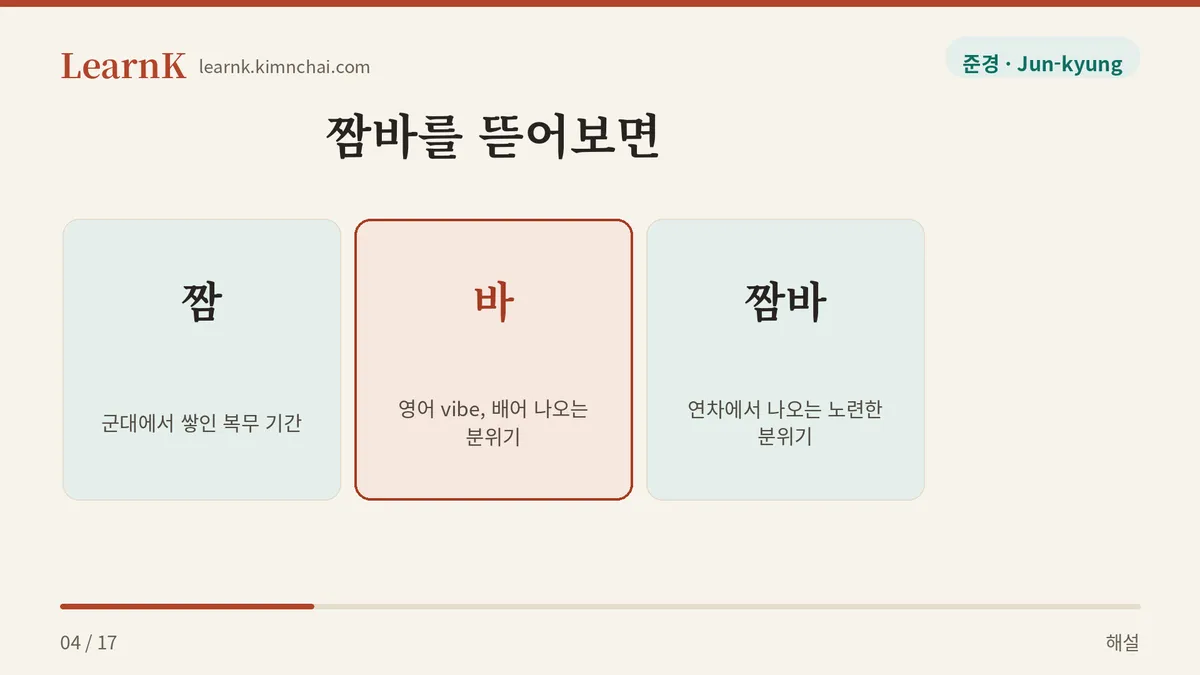
The first syllable of 짬바, 짬 (jjam), is military slang for length of service. Saying “짬이 찼다 (jjam-i chatda)” means someone has been in that long, and 짬밥 (jjambap), which grew out of it, means the food you eat in the army and, by extension, “the number of bowls you’ve eaten = your experience.” The 바 (ba) at the end is widely explained as the first syllable of the English word vibe (바이브, baibeu). The vibe that comes out of 짬 — that is, the air that seeps out of your years on the job. That said, the coining of slang like this is never officially recorded, so it’s best filed away as one widely accepted explanation.
The fact that this word came from the military is still visible in how it’s used. The majority of adult Korean men go through military service, and the sense of “years served = ability” that they absorb there has flowed out into wider society. That’s why 짬바 (jjamba) attaches far more readily to hands-on workplaces than to desk jobs — kitchens, construction sites, auto shops, sports.
The channels that spread the word widely in the 2020s were sports broadcasts and variety-show subtitles. When a veteran player stays calm in a crisis, the subtitle “짬바” pops up on screen; the same subtitle appears when the owner of an old restaurant eyeballs exactly the right amount of dough. It compresses into two syllables a theme Korean workplace dramas have long explored — the senior’s instinct that a newcomer can’t match right away no matter how hard they try, and the mix of respect and frustration you feel in front of that instinct.
The weight this word carries in Korean society is worth noticing too. In a culture that puts stock in age and seniority, the mere fact of “having done it a long time” easily becomes authority in itself — and 짬바 attaches one condition to that. Time alone isn’t enough; that time has to have stayed in your fingertips. So Koreans say a senior with no real ability has just “짬만 찼다 (jjam-man chatda)” — put in the years — rather than saying he has 짬바 (jjamba). Grasp that subtle distinction and you understand more than half of this word.
Today’s Quiz
Which of the following uses ‘짬바’ most naturally?
- 이번 프로젝트 지원서에 제 짬바를 상세히 기재했습니다. (Ibeon peurojekteu jiwonseo-e je jjamba-reul sangsehi gijaehaetseumnida.) — I described my jjamba in detail on the application for this project.
- 저 셰프님 칼질 봐. 진짜 짬바 다르다. (Jeo syepeunim kaljil bwa. Jinjja jjamba dareuda.) — Look at that chef’s knife work. His jjamba really is on another level.
- 사장님, 짬바가 참 훌륭하십니다. (Sajangnim, jjamba-ga cham hullyunghasimnida.) — Sir, your jjamba is truly excellent.
- 저는 이 자격증을 따려고 짬바를 공부했습니다. (Jeoneun i jagyeokjeung-eul ttaryeogo jjamba-reul gongbuhaetseumnida.) — I studied jjamba to get this certification.
Answer: 2. 짬바 (jjamba) ① isn’t used in official documents (1), ② isn’t pinned directly on someone senior to you (3), and ③ is most natural when you’re admiring practiced skill unfolding right in front of you. Number 1 should be 경력 (gyeongnyeok) and number 3 should be 연륜 (yeollyun); number 4 doesn’t work at all, since 짬바 isn’t the kind of thing you obtain by studying.
Definitions and example sentences are from the National Institute of Korean Language’s Basic Korean Dictionary (krdict.korean.go.kr); that portion of this post, including our translations, is licensed under CC BY-SA 2.0 KR.