찜닭 (jjimdak) — The Word for One Big Plate in the Middle, and Everyone Digging for the Noodles First
찜닭
찜닭 (jjimdak) means a Korean chicken dish in which chopped-up chicken is braised down in a soy-sauce seasoning along with vegetables like potato, carrot, and onion, plus glass noodles. It is not food that arrives one plate per person — one enormous plate is set in the middle of the table and four people reach in with their chopsticks at the same time. So the word is a menu item and, at the same time, something closer to a signal that means “let’s eat together today.”
The situations where Koreans agonize over “오늘 뭐 먹지?” (oneul mwo meokji?) — “what should we eat today?” — and end up landing on 찜닭 (jjimdak) tend to look alike. There are three or more people, one of them can’t really handle spicy food, and it’s a gathering that calls for a proper meal rather than drinks. The name comes up a lot when a department is picking a place for a team dinner, when people sit among the moving boxes on move-in day and order their first meal, and on the evening everyone pours out of the building after exams finish.
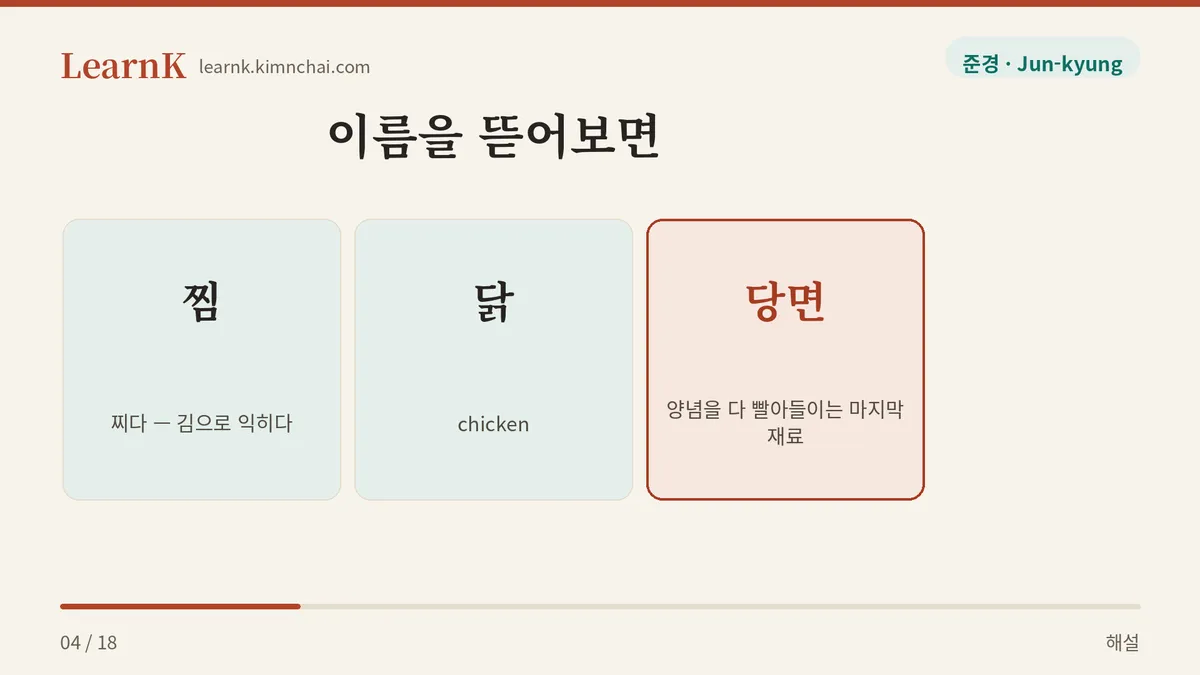
Take the name apart and the meaning is right there. 찜 (jjim) comes from 찌다 (jjida), “to cook with steam,” and 닭 (dak), “chicken,” is attached behind it. The actual cooking, though, is closer to braising than steaming. Chicken and vegetables go into a seasoning of soy sauce, sugar, garlic, and corn syrup, and it all simmers until the liquid has reduced by about half. The 당면 (dangmyeon) — glass noodles — that go in at the very end soak up all of that reduced sauce, and plenty of people fish out the noodles before the chicken. There’s even a half-joking saying that goes around: “닭은 남아도 당면은 안 남는다” (dageun namado dangmyeoneun an namneunda) — “the chicken may be left over, but the noodles never are.”
The base flavor is a sweet-savory soy sauce, not a spicy one. Instead, the heat is adjusted by how many 청양고추 (cheongyang-gochu) peppers go in, so restaurants usually let you pick a level: 순한맛 (sunhan-mat) (mild), 보통맛 (botong-mat) (medium), 매운맛 (maeun-mat) (spicy). And you don’t order it by the plate — you order it by the bird. You count “한 마리, 두 마리” (han mari, du mari), “one chicken, two chickens,” and when two people are eating, one chicken plus an extra bowl of rice is the normal move. These two things — that you can choose the spice level, and that it comes by the bird — are the practical reasons this dish gets picked so often when a group gets together.
See It in a Real Conversation
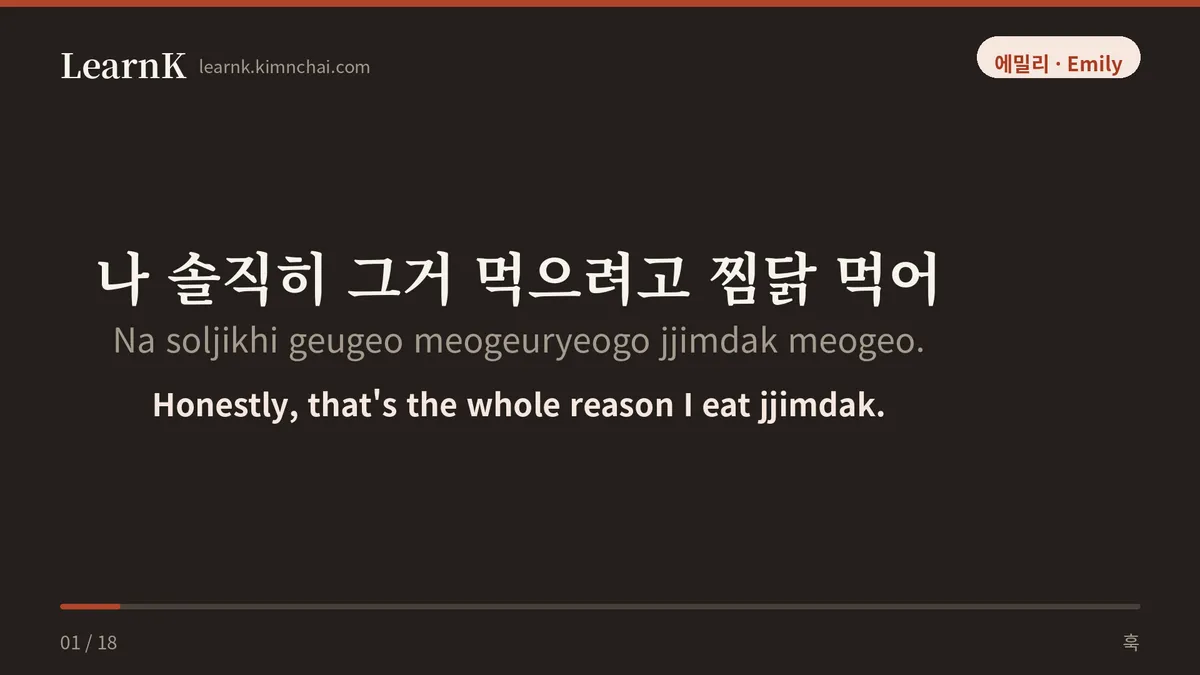
Setting: the Chicken Alley of Andong’s Old Market. It’s the first evening of the trip, and jjimdak restaurant signs line both sides of the alley.
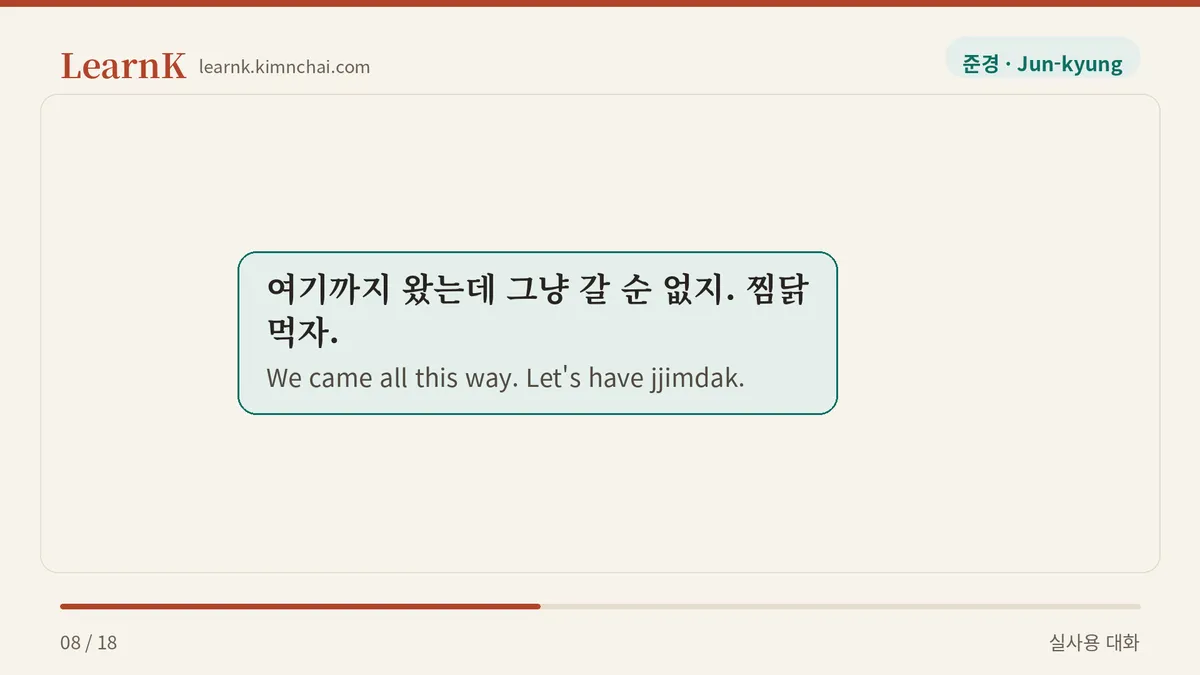
준경: 여기까지 왔는데 그냥 갈 순 없지. 찜닭 먹자. We came all this way — we can’t just skip it. Let’s have jjimdak.
에밀리: 좋아. 근데 나 매운 거 잘 못 먹는데, 순한맛도 돼? Sounds good. But I’m not great with spicy food — can they do it mild?
준경: 되지. 청양고추 빼 달라고 하면 돼. 몇 마리 시킬까? Sure. You just ask them to leave out the cheongyang peppers. How many chickens should we get?
에밀리: 둘인데 한 마리면 충분하지 않아? 찜닭은 반이 당면이잖아. There’s only two of us — isn’t one enough? Half of jjimdak is glass noodles anyway.
준경: 그러네. 대신 공깃밥 하나 시켜서 남은 양념에 비벼 먹자. True. Let’s get a bowl of rice instead and mix it into the leftover sauce.
에밀리: 야, 그게 진짜지. 나 솔직히 그거 먹으려고 찜닭 먹어. Now that’s the real deal. Honestly, that’s the whole reason I eat jjimdak.
This Sounds Off
찜닭 is the name of a food, so it isn’t a word you have to adjust depending on who you’re talking to. Instead, here are two misunderstandings learners actually run into.
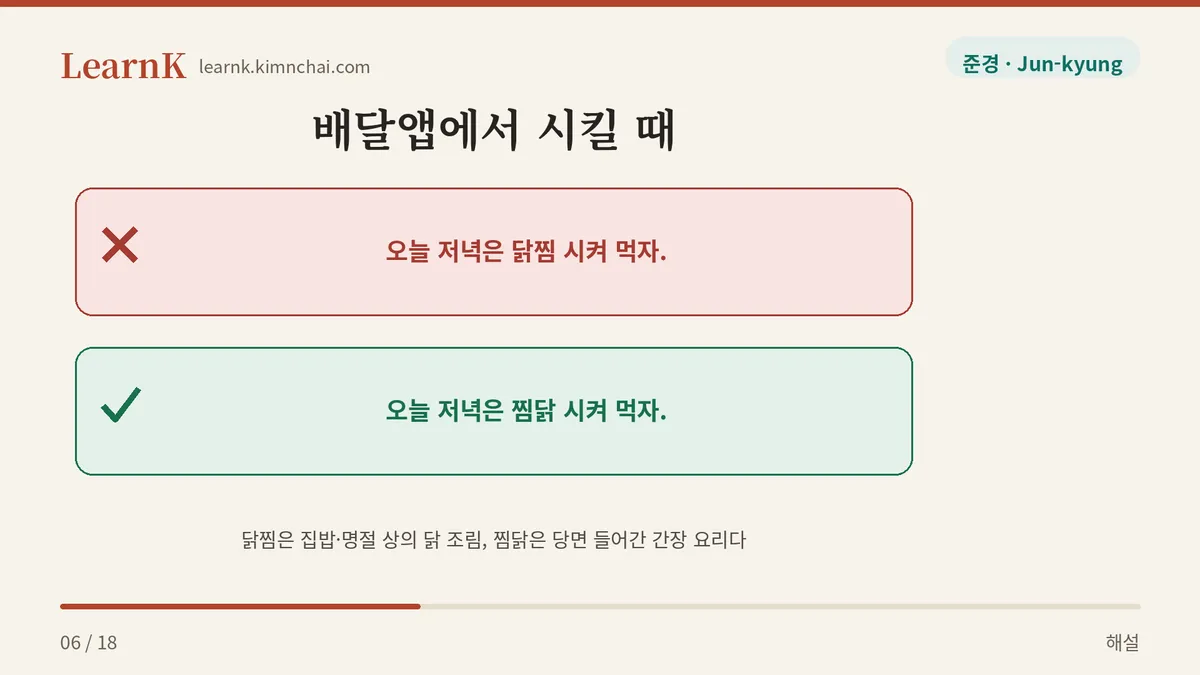
✗ (trying to order Andong-style jjimdak on a delivery app) 오늘 저녁은 닭찜 시켜 먹자. ✓ (same situation) 오늘 저녁은 찜닭 시켜 먹자. → It looks like only the syllable order flipped, but the two words point to different foods. 닭찜 (dakjjim) is an older, general term for braised chicken dishes, so it belongs more to home cooking and holiday tables; what’s on restaurant signs and delivery apps right now is the soy-sauce 찜닭 (jjimdak) with glass noodles in it. Say “닭찜 먹자” (dakjjim meokja) to a Korean and you’ll get a puzzled “어머니가 해 주시는 그거?” (eomeoniga hae jusineun geugeo?) — “you mean the thing my mom makes?”
✗ (walking into a restaurant alone) 사장님, 찜닭 1인분 주세요. ✓ (same situation) 사장님, 혼자 왔는데 찜닭 작은 거 되나요? → 찜닭 comes by the bird and assumes sharing, so the unit 1인분 (irinbun), “one portion,” doesn’t really attach to it. These days some places do keep a solo-size menu item, but it isn’t the default, so asking whether they have one is the natural approach.
Example Sentences by Situation
1) The group chat where the team dinner gets decided
Situation: the department can’t settle on a place. One of the new hires can’t eat spicy food at all.
“이번엔 찜닭 어때요? 순한맛으로 하면 다 같이 먹을 수 있어요.” (Ibeonen jjimdak eottaeyo? Sunhan-mateuro hamyeon da gachi meogeul su isseoyo.) “How about jjimdak this time? If we get it mild, everyone can eat it.”
→ Every reason jjimdak gets picked for team dinners is packed into that one sentence. You can dial the heat down, rice comes with it, and one plate feeds a group. Tacking on “다 같이 먹을 수 있어요” (da gachi meogeul su isseoyo) — “everyone can eat it” — while suggesting a place is a very Korean way of showing consideration.
2) The evening of moving day
Situation: unpacking isn’t even half done. The dishes are still in boxes, and everyone needs to eat.
“이삿날 첫 끼는 역시 찜닭이지. 그릇 안 꺼내도 되잖아.” (Isatnal cheot kkineun yeoksi jjimdagiji. Geureut an kkonaedo doejanha.) “The first meal on moving day has to be jjimdak, right? You don’t even have to unpack the dishes.”
→ 역시 (yeoksi) means “just as expected” or “when all is said and done,” and it’s used to confirm an answer that was already settled. You can eat it straight out of the delivery container and it takes care of the rice too, so it lands on the moving-day menu often.
3) To a friend visiting Korea for the first time
Situation: your friend says they’re taking a trip to Andong.
“안동 가면 찜닭은 꼭 먹어. 골목 하나가 통째로 찜닭집이야.” (Andong gamyeon jjimdageun kkok meogeo. Golmok hanaga tongjjaero jjimdakjibiya.) “If you go to Andong, you have to eat jjimdak. There’s a whole alley that’s nothing but jjimdak places.”
→ 꼭 (kkok) means “without fail,” and it attaches almost idiomatically when you’re recommending food at a travel destination. Adding one concrete image the way the second sentence does makes the recommendation land much harder.
Polite vs. Casual, and Similar Expressions
The name of the food itself has nothing to do with politeness levels, but the register shows up in the sentences you use to order it and offer it.
- At a restaurant (polite): “찜닭 한 마리 주세요.” (Jjimdak han mari juseyo.) — “One jjimdak, please.”
- To a friend (casual): “찜닭 시키자.” (Jjimdak sikija.) — “Let’s order jjimdak.”
- Suggesting it to someone senior: “찜닭 괜찮으세요?” (Jjimdak gwaenchanheuseyo?) — “Would jjimdak be all right?” You go with a form that asks their preference rather than announcing the decision.
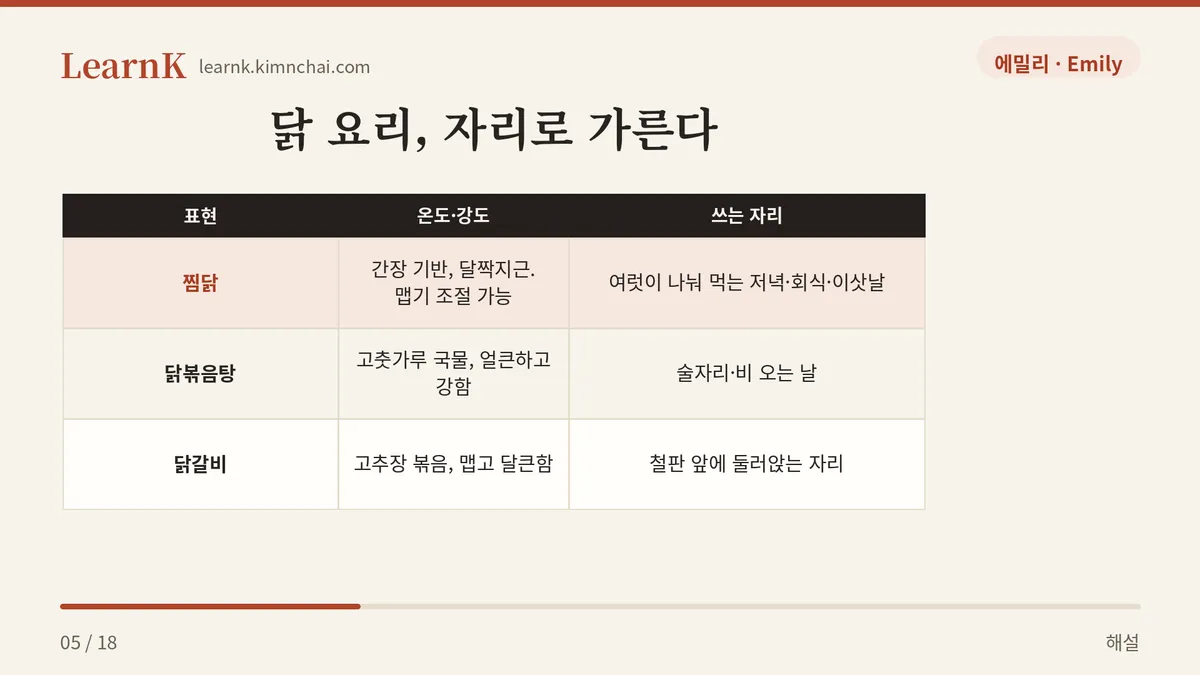
Korea’s signature chicken dishes have similar-sounding names and are easy to mix up. Sorting them by the occasion and the heat level makes it clear.
| Expression | Flavor / intensity | Where it’s used |
|---|---|---|
| 찜닭 (jjimdak) | Soy-sauce based, sweet-savory. Heat level adjustable | Dinners, team dinners, and moving days where a group shares. Safe even when someone can’t eat spicy food |
| 닭볶음탕 (dakbokkeumtang) | Red-pepper-flake broth, hot and strong | Drinking gatherings, rainy days. The kind of meal where you mix rice into the broth |
| 닭갈비 (dakgalbi) | Stir-fried in gochujang, spicy and sweet | Sitting around a hot griddle together. The fried rice at the end is the whole point |
| 닭찜 (dakjjim) | Mild and clean-tasting | Home cooking and holiday tables. Rarely seen on restaurant signs |
Cultural Background — The Neighborhood Where a Whole Alley Is the Sign
The most interesting thing about the name 찜닭 is the word order. Korean already had the word 닭찜 (dakjjim), and yet the dish we eat today settled in under the reversed form, 찜닭 (jjimdak). The flipped name ended up far more famous than the original — which is why the two words now point to different foods.
안동 (Andong), the word so often attached in front, is the name of a city in North Gyeongsang Province. The most widely told story is that jjimdak in its current form spread out from the chicken alley of Andong’s Old Market, though there are several competing accounts of who first made it and when, so it’s hard to pin down a single version. What is clear is that this alley’s name attached itself to the dish and traveled across the country. Go to that alley today and there are still dozens of jjimdak restaurants packed side by side, which means tourists can spend a solid ten minutes just choosing one.
Scenes with jjimdak in Korean dramas and variety shows almost always look the same. The staging says more than the dialogue does — a huge plate goes in the center of the table, people sit around it, and nobody portions out their own share. In Korea, “eating together” doesn’t mean eating separately at the same time; it means putting your chopsticks into the same dish, and jjimdak is that sentence turned directly into a picture. Which is why knowing this word is a slightly bigger thing than knowing one dish.
One more thing. Once the jjimdak is gone, putting a bowl of rice into the thick sauce left at the bottom of the plate and mixing it in is practically a fixed step in the sequence. People say of it, “진짜는 마지막에 온다” (jinjjaneun majimage onda) — “the real thing comes at the end.” If you see someone order extra rice at the restaurant, that means they’re no beginner.
Today’s Quiz
You’ve made dinner plans with three Korean friends. One of them can’t eat spicy food at all, and everyone wants a filling meal with rice. Which of the following is the safest suggestion?
- “우리 닭볶음탕 먹을까?” (Uri dakbokkeumtang meogeulkka?) — “Should we have dakbokkeumtang?”
- “우리 찜닭 먹을까? 순한맛으로 시키면 돼.” (Uri jjimdak meogeulkka? Sunhan-mateuro sikimyeon dwae.) — “Should we have jjimdak? We can just order it mild.”
- “우리 찜닭 1인분씩 시킬까?” (Uri jjimdak irinbunssik sikilkka?) — “Should we each order one portion of jjimdak?”
Answer: Number 2. Jjimdak’s heat can be dialed down to 순한맛 (sunhan-mat), and one chicken is just right for four people to share. Number 1, 닭볶음탕 (dakbokkeumtang), comes with a hot red-pepper broth by default, which is a lot to ask of someone who can’t handle spice, and in number 3, jjimdak is served by the bird, so the phrase “1인분씩” (“one portion each”) is itself unnatural.
Definitions and example sentences are from the National Institute of Korean Language’s Basic Korean Dictionary (krdict.korean.go.kr); that portion of this post, including our translations, is licensed under CC BY-SA 2.0 KR.