조공 (jogong) — The Devotion Fans Offer Up to Their Idols, from Coffee Trucks to Donations
조공 (jogong)
조공 (jogong) means a gift that fans put real care into preparing and then offer up to the idol they love. It began as a weighty Sino-Korean term for the tribute a small country would present to the court of a larger one, but K-pop fandom borrowed the word as a joke — and the joke hardened into the meaning it has today.
Picture the front of a broadcasting station at five in the morning on a Saturday, when a music show is taping. The sun isn’t up yet, but over in one corner of the parking lot a coffee truck is puffing steam, and across its side, in big letters, are the fandom’s name and a message like “Happy 1,000 days since debut.” Fans spent weeks pooling money to send it. The staff who have been waiting around come by for paper cups one at a time, and a manager photographs the scene and sends it to the idol. That one coffee truck is exactly what 조공 (jogong) is.
The heart of 조공 (jogong) is direction. Built into the word is the image of something being sent up from below. Fans put themselves in the position of a subject and the idol in the position of a king or queen. Of course, no fan actually thinks of themselves as anyone’s subject. The exaggeration is a joke, and because both sides know it’s a joke, it comes across as affection instead. In the very same situation, 선물했어 (seonmulhaesseo), “I gave them a gift,” just states the fact — but 조공했어 (jogonghaesseo) piles the size of the feeling on top of it: this is how much I love them.
There’s no fixed scale. A single handwritten letter is 조공 (jogong), and so is a food truck paid for by thousands of fans chipping in. Three phrasings turn up again and again: 조공하다 (jogonghada), 조공 준비하다 (jogong junbihada), and 조공 넣다 (jogong neotda). Because it’s so often a matter of many people pooling money to send one thing, 조공 (jogong) tends to move under the name of the fandom as a group rather than as one person’s gift.
Seeing It in a Real Conversation
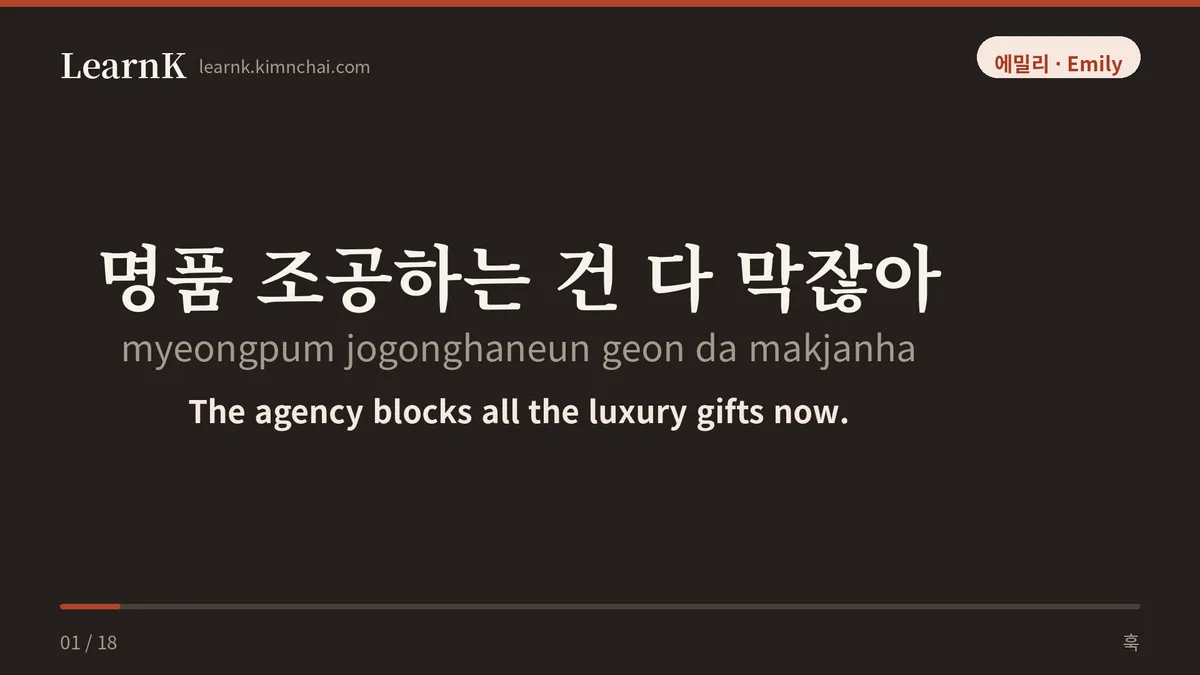
Scene: Early Saturday morning, outside a broadcasting station where a music show is taping. Steam is rising off the coffee truck the fans sent.
Jun-kyung: 야, 저 커피차 우리 팬덤에서 보낸 거 맞지? Hey, that coffee truck is from our fandom, right?
Emily: 응, 어제 모금 마감했어. 이번엔 스태프분들 도시락까지 조공 넣었대. Yeah, the fundraising closed yesterday. This time they even put in lunch boxes for the staff.
Jun-kyung: 오, 잘했다. 요즘은 현장 사람들 챙기는 게 진짜 센스지. Oh, nice. These days looking after the crew is what really counts.
Emily: 그니까. 예전처럼 명품 조공하는 건 소속사에서 다 막잖아. Right. Sending luxury stuff the way people used to — the agency blocks all of that now.
Jun-kyung: 막을 만해. 팬들 지갑 털리는 것도 한두 번이지. Fair enough. Fans can only get their wallets drained so many times.
Emily: 그래서 이번엔 반은 커피차, 반은 걔 이름으로 기부. 조공도 요즘은 방향이 바뀌었어. So this time it’s half coffee truck, half a donation in their name. Fan gifts have changed direction lately.
This Is Where It Sounds Off
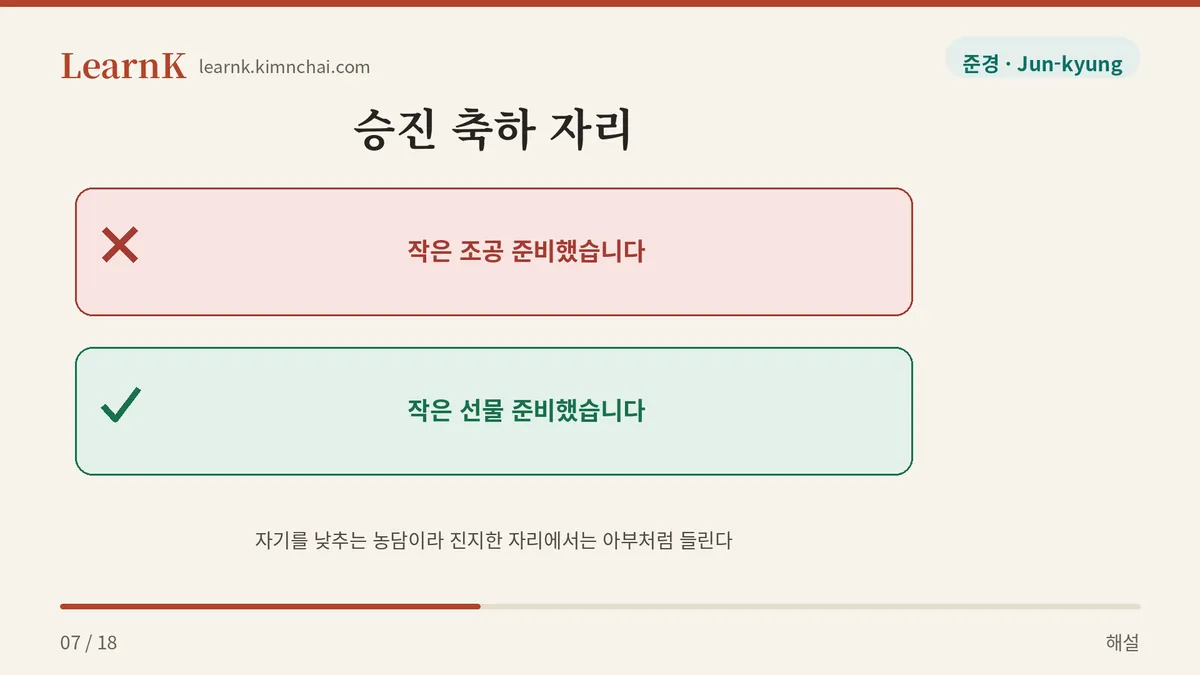
✗ (Congratulating your team lead on a promotion) 팀장님, 승진 축하드립니다. 작은 조공 준비했습니다. ✓ (Congratulating your team lead on a promotion) 팀장님, 승진 축하드립니다. 작은 선물 준비했습니다. → 조공 (jogong) is a joke that deliberately overplays a relationship: “I’m the lowly one, you’re the one to be exalted.” Used at an occasion that calls for sincere congratulations, it sounds like you’re announcing your own flattery, and the person receiving it won’t know whether to laugh or keep a straight face.
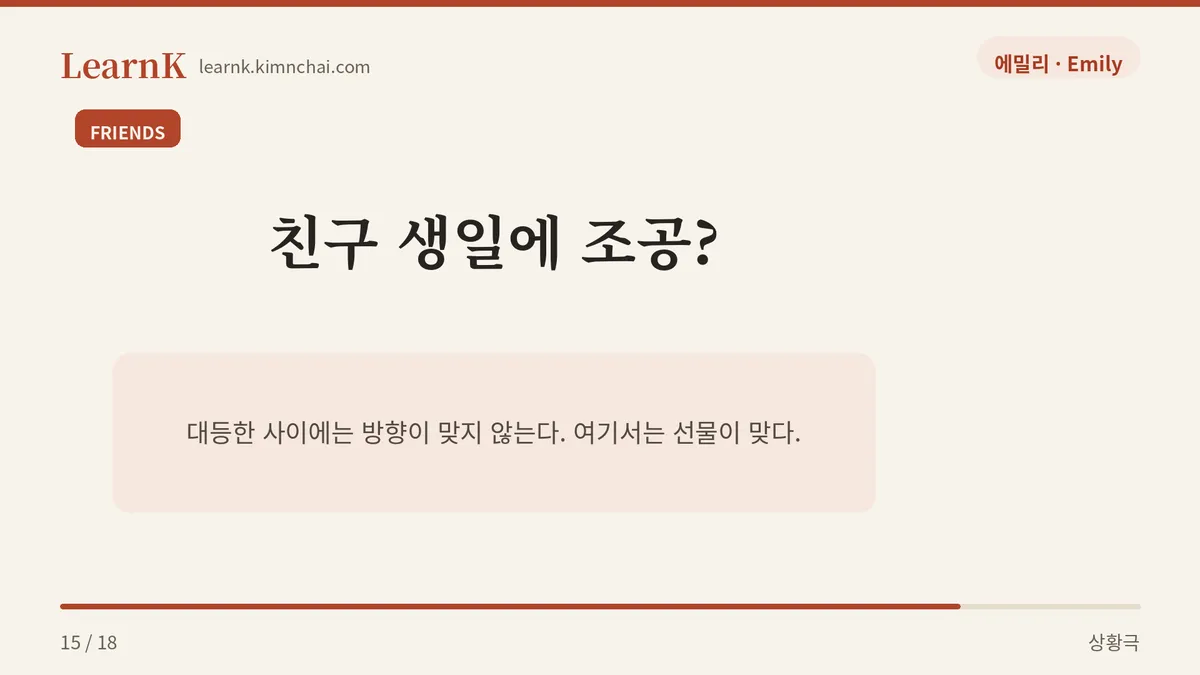
✗ (At a friend’s birthday) 생일 축하해. 이거 내 조공이야. ✓ (At a friend’s birthday) 생일 축하해. 이거 내 선물이야. → 조공 (jogong) is a word for sending something up from below, so it doesn’t fit between friends who stand as equals. Unless you’re deliberately playing at treating your friend like royalty, 선물 (seonmul) is the right word.
Example Sentences by Situation
Situation 1 — Deciding how to run the fundraising in the fandom group chat before a concert
이번 조공은 커피차로 하자. ibeon jogong-eun keopi-charo haja. Let’s make this time’s fan gift a coffee truck.
This is the sentence you’ll hear most when the group is deciding what to send. 조공 (jogong) becomes the thing you pick a form for — a coffee truck, a meal truck, handwritten letters, a donation.
Situation 2 — A fan who went to the taping fills in a friend who couldn’t make it
팬들이 스태프분들 도시락까지 조공했대. paendeul-i seutaepeu-bundeul dosirak-kkaji jogonghaet-dae. I heard the fans even sent lunch boxes for the staff.
The particle 「-까지」 adds a note of admiration: they thought of that too. What counts as a good 조공 (jogong) in fandom these days isn’t an expensive item going to the idol personally, but something that reaches the people working alongside them on site.
Situation 3 — Bragging at the office the day after a fan meeting
팬미팅에서 역조공으로 손편지를 받았어요. paenmiting-eseo yeokjogong-euro sonpyeonji-reul badasseoyo. At the fan meeting I got a handwritten letter as a gift back from the artist.
역조공 (yeokjogong) is the word with its direction flipped. It refers to an idol giving a gift back to the fans, and from the fan’s side it means “I’m supposed to be the one offering things up, and it came back to me instead” — so it carries surprise and delight together.
Polite and Casual Forms, and Related Expressions
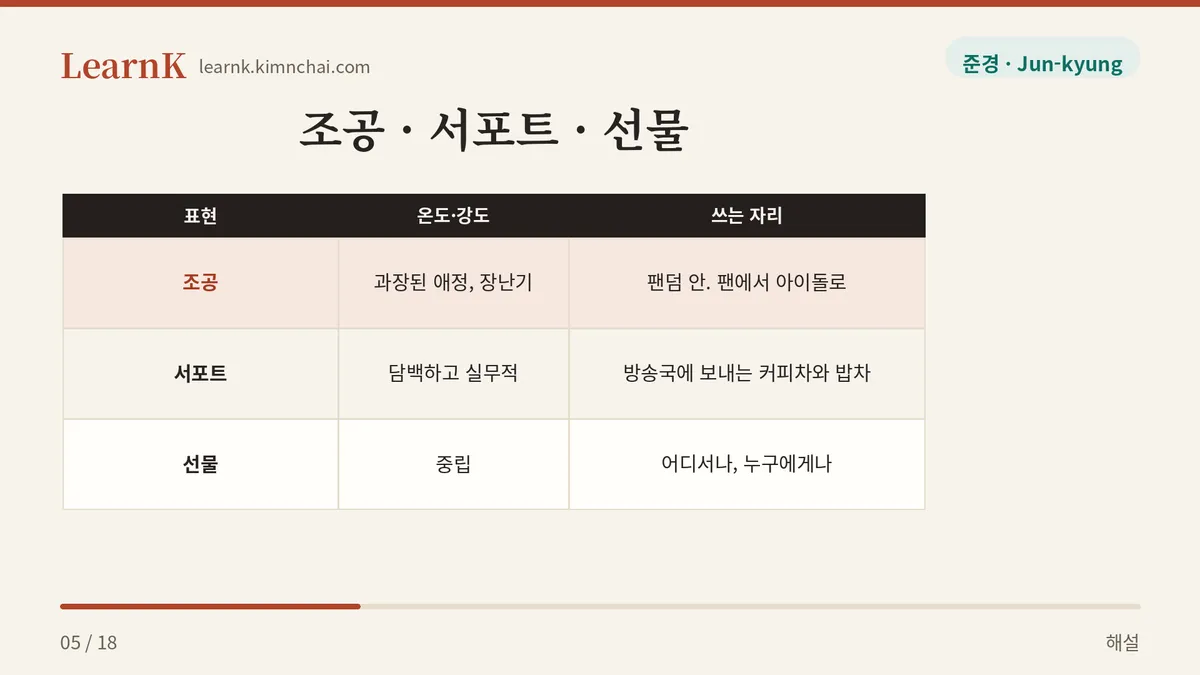
조공하다 (jogonghada) conjugates regularly. The casual form is 조공했어 (jogonghaesseo), and the polite forms are 조공했어요 (jogonghaesseoyo) or 조공했습니다 (jogonghaetseumnida). That said, switching to polite speech doesn’t make the word formal. It’s fandom slang at its core, so news articles and official agency announcements swap it out for 팬 선물 (paen seonmul), “fan gifts,” or 팬들의 서포트 (paendeul-ui seopoteu), “support from fans.”
| Expression | Tone and intensity | Where it’s used |
|---|---|---|
| 조공 (jogong) | Exaggerated affection, playful | Inside fandom. Fan → idol |
| 서포트 (seopoteu) | Plain, practical | Coffee trucks and meal trucks sent to sets and broadcasting stations |
| 선물 (seonmul) | Neutral | Anywhere, to anyone |
| 역조공 (yeokjogong) | Delight, surprise | Idol → fan. Fan meetings and events |
조공 (jogong) and 서포트 (seopoteu) often refer to the exact same physical thing. The very same coffee truck is 조공 (jogong) when fans talk among themselves and 서포트 (seopoteu) when you’re speaking officially to the agency or the production team. The difference is simply whether the self-lowering joke is in there or not.
Cultural Background — From Tribute to Donation
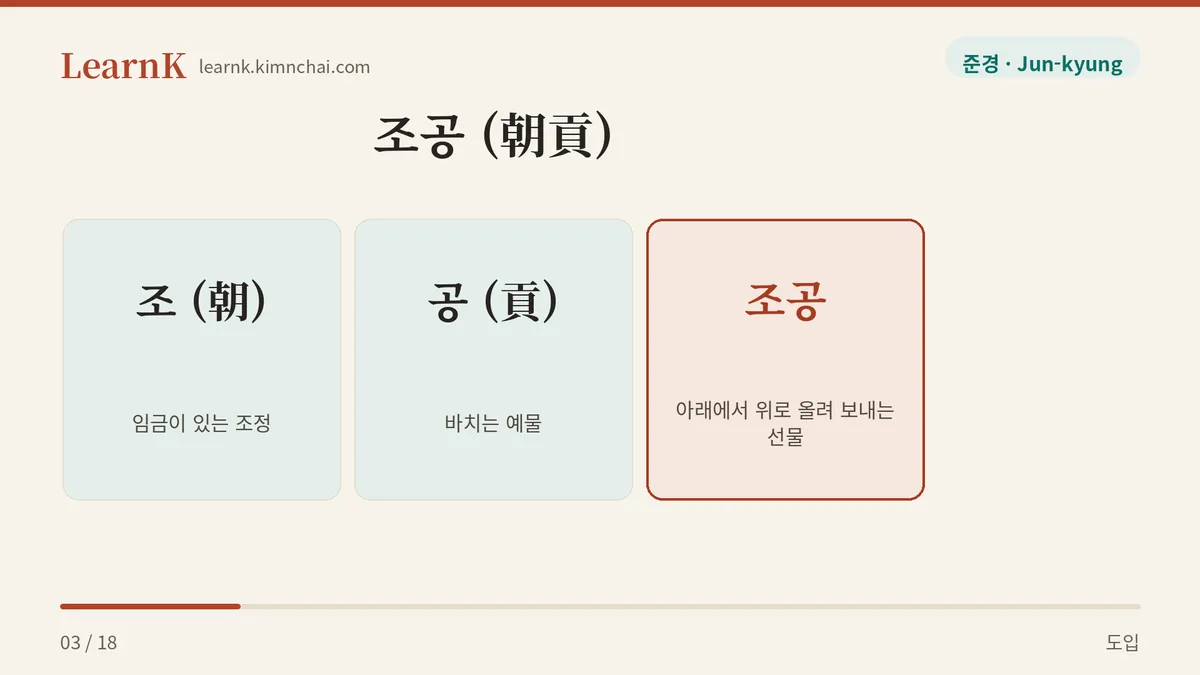
조공 (jogong), written 朝貢, joins 朝 (조, jo), the character for the royal court, with 貢 (공, gong), “to offer as tribute.” Historically it refers to the diplomatic relationship in which a smaller country sent envoys and gifts to a larger one. Why fandom reached for this particular word is obvious enough: there’s no better picture for overstating the size of your affection. You offer a gift up to an idol the way tribute was offered up to a king — an exaggeration made by people who know perfectly well how funny it is.
The temperature of the word shifted sharply once over the past decade or so. From the late 2000s through the mid-2010s, expensive gifts were the norm. Luxury goods and high-end electronics changed hands, competition flared between fandoms, and the pressure grew heavy enough that people started asking whether you needed money in order to be a fan. Agencies then began announcing that they would no longer accept gifts addressed to their artists. That’s the period when a shadow fell over the word 조공 (jogong).
The direction has shifted again. Instead of pressing goods on an idol personally, 기부 조공 (gibu jogong) — donating in the idol’s name — has taken hold. The 쌀화환 (ssalhwahwan), or rice wreath, sent to celebrate a debut or a concert follows the same current: rice is sent in place of flowers, and when the event is over that rice goes to a welfare facility. It’s the same reason coffee trucks and meal trucks that benefit the on-site staff are held in such high regard. What has changed is the fandom’s answer to the question of where all that affection should flow.
So when fans today say 이번 조공은 기부로 간다 (ibeon jogong-eun gibu-ro ganda), “this time the fan gift is going to charity,” that sentence carries more than a choice of gift format. It’s the wish that their idol’s name stay attached to something good. The scene shows up often in dramas and variety shows about aspiring idols and fandoms, too: fans lined up since before dawn, a coffee truck with a name on it, and the staff in front of it taking their paper cups. That whole landscape fits inside the single word 조공 (jogong).
Today’s Quiz
Which of the following uses 조공 (jogong) naturally?
- 오늘 친구 생일이라 친구한테 조공했어.
- 팀장님, 어제 도와주셔서 감사합니다. 작은 조공 준비했습니다.
- 이번 팬미팅 때 우리 팬덤에서 케이크 조공 넣는대.
Answer: 3
In 1, the friends stand as equals, so the direction is wrong (선물했어). In 2, the speaker has mixed a self-lowering joke into a moment of sincere thanks, which leaves the other person stuck (선물 준비했습니다). Sentence 3 — a fandom sending something to their idol — is the situation where 조공 (jogong) truly comes alive.