죽이 잘 맞다 (jugi jal matda) — The Kind of Bond Where Hands Sync Before Words Do
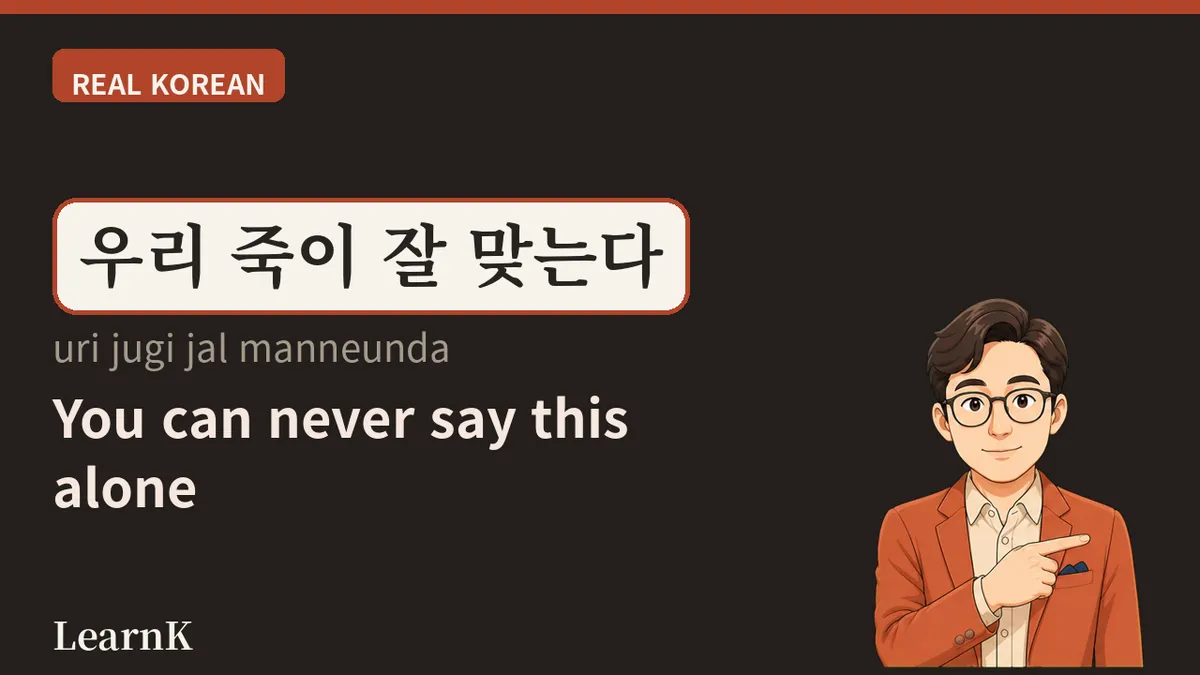
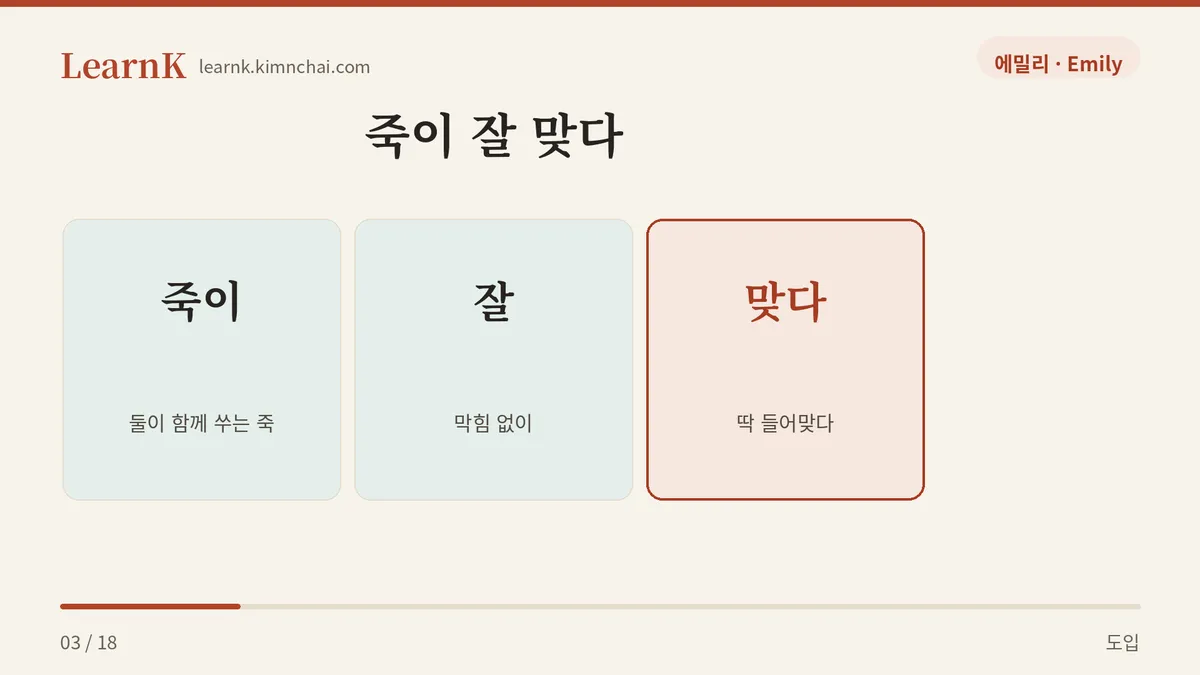
죽이 잘 맞다
죽이 잘 맞다 (jugi jal matda) describes two people who fall into perfect rhythm when they do something together — no planning, no agreeing on who does what. One picks up their chopsticks and the other slides a small plate over; one tosses out a joke and the other catches it and rolls it one turn further. Nobody gave any instructions, yet the work keeps moving. And whoever has been watching from the side finally says it out loud: “Those two really 죽이 잘 맞아.”
The most important thing about this expression is that it can never be true of one person alone. “나는 죽이 잘 맞아” simply isn’t a sentence. There have to be two people — or more — and there has to be time that has passed between them. That’s why it isn’t praise for ability. Two people can both be excellent at what they do and still not click; two people can both be clumsy and click beautifully. What’s being judged isn’t the individual but the fit (합, hap) between the two.
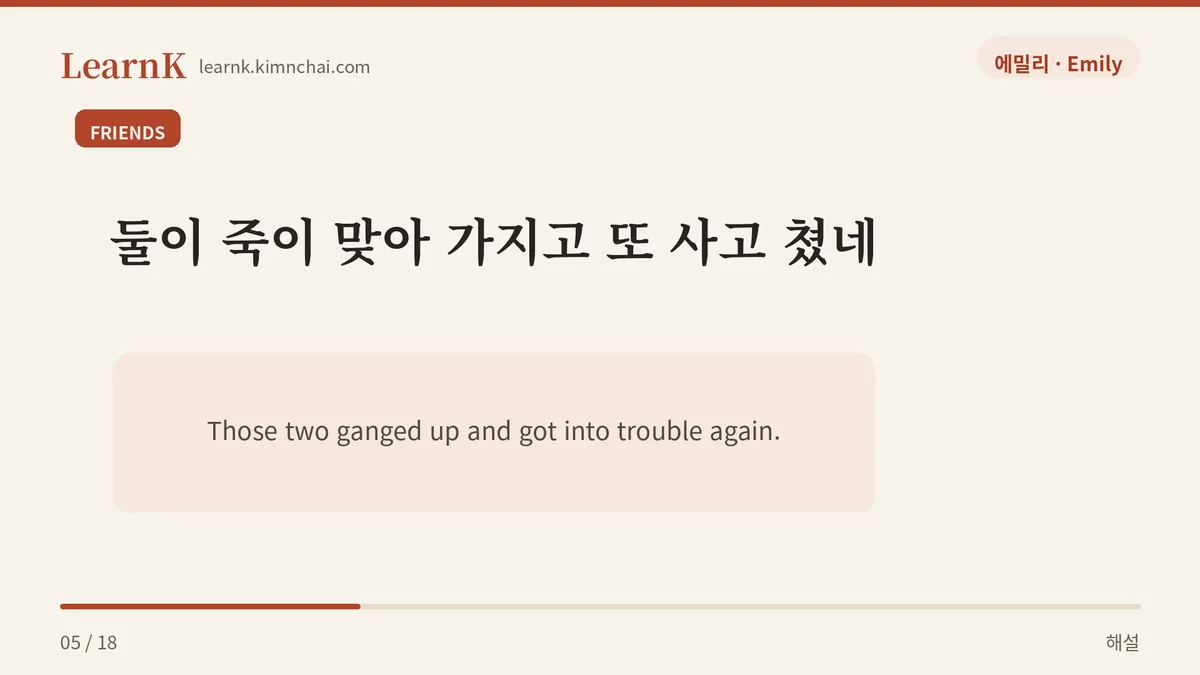
The temperature is light and warm, with a streak of mischief running through it. So it gets used for good things, but also for cheeky ones — as in “둘이 죽이 맞아 가지고 또 사고 쳤네” (Those two ganged up and got into trouble again). Because a trace of “the two of them joined forces and pulled something off” is still in there, it isn’t really used in very serious, formal settings. Saying “두 분은 죽이 잘 맞으십니다” at a company year-end awards ceremony is a compliment, yes — but it lands somewhere closer to a joke.
A Real Conversation
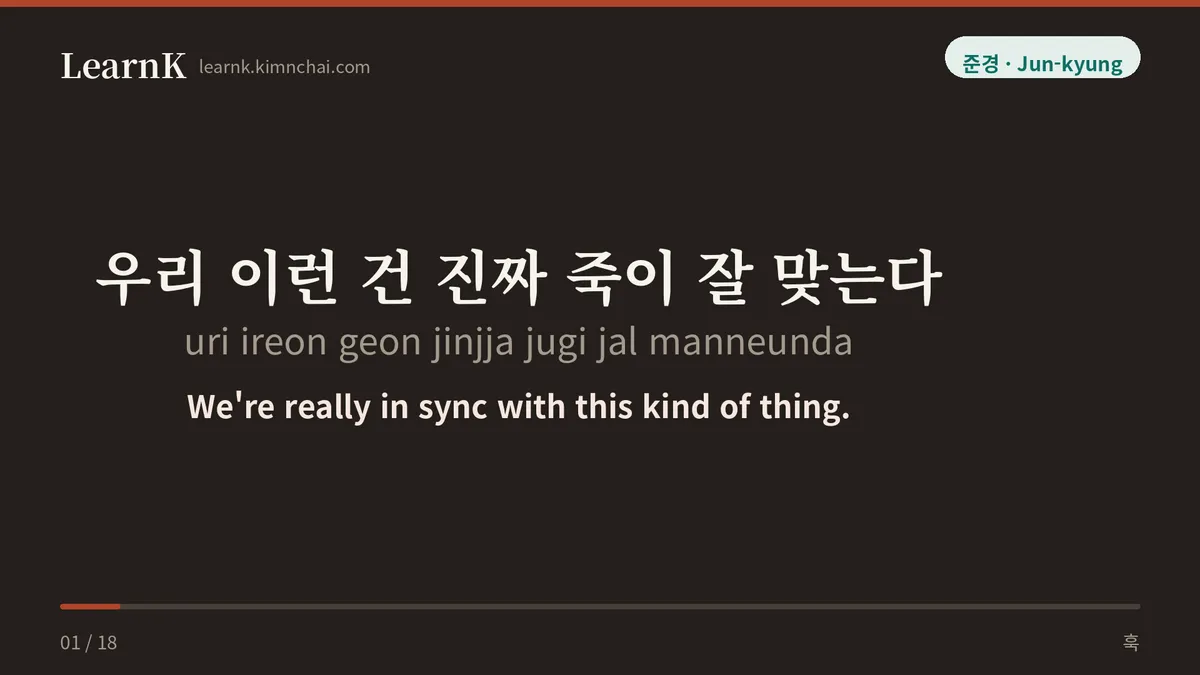
Situation: the evening before the Lunar New Year holiday. Jun-kyung and Emily have spread newspaper over the living room floor and are folding dumplings together.
Jun-kyung: 야, 너 소 넣는 속도 뭐냐. 나 피 미는 게 못 따라가. Hey, how are you filling them that fast? I can’t roll the wrappers fast enough.
Emily: 그럼 바꾸자. 내가 밀 테니까 네가 넣어. Then let’s switch. I’ll roll and you fill.
Jun-kyung: (조금 뒤) 어… 이거 되네? 우리 이런 건 진짜 죽이 잘 맞는다. (a bit later) Huh… this works? We’re really in sync when it comes to this kind of thing.
Emily: 그치? 근데 작년에 여행 계획 짤 때는 왜 그렇게 싸웠지. Right? But why did we fight so much planning that trip last year?
Jun-kyung: 그건 네가 새벽 다섯 시에 일어나자 그래서 그런 거고. That’s because you wanted to get up at five in the morning.
Emily: 아무튼 만두는 죽이 맞아. 내년에도 나 불러. Anyway, we click when it comes to dumplings. Call me again next year.
The conversation shows you exactly where these two attach the phrase. They click at folding dumplings; they don’t click at planning trips. This expression isn’t a verdict on a whole person — it names the fit between two people in the face of a particular task. That’s why limiting phrases like “우리 이런 건” (us, with this kind of thing) and “만두는” (when it comes to dumplings) slip so naturally in front of it.
This Sounds Off
✗ (to your department head) 부장님, 부장님이랑 팀장님은 참 죽이 잘 맞으시네요. Sir, you and the team lead really click, don’t you. ✓ (to a coworker) 부장님이랑 팀장님, 진짜 죽이 잘 맞으시더라. The department head and the team lead — those two really click. → At heart, this is a remark you toss out while watching from the sidelines. On top of that, the mischievous “those two are in cahoots” flavor is still hanging around, so appraising a senior’s relationship to their face this way comes off as cheeky. If you have to say it directly to someone above you, “두 분 호흡이 정말 좋으십니다” (The two of you work together wonderfully) is the safe choice.
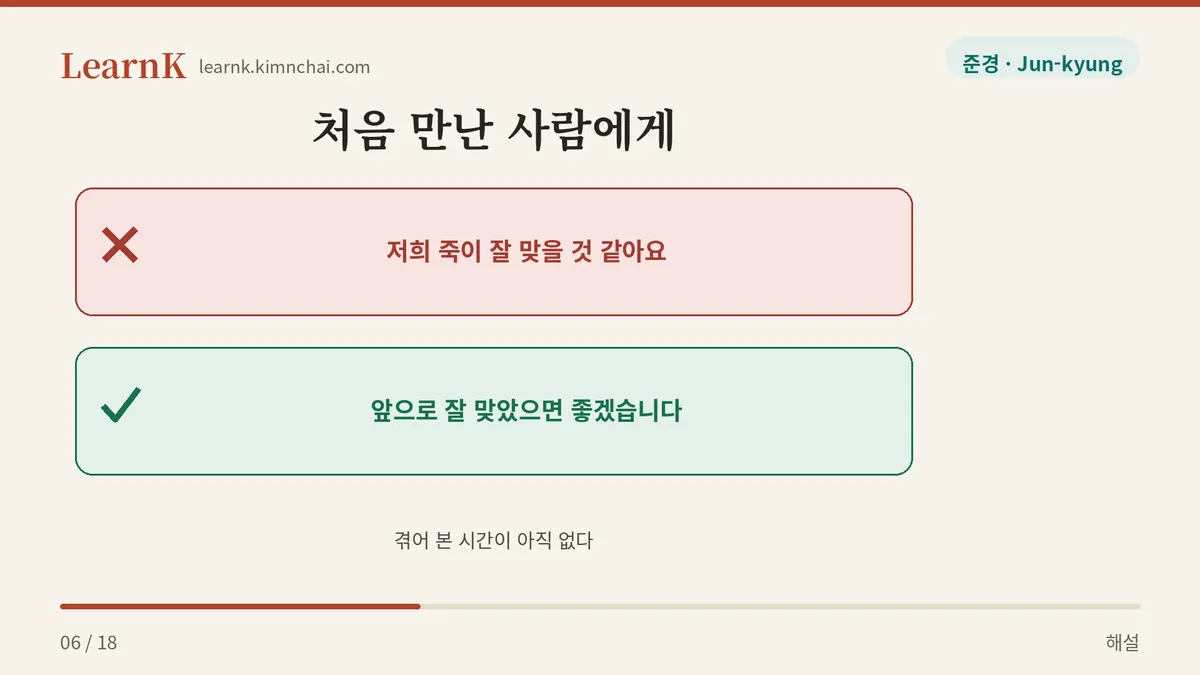
✗ (to someone you’ve just met) 처음 뵙겠습니다. 저희 죽이 잘 맞을 것 같아요. Nice to meet you. I think we’re going to click. ✓ (to someone you’ve just met) 처음 뵙겠습니다. 앞으로 잘 맞았으면 좋겠습니다. Nice to meet you. I hope we work well together going forward. → 죽이 잘 맞다 (jugi jal matda) points to a result produced by time you’ve already spent together. Use it with someone you haven’t actually done anything with yet and they’ll be left blinking: “When did we ever do anything together?” When you’re talking about hopes for the future, dial it down to “잘 맞다” (to get along, to be a good match).
Example Sentences by Situation
① Getting ready for a club performance — watching two people on the stage crew
Setting up a stage is fiddly, hands-on work, but there are certain pairs you can put together and they’ll just finish it without a word. A younger club member watches and marvels.
형이랑 정민이는 무대 세팅할 때 진짜 죽이 잘 맞아. 둘이 붙여 놓으면 삼십 분이면 끝나. (hyeongirang jeongmini-neun mudae seting-hal ttae jinjja jugi jal maja. duri buchyeo noeumyeon samsip bunimyeon kkeutna.) Hyung and Jeongmin are really in sync when they set up the stage. Put those two together and it’s done in thirty minutes.
② A kimjang kitchen — Mom and my aunt
Making kimchi for the winter works like a relay: one person passes over the salted cabbage, the other packs in the filling. Get the order wrong and it tangles fast. Two sisters who have done it together for decades never settle that order out loud.
엄마랑 이모는 김장할 때 말을 한마디도 안 해. 그렇게 죽이 잘 맞나 봐. (eommarang imo-neun gimjanghal ttae mareul hanmadido an hae. geureoke jugi jal manna bwa.) Mom and my aunt don’t say a single word while making kimchi. I guess they’re that in sync.
③ At work — a new hire, two months in with their mentor
In polite-speech settings, you soften it like this. It’s less something you say to the people involved and more something a person from the next team over offers up.
두 분이 죽이 잘 맞으시나 봐요. 요즘 그 팀 일이 제일 빨라요. (du buni jugi jal majeusina bwayo. yojeum geu tim iri jeil ppallayo.) You two seem to click really well. That team’s been the fastest lately.
Polite and Casual Forms, and Similar Expressions
The casual form is “죽이 잘 맞아 (jugi jal maja)”; the polite form is “죽이 잘 맞으시네요 (jugi jal majeusineyo)” or “죽이 잘 맞으시나 봐요 (jugi jal majeusina bwayo).” As we saw above, though, the polite forms sound far more natural when you’re talking about a third party than when you’re talking to the people themselves.
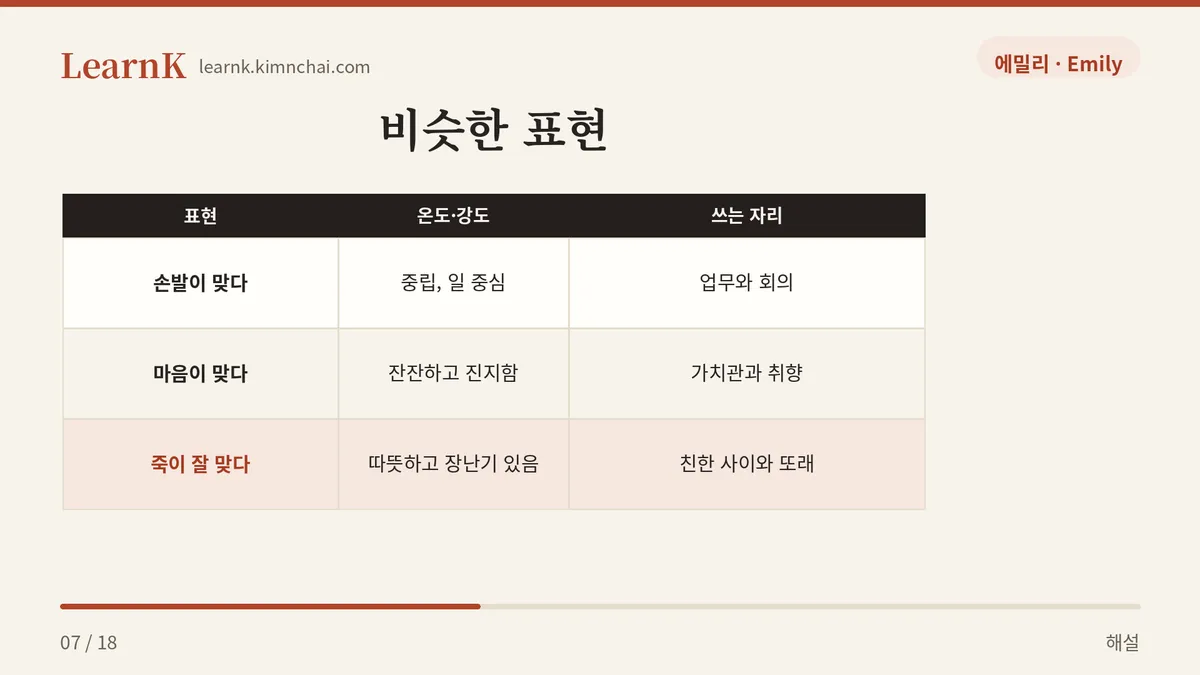
| Expression | Tone & Intensity | Where It Fits |
|---|---|---|
| 죽이 잘 맞다 (jugi jal matda) | Warm and playful. Strong | Close friends and peers. Careful in front of seniors |
| 손발이 맞다 (sonbari matda) | Neutral. Task-focused | Work and collaboration. Fine even in meetings |
| 마음이 맞다 (maeumi matda) | Quiet and sincere | When values or tastes align. Works in formal settings too |
| 코드가 맞다 (kodeuga matda) | Light, contemporary slang | Peers and social media. Taste and sense of humor |
| 궁합이 좋다 (gunghabi jota) | Half-joking | Used for food and objects, not just people |
The difference in one line: 손발이 맞다 (sonbari matda) is about the work rolling along smoothly, 마음이 맞다 (maeumi matda) is about understanding each other on the inside, and 죽이 잘 맞다 (jugi jal matda) is what you get when those two overlap and it turns fun. That’s why it turns up most often in places where people use their bodies side by side — kimjang, dumpling-making, moving day, the night before a show.
Cultural Background — Time Spent Working Hand in Hand
Gather up the settings where Koreans reach for this phrase and a pattern shows up. The kimjang kitchen. The dumpling table the night before a holiday. The stairwell on moving day, hauling boxes. The stage the night before a club performance. All of them are places where several people put their bodies right next to each other and do the same job. Korean daily life has long been full of tasks you knock out in one go by pooling hands, and in those settings, rhythm mattered more than a way with words. The person who catches half a beat early what you’re about to do next — that’s the person you click with.
So as compliments go, this one sits fairly high. “일 잘한다” (you’re good at your job) is something you can hear on your own; “죽이 잘 맞는다” only comes to you as a pair. It takes accumulated time — several rounds of doing something together — so it doesn’t stick to people who’ve only just met.
Korean dramas are full of these pairs. In family dramas set in the alleyways of 1980s Seoul, there’s a recurring image: neighborhood mothers carrying side dishes back and forth, making kimchi together, passing the order between them without speaking. Two people whose fit is fully visible without a single line of dialogue — that scene is the picture this expression paints. In crime shows, two detectives who’ve ridden together for years bicker constantly, then move on nothing more than a glance at the decisive moment — and what the junior officer watching from the side says about them is, more often than not, exactly this phrase.
Various explanations of the phrase’s origin get passed around, but nothing has been firmly established, so I won’t make a claim here. What is clear is the picture the idiom draws — it points not to people who connect through their heads, but to people whose hands sync up first.
Today’s Quiz
Which of the following is the most natural situation for 죽이 잘 맞다 (jugi jal matda)?
- Greeting an interviewer you’re meeting for the first time in a job interview
- Someone standing nearby marveling at two friends who help each other move every year
- Praising yourself after a presentation you prepared alone went well
The answer is 2. Number 1 doesn’t work because there’s no shared time behind it yet, and number 3 is wrong because the expression can’t stand with just one person. Option 2 is where this phrase belongs: two or more people working side by side with their hands, and someone watching from the sidelines saying it out loud.
Definitions and example sentences are from the National Institute of Korean Language’s Basic Korean Dictionary (krdict.korean.go.kr); that portion of this post, including our translations, is licensed under CC BY-SA 2.0 KR.