졌잘싸 (jyeotjalssa) — The Three Syllables for When You Lose and People Still Clap
졌잘싸 (jyeotjalssa)
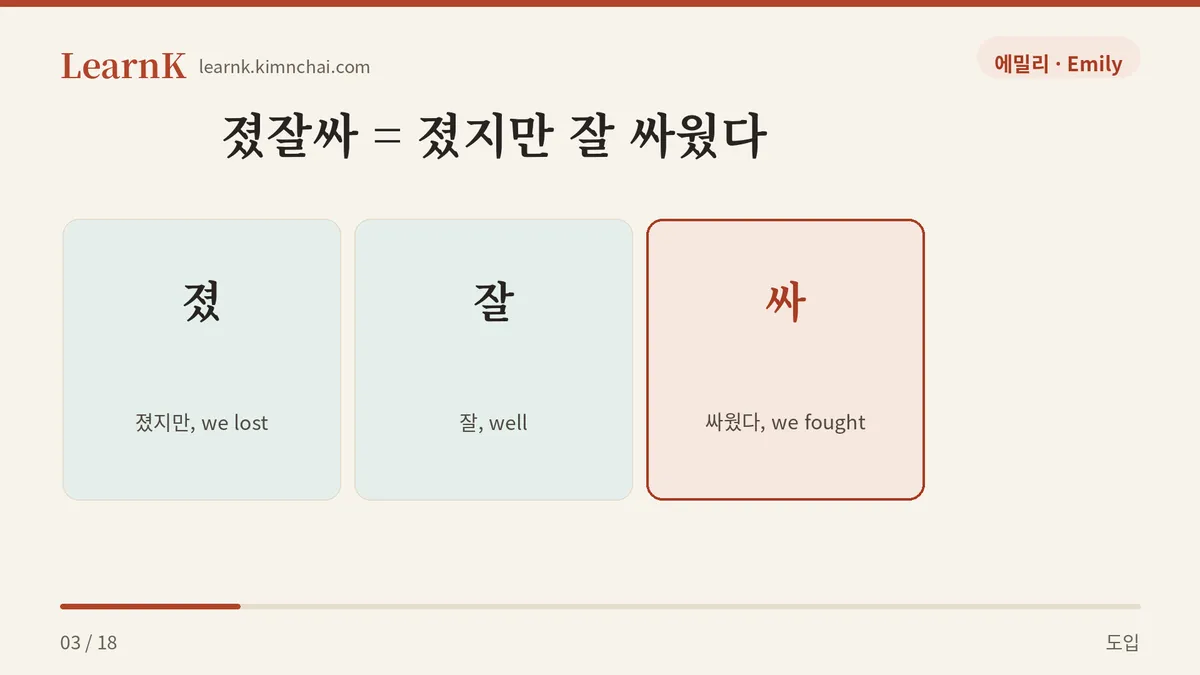
졌잘싸 (jyeotjalssa) is a three-syllable contraction of 졌지만 잘 싸웠다 (jyeotjiman jal ssawotda), “we lost, but we fought well.” The result was a defeat, but the process itself was something to be proud of.
Three in the morning. The national team’s match ends by a one-goal margin, and the screen shows players collapsed on the grass. The commentator’s voice goes quiet, and at every table in the beer hall sighs break out a half-beat apart from one another. And from that moment on, the Korean-language timeline is buried under three syllables — 졌잘싸, 졌잘싸, 졌잘싸. It doesn’t say “we won,” and it doesn’t only say “we lost.” It lands on a precise spot somewhere in between.
The heart of this word is that it does not deny the loss. The very first syllable is 졌 (jyeot), “lost.” It doesn’t try to overturn the result — it admits the defeat first, and only then continues with what comes next. That’s why 졌잘싸 holds two layers of feeling at once. One is regret; the other is recognition. Regret alone gives you “아, 아깝다 (a, akkapda)” — “ah, so close.” Recognition alone gives you “잘했어 (jalhaesseo)” — “you did great.” 졌잘싸 is what you reach for when you need to say both in a single breath.
Grammatically it behaves like a noun. Attach -이다 (-ida) and you get 졌잘싸다 (jyeotjalssada) or 졌잘싸였어 (jyeotjalssayeosseo), and it also floats around in short chunks like 졌잘싸 각 (jyeotjalssa gak) (meaning “this is shaping up to be a 졌잘싸 situation”) and 졌잘싸 인정 (jyeotjalssa injeong). Because it’s a three-syllable slang contraction, its default temperature is light and conversational.
But this word has one more face, turned inside out. When the same team loses every time and every loss gets wrapped up with a 졌잘싸, at some point the word stops being comfort and becomes a jab. You’ll see it in sentences like “또 졌잘싸냐 (tto jyeotjalssanya)” — “another 졌잘싸, huh?” — or “졌잘싸 그만 좀 하자 (jyeotjalssa geuman jom haja)” — “can we stop with the 졌잘싸 already?” The direction has flipped toward criticizing an attitude that keeps prettifying defeat. This is exactly where learners get confused. The same three syllables can be a pat on the back or a scolding, depending on the speaker’s face and the sentences around it.
See It in a Real Conversation
Setting: two in the morning, a neighborhood beer hall. On screen, the national team’s match ends 1–2, and customers start getting up one by one.
Jun-kyung: 아 진짜… 후반 40분에 그거 하나만 들어갔어도. Ah, come on… if just that one shot in the 85th minute had gone in.
Emily: 그래도 오늘은 졌잘싸 아니야? 마지막까지 안 접었잖아. Still, wasn’t today a “lost but fought well”? They didn’t give up till the end.
Jun-kyung: 야, 그 말 좀 그만해. 맨날 졌잘싸 졌잘싸 하니까 안 바뀌는 거야. Hey, quit saying that. Nothing changes because everyone keeps going “we lost but fought well.”
Emily: 어우, 오늘따라 왜 이렇게 매서워. 한 잔 더 시켜? Whoa, why so harsh tonight. Want another round?
Jun-kyung: …시켜. 근데 골키퍼는 진짜 졌잘싸 맞다. 걔 아니었으면 네 골이었어. …Yeah, order. But the keeper — that really was a “lost but fought well.” Without him it’d have been four.
Emily: 거봐. 너도 결국 하면서. See? You end up saying it too.
Using It This Way Sounds Off
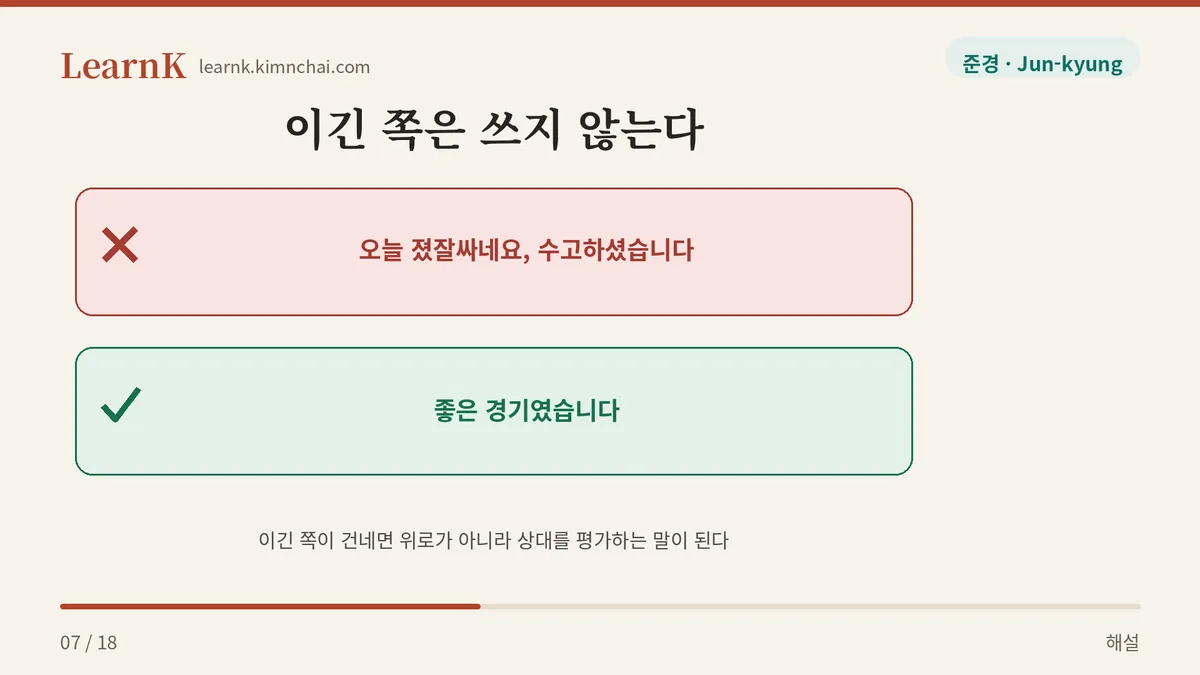
✗ (shaking hands with the captain of the team that just lost to you) 오늘 졌잘싸네요, 수고하셨습니다. ✓ (in your own team’s group chat after the match) 오늘 졌잘싸다. 다들 고생했어. → 졌잘싸 is something the losing side says to its own people. If the winning side offers it to the losers, it isn’t comfort — it becomes a look-down-from-above “well, you weren’t bad, I guess.” To an opponent, “좋은 경기였습니다 (joeun gyeonggiyeosseumnida)” — “it was a good match” — is the safe choice.
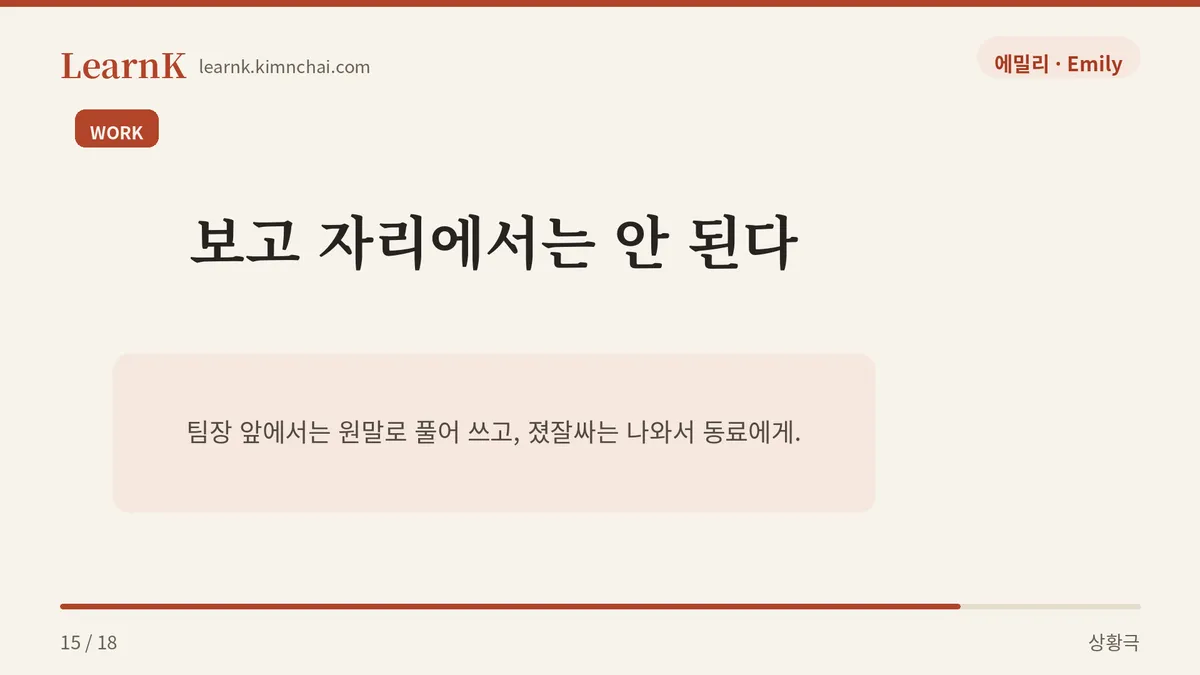
✗ (reporting a failed project to your team lead) 이번 건은 졌잘싸였습니다. ✓ (talking to a colleague after you’ve left the meeting) 우리 이번 건 진짜 졌잘싸였다, 그치? → As a three-syllable slang contraction it sounds too light for an official report, and more importantly, it comes across as an excuse that glamorizes your own result. In front of a superior, it’s better to spell it out: “결과는 아쉽지만 팀원들이 끝까지 최선을 다했습니다” — “the result is disappointing, but the team gave it everything right to the end.”
Example Sentences by Situation
1) An amateur baseball team’s group chat, the night they lost
오늘 졌잘싸였어. 9회까지 따라붙은 게 어디야. (oneul jyeotjalssayeosseo. guhoekkaji ttarabuteun ge eodiya.) Today was a “lost but fought well.” We clawed back into it through the ninth — that counts for something.
This is the captain admitting the loss first, then catching the team’s morale before it drops. Used this way, 졌잘싸 is the word that balances “we played badly” against “we played well.”
2) Talking to yourself after being cut at the final interview
3차까지 갔으니까 그냥 졌잘싸라고 해 두자. (samchakkaji gasseunikka geunyang jyeotjalssarago hae duja.) I made it to the third round, so let’s just call it a “lost but fought well.”
The word came out of sports, but it crosses over very easily into self-directed comfort with a wry, self-deprecating edge like this. It fits anything with a clean pass-or-fail outcome: exams, competitions, job interviews. Say it in a low voice and it’s bitterness; say it with a smile and it’s letting go.
3) Team voice chat right after a ranked online match
상대가 너무 셌다. 졌잘싸 인정, 다음 판 가자. (sangdaega neomu setda. jyeotjalssa injeong, daeum pan gaja.) They were just too strong. “Lost but fought well” — accepted. Next game.
In a setting where the whole session falls apart the moment people start blaming each other, 졌잘싸 works as a switch that cuts off the finger-pointing. The 인정 (injeong), “accepted,” tacked onto the end is the signal for “let’s not argue about it any further.”
Politeness Levels and Similar Expressions
Because 졌잘싸 is a slang contraction, it has no separate polite form. Forcing it into “졌잘싸였습니다” sounds awkward; in formal settings you unfold it back into the original phrase and say “졌지만 잘 싸웠습니다 (jyeotjiman jal ssawotseumnida)”. In other words, the polite version of this expression isn’t “attach an honorific ending” — it’s returning the contraction to the full sentence it came from.
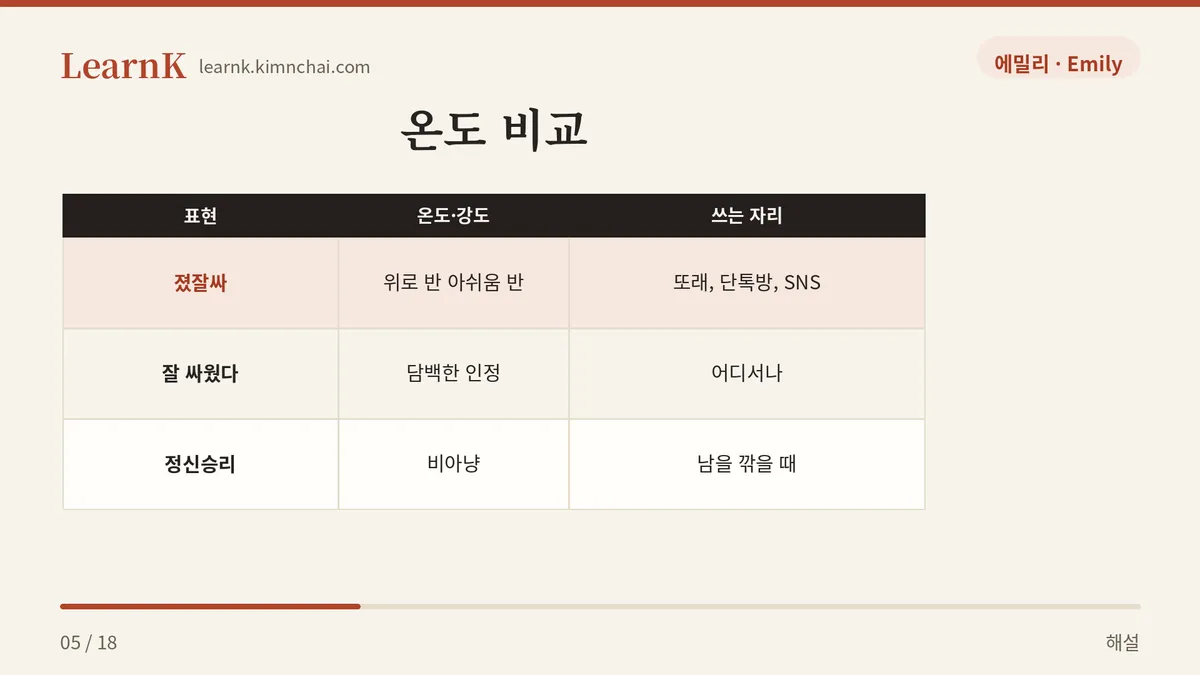
| Expression | Temperature / intensity | Where it’s used |
|---|---|---|
| 졌잘싸 (jyeotjalssa) | Half comfort, half regret; light and colloquial | Among peers, fan communities, group chats, social media. Not used in formal settings |
| 잘 싸웠다 (jal ssawotda) | Plain recognition, neutral | Anywhere. A coach to a player, a senior to a junior |
| 수고했어 / 수고하셨습니다 (sugohaesseo / sugohasyeosseumnida) | Comfort unrelated to the result | Anywhere. Has an honorific form, so it works toward superiors too |
| 정신승리 (jeongsin-seungni) | Sarcastic, negative | Used to cut someone else down. Never used as comfort |
You especially need to keep your distance right with 정신승리 (jeongsin-seungni), literally “mental victory.” The two are neighbors, but they point in opposite directions. 졌잘싸 fundamentally shelters the losing side, while 정신승리 mocks someone for “insisting they won when they clearly lost.” That said, as noted above, using 졌잘싸 in a sarcastic tone makes it slide toward 정신승리 territory.
Cultural Background — Comfort Folded into Three Syllables
The word-formation is simple. Take the first syllables of 졌지만 잘 싸웠다 and stick them together. Korean slang loves this method: 소확행 (sohwakhaeng) (small but certain happiness) and 비담 (bidam) (the visual, literally “visual in charge”) fold long phrases down into three or four syllables the same way. A word folded like this gets lighter as it gets shorter, and the lighter it is, the faster it flies through live chat and the cheering section. Which is to say: to survive, it has to be short enough to thumb out within three seconds of the final whistle.
There’s a reason this word grew in sports fan communities and then spread into everyday speech. Korean fan culture is fairly strict about results. After a loss in a big tournament, it’s not unusual for the arrows to point at individual players. 졌잘싸 established itself as a way to hit the brakes on that mood — “let’s look at the process, not just the result.” So there’s something more than comfort packed into it: a small argument about how to face defeat.
And pushback against that argument grew right alongside it. As the criticism took hold that nothing improves if you lose every time and paper over it every time with a 졌잘싸, the same word can now be comfort or mockery depending on the situation. In the conversation above, Jun-kyung says “quit saying that” and then ends up handing the goalkeeper a 졌잘싸 anyway — that’s exactly the double nature of it. Koreans use the word that way too: unable to fully believe in it, unable to fully throw it away.
These days it has spread well beyond sports, landing anywhere someone wants to say “the result was disappointing, but they tried hard” — exams, interviews, negotiations, even a kid’s school talent show. You’ll spot it easily in variety-show subtitles and sports headlines, so the next time those three syllables flash across the screen while you’re watching Korean content, you’ll be able to guess what kind of scene it is. Nine times out of ten, somebody just lost — and the camera is still on them anyway.
Today’s Quiz
In which of the following situations would 졌잘싸 (jyeotjalssa) be the most out of place?
① Leaving a message in your team group chat after losing an early-morning pickup soccer match ② Posting a quick line on social media the night the team you support loses the final ③ Saying it while shaking hands with the captain of the team that just lost to yours ④ Comforting yourself after being cut at the final interview
Answer: ③
졌잘싸 is a word the losing side uses toward its own people or toward itself. If the winning side hands it to the losing side, it stops being comfort and turns into a judgment of the other team — and a condescending one at that. In that moment, a greeting that doesn’t touch the result is the right call: “좋은 경기였습니다 (joeun gyeonggiyeosseumnida)” — “it was a good match” — or “고생하셨습니다 (gosaenghasyeosseumnida)” — “you worked hard out there.”
Definitions and example sentences are from the National Institute of Korean Language’s Basic Korean Dictionary (krdict.korean.go.kr); that portion of this post, including our translations, is licensed under CC BY-SA 2.0 KR.