칼답 (kaldap) — The Person Whose Replies Come Back Knife-Fast

칼답
칼답 (kaldap) means a reply that comes flying back the instant you send a message — an answer as fast and clean as a knife. You send a KakaoTalk message, and before you can even slide your phone back into your pocket the screen lights up again; that’s when Koreans say of someone, “칼답이네 (kaldabine)” — “Now that’s a fast reply.” To anyone who has spent a whole day waiting on a response, it’s something to envy. And when a friend who normally leaves you hanging for hours suddenly answers in three seconds, it turns into teasing: “웬일로 칼답이야? (wenillo kaldabiya?)” — “What’s the occasion? Look at you replying instantly.”
The word works as a noun (“칼답 고마워 (kaldap gomawo)” — thanks for the quick reply) and as a predicate (“걔는 항상 칼답이야 (gyaeneun hangsang kaldabiya)” — she’s always lightning-fast). The verb form 칼답하다 (kaldapada) sounds natural too, and when you’re talking about someone older or higher-ranking, you can attach polite endings: “팀장님은 새벽에도 칼답이세요 (timjangnimeun saebyeogedo kaldabiseyo)” — “Our team lead replies instantly even at dawn.”
The important thing is that 칼답 (kaldap) measures exactly one thing: speed. It makes no difference whether the reply is long or short, warm or blunt. Even a two-letter “ㅇㅇ (eung-eung — ‘yep’)” counts as 칼답 if it lands within a second. That’s why the word naturally comes with the reading, “this person is making me a priority right now.” Conversely, no matter how heartfelt and long a message is, if it shows up days later, it isn’t 칼답.
One more thing: the bar for 칼답 (kaldap) is different for everyone. For some people it has to be under ten seconds; for others, five minutes is plenty fast. Which is exactly why the word so often becomes the conversation itself.
A Real Conversation
Scene: Saturday afternoon, Exit 3 of a subway station. Emily has come out to hand over a floor lamp she sold secondhand, but the person who said they’d buy it has gone completely silent. Jun-kyung tagged along to help carry things.
Emily: 십 분째 안 읽어. 어제까진 칼답이었는데. They haven’t even read it for ten minutes. Up until yesterday they were replying instantly.
Jun-kyung: 원래 살 때만 칼답이야. 물건 받고 나면 읽씹. People are only lightning-fast while they’re still buying. Once they get the item, they leave you on read.
Emily: 야, 너무 나갔다. 화장실 갔을 수도 있지. Hey, that’s going too far. Maybe they just went to the bathroom.
Jun-kyung: 어, 방금 왔다. 봐, 3분 만에 칼답. Oh, it just came. Look — a lightning reply, three minutes flat.
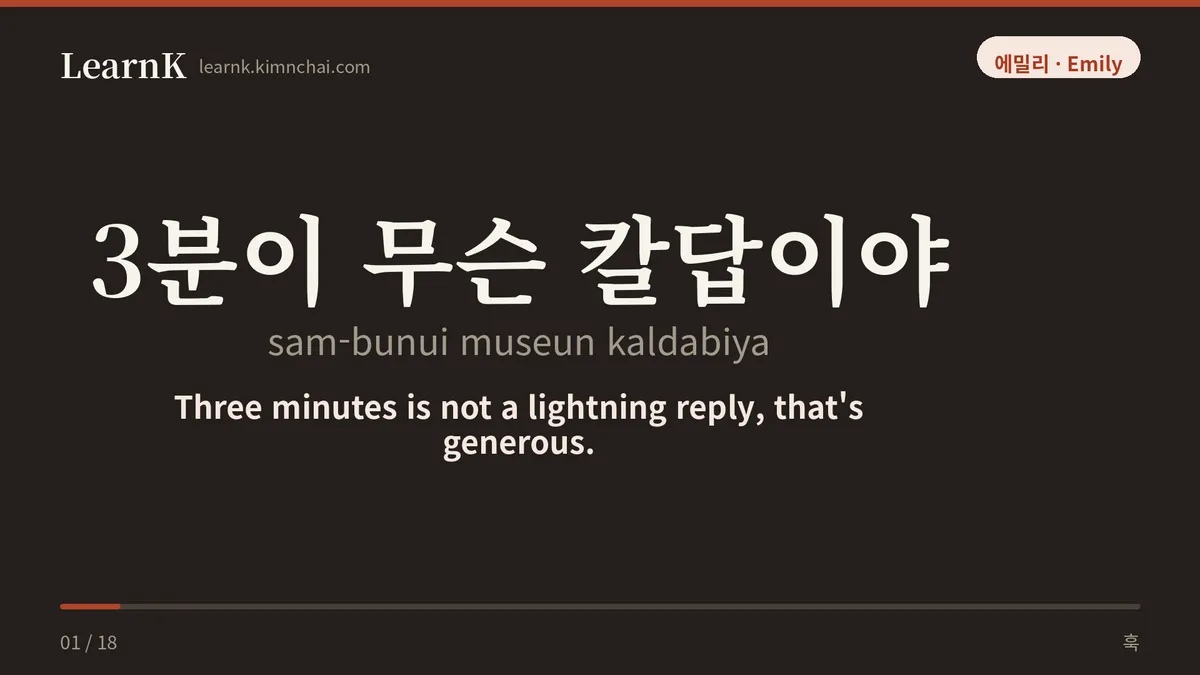
Emily: 3분이 무슨 칼답이야. 너 기준 되게 후하다. Three minutes is not a lightning reply. Your standards are super generous.
Jun-kyung: 나한텐 3분이면 칼이지. 넌 몇 초까지 봐주는데? Three minutes is knife-sharp to me. How many seconds do you allow, then?
When It Sounds Off
✗ (in an email to your professor) 교수님, 늘 칼답 감사합니다. (gyosunim, neul kaldap gamsahamnida.) ✓ (in an email to your professor) 교수님, 늘 빠르게 답장 주셔서 감사합니다. (gyosunim, neul ppareuge dapjang jusyeoseo gamsahamnida.) → It’s a clipped piece of slang that circulates among peers, so dropping it into a compliment aimed at someone senior doesn’t read as polite thanks — it reads as a flippant little joke.
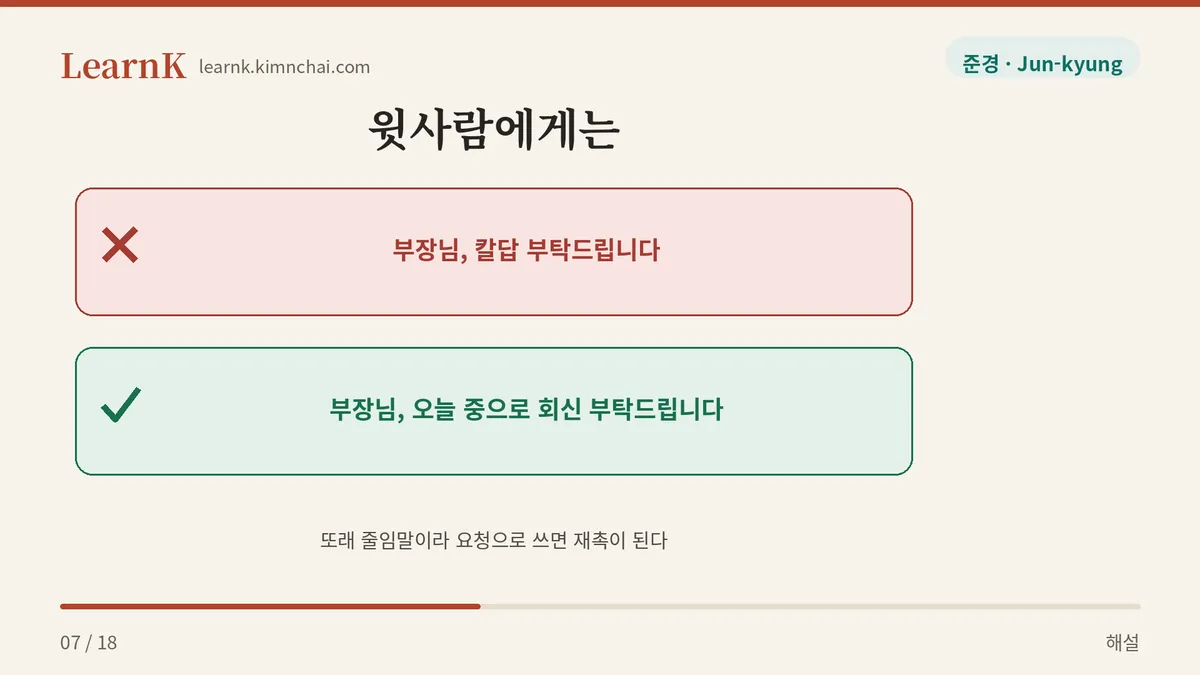
✗ (to a manager at a partner company) 부장님, 칼답 부탁드립니다. (bujangnim, kaldap butakdeurimnida.) ✓ (to a manager at a partner company) 부장님, 가능하시면 오늘 중으로 회신 부탁드립니다. (bujangnim, ganeunghasimyeon oneul jungeuro hoesin butakdeurimnida.) → 칼답 (kaldap) describes how fast the other person replies, so using it as a request turns into “hurry up and answer me.” Cute in a group chat with friends; rude to someone you work with.
Example Sentences by Situation
1. The day after a blind date, giving your friend the recap
어제 그 사람 진짜 칼답이더라. 나 관심 있나 봐. (eoje geu saram jinjja kaldapideora. na gwansim inna bwa.) That person yesterday replied lightning-fast. I think they’re into me.
This is the most typical use of all: reading reply speed as evidence of interest. Adding ‘-더라 (-deora)’ gives it the nuance of “that’s how it seemed from my own firsthand experience.”
2. Posting an announcement in your club’s group chat
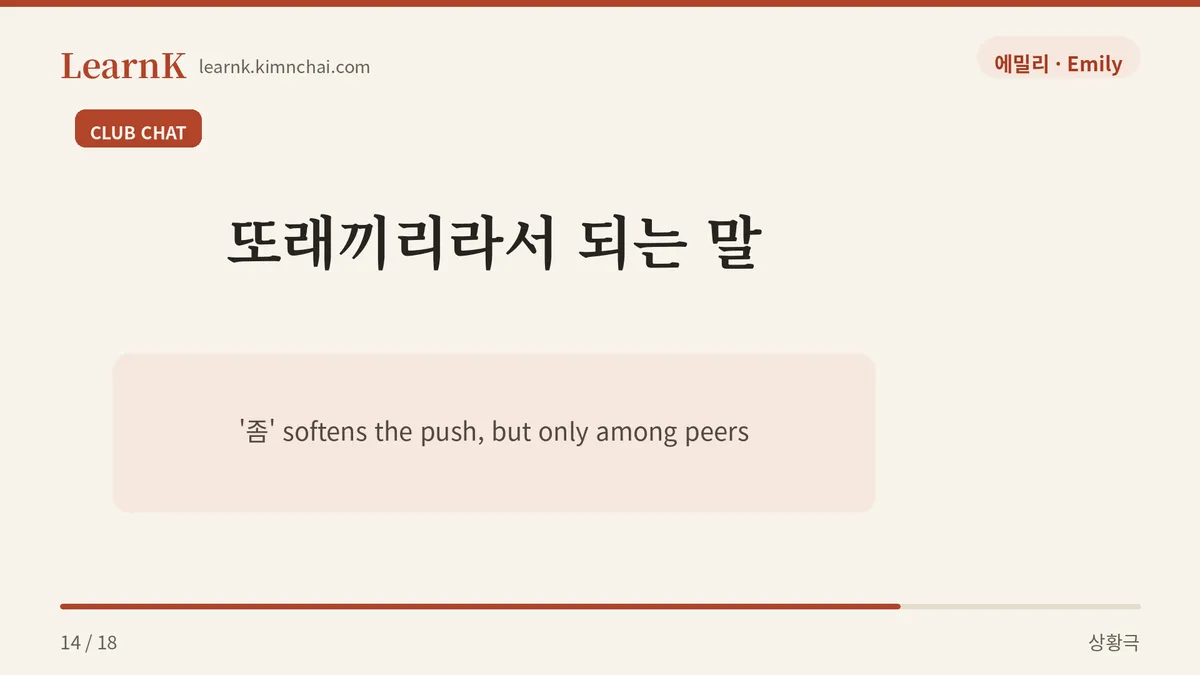
내일까지 인원 파악해야 되니까 다들 칼답 좀! (naeilkkaji inwon paakaeya doenikka dadeul kaldap jom!) I need a head count by tomorrow, so everyone reply right away!
This sentence only works because everyone involved is a peer. The little ‘좀 (jom)’ softens the nagging into something playful.
3. Praising a team you collaborate with at work
그 팀은 메일이 칼답이라 같이 일하기 편해. (geu timeun meiri kaldapira gachi ilhagi pyeonhae.) That team answers emails instantly, so they’re easy to work with.
It attaches naturally to a thing rather than a person, as in ‘메일이 칼답 (meiri kaldap)’ — the emails are lightning-fast. That said, this is talk among colleagues; it’s not something you’d say to that team’s manager face to face.
Polite and Casual Forms, and Similar Expressions
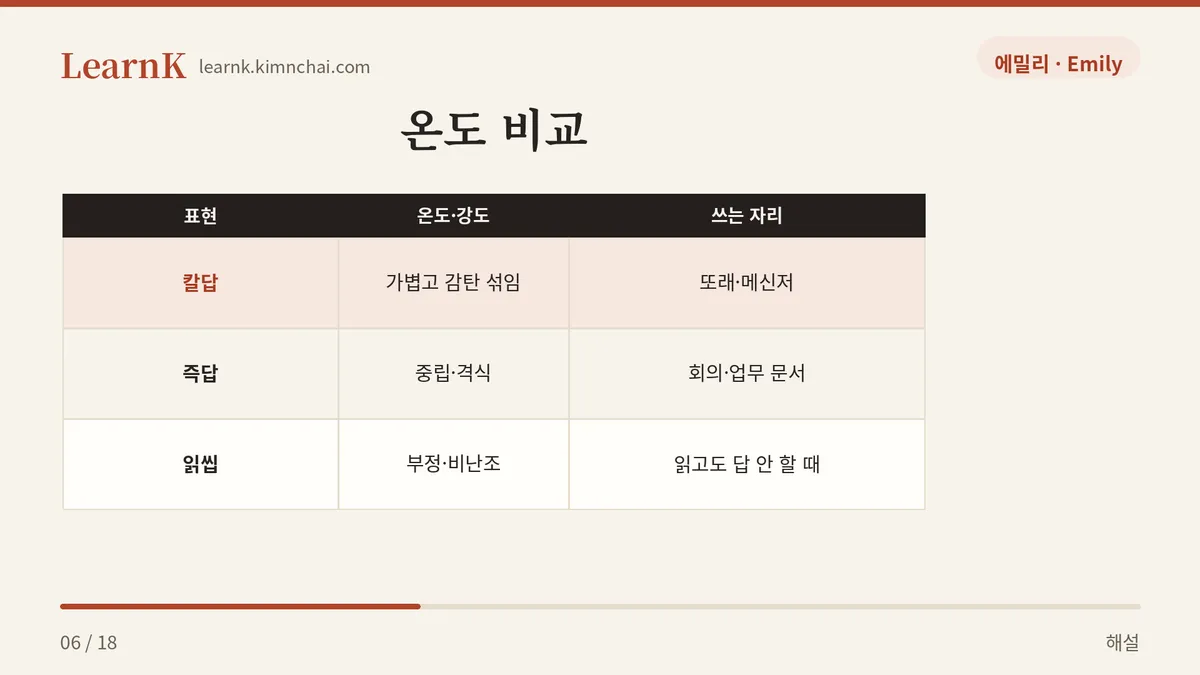
칼답 (kaldap) slips into polite sentences with just a change of ending (“칼답이세요 (kaldabiseyo)”, “칼답이시네요 (kaldabisineyo)”). But even with an honorific ending, the temperature of the word itself still sits on the casual side. So you can use it when discussing a senior person with a third party, but saying it directly to that person is too light. In settings that call for formality, it’s safer to change into 즉답 (jeukdap) or 빠른 회신 (ppareun hoesin).
| Expression | Tone & intensity | Where it belongs |
|---|---|---|
| 칼답 (kaldap) | light, tinged with admiration; new slang | peers, messengers, social media. Not said directly to someone senior |
| 즉답 (jeukdap) | neutral, formal | meetings, news articles, business documents |
| 빠른 답장 (ppareun dapjang) | neutral | anywhere. Safe even with someone senior |
| 읽씹 (ikssip) | the opposite; negative, accusing | among peers. For reading a message and not replying |
읽씹 (ikssip) in particular is the natural partner to 칼답 (kaldap), so it’s worth memorizing the pair together. It’s short for 읽고 씹다 (ilkgo ssipda), “read it and blow it off,” and it means reading a message without answering. If they don’t even open it, that’s 안읽씹 (anikssip).
Cultural Background — The Words a Knife Made
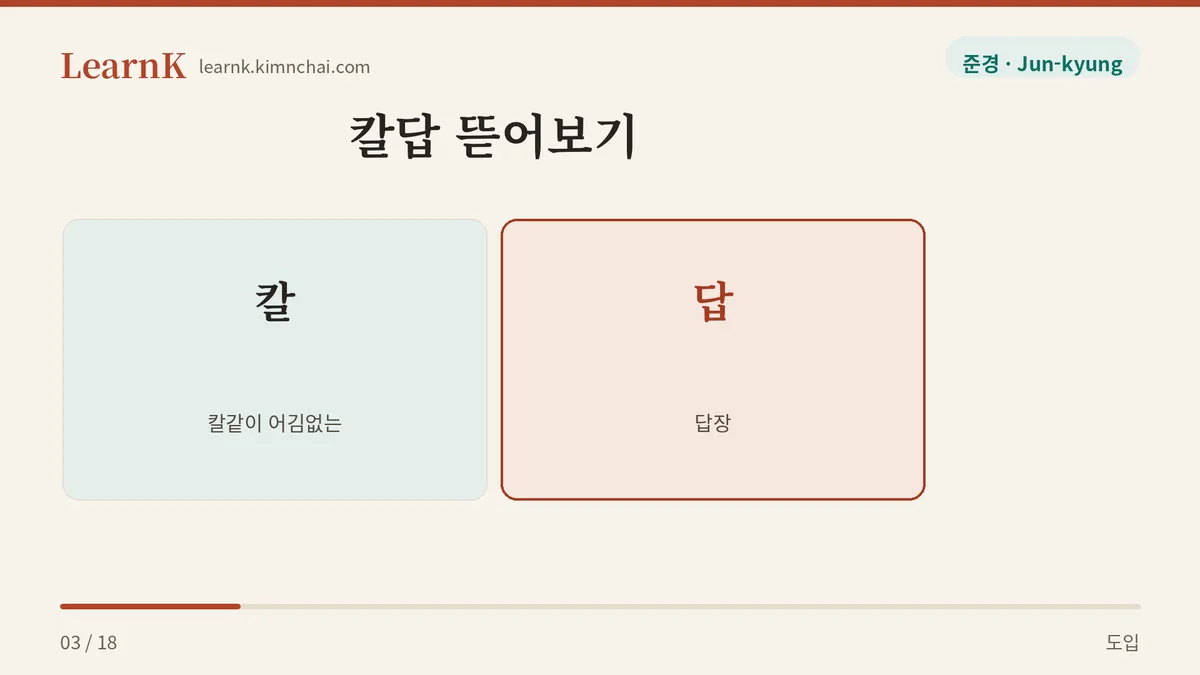
The 칼 (kal) in 칼답 isn’t an actual knife; it’s a prefix that comes from 칼같다 (kalgatda). In Korean, 칼같다 means “exact, without deviation,” and this ‘칼- (kal-)’ lives at the front of all sorts of new coinages. Clock out the second the workday officially ends and that’s 칼퇴 (kaltoe); fold your blanket or your clothes into edges sharp enough to have been measured with a ruler and that’s 칼각 (kalgak). 칼답 belongs to the same family — the picture is of a reply arriving immediately, sliced clean, with nothing extra attached.
There’s a reason this word is especially alive in Korea. In KakaoTalk, the little number ‘1’ beside your message disappears the moment the other person reads it. So both people can see whether it was read and when it was read. In an environment where reply speed can’t be hidden, it makes sense that several names for that speed sprang up. 칼답, 읽씹, and 안읽씹 are all vocabulary created by one tiny number.
TV dramas lean on this device constantly. Sending a confession by text and then waiting for the number 1 to vanish; the camera cutting to the other person’s face the instant a reply arrives — in romance shows these are practically formulas, because they convey the temperature of a relationship without a single line of dialogue. When you’re watching a Korean drama and a character stares at their phone screen for a long time, it usually means the 칼답 isn’t coming.
Today’s Quiz
Which of the following uses 칼답 awkwardly?
- 걔는 새벽 두 시에 보내도 칼답이야. (gyaeneun saebyeok du sie bonaedo kaldapiya.) — He replies instantly even if you text at two in the morning.
- 부장님, 이번 건은 칼답 부탁드립니다. (bujangnim, ibeon geoneun kaldap butakdeurimnida.) — Sir, please give me a lightning reply on this one.
- 그 가게는 문의 넣으면 칼답이라 좋더라. (geu gageneun muni neoheumyeon kaldapira jotdeora.) — That shop answers inquiries instantly, which is nice.
Show the answer
Answer: 2
칼답 (kaldap) is clipped slang used among peers, and turning it into a request makes it mean “answer me fast.” With someone senior, it’s more natural to spell it out, as in “오늘 중으로 회신 부탁드립니다 (oneul jungeuro hoesin butakdeurimnida)” — “Please reply sometime today.” Sentences 1 and 3, which use it admiringly about a third party or about how fast a shop responds, are perfectly natural.
Definitions and example sentences are from the National Institute of Korean Language’s Basic Korean Dictionary (krdict.korean.go.kr); that portion of this post, including our translations, is licensed under CC BY-SA 2.0 KR.