Today's Korean Slang '칼퇴 (kaltoe)' — Clocking Out Right on the Dot
Introduction
Picture the face of an office worker at 6 p.m. on a Friday, shutting down their computer and grabbing their bag. No overtime today. That refreshing moment of walking out of the office at exactly the set time, not a single minute later. Here is where the word that Korean office workers love most makes its entrance. Today’s expression is 칼퇴 (kaltoe).
If you watch Korean dramas or variety shows, you’ll often come across office-worker characters vowing, “오늘은 무조건 칼퇴한다! (oneureun mujokeon kaltoehanda!)” — “Today I’m clocking out on time no matter what!” You won’t easily find it in the dictionary, but it’s a vivid new coinage that Koreans use every single day in everyday conversation and on social media.
칼퇴
칼퇴 (kaltoe) is an abbreviation that combines 칼 (kal, blade) and 퇴근 (toegeun, to leave work). Translated literally, it means “a clocking-out done as sharp as a blade.”
The key here is the image of the 칼 (kal), the blade. It carries the sense of being precise and clean, like a blade’s edge, and in Korean the expression ‘칼같다 (kalgatda)’ is used to mean “extremely precise, without the slightest margin of error.” So 칼퇴 (kaltoe) doesn’t simply mean “to leave work” — it refers to clocking out exactly on time, not going even one minute past the set quitting hour.
Shall we look at the nuance? Within Korean workplace culture, where 야근 (yageun, working late into the night) is common, 칼퇴 is a kind of ‘small victory’ and a symbol of ‘워라밸 (worabael, work-life balance).’ That’s why this word carries a mix of envy, satisfaction, and a little bit of humor.
Note: ‘칼퇴 (kaltoe)’ is not a standard word listed in official dictionaries but a new coinage widely used in everyday life. The definition above is put together based on its actual usage.
Example Sentences by Situation
1) Friday afternoon, to a coworker
오늘 금요일인데 칼퇴하고 영화 보러 갈까? (oneul geumyoirinde kaltoehago yeonghwa boreo galkka?) Since it’s Friday, want to clock out right on time and go see a movie?
This is a situation where you want to make the most of Friday evening’s freedom. As in ‘칼퇴하고 (kaltoehago),’ you can freely turn it into a verb by attaching -하다 (-hada) to the end.
2) To your boss (cautiously)
팀장님, 오늘은 약속이 있어서 칼퇴해도 될까요? (timjangnim, oneureun yaksogi isseoseo kaltoehaedo doelkkayo?) Team leader, I have plans today — would it be okay if I clock out on time?
This is a situation where you ask a superior’s understanding about leaving on time. Even though it’s slang, when paired with a polite ending like -해도 될까요? (-haedo doelkkayo?), it passes without any trouble even at work.
3) When bragging on social media
오늘 칼퇴 성공! 이게 바로 행복이지. (oneul kaltoe seonggong! ige baro haengbogiji.) Clocked out right on time today — success! This is exactly what happiness is.
‘칼퇴 성공 (kaltoe seonggong)’ has hardened into a set phrase, almost like an idiom. In the very fact that leaving on time is described as a ‘success,’ you can catch a glimpse of the shadow of overtime culture.
Comparing Polite and Casual Speech, and Similar Expressions
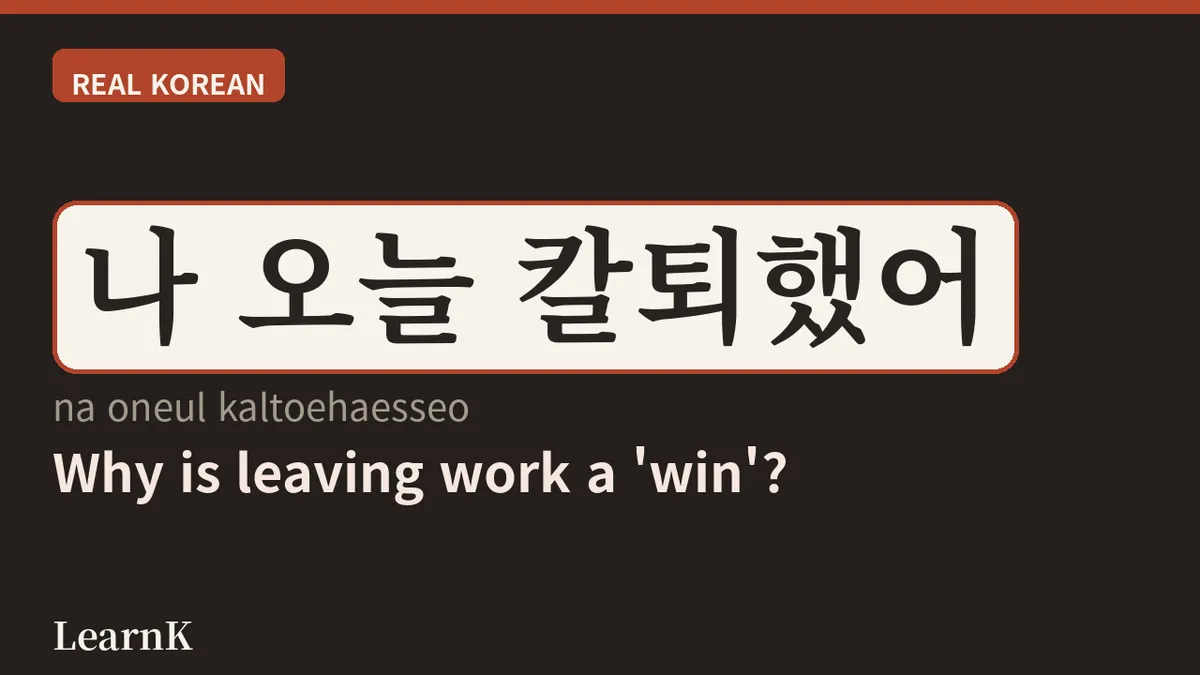
- Casual (반말, banmal): 나 오늘 칼퇴했어. (na oneul kaltoehaesseo.) — “I clocked out on time today.” — between friends or peers
- Polite (존댓말, jondaenmal): 저 오늘 칼퇴했어요. (jeo oneul kaltoehaesseoyo.) — “I clocked out on time today.” — at work or with someone you’ve just met
It’s good to learn the opposite word too. If leaving on time is 칼퇴 (kaltoe), its opposite is 야근 (yageun) — that is, working late into the night. A new coinage with a similar feel is 정시 퇴근 (jeongsi toegeun, leaving work at the exact set time), but this is a more decorous and literary expression. 칼퇴 (kaltoe), on the other hand, is far more casual, colloquial, and loaded with emotion.
Cultural Background
Korea was long a society where overtime was regarded almost as a virtue. As a result, even leaving work on time required ‘courage,’ and this sentiment is baked right into the word 칼퇴 (kaltoe). Recently, as the mood of valuing ‘워라밸 (worabael, work-life balance)’ has grown, workplace scenes in dramas often depict a protagonist nervously reading the room while packing their bag, only to finally stride out of the office in triumph.
For example, the drama Misaeng (미생, tvN, 2014), which portrayed the joys and sorrows of office workers, gained wide sympathy by delicately showing the reality of a new employee who can’t even leave on time with a clear conscience. Knowing this kind of background will help you understand, on a deeper level, the feelings of Korean office workers packed into the short word ‘칼퇴 (kaltoe).’
Closing Quiz
Q. A friend says, “나 오늘 드디어 칼퇴했어! (na oneul deudieo kaltoehaesseo!)” — “I finally clocked out on time today!” What kind of day did this friend have?
① They worked overtime for a very long time ② They left work exactly at the set time ③ They were late to work
The answer is ②. 칼퇴 (kaltoe) means leaving right on the dot, sharp as a blade. Today, why not try using this expression by asking a Korean friend, “칼퇴 성공했어요? (kaltoe seonggonghaesseoyo?)” — “Did you manage to clock out on time?”