카톡 (katok) — What Koreans Say Instead of 연락하다 (yeollakhada)
카톡 (katok)
카톡 (katok) is both the clipped nickname for Korea’s messenger app 카카오톡 (Kakao Talk) and the word for the messages you trade on it. Land in Korea and you will hear it within three days. Mid-meal, stepping off the subway, standing up as a meeting wraps — Koreans toss this word out in the last second before they part: 카톡해 (katokhae), 카톡 줘 (katok jwo), 카톡 보낼게 (katok bonaelge).
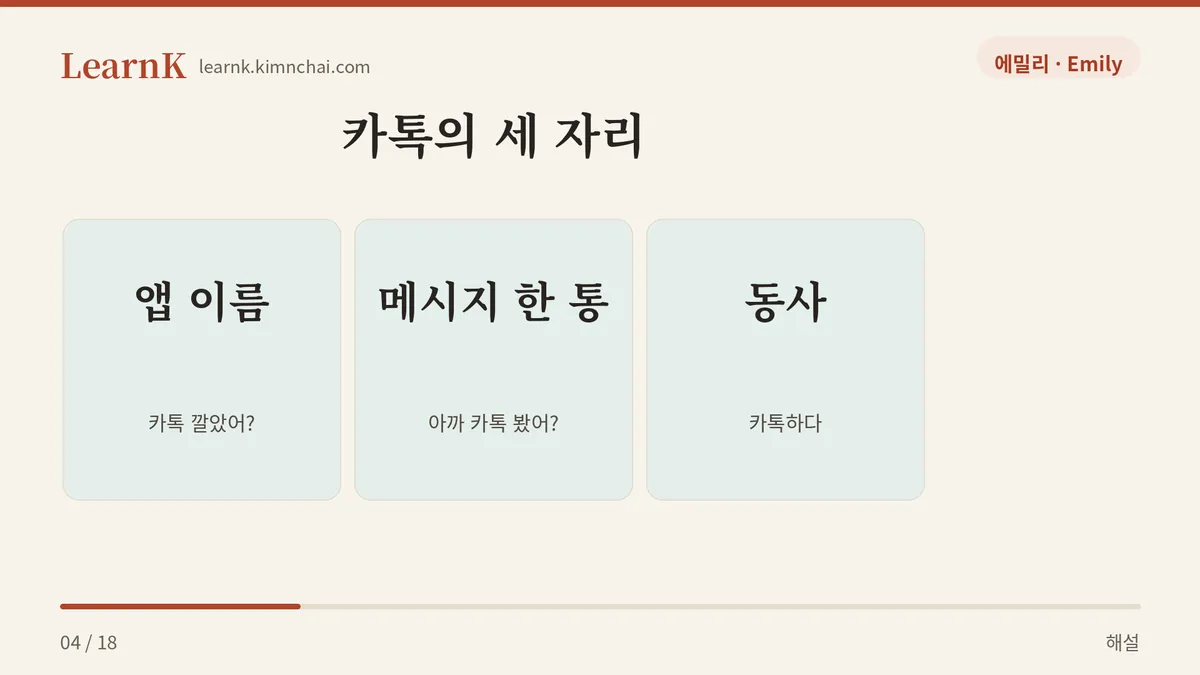
What makes these two little syllables fun is that one word sits in three seats at once. First, it is an app name — 카톡 깔았어? (katok kkarasseo?) means “Did you install KakaoTalk?” Second, it is a single message — 아까 카톡 봤어? (akka katok bwasseo?) becomes “Did you see the message I sent earlier?” Third, it is a verb — 카톡하다 (katokhada) means “to get in touch via KakaoTalk,” a very typical Korean move in which a borrowed noun picks up -하다 (-hada) and becomes a verb.
There is one nuance you cannot afford to miss. 카톡 is far lighter, far more concrete, and far closer than 연락 (yeollak), the general word for “contact.” In Korea, text messaging (문자, munja / SMS) has become mostly a pipe for verification codes and ads, and almost everything said between two people travels by 카톡. So if 연락할게 (yeollakhalge) sounds like a vague promise that might arrive someday, 카톡할게 (katokhalge) has the warmth of a phone that will buzz before the night is out. Same meaning, different distance.
A real conversation
Scene: 11 p.m., in front of the subway turnstiles. You’ve just had dinner together and you’re splitting up. The last train is cutting it close.
Jun-kyung: 야, 막차 몇 분 남았어? 뛰어야 되는 거 아니야? Hey, how many minutes until the last train? Shouldn’t you run?
Emily: 괜찮아, 3분 남았어. 집 도착하면 카톡할게. It’s fine, I’ve got three minutes. I’ll message you when I get home.
Jun-kyung: 어, 꼭 카톡 줘. 답 없으면 나 계속 확인하잖아. Yeah, make sure you text. When there’s no reply I just keep checking.
Emily: 알았어, 알았어. 근데 너 어제 단톡방 카톡 씹었지? Okay, okay. But hey — you ignored the group chat yesterday, didn’t you?
Jun-kyung: 아 그거… 회의 중이었어. 숫자 1 안 없어진 거 봤구나. Ah, that… I was in a meeting. So you noticed the ‘1’ didn’t disappear.
Emily: 다 봤지. 얼른 가, 나 뛴다! I saw it all. Get going — I’m running!
This sounds off
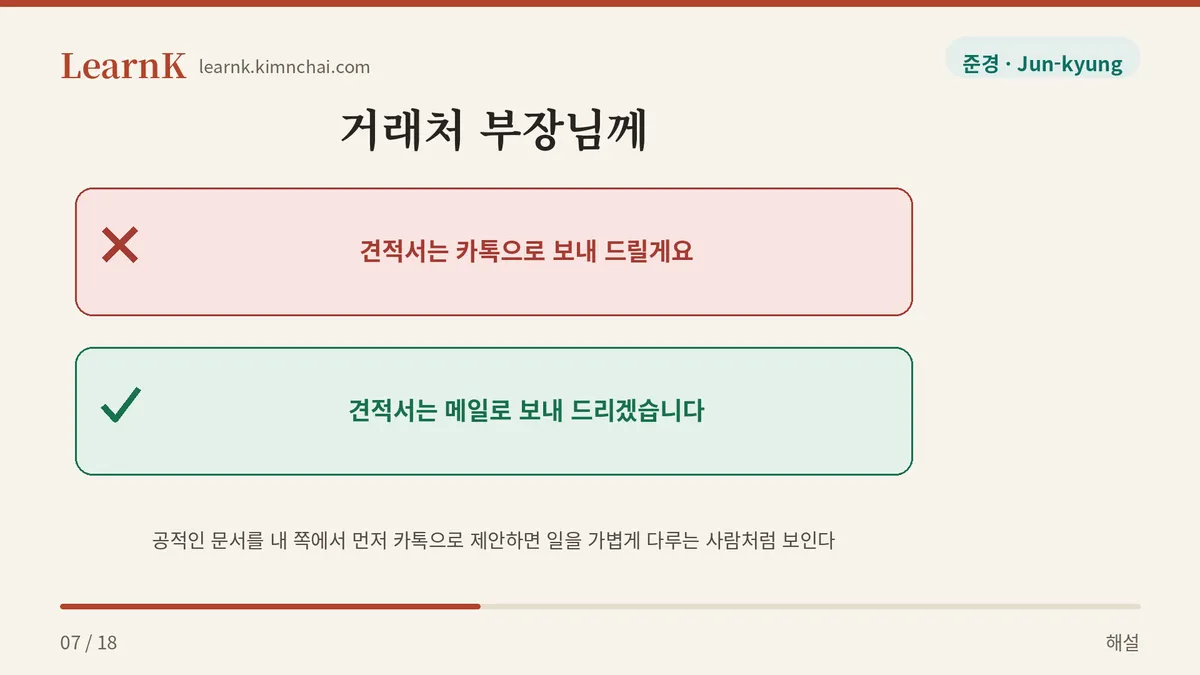
✗ (To a department head at a client company you’re meeting for the first time) 부장님, 견적서는 카톡으로 보내 드릴게요. (bujangnim, gyeonjeokseoneun katogeuro bonae deurilgeyo.) — “Sir, I’ll send you the quote over 카톡.” ✓ (To a department head at a client company you’re meeting for the first time) 부장님, 견적서는 메일로 보내 드리겠습니다. (bujangnim, gyeonjeokseoneun maeillo bonae deurigetseumnida.) — “Sir, I’ll send you the quote by email.” → 카톡 is a private channel. The grammar is perfectly fine, but if you are the one who proposes sending an official document by 카톡, you come across as someone who treats the work lightly. If the other person asks first — ‘카톡으로 주세요 (katogeuro juseyo)’ — following their lead is the safe move.
✗ (To a foreign friend who only uses WhatsApp) 이따 카톡할게. (itta katokhalge.) — “I’ll 카톡 you later.” ✓ 이따 톡할게. (itta tokhalge.) / 이따 메시지 보낼게. (itta mesiji bonaelge.) — “I’ll message you later.” → 카톡 is the name of one specific app. Koreans do use it loosely among themselves to mean messaging in general, but aimed at someone who doesn’t use the app, the word simply misses. The one-syllable 톡 (tok) is app-neutral, which makes it handy here.
Examples by situation
1) Asking someone to check in as you part ways — this is where 카톡 shows up most often in Korea. Late at night you don’t just say “get home safe” and leave it there; asking for confirmation that they arrived is a sign of closeness.
집에 도착하면 카톡 줘. (jibe dochakhamyeon katok jwo.) Send me a message when you get home.
2) Pushing plans or details to later — rather than hashing everything out on a long phone call, handing it off with “the rest by 카톡” is the Korean default. Especially for things that need to stay in writing: times, places, bank account numbers.
자세한 건 이따 카톡으로 보낼게요. (jasehan geon itta katogeuro bonaelgeyo.) I’ll send you the details by message later.
3) When you’re hurt by the silence — here 카톡 stops being a mere channel and becomes a thermometer for the relationship. Because it’s aimed at someone who read your message and didn’t answer, the voice rises a little.
카톡 읽었으면 답장 좀 해 줘. (katok ilgeosseumyeon dapjang jom hae jwo.) If you read my message, please answer.
Polite vs. casual, and related expressions
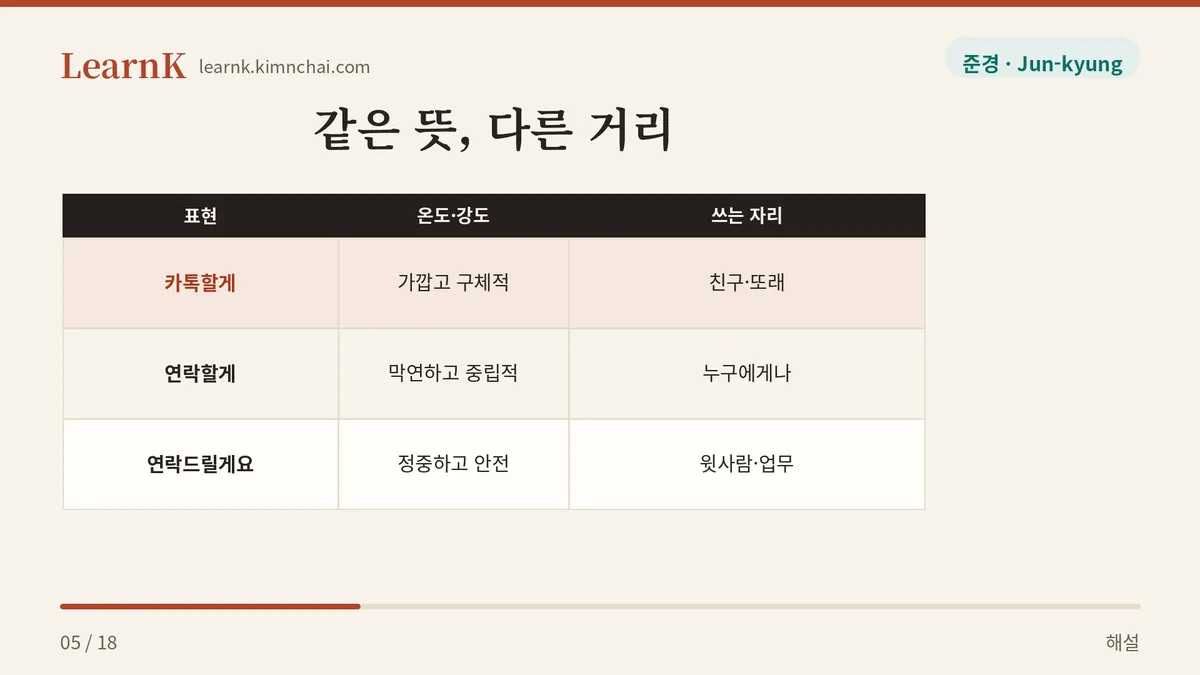
| Expression | Temperature / intensity | Where it fits |
|---|---|---|
| 카톡해 (katokhae) | 반말 (banmal, casual speech); easy and warm | Friends, younger siblings, close peers |
| 카톡 주세요 (katok juseyo) | 존댓말 (jondaenmal, polite speech), but still personal | Seniors you know, neighbors, the owner of your regular shop |
| 톡해 (tokhae) | The lightest and shortest | Peers. Doesn’t name any particular app |
| 문자 보낼게 (munja bonaelge) | Neutral, slightly businesslike | When you’re actually using SMS. These days it reads as notices and verification codes |
| 연락드릴게요 (yeollakdeurilgeyo) | Polite and neutral | Superiors and work contacts. Safest because it never names the channel |
The trick with people above you is simple: don’t lead with the channel, lead with the act. 연락드릴게요 (yeollakdeurilgeyo) works in any room where 카톡 드릴게요 (katok deurilgeyo) would feel slightly off.
Cultural background — the notification sound that became the name
The word-building is transparent. 카카오톡 (Kakao Talk) joins the company name 카카오 (Kakao) with 톡 (tok), from the English “talk,” and 카톡 keeps only the front syllable of each half. Then a coincidence piled on top. The app’s default notification sound is a human voice saying “카톡!” — so the name and the sound became the same thing. Which is why, when that sound goes off once in a quiet café, you get the sight of several people patting their pockets at the same moment.
Understanding 카톡 drags a small vocabulary along with it. When you send a message, a 숫자 1 (sutja il), the number 1, appears beside it, and it vanishes once the other person reads it. Reading a message and not replying is therefore called 읽씹 (ikssip) — short for ‘읽고 씹다 (ilkgo ssipda)’, “read it and blow it off,” where 씹다 (ssipda) is slang for pretending you never heard what someone said. Not even opening it is 안읽씹 (anikssip). A group chat with several people in it is a 단톡방 (dantokbang), and since family, school friends, and the work team each get one, a Korean office worker’s phone can easily stack up more than ten of them.
Knowing this word changes how Korean dramas look, too. The character’s phone screen fills the frame, one speech bubble floats up, and several seconds pass with the number 1 stubbornly still there — that shot has hardened into a kind of grammar. Without a single line of dialogue, the audience knows exactly where those two people stand. In Korea, 카톡 has grown past being an app name into a ruler for measuring the distance between people.
Today’s quiz
The day after a job interview, you’re writing an email to the HR manager to ask about the result. Which is the most natural closing sentence?
- 결과는 카톡으로 알려 주세요. (gyeolgwaneun katogeuro allyeo juseyo.) — “Please let me know the result by 카톡.”
- 결과는 카톡 주세요. (gyeolgwaneun katok juseyo.) — “Send me the result on 카톡.”
- 결과 안내를 기다리겠습니다. 연락 주시면 감사하겠습니다. (gyeolgwa annaereul gidarigetseumnida. yeollak jusimyeon gamsahagetseumnida.) — “I’ll be waiting to hear about the result. I’d be grateful if you’d get in touch.”
Answer: 3. 카톡 is a private, lightweight channel, so in a formal relationship it’s a breach of etiquette for you to be the one who designates it. Options 1 and 2 are grammatically correct but wrong for the room. Flip the setting to a friend and option 2 becomes the most natural of the three — the answer reversing completely depending on where you’re standing is the heart of this word.
Definitions and example sentences are from the National Institute of Korean Language’s Basic Korean Dictionary (krdict.korean.go.kr); that portion of this post, including our translations, is licensed under CC BY-SA 2.0 KR.