클라스가 다르다 (keullaseuga dareuda) — Not Just "Good," But On a Whole Different Tier
클라스가 다르다 (keullaseuga dareuda)
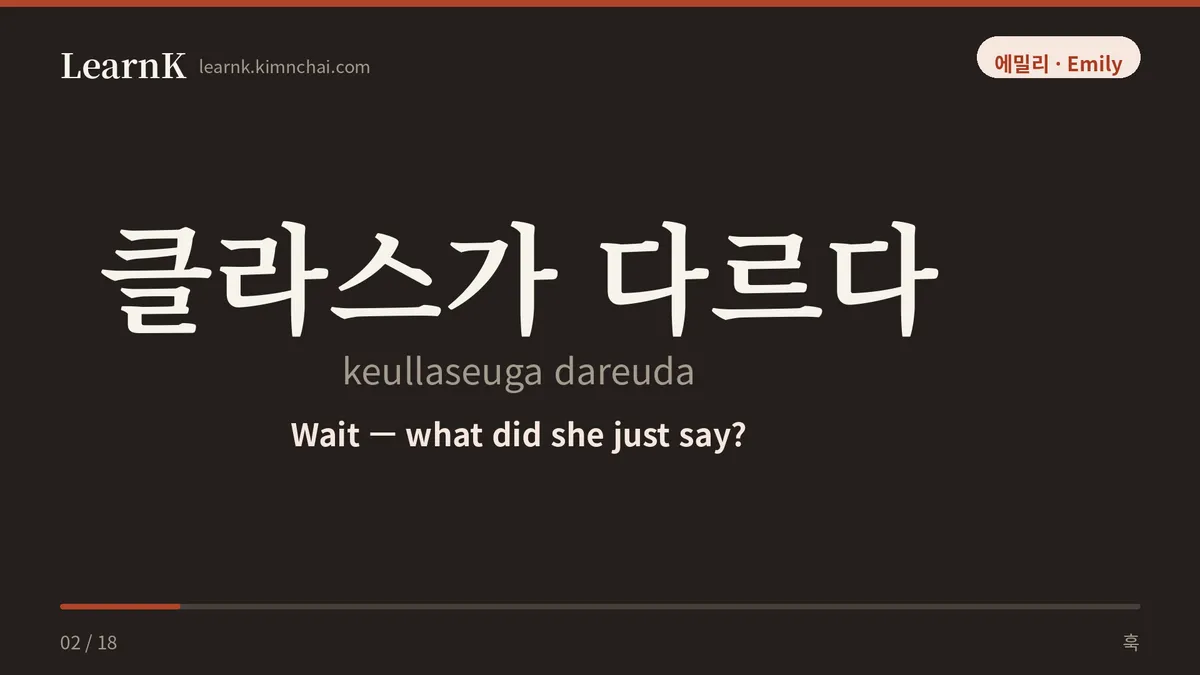
클라스가 다르다 (keullaseuga dareuda) means that someone’s skill or level is so far ahead that you can’t even line them up next to everyone else for comparison. Deep into stoppage time, everyone is exhausted and just busy hoofing the ball away — and then one player lifts his head and sees the empty space on the far side. That single pass ends the match. The words that come out of everyone’s mouth almost simultaneously: “와, 클라스가 다르네 (wa, keullaseuga dareune)” — “Wow, he’s on another level.”
At the heart of this phrase is comparison. It isn’t simply praise for doing well; it’s closer to a declaration that this person was standing on a different floor from everyone else beside them to begin with. So when this phrase gets said, it isn’t only the person being praised who rises — everyone around them turns into background.
One more thing: this is a reaction, not an analysis. It rarely shows up in a setting where people are itemizing exactly why someone is excellent; it bursts out right after you’ve witnessed something with your own eyes. That’s why the sentences never get long. They stop short at 클라스가 다르다 (keullaseuga dareuda), 클라스가 다르네 (keullaseuga dareune), or just 역시 클라스 (yeoksi keullaseu).
The range of use is wider than you might expect. People use it for visible ability — an athlete’s technique, a singer’s live vocals — but also for someone’s attitude and character. When an actor wins a big award, walks up on stage, and starts by naming the crew instead of talking about himself, people say exactly the same thing. Whether it’s the height of someone’s ability or the size of their heart, if there’s that sense of “a different floor from everyone else,” this phrase attaches itself.
There’s a flip side to watch out for, though. The admiration packed into it is so strong that if you use it in the face of a terrible result, it reads immediately as irony — as sarcasm. This is the common fate of strong praise expressions in Korean, and 클라스가 다르다 (keullaseuga dareuda) leans that way especially easily.
A Real Conversation
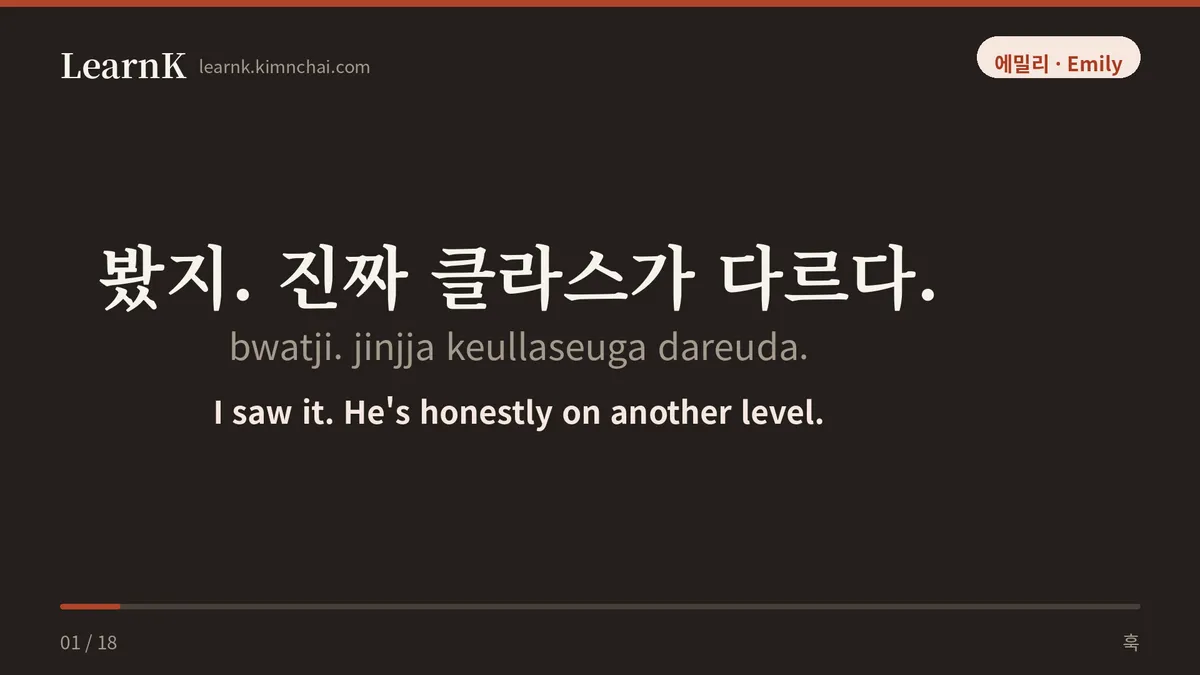
Situation: A neighborhood fried chicken place. It’s the second half of a national team match, and both of them are staring at the screen on the wall.
Jun-kyung: 야, 방금 그거 봤어? 수비 세 명 사이로 찔러 넣었어. Hey, did you just see that? He threaded it between three defenders.
Emily: 봤지. 진짜 클라스가 다르다. I saw it. He’s honestly on another level.
Jun-kyung: 근데 쟤 작년엔 벤치만 지켰잖아. But he was warming the bench all last year.
Emily: 그러니까 더 대단한 거지. 욕 먹으면서도 안 꺾였잖아. That’s what makes it bigger. He took all that flak and didn’t break.
Jun-kyung: 하긴. 발보다 그게 더 클라스가 다른 건가 싶기도 하고. True. Maybe that’s the part that’s really on another level, not his feet.
Emily: 어어, 또 간다! 사장님, 소리 좀만 키워 주세요! Oh—here he goes again! Sir, could you turn it up a bit?
When It Sounds Off
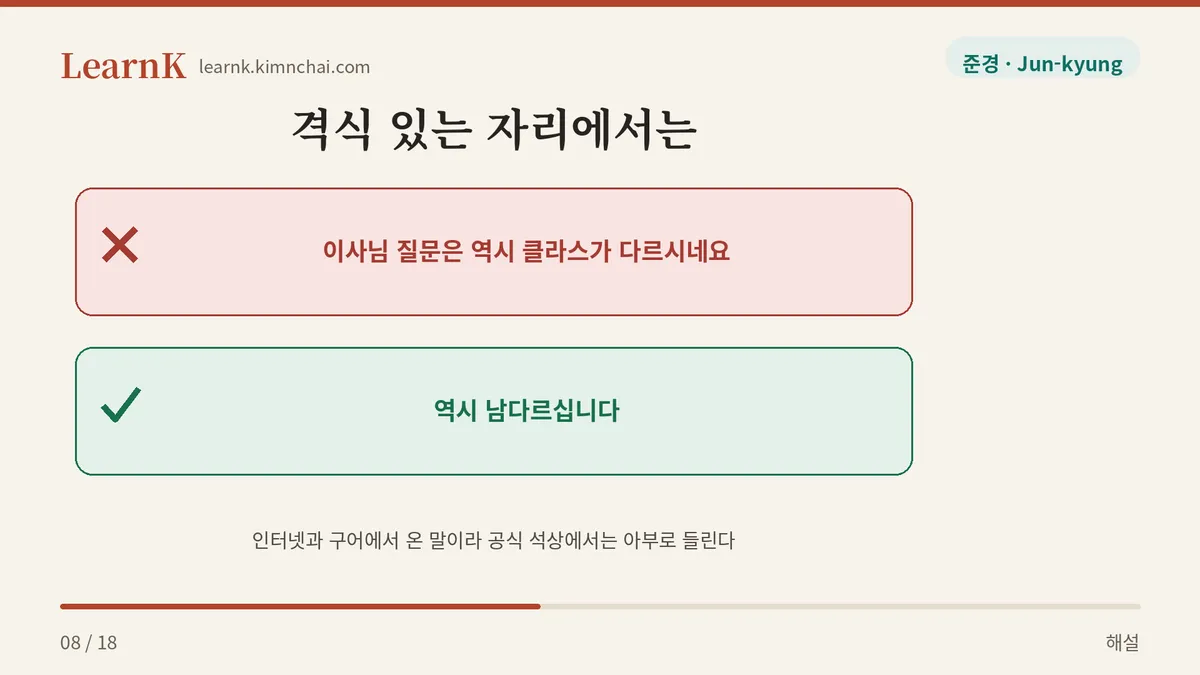
✗ (To your interviewer at an executive-level job interview) 이사님 질문은 역시 클라스가 다르시네요. (isanim jilmuneun yeoksi keullaseuga dareusineyo.) — “Your questions really are on another level, sir.” ✓ (In an interview) 좋은 질문 감사합니다. 조금 더 깊이 생각해서 말씀드리겠습니다. (joeun jilmun gamsahamnida. jogeum deo gipi saenggakaeseo malsseumdeurigetseumnida.) — “Thank you for the excellent question. Let me think it through more carefully before I answer.” → This phrase was born on the internet and in casual speech, so using it toward someone senior in a formal setting doesn’t land as praise — it lands as clumsy flattery. In formal settings, 남다르다 (namdareuda) or 깊이가 있다 (gipiga itda) are the safe choices.
✗ (Right after your friend breaks a cup) 와, 너 진짜 클라스가 다르다. (wa, neo jinjja keullaseuga dareuda.) — “Wow, you really are in a class of your own.” ✓ (When your friend passes a difficult certification exam on the first try) 와, 너 진짜 클라스가 다르다. (wa, neo jinjja keullaseuga dareuda.) — “Wow, you really are in a class of your own.” → Lay strong praise over a failure and it turns into sarcasm on the spot. Between close friends it passes as a joke, but with someone you’re not close to, it sounds like mockery.
Example Sentences by Situation
Situation 1 — A new neighbor moved in and handed out rice cakes on every floor. In Seoul these days, it’s common to live for years without knowing the face of the person next door. So a greeting like this goes beyond simple courtesy and leaves an impression.
요즘 이런 분 없는데. 진짜 클라스가 다르다. (yojeum ireon bun eomneunde. jinjja keullaseuga dareuda.) “You don’t see people like this anymore. She’s really a class apart.”
Situation 2 — At an old gukbap (rice-and-soup) restaurant. The owner ladles in an extra scoop of broth without a word and walks on. The customer never even asked.
이 집은 예전부터 클라스가 달랐어. 그러니까 20년을 하지. (i jibeun yejeonbuteo keullaseuga dallasseo. geureonikka isimnyeoneul haji.) “This place has always been on another level. That’s how it’s lasted twenty years.”
Situation 3 — On the way out after a concert. The singer had said in advance that he’d caught a cold, and still he didn’t waver through the final song.
목 상태 저런데 저렇게 부른다고? 라이브 클라스가 다르네. (mok sangtae jeoreonde jeoreoke bureundago? raibeu keullaseuga dareune.) “With his throat like that? His live singing really is another class.”
Polite vs. Casual Speech, and Similar Expressions
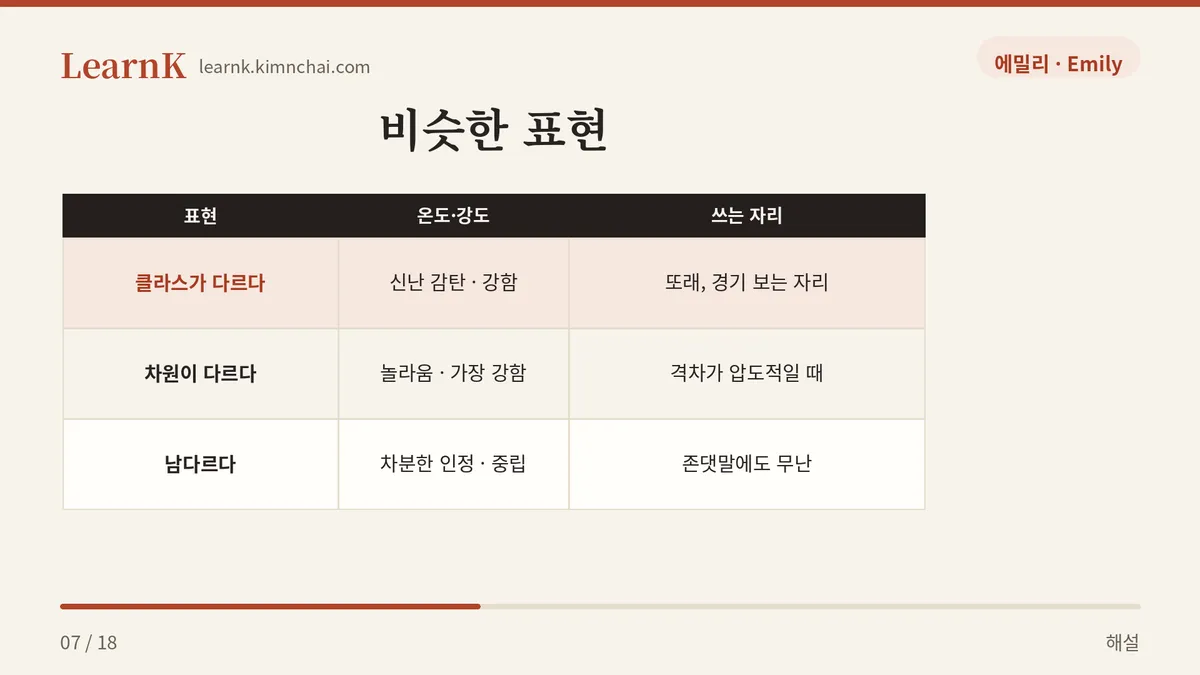
This phrase is casual speech and spoken language by birth. Turn it into polite speech and you get a form like 클라스가 다르시네요 (keullaseuga dareusineyo) — grammatically valid, but picky about where it’s used. With people you’re already comfortable with, like a friendly senior or the owner of a shop you frequent, you can say it with a smile. In front of a boss, a client, or an elder, 역시 남다르십니다 (yeoksi namdareusimnida) is far safer.
| Expression | Tone & Strength | Where It’s Used |
|---|---|---|
| 클라스가 다르다 (keullaseuga dareuda) | Excited admiration · strong | With peers, on social media, while watching a match. Not for formal occasions |
| 급이 다르다 (geubi dareuda) | Matter-of-fact, decisive · strong | Everyday life in general. Used for both people and things |
| 차원이 다르다 (chawoni dareuda) | Astonishment · strongest | When the gap is overwhelming |
| 넘사벽 (neomsabyeok) | Playful · strong | Peers and the internet. Off-limits in front of anyone senior |
| 남다르다 (namdareuda) | Calm acknowledgment · neutral | Anywhere. Works fine in polite speech too |
They all mean “outstanding,” but the temperature differs. If 남다르다 (namdareuda) is a nod of the head, 클라스가 다르다 (keullaseuga dareuda) is a burst of applause, and 차원이 다르다 (chawoni dareuda) is standing there with your mouth open.
Cultural Background — Why It’s 클라스 (keullaseu), Not 클래스 (keullaeseu)
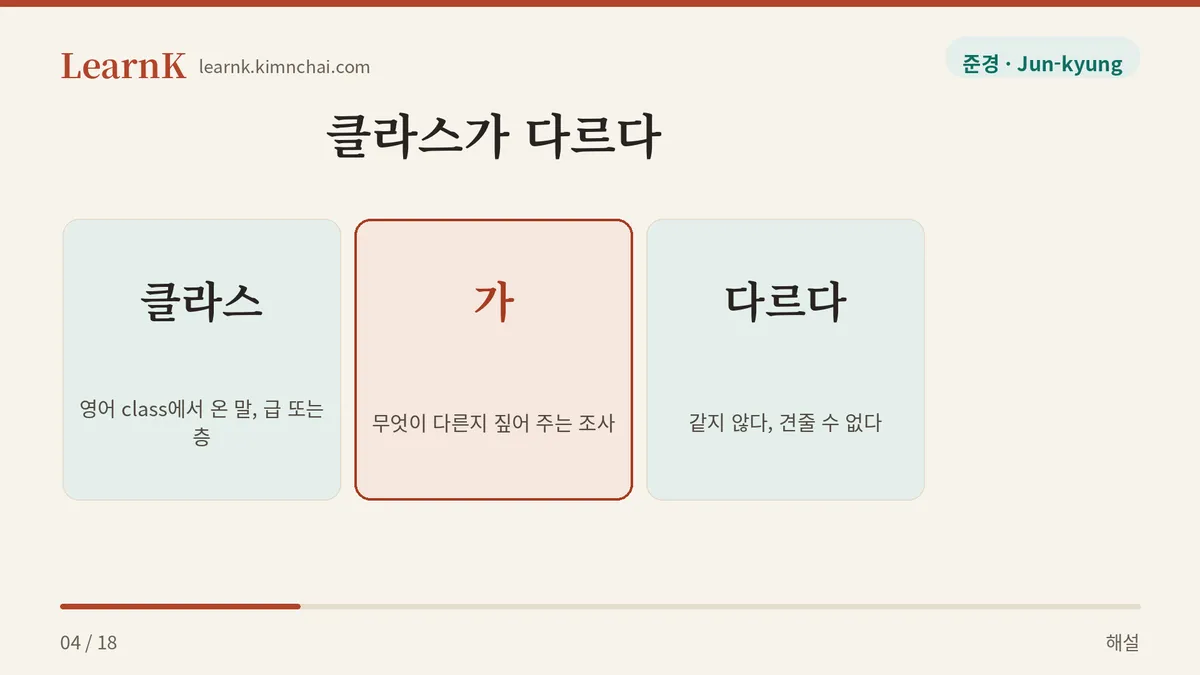
This expression takes the English word class straight into Korean and attaches 다르다 (dareuda, “to be different”). The interesting part is the spelling. By the official rules for transcribing loanwords, 클래스 (keullaeseu) is correct — but in this expression alone, it’s almost always written 클라스 (keullaseu). The flavor of the spoken word, drawn out as “클~라스” when people gasp in admiration, hardened right into the letters. So this spelling is less a matter of orthography than a matter of facial expression. It’s also why you’ll rarely see this form in newspaper articles or official documents. If you’re studying Korean, it’s easiest to file 클래스 (keullaeseu, “class/lesson/grade”) and 클라스 (keullaseu, “wow, what a class act”) in two separate drawers.
Many people say the channels that spread this phrase widely were sports broadcasts and fan communities. That said, it isn’t clear who used it first, so let’s not state it as fact. These days it’s common in variety-show subtitles too — a skilled performer appears on screen and 클라스가 다름 (keullaseuga dareum) pops up in big letters. In dramas, it often sits in the spot where a supporting character explains the lead’s ability through admiration.
Korean has an unusual abundance of expressions that map superiority onto “grades” and “floors.” 급이 다르다 (geubi dareuda), 넘사벽 (neomsabyeok — short for 넘을 수 없는 사차원의 벽 (neomeul su eomneun sachawonui byeok), “a fourth-dimensional wall you cannot cross”), 차원이 다르다 (chawoni dareuda) — they’re all the same picture. What gives 클라스가 다르다 (keullaseuga dareuda) its special place among them is that it’s almost never used to put someone down. It isn’t a phrase for confirming a hierarchy; it’s a phrase for laying admiration on top of someone. That’s why it moves so easily around stadiums, concert halls, and gukbap shops.
Today’s Quiz
Which of the following is the most fitting situation for 클라스가 다르다 (keullaseuga dareuda)?
- When your friend accidentally breaks a cup
- When you’re impressed by an interviewer’s question at an executive-level job interview
- When your favorite singer nails a live performance perfectly even though he has a cold
Show the answer
Answer: 3
Number 1 is a failure, so it sounds like sarcasm right away. Number 2 isn’t wrong as an expression, but the setting is formal, so it comes off as too light — “좋은 질문 감사합니다 (joeun jilmun gamsahamnida)” is the right call there. Number 3 — the moment you witness extraordinary skill right in front of you — is where this phrase truly belongs.