The Perilla Leaf Debate — Why Korean Couples Genuinely Fight at the Dinner Table
깻잎 논쟁 (kkaennip nonjaeng)
깻잎 논쟁 (kkaennip nonjaeng) — literally “the perilla leaf debate” — is a hypothetical argument with no set answer: at a meal you’re all sharing, is it acceptable for your partner to press down a perilla leaf with their chopsticks so a friend of the opposite sex can peel one off? Nobody is telling a real story here. When conversation dries up over drinks, when two people on a blind date want to know what the other is really like, when a couple is bored — someone slips it in, and everyone at the table splits into two camps. And nine times out of ten, it runs longer than anyone expected.
Picture the scene. Three people at the table: you, your partner, and your partner’s longtime friend of the opposite sex. Among the side dishes is 깻잎장아찌 (kkaennipjangajji), soy-pickled perilla leaves. The leaves are thin and cling together in a stack, so getting just one loose with a single pair of chopsticks is genuinely hard. Your partner watches their friend struggle, then gently pins the top leaf down with their own chopsticks. That one moment. Do you read it as “of course you’d help,” or as “that crossed a line”?
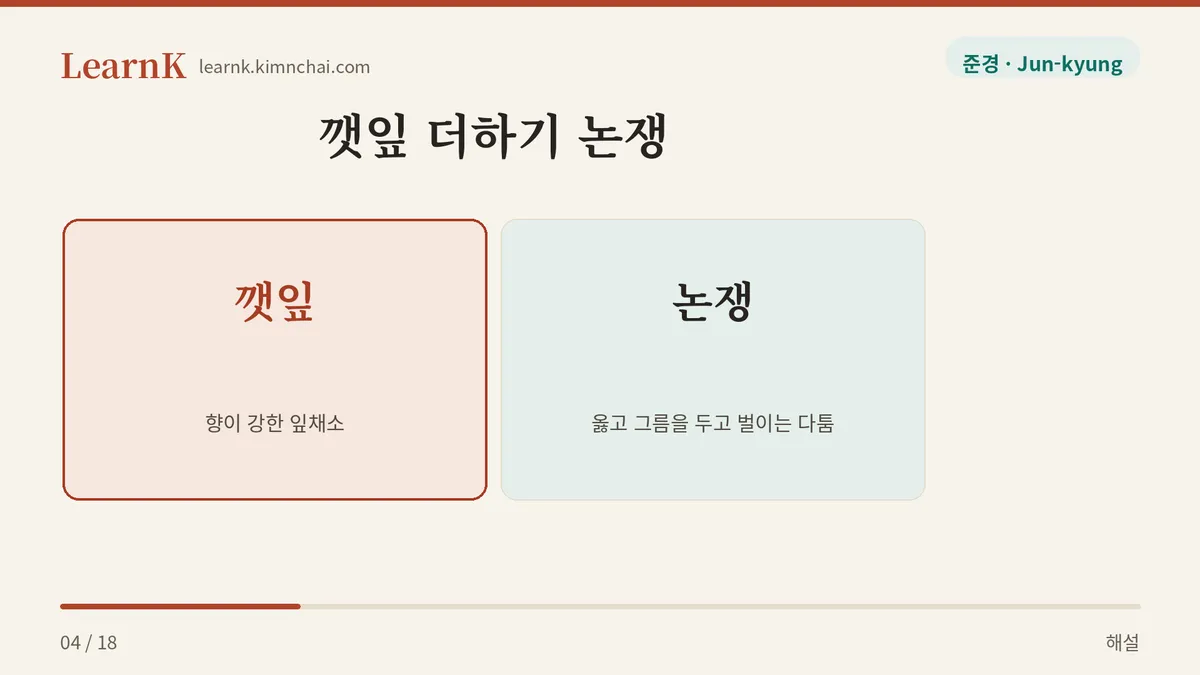
Taken apart, the words are simple. 깻잎 (kkaennip) is the strongly fragrant leafy green that shows up constantly on Korean tables, and 논쟁 (nonjaeng) is an argument over what’s right and wrong. Put them together and you get “a fight about perilla leaves” — except perilla is not what anyone is actually fighting about. Where does ordinary kindness end and line-crossing begin? Where each person draws that boundary is what comes out, hanging off a single leaf. The perilla is just the prop; the real subject is your instinct for relationships.
The temperature is the fun part. It starts as a joke, unmistakably. Everyone’s laughing. But three or four exchanges in, voices creep up, someone says 야 그건 좀 아니지 (ya geugeon jom aniji), “hey, no, that’s not okay,” and at some point a real expression crosses someone’s face. Because it swings back and forth between play and sincerity, even Koreans size up the room before bringing it out — is this a table where that joke will land?
Seeing It in Real Conversation
Scene: Friday evening at a neighborhood barbecue place. The pork belly is sizzling away, and soy-pickled perilla leaves have come out as a side dish.
Jun-kyung: 어, 깻잎장아찌 나왔네. 근데 이거 진짜 한 장씩 안 떼어져. Oh, pickled perilla leaves. These never come apart one at a time.
Emily: 아 나 이거 알아! 그 깻잎 논쟁 그거지? Ah, I know this one! That “perilla leaf debate,” right?
Jun-kyung: 야, 너 그것도 알아? 한국 산 지 오래되긴 했다 진짜. Whoa, you know that too? You really have lived here a long time.
Emily: 근데 솔직히 아직도 이해가 안 돼. 그냥 한 장 눌러 주는 건데 왜 싸워? Honestly, I still don’t get it. You’re just holding down one leaf — why fight over it?
Jun-kyung: 그게 깻잎 논쟁의 핵심이야. 답이 있으면 그게 논쟁이겠냐. That’s the whole point of the perilla leaf debate. If there were an answer, it wouldn’t be a debate.
Emily: 어우, 말 돌리지 말고. 그래서 넌 어느 편인데? Ugh, don’t dodge. So which side are you on?
Jun-kyung: …나? 난 그냥 내가 떼서 접시에 올려 줘. 그럼 조용하잖아. …Me? I just take one off and put it on their plate. Then nobody says anything.
These Uses Sound Off
✗ (Your partner is genuinely hurt and crying) 야, 그거 그냥 깻잎 논쟁이잖아. 뭘 그렇게 심각해. “Come on, that’s just the perilla leaf debate. Why are you taking it so seriously?” ✓ (Out drinking with friends) 우리도 깻잎 논쟁 한번 해 볼까? 넌 어느 편이야? “Should we do the perilla leaf debate too? Which side are you on?” → The whole point is that it’s a made-up scenario with no answer, played for fun. Pin it on a real conflict happening in front of you and you’re shrinking the other person’s feelings down to a party game.
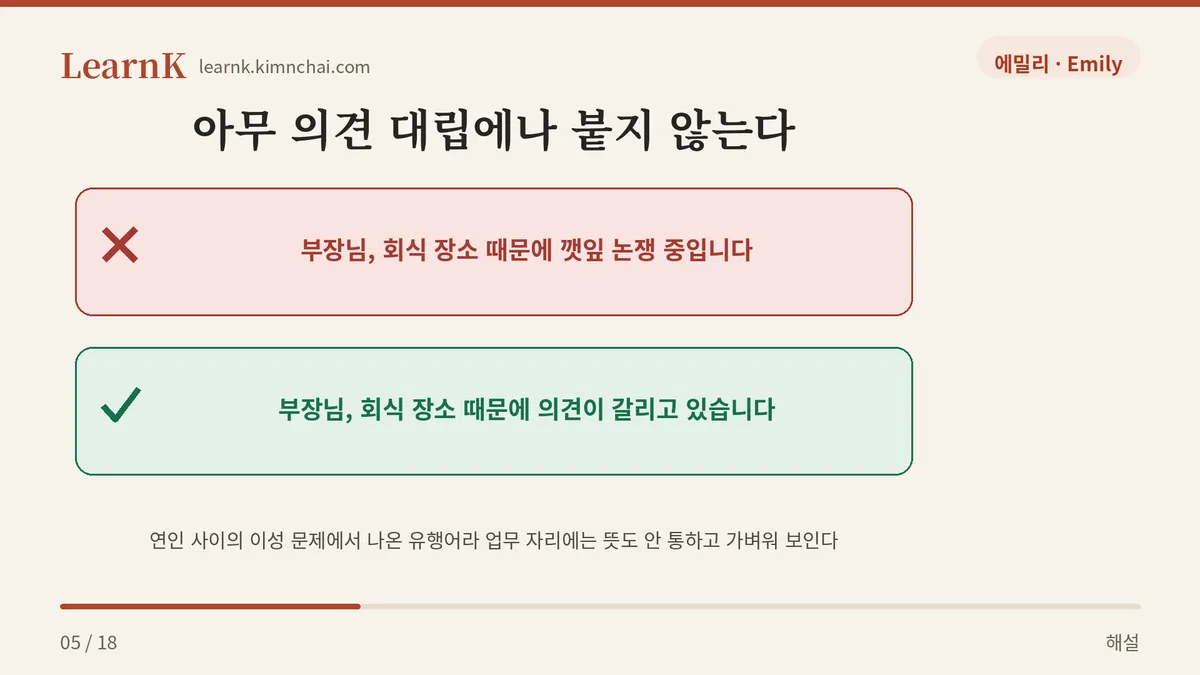
✗ (To your boss in a meeting) 부장님, 저희 팀 회식 장소 때문에 깻잎 논쟁 중입니다. “Sir, our team is having a perilla leaf debate about where to hold the team dinner.” ✓ (To your boss in a meeting) 부장님, 저희 팀 회식 장소 때문에 의견이 갈리고 있습니다. “Sir, our team is split on where to hold the team dinner.” → This is a common misunderstanding: the phrase doesn’t attach to just any disagreement. It’s internet slang born in the narrow setting of opposite-sex issues between romantic partners, so at work it won’t land and you’ll come across as unserious.
Example Sentences by Situation
1. Throwing out a topic over drinks
“오늘 주제 정했다. 깻잎 논쟁. 자, 찬성 쪽 손.” (oneul juje jeonghaetda. kkaennip nonjaeng. ja, chanseong jjok son.) “I’ve picked tonight’s topic. The perilla leaf debate. Okay — hands up if you’re in favor.”
This is deliberately lighting a fire when things have gone quiet. As 주제 정했다 (juje jeonghaetda), “I’ve picked the topic,” makes clear, this isn’t a serious debate — it’s a signal that everyone should come play.
2. Comparing another conflict to it
“이건 거의 깻잎 논쟁급인데? 물어보는 사람마다 답이 달라.” (igeon geoui kkaennip nonjaenggeubinde? mureoboneun saramada dabi dalla.) “This is basically perilla-leaf-debate tier. Everyone I ask gives a different answer.”
Adding -급 (-geup), “tier” or “class,” stretches the phrase to mean “a problem that unanswerable to about that degree.” Here the subject doesn’t have to be perilla at all — you’re just borrowing the name as shorthand for an argument that goes nowhere.
3. Wrapping the argument up
“깻잎 논쟁은 정답이 없어요. 그냥 서로 다른 거예요.” (kkaennip nonjaengeun jeongdabi eopseoyo. geunyang seoro dareun geoyeyo.) “There’s no right answer to the perilla leaf debate. People are just different, that’s all.”
This is the closing line someone offers when the mood starts to turn. Switched into 존댓말 (jondaenmal), polite speech, it becomes exactly this kind of step-back, mediating tone.
Politeness Levels and Similar Expressions
“깻잎 논쟁” is a noun, so it carries no honorific weight on its own — you adjust with the predicate that follows. To a friend, “그거 완전 깻잎 논쟁이야” (geugeo wanjeon kkaennip nonjaengiya), “that’s a total perilla leaf debate.” With someone you owe a bit more politeness, “깻잎 논쟁 같은 거죠” (kkaennip nonjaeng gateun geojyo), “it’s kind of a perilla leaf debate thing,” sounds natural. That said, no amount of polite ending erases the fact that it’s slang, so in front of someone older or senior you’re better off not raising it at all.
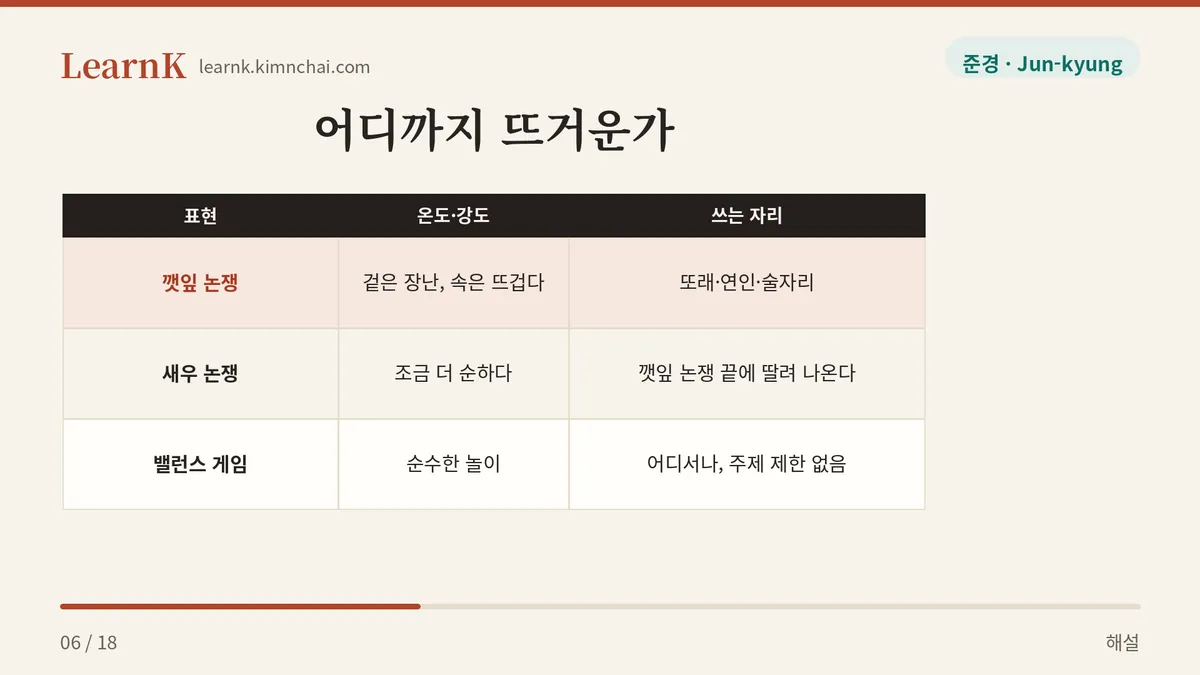
| Expression | Temperature / intensity | Where it’s used |
|---|---|---|
| 깻잎 논쟁 (kkaennip nonjaeng) | Playful on the surface, quietly heated underneath | Peers, couples, drinking tables. Not in meetings or official documents |
| 새우 논쟁 (saeu nonjaeng) | Same family, a little milder | Comes up trailing right behind the perilla leaf debate |
| 밸런스 게임 (baelleonseu geim) | Pure play, little emotion involved | Anywhere. No limits on topic |
| 논쟁 (nonjaeng) | Neutral and stiff | News, reports, and other formal settings |
“새우 논쟁 (saeu nonjaeng),” the shrimp debate, asks whether it’s okay for your partner to peel shrimp for a friend of the opposite sex. The structure is identical, so the two get mentioned as a set — but the perilla version is overwhelmingly the famous one. “밸런스 게임 (baelleonseu geim),” from the English “balance game,” is the umbrella term for any pick-one-of-two game, which means you could file the perilla leaf debate under it as one event.
Cultural Background — The Line Drawn by a Single Pair of Chopsticks
Why perilla, of all things? Look at the table and you’ll see. 깻잎장아찌 (kkaennipjangajji) is made by stacking leaves and curing them in soy sauce, so it arrives in the dish as one solid block. Grab it with chopsticks and three or four come along for the ride. Which is why, at a Korean table, the sight of the person next to you pinning the top leaf down comes up quite naturally. In other words, this debate is built on a gesture that really does happen all the time. It isn’t an imagined scenario but a scene everyone has witnessed, so the instant someone brings it up, the whole table pictures it immediately. That’s the making of a good debate.
It started spreading through online communities around 2021, and after web variety shows and YouTube kept coming back to it, it became the flagship event of the “Korean couple debate” genre. Since then the format has outlived the content, and variations keep appearing.
There’s one more feature of Korean food culture underneath all this. A Korean table is built around shared side dishes in the middle rather than portions plated separately, which means chopsticks are constantly crossing into each other’s territory. In a culture where eating together already presumes a degree of closeness, reaching your chopsticks over to help with someone else’s food reads not as a simple hand movement but as a marker of the relationship. That’s why the debate works at all. If everyone had their own plate, Western style, there’d be nothing to fight about in the first place.
This is exactly why the expression is worth so much to Korean learners. Knowing the meaning matters far less than knowing how people’s faces change while it’s being tossed around. Once you can read that curve — starting in laughter, turning serious, ending in laughter again — you’ve stepped one foot further into a Korean drinking table.
Today’s Quiz
Which of the following is the most awkward situation in which to use 깻잎 논쟁 (kkaennip nonjaeng)?
- Throwing out a new topic when the conversation stalls while drinking with friends
- Comparing an unanswerable problem to it: 이건 깻잎 논쟁급이다 (“this is perilla-leaf-debate tier”)
- Saying 그건 그냥 깻잎 논쟁이야 (“that’s just the perilla leaf debate”) while your partner is genuinely hurt and crying
- Introducing Korean culture and explaining 이런 논쟁이 유행했다 (“this debate was a trend”)
Show answer
Answer: 3
The perilla leaf debate is a game played over a hypothetical that never actually happened. Bring it out when the person in front of you is truly hurt and crying, and you’re dragging their feelings down to the level of an internet meme — which makes the situation far worse. 1, 2, and 4 are all places the expression genuinely gets used.
Definitions and example sentences are from the National Institute of Korean Language’s Basic Korean Dictionary (krdict.korean.go.kr); that portion of this post, including our translations, is licensed under CC BY-SA 2.0 KR.