빙의 (bingui) — "너 지금 누구 빙의했어?" (neo jigeum nugu binguihaesseo?) The One Word Every K-Drama Fan Knows
빙의
빙의 (bingui) means a spirit moving out of one place and attaching itself to another person or object. In everyday Korean conversation today, though, it’s used far more often to mean “being so absorbed in someone that you start talking and acting exactly like them.” It began as the language of shamanism and religion, but now it’s the word that pops out when a friend suddenly belts out high notes like a professional singer at the noraebang, when an actor plays a role so well you can’t tell them apart from the character, or when you’re cooking and your mother’s exact tone of voice comes out of your own mouth.
If you watch Korean dramas with subtitles, you’ll run into this word from more than one direction. Sometimes it’s built into the plot (a story where someone’s soul enters another body), and sometimes it shows up in viewer comments (“이 배우 진짜 캐릭터에 빙의했네” (i baeu jinjja kaerikteoe binguihanne) — “this actor has really been possessed by the character”). The two uses share a root, but their temperature is completely different. The first is frightening and supernatural; the second is light, closer to admiration. Use it without knowing the difference and you can end up hurting someone when you meant to pay them a compliment.
Today we’ll follow this single word from its shamanic meaning all the way to the temperature of the joke Koreans actually make with it.
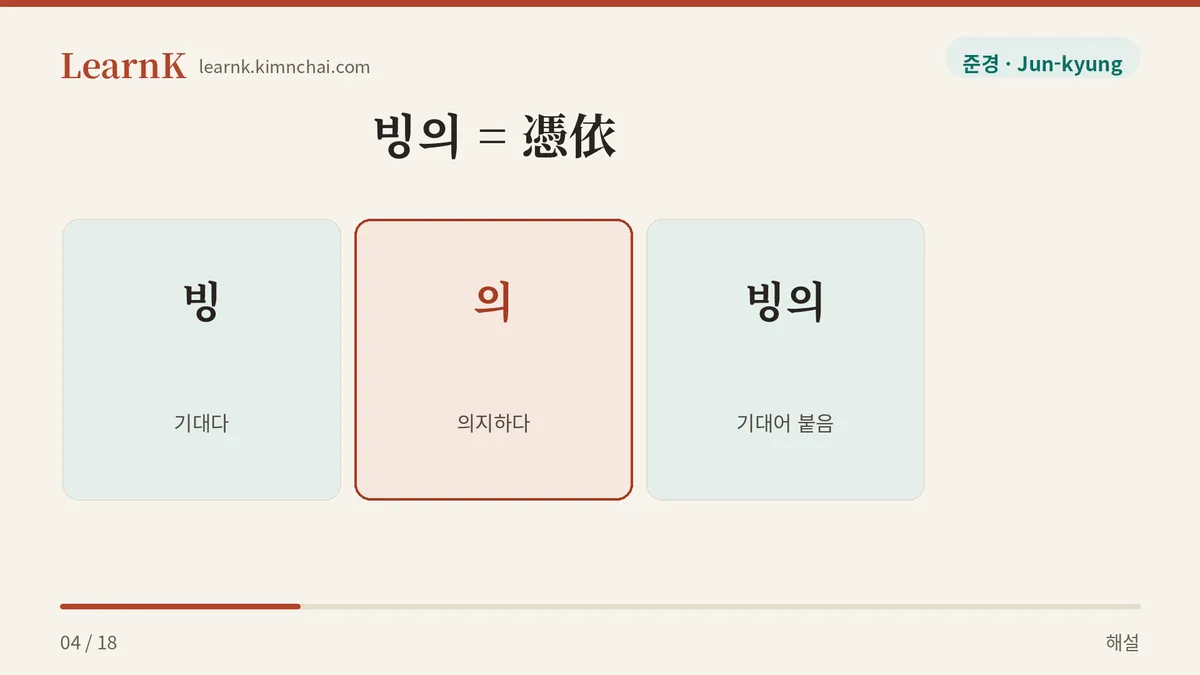
In hanja it’s written 憑依. 憑 (bing) means “to lean on” and 依 (ui) means “to depend on” — both characters carry the sense of attaching to something and resting your weight on it. Read literally, it’s “leaning and clinging,” and that’s where the meaning “a spirit attaches itself to someone else’s body” comes from.
As a verb it takes two forms. 빙의하다 (binguihada) leans active — “I throw myself into something and go in.” 빙의되다 (binguidoeda) leans passive — “I ended up in that state without meaning to.” In real conversation people mix the two without drawing a strict line, but when you’re explaining away something you did yourself, the passive form feels more natural: “나도 모르게 빙의됐어” (nado moreuge binguidwaesseo), “I got possessed without even realizing it.” It has the nuance of shifting just a little of the responsibility off your shoulders.
The most common form is to stick a noun in front of it: 엄마 빙의 (eomma bingui), 선생님 빙의 (seonsaengnim bingui), or an actor’s name plus ○○ 빙의. Saying “A 빙의했다” (A binguihaetda) is far stronger and more exaggerated than “A인 줄 알았다” (A-in jul aratda), “I thought you were A” — so it’s used when surprise or laughter is part of the mix. Drop it into a serious evaluation and the tone floats right off the ground.
In Real Conversation
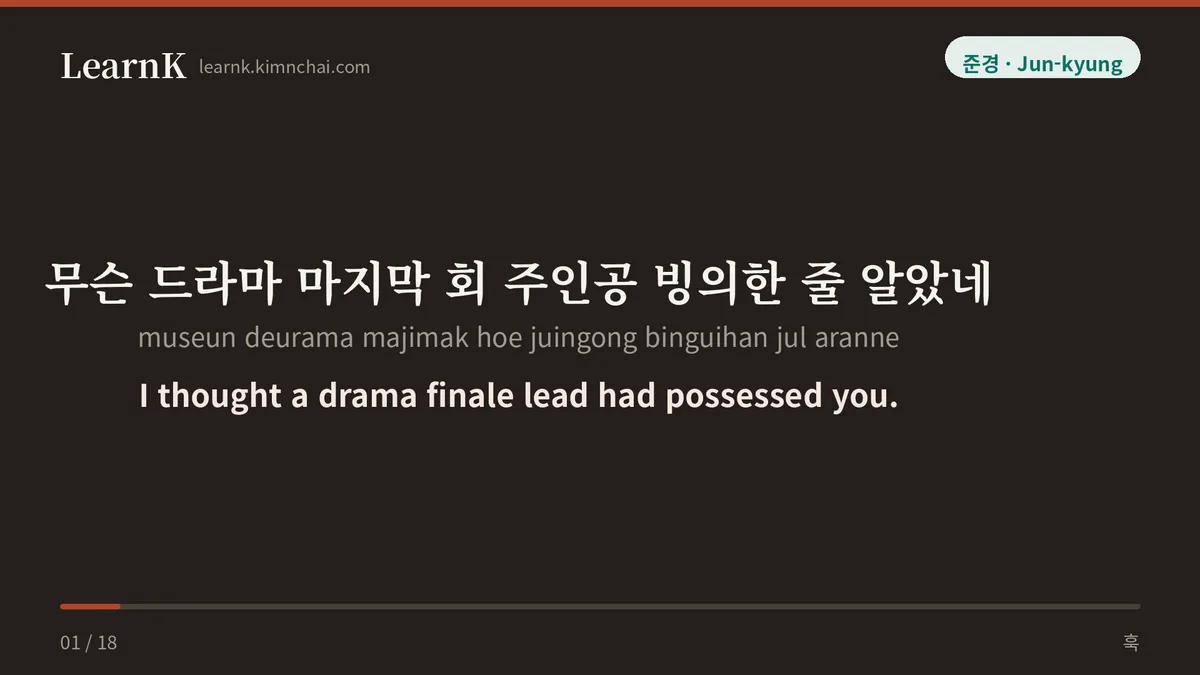
Scene: A coin noraebang on a Friday night. Emily has just sung an entire ballad with her eyes closed, all the way to the end.
Jun-kyung: 야… 너 방금 뭐야. 눈 감고 고음까지 갔어. Whoa… what was that just now? You had your eyes closed and hit the high note and everything.
Emily: 나도 몰라. 반주 깔리니까 그냥 빙의됐어. I don’t know either. The backing track started and I just got possessed.
Jun-kyung: 무슨 드라마 마지막 회 주인공 빙의한 줄 알았네. I thought the lead from a drama finale had possessed you.
Emily: 이 노래는 원래 이렇게 부르는 거야. 안 그러면 노래방 온 의미가 없잖아. This song is meant to be sung like that. Otherwise why even come to a noraebang?
Jun-kyung: 알겠으니까 마이크 좀 내려놔. 다음 내 차례야. Fine, fine, just put the mic down. It’s my turn.
Emily: 어, 미안. 아직 안 풀렸어. Oh, sorry. I’m still not out of it.
That last line — “아직 안 풀렸어” (ajik an pullyeosseo) — captures the feel of this word perfectly. 빙의 is a state with a beginning and an end, so Koreans talk about it as something that 들어왔다 (deureowatda), “came in,” and later 풀렸다 (pullyeotda), “wore off.”
Where It Sounds Off
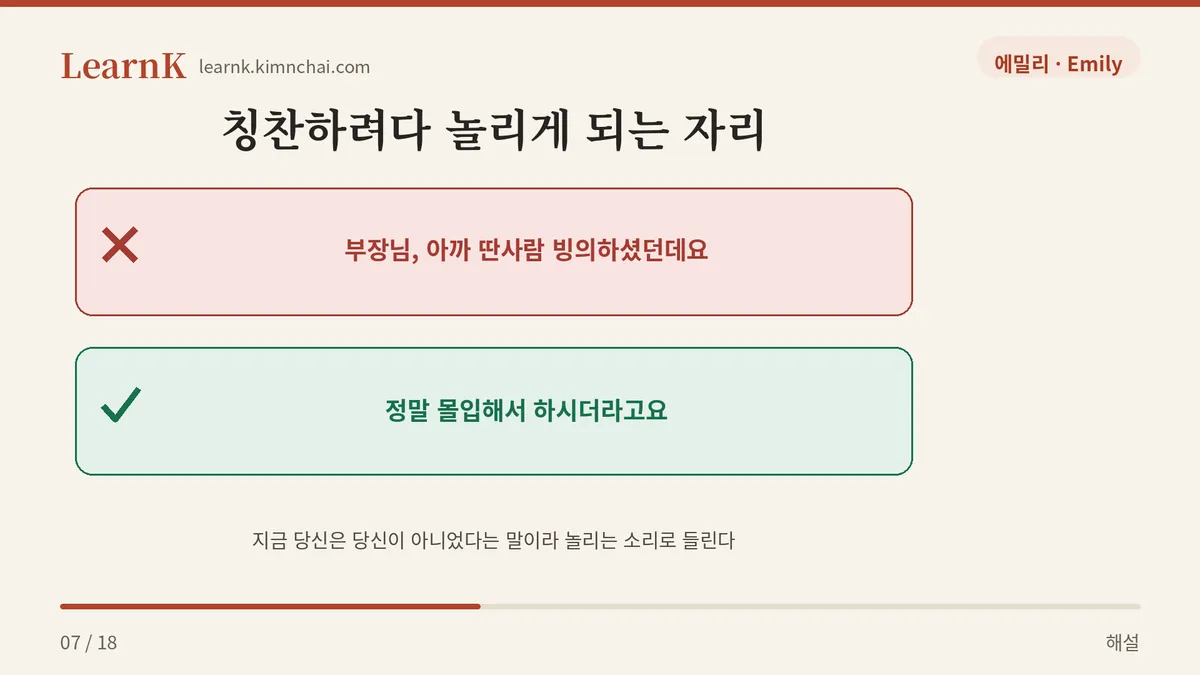
✗ (Said directly to your manager) 부장님, 아까 회의 때 완전 딴사람 빙의하셨던데요. (bujangnim, akka hoeui ttae wanjeon ttansaram binguihasyeotdendeyo.) — “Sir, in that meeting earlier you were totally possessed by a different person.” ✓ (Said to a coworker) 야, 부장님 아까 딴사람 빙의한 줄 알았어. (ya, bujangnim akka ttansaram binguihan jul arasseo.) — “Dude, I thought the manager was possessed by someone else back there.” → 빙의 essentially says “right now, you are not you,” so using it to someone’s face when they’re older or senior to you comes across as teasing. If you want to express admiration to someone above you, “정말 몰입해서 하시더라고요” (jeongmal moriphaeseo hasideoragoyo), “you were really immersed in it,” is the safe choice.
✗ (To a friend struggling with their mental health) 너 그거 완전 빙의 아니야? (neo geugeo wanjeon bingui aniya?) — “Isn’t that straight-up possession?” ✓ (To a friend) 많이 힘들었겠다. 병원은 다녀왔어? (mani himdeureotgetda. byeongwoneun danyeowasseo?) — “That must have been so hard. Have you seen a doctor?” → The moment you turn a genuinely suffering person’s condition into a supernatural joke, this word stops being funny and becomes cruel. The light usage of 빙의 is permitted only for a perfectly healthy person who got a little too into something for a moment.
Example Sentences by Situation
1. When your parent’s voice comes out of your own mouth
You’re cleaning up your younger sibling’s room and, without meaning to, the lecture goes on and on. When you finish, you startle yourself.
나 방금 우리 엄마 빙의했나 봐. (na bangeum uri eomma binguihanna bwa.) I think my mom just possessed me for a second there.
This is the single most common use of 빙의 in Korea. The words came out of you, but they don’t feel like yours — and that strangeness gets handled with this one word. It’s a device for turning embarrassment into a laugh.
2. When you pull off something explosive that isn’t like you at all
Two days before the exam, your focus suddenly ignites in the early hours and you tear through the material.
어제 새벽에 공부의 신 빙의해서 세 단원 다 끝냈어. (eoje saebyeoge gongbuui sin binguihaeseo se daneon da kkeunnaesseo.) Last night in the small hours I got possessed by the god of studying and finished all three chapters.
You can also put an image rather than a real person in front of it, like 공부의 신 (“the god of studying”). It’s a very Korean way of speaking: bragging about yourself while folding in a bit of modesty — “that wasn’t really my ability, something just moved in for a bit.”
3. When you’re praising an actor’s performance
You’ve finished the drama and you’re telling a friend what you thought.
그 배우 진짜 캐릭터에 빙의했더라. 눈빛이 아예 딴사람이야. (geu baeu jinjja kaerikteoe binguihaetdeora. nunbichi aye ttansaramiya.) That actor was seriously possessed by the character. Even the look in their eyes was a completely different person.
As praise for acting, this is close to the highest grade there is. It’s much stronger than “they’re a good actor,” because it means the line between the actor and the role has disappeared.
Politeness Levels and Similar Expressions
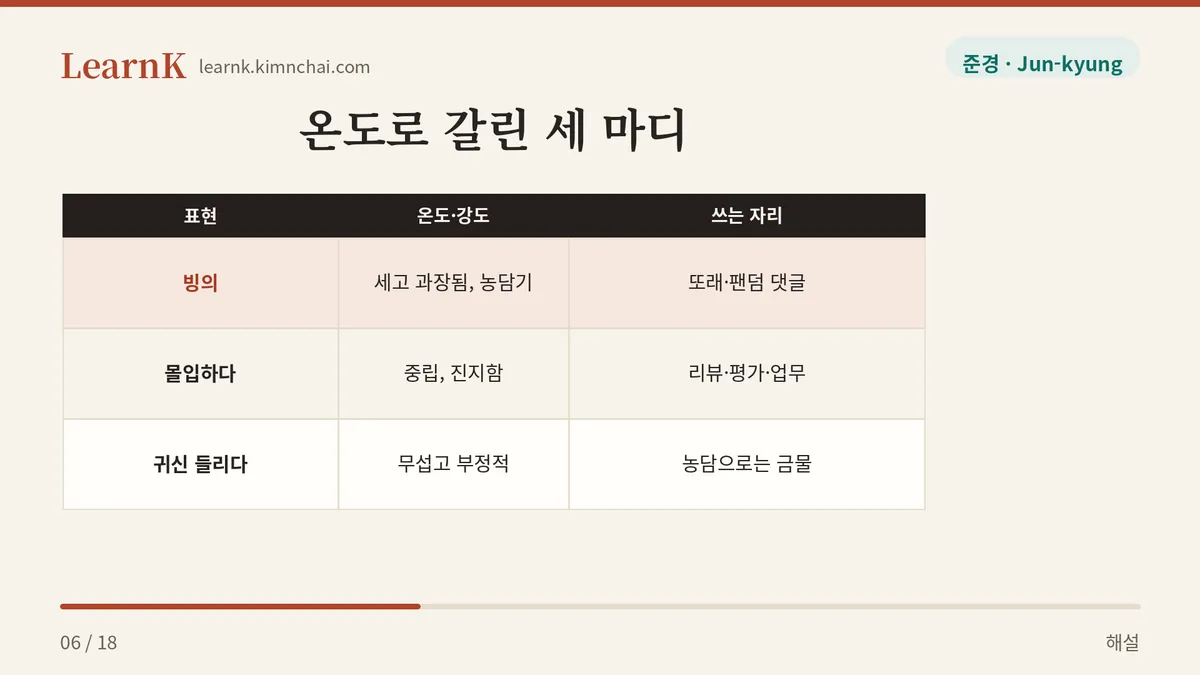
빙의 is fundamentally casual speech, something exchanged between peers. You can make a polite form of it (“빙의하셨네요” (binguihasyeonneyo)), but as we saw above, using it with the person right in front of you easily turns into teasing — so in practice it’s only used about a third party. The safe polite version is “정말 몰입하셨더라고요” (jeongmal moriphasyeotdeoragoyo), “you were really immersed in it.”
| Expression | Temperature / intensity | Where it belongs |
|---|---|---|
| 빙의 (bingui) | Strong and exaggerated, joking | Peers, social media, fandom comments. Not in front of someone senior |
| 몰입하다 (moriphada) | Neutral, serious | Anywhere. Fits reviews, evaluations, and work settings |
| 귀신 들리다 (gwisin deullida) | Frightening and negative | Genuinely abnormal behavior. Joking about a person with it crosses a line |
| ○○인 줄 알았다 (○○in jul aratda) | Light and gentle | The safest compliment. Fine even with someone senior |
The thing to notice in the table is the distance between 빙의 and 귀신 들리다. Their meanings are nearly identical, yet their usage has split completely. 빙의 is a Sino-Korean word, so it feels somewhat literary and keeps you at arm’s length — which is exactly what let it roll into joke territory. 귀신 들리다 is native Korean, and the picture it paints is too vivid to ever become a joke. Two words pointing at the same phenomenon ended up in opposite places, purely because of the texture of the vocabulary.
Cultural Background — From a Shaman’s Word to a Web-Novel Cliché
빙의 was originally the language of shamanism. In Korean shamanic tradition, a mudang is said to become a mudang after experiencing a god descending into their body, and 빙의 was one of the words used to explain that worldview. That’s why the air still turns heavy whenever this word shows up in a historical drama or an occult film.
What dragged the word down into everyday public speech was dramas and web novels. Stories in which two characters’ souls get swapped have been steadily loved in Korean dramas, and when body-swap premises like Secret Garden (SBS, 2010) became huge hits, viewers started calling this kind of story a 빙의물 (binguimul). The suffix -물 (物) here means “works of that type.”
The decisive spread happened in web novels. Korean web-novel readers bundle three signature premises together under the name 회빙환 (hoebinghwan) — 회귀 (hoegwi, going back in time), 빙의 (bingui, entering another character’s body), and 환생 (hwansaeng, being reborn). Those three syllables are now standard vocabulary for describing the genre, and along the way 빙의 stopped being scary and became a storytelling device everybody knows.
A word that stops being scary becomes a joke. And so 빙의 walked out of the shaman’s shrine and into coin noraebangs and group chats. It’s a fairly rare example of how a single word can migrate from sacred ground to the playground. That’s also exactly why this word is so valuable for someone learning Korean: memorizing the meaning only gets you halfway. You have to know which side of that journey the word is being used on right now to use it properly.
Today’s Quiz
Which of the following uses 빙의 most naturally?
- 팀장님, 오늘 발표 때 완전 명강사 빙의하셨던데요. (timjangnim, oneul balpyo ttae wanjeon myeonggangsa binguihasyeotdendeyo.) — “Boss, during today’s presentation you were totally possessed by a star lecturer.”
- 어제 청소하다가 나도 모르게 우리 아빠 빙의했어. 잔소리가 10분 넘게 나오더라. (eoje cheongsohadaga nado moreuge uri appa binguihaesseo. jansoriga sip-bun neomge naodeora.) — “Yesterday while I was cleaning, I got possessed by my dad without realizing it. The nagging went on for over ten minutes.”
- 이 계약서 조항은 3항에 빙의되어 있습니다. (i gyeyakseo johangeun sam-hange binguidoeeo itseumnida.) — “This contract clause is possessed into Article 3.”
The answer is number 2. 빙의 is most natural when you’re describing, with a bit of self-surprise, a state that isn’t like your usual self — and casual speech among peers is its home turf. Number 1 gets the meaning across, but with a senior person standing right there you’re essentially saying “you weren’t yourself,” which lands as teasing — “정말 몰입해서 하시더라고요” is the safe alternative. Number 3 doesn’t work at all, because the word can’t be applied to documents or objects. The subject of 빙의 is always something a spirit could inhabit — that is, a person.
Definitions and example sentences are from the National Institute of Korean Language’s Basic Korean Dictionary (krdict.korean.go.kr); that portion of this post, including our translations, is licensed under CC BY-SA 2.0 KR.