데뷔 (debwi) — Why a "First Stage" Is Remembered Like a Birthday in Korea

데뷔 (debwi)
데뷔 (debwi) means appearing for the first time in a particular field of activity — the entertainment world, the literary world, and so on. If you started learning Korean because of K-pop, these two syllables were probably the very first word you ran into. It’s the date printed on the top line of your favorite group’s profile, the date fans mark every year with cake photos and hashtags: the 데뷔일 (debwiil), the debut day.
In Korea this word carries much more weight than “showed up for the first time.” After spending years as a trainee, the day a person’s name and face finally go out on air is the day their life splits into a before and an after. That’s why Korean fans don’t ask “How long have you been active?” — they ask 데뷔 언제 했어? (debwi eonje haesseo?), “When did you debut?” Debut is also the unit careers are counted in: 데뷔 3년 차 (debwi sam-nyeon cha), “third year since debut,” or 데뷔 20주년 (debwi isip-junyeon), “20th debut anniversary.”
The most important point about the nuance is that it happens only once per field. A second album isn’t a debut, and a second drama isn’t a debut either. But if the field changes, you can debut again. When a singer acts for the first time, it’s “배우로 데뷔했다 (baeuro debwihaetda)” — debuted as an actor. When an actor steps behind the camera for the first time, it’s “감독으로 데뷔했다 (gamdogeuro debwihaetda)” — debuted as a director. And the word isn’t reserved for showbiz. A novelist’s first published work is a debut, and the first match a footballer plays for the national team is a 데뷔전 (debwijeon), a debut match. Wherever there’s a stage and a first moment of stepping onto it, 데뷔 applies.
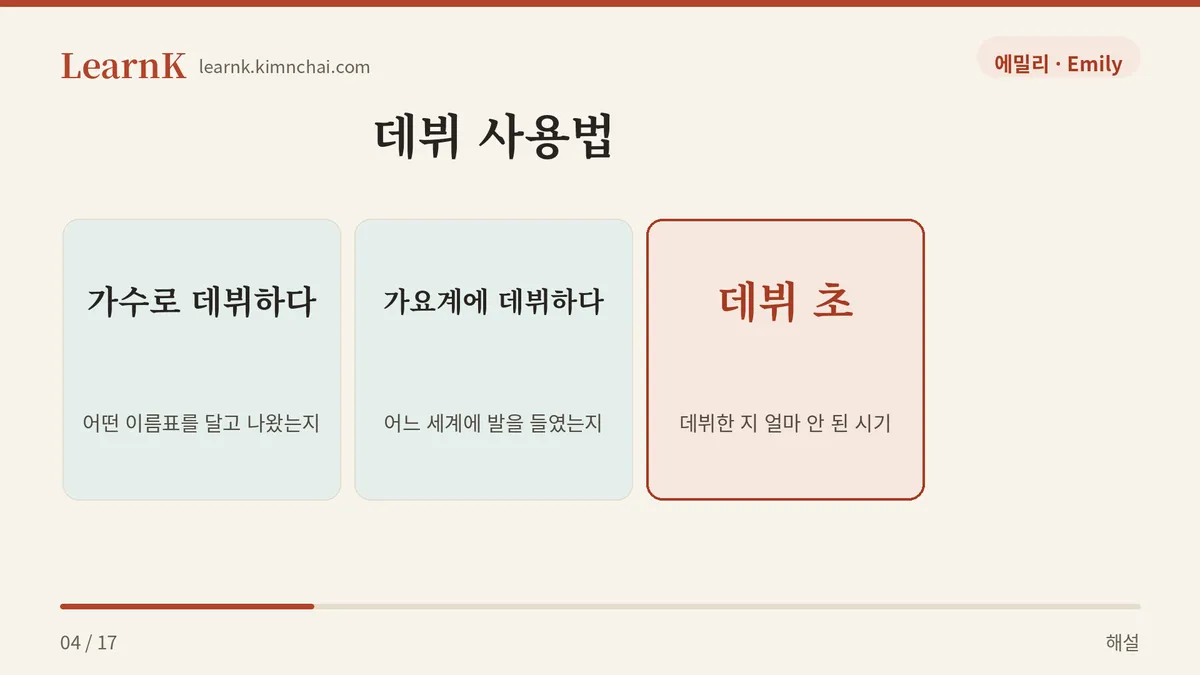
Using it is simple. The verb is 데뷔하다 (debwihada); spelled out with the noun and a light verb, it becomes 데뷔를 하다 (debwireul hada). Attach a noun after it and you get 데뷔 무대 (debwi mudae, debut stage), 데뷔 앨범 (debwi aelbeom, debut album), or 데뷔 초 (debwi cho, the early period just after debuting). For particles, just remember the two patterns: “가수로 데뷔하다 (gasuro debwihada)” and “가요계에 데뷔하다 (gayogyee debwihada).” The first tells you what label you came out wearing; the second tells you which world you set foot in.
Checking the National Institute of Korean Language dictionary

데뷔 (debwi) 「명사」 noun 문단이나 연예계 등 일정한 활동 분야에 처음으로 등장함. [en] début — An act of making the first appearance in a certain field of activity, as on the scene of literature, entertainment, etc. [ja] デビュー — 文壇や芸能界など、一定の活動分野で初めて登場すること。 [es] estreno, debut, primer acto, presentación — Acción de presentarse por primera vez en cierto sector de actividad como el círculo literario o el mundo del espectáculo. [zh] 出道,首次登坛 — 在文坛或演艺圈等活动领域,第一次登场。 — National Institute of Korean Language, Basic Korean Dictionary (krdict.korean.go.kr)
A Portuguese definition isn’t included in this dictionary. For reference, our own rendering would be something like estreia — o ato de aparecer pela primeira vez em certa área de atividade, como a literatura ou o meio artístico. Note that this is our own translation, not a dictionary quotation.
The words to notice in the definition are “처음으로 (cheoeumeuro)” — “for the first time.” Because the dictionary went out of its way to include them, the rule that the second time is never a debut is already built into the definition itself. Below are the actual usage examples the dictionary lists.
가수로 데뷔하다. (gasuro debwihada.) To debut as a singer. — National Institute of Korean Language, Basic Korean Dictionary (krdict.korean.go.kr)
This is the most basic form. The particle “-로 (-ro)” tells you which job title you wore when you came out into the world. 배우로 (baeuro, as an actor), 작가로 (jakgaro, as a writer), 감독으로 (gamdogeuro, as a director) — swap that one slot and the sentences go on forever.
지수는 여러 차례 가요제에서 수상을 하며 가수로 데뷔했다. (Jisuneun yeoreo charye gayojeeseo susangeul hamyeo gasuro debwihaetda.) Jisu won prizes at several song festivals and debuted as a singer. — National Institute of Korean Language, Basic Korean Dictionary (krdict.korean.go.kr)
This sentence shows that a debut doesn’t happen overnight. First comes the process of winning at competitions, and the debut sits at the end of it. The reason the word sounds so heavy in Korea is right there in the structure of this sentence.
몰라? 원래 가수였는데 배우로 데뷔했잖아. (Molla? Wollae gasuyeonneunde baeuro debwihaetjanha.) You didn’t know? They were originally a singer, but they debuted as an actor. — National Institute of Korean Language, Basic Korean Dictionary (krdict.korean.go.kr)
A textbook example of the “change the field and you can debut again” rule mentioned above. This person was already working as a singer, but acting is new for them, so as an actor it really is a debut. It’s casual speech between friends, so you can lift it straight into a real conversation.
그 노련한 배우도 데뷔 초기에는 대사가 한두 줄밖에 안 되는 단역을 하면서 긴장이 되고 떨렸다고 한다. (Geu noryeonhan baeudo debwi chogieneun daesaga handu julbakke an doeneun danyeogeul hamyeonseo ginjangi doego tteollyeotdago handa.) They say even that seasoned actor was nervous and shaky in the early days after debuting, playing bit parts with only a line or two of dialogue. — National Institute of Korean Language, Basic Korean Dictionary (krdict.korean.go.kr)
Here we get 데뷔 초 (debwi cho) or 데뷔 초기 (debwi chogi). It refers to the clumsy, unpolished stretch right after debuting, and it’s often attached to stories about the past of someone who is a big deal now.
그녀는 가요계에 데뷔를 한 지 한 달 만에 자신의 곡을 히트시켰다. (Geunyeoneun gayogyee debwireul han ji han dal mane jasinui gogeul hiteusikyeotda.) Just one month after debuting in the pop music industry, she made a hit out of her own song. — National Institute of Korean Language, Basic Korean Dictionary (krdict.korean.go.kr)
This one uses “가요계에 데뷔를 하다 (gayogyee debwireul hada)” — the destination is the industry as a whole rather than a job title. You can also see, in 데뷔한 지 한 달 (debwihan ji han dal), how the debut becomes the reference point from which time is measured.
A real conversation
Scene: Friday night, Emily’s living room. A live music show is about to start. A trainee Emily has been following for three years is taking the stage for the very first time tonight.
Jun-kyung: 야, 시작한다! 소리 좀 키워 봐. Hey, it’s starting! Turn it up.
Emily: 어떡해, 나 손 떨려. 이 데뷔 무대 3년 기다렸어. Oh no, my hands are shaking. I waited three years for this debut stage.
Jun-kyung: 3년? 그동안 연습만 시킨 거야? 회사 너무했다 진짜. Three years? They just made them train that whole time? The agency’s too much, seriously.
Emily: 그러니까. 같이 연습하던 애들 절반은 데뷔도 못 하고 나갔대. Right? Half the trainees who practiced with them left without ever debuting.
Jun-kyung: 아, 인사한다 인사해. 목소리 갈라진 거 들었어? Oh, they’re greeting the audience. Did you hear their voice crack?
Emily: 들었지. 근데 괜찮아, 원래 데뷔 초엔 다 떨려. 오늘이 데뷔일이니까 내년부터 케이크 사야겠다. I did. But it’s fine, everyone’s shaky at the start of their debut. Today’s their debut day, so from next year I’m buying a cake.
This sounds awkward
✗ (A new hire on their first day, to the department head) 부장님, 오늘이 제 회사 데뷔입니다! (Bujangnim, oneuri je hoesa debwiimnida!) — “Sir, today is my company debut!” ✓ (To the department head) 부장님, 오늘 첫 출근입니다. 잘 부탁드립니다. (Bujangnim, oneul cheot chulgeunimnida. Jal butakdeurimnida.) — “Sir, today is my first day. I look forward to working with you.” → 데뷔 belongs to fields that have a stage. Used for your first day at an office, it turns into a joke comparing yourself to a celebrity — fine for a laugh among peers, but it sounds flippant in a formal greeting to someone senior.
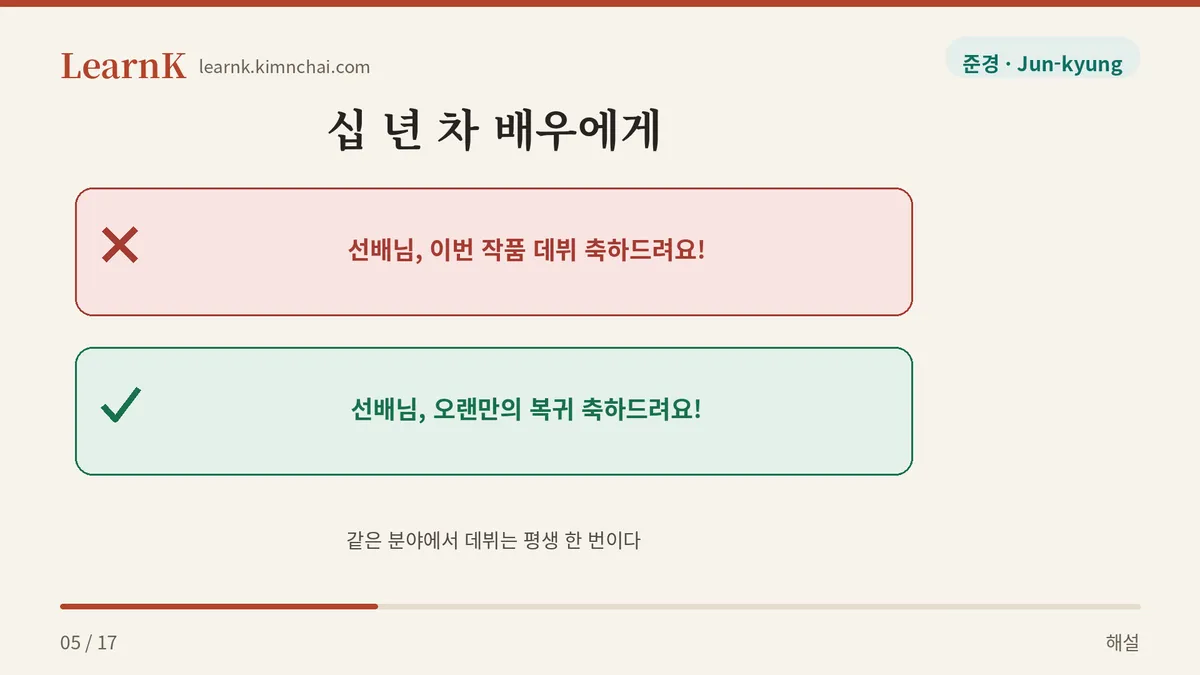
✗ (On hearing about a 10-year veteran actor’s new drama) 선배님, 이번 작품 데뷔 축하드려요! (Seonbaenim, ibeon jakpum debwi chukhadeuryeoyo!) — “Congratulations on your debut with this project!” ✓ 선배님, 오랜만의 복귀 축하드려요! (Seonbaenim, oraenmanui bokgwi chukhadeuryeoyo!) — “Congratulations on your long-awaited return!” → Within the same field, you debut once in a lifetime. Telling someone with ten years behind them that it’s their debut erases their whole career. For a new project, use 복귀 (bokgwi, return), 컴백 (keombaek, comeback), or 첫 방송 (cheot bangsong, first broadcast). Of course, if that actor is directing for the first time, then “감독 데뷔 축하드려요 (gamdok debwi chukhadeuryeoyo)” is exactly right.
Example sentences by situation
1. Talking to a fan you’ve just met in line at a fan signing In Korean fandom, where people measure who has loved the group longest, this word is the strongest card you can play.
저는 데뷔 때부터 팬이었어요. jeoneun debwi ttaebuteo paenieosseoyo. I’ve been a fan since their debut.
2. The day after an audition survival show’s finale, feeling let down On Korean audition programs, the final prize is often not money but the debut itself. So elimination gets phrased like this.
걔 결국 데뷔 못 했어. 진짜 아깝다. gyae gyeolguk debwi mot haesseo. jinjja akkapda. They didn’t get to debut in the end. Such a shame.
3. Telling a Korean friend about your first video This is the extended, half-joking usage outside the entertainment world. It sits naturally on anything with that “stepping onto a stage” feeling — a first broadcast, a first exhibition, a first competition. Just remember that this light usage is something you trade with peers.
저 다음 주에 유튜브 데뷔해요. jeo daeum jue yutyubeu debwihaeyo. I’m making my YouTube debut next week.
Politeness levels and similar expressions
데뷔 is a loanword, so it carries no politeness level on its own. The honorifics are handled by the “-하다 (-hada)” attached to it. To a friend, 데뷔했어? (debwihaesseo?); politely, 데뷔했어요 (debwihaesseoyo); and if the other person is older than you or a senior artist you respect, 데뷔하셨어요 (debwihasyeosseoyo). When a fan greets a long-established idol, slipping in the honorific -시- (-si-) — as in “데뷔하신 지 벌써 10년이네요 (debwihasin ji beolsseo sim-nyeonineyo),” “It’s already been ten years since you debuted” — sounds far more natural.
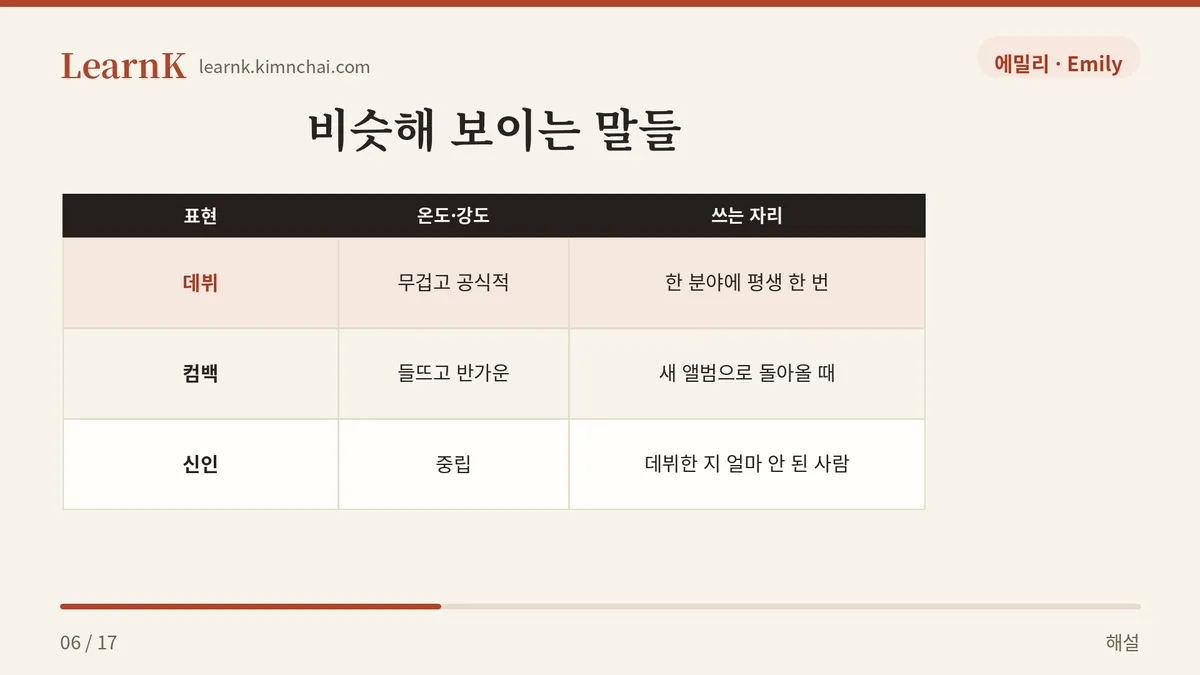
Let’s line up some words that look similar but sit in different places.
| Expression | Temperature / intensity | Where it’s used |
|---|---|---|
| 데뷔 (debwi) | A life’s first appearance. Weighty and official | Fields with a stage — entertainment, literature, sports. Once in a lifetime per field |
| 컴백 (keombaek) | Excited, glad to see you again | When an already-debuted singer returns with a new album. Everyday fandom vocabulary |
| 첫 무대 (cheot mudae) | Plain statement of fact | Used for a debut stage, but also for the first performance of a new song |
| 신인 (sinin) | Neutral, positioned slightly below | What you call someone who debuted recently. 신인상 (rookie award), 신인 배우 (rookie actor) |
| 입봉 (ipbong) | Industry insider slang | When a broadcast or film crew member takes on their first work as a director or PD. Fans rarely use it |
Cultural background — the date that became a second birthday
데뷔 is a loanword from the French début. The original meaning is simply “beginning, first appearance.” Once it entered Korean it first took root in the literary world — a novelist’s first published work is still called a 데뷔작 (debwijak) — and from there it spread widely into entertainment and sports.
But passing through the K-pop industry, this word came to carry something far heavier than its source language ever did. Korean idols usually join a company and spend years as trainees. They learn to sing and dance, take regular evaluations, and cycle in and out of the 데뷔조 (debwijo), the debut lineup. During this period they have neither a name nor a face in the world. Then, once the debut is confirmed, the team name is decided, a debut showcase is held, and a debut album comes out. Up until the day before, they were a trainee; from the day after, they’re a singer. Few professions have a boundary that sharp.
That’s why a debut day is treated like a second birthday in fandom. At 데뷔 100일 (100 days since debut), 데뷔 1주년 (first anniversary), 데뷔 10주년 (tenth anniversary), hashtags circulate and ads go up in subway stations. The artists themselves post reflections while counting how many days it’s been since they debuted.
This is also why audition survival shows become such enormous talking points in Korea. In the final episode, the host calls out the names of the final members one by one — and every time, the same scene repeats: a trainee whose name isn’t called walks off the stage leaving years of their life behind. That scene looks so cruel precisely because what’s on the line isn’t prize money but those two syllables, 데뷔. It’s the same reason the line “나 데뷔할 수 있을까? (na debwihal su isseulkka?)” — “Do you think I can debut?” — almost never fails to appear when dramas and variety shows deal with a trainee’s life.
Today’s quiz
Which of the following sentences uses 데뷔 naturally?
① 그 가수 어제 새 앨범 나왔대. 벌써 세 번째 데뷔야. (Geu gasu eoje sae aelbeom nawatdae. Beolsseo se beonjjae debwiya.) — “I heard that singer’s new album came out yesterday. It’s already their third debut.” ② 원래 가수였는데 이번에 배우로 데뷔했대. (Wollae gasuyeonneunde ibeone baeuro debwihaetdae.) — “They were originally a singer, but I heard they debuted as an actor this time.” ③ (On their first day at work, to the department head) 부장님, 오늘 이 회사에 데뷔했습니다. (Bujangnim, oneul i hoesae debwihaetseumnida.) — “Sir, I debuted at this company today.”
Answer: ②
① is a second round of activity in the same field, so it’s a 컴백 (comeback), not a debut. ③ takes place in an office, where there’s no stage, so it should be 첫 출근 (cheot chulgeun, first day at work) — and it sounds especially flippant in front of a superior. ② is someone who was a singer stepping into the new field of acting for the first time, which fits the rule exactly: change the field, and you can debut again.
Definitions and example sentences are from the National Institute of Korean Language’s Basic Korean Dictionary (krdict.korean.go.kr); that portion of this post, including our translations, is licensed under CC BY-SA 2.0 KR.