The Word Koreans Say Countless Times a Day: Mastering '그냥'
When you watch Korean dramas, you’ll notice this scene all the time: someone asks the main character why, and they just shrug and answer 그냥 (geunyang). “왜 안 먹어? (Why aren’t you eating?)” “그냥 (No reason).” “왜 울어? (Why are you crying?)” “그냥… (It’s nothing…).” Packed into this one short word are all kinds of unspoken feelings — ‘no particular reason,’ ‘I don’t feel like explaining,’ ‘I’m just kind of in that mood.’ Today, let’s take a deep dive into 그냥, the magical adverb that foreign learners struggle with the most — but that suddenly makes your Korean sound natural once you get it.
그냥
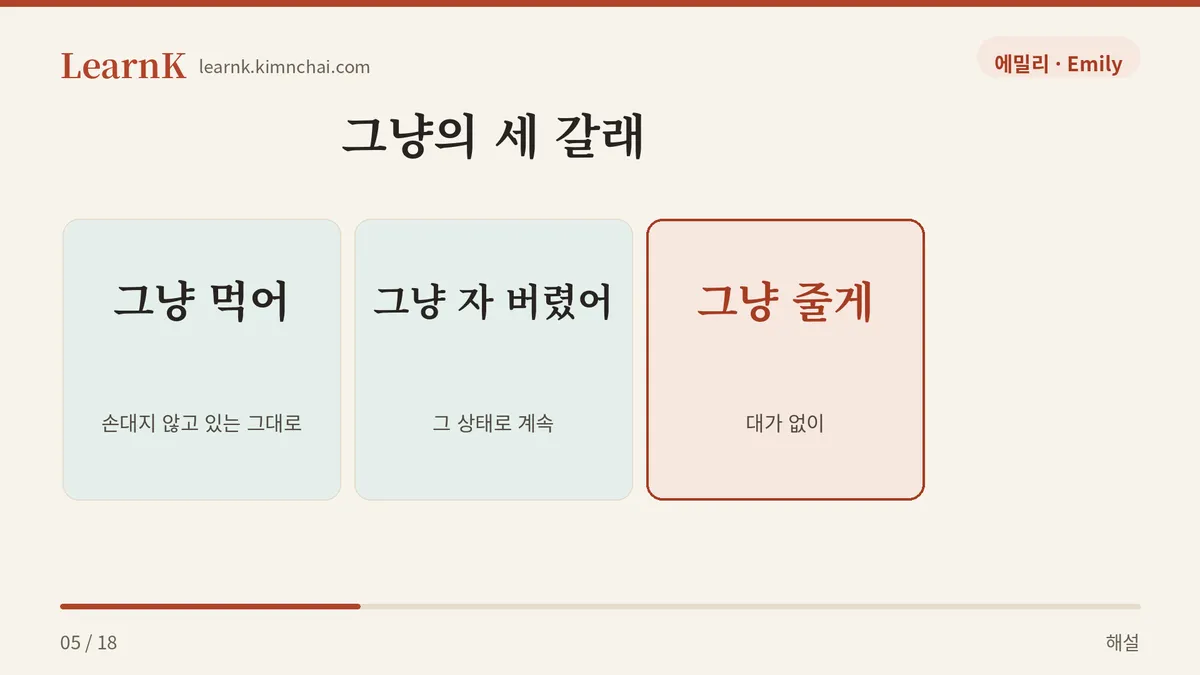
그냥 (geunyang) is an adverb. It’s used in four broad ways, and what they all share is a sense of ‘the state something is in, as it is, without adding to it or changing it.’
First, the meaning as it is. Like “썰지 말고 그냥 먹어 (Don’t slice it, just eat it as it is)” — leaving something in its original state without touching it. Second, staying in that state / carrying on that way. Like “그냥 자 버렸어 (I just fell asleep),” a feeling of some flow simply continuing. Third, without any payment or condition (for free). “그냥 줄게 (I’ll just give it to you)” means you won’t take any money for it. Fourth — the most distinctly Korean one — without any particular meaning (just / no reason). This is exactly the “그냥.” from the dramas.
Since the same word shifts in nuance so much depending on the situation, it’s better to learn it together with real situations than to memorize it as one fixed rule.
Checking with the National Institute of Korean Language Dictionary
The National Institute of Korean Language’s Basic Korean Dictionary treats ‘그냥’ as an adverb and lists four meanings.
- 아무것도 하지 않고 있는 그대로. (as it is; そのまま; tal como está; 就那样)
- 그런 모양으로 그대로 계속하여. (all the time; そのまま; continuamente; 照样)
- 아무런 대가나 조건 없이. (without any conditions; ただで; gratis; 白白地)
- 아무런 생각이나 별다른 의미 없이. (just; ただなんとなく; sin razón; 随便) — National Institute of Korean Language, Basic Korean Dictionary (krdict.korean.go.kr)
Looking at the actual example sentences printed in the dictionary makes the nuance easy to grasp.
썰지 마세요. 그냥 가래째로 먹을래요. — National Institute of Korean Language, Basic Korean Dictionary (krdict.korean.go.kr)
(“Don’t slice it. I’ll just eat the whole rice-cake stick as it is.”) This is a classic example of the first meaning (as it is) — eating it in its original state without touching it.
우리는 정해 놓은 목적지도 없이 그냥 발길이 가는 대로 걸었다. — National Institute of Korean Language, Basic Korean Dictionary (krdict.korean.go.kr)
(“With no set destination, we just walked wherever our feet took us.”) This is closer to the fourth meaning (just / no particular reason) — walking with no special plan or purpose.
나는 동생이 화가 난 것 같아서 그냥 가만두었다. — National Institute of Korean Language, Basic Korean Dictionary (krdict.korean.go.kr)
(“My younger sibling seemed angry, so I just left them alone.”) A situation of not stirring things up and leaving them as they were.
마취를 하니까 의식이 가물거리면서 그냥 잠이 든 것 같았어. — National Institute of Korean Language, Basic Korean Dictionary (krdict.korean.go.kr)
(“Once the anesthesia kicked in, my consciousness faded and I think I just drifted off to sleep.”) This has the feel of the second meaning (staying in that state) — a flow simply continuing until you fall asleep. (By the way, the dictionary has no Portuguese translation; if we were to render it ourselves, something like ‘só, simplesmente’ would work.)
Example Sentences by Situation
① When you’re brushing off the reason When a friend asks, “오늘 왜 이렇게 조용해? (Why are you so quiet today?)” and you don’t really want to explain:
그냥. 좀 피곤해서 (geunyang. jom pigonhaeseo). (No reason. Just a little tired.) The nuance is roughly ‘there’s no special reason, but if I had to say something.’
② When you tell someone not to bother When your mom is about to do the dishes and you stop her:
놔두세요, 제가 그냥 할게요 (nwaduseyo, jega geunyang halgeyo). (Leave it, I’ll just do it.) It means ‘don’t go to the trouble — I’ll just take care of it as things are.’
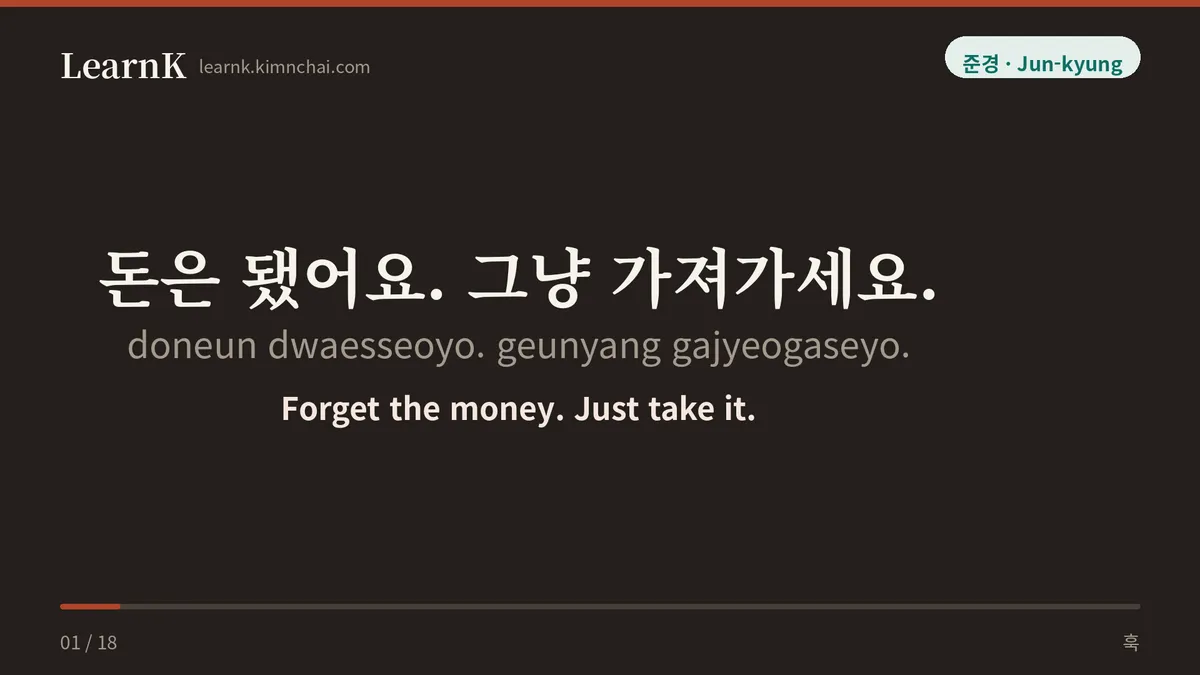
③ When you say you’ll give it for free Handing over a secondhand item:
돈은 됐어요. 그냥 가져가세요 (doneun dwaesseoyo. geunyang gajyeogaseyo). (Forget the money. Just take it.) This is a sentence where the third meaning — giving without payment — comes alive.
Comparing Polite/Casual Speech and Similar Expressions
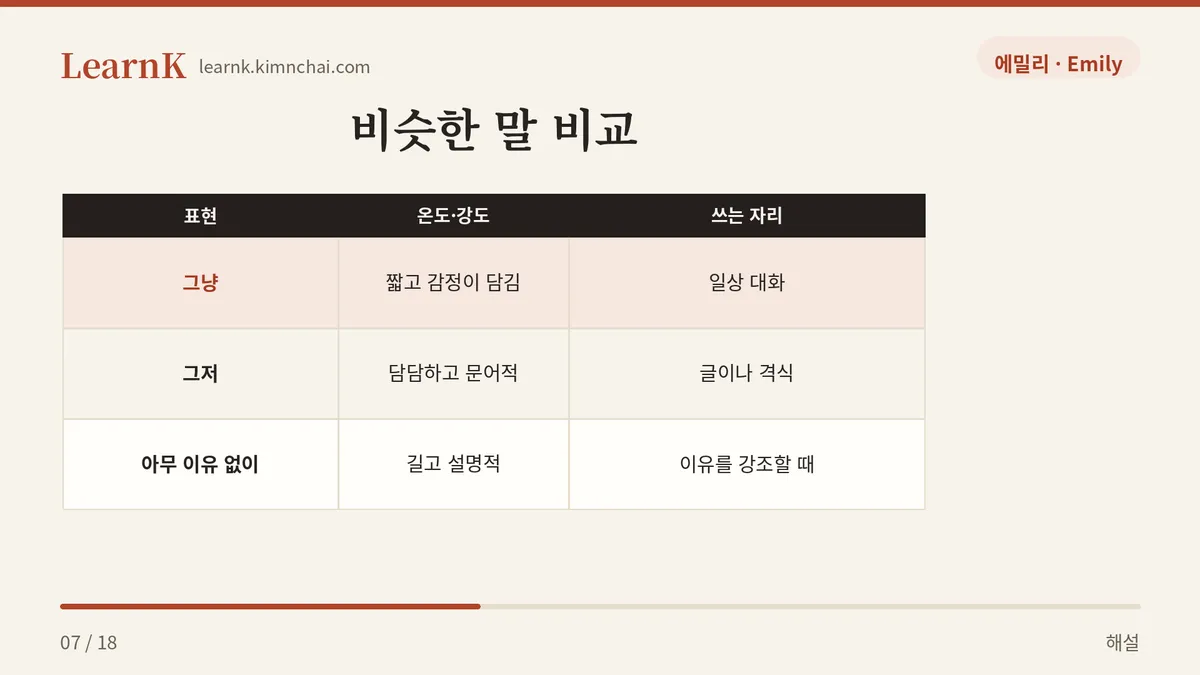
‘그냥’ itself has no separate casual or polite form. The level of politeness is decided by the verb that follows it. Casual: “그냥 갈래 (geunyang gallae)” (I’ll just go), polite: “그냥 갈게요 (geunyang galgeyo)” (I’ll just go).
A similar word is 그저 (geujeo), but ‘그저’ feels more literary and understated, so in everyday conversation ‘그냥’ sounds far more natural. There’s also 아무 이유 없이 (amu iyu eopsi) (for no reason at all), which means the same thing but is long and explanatory — a different temperature from the short, emotion-carrying ‘그냥.‘
Cultural Background
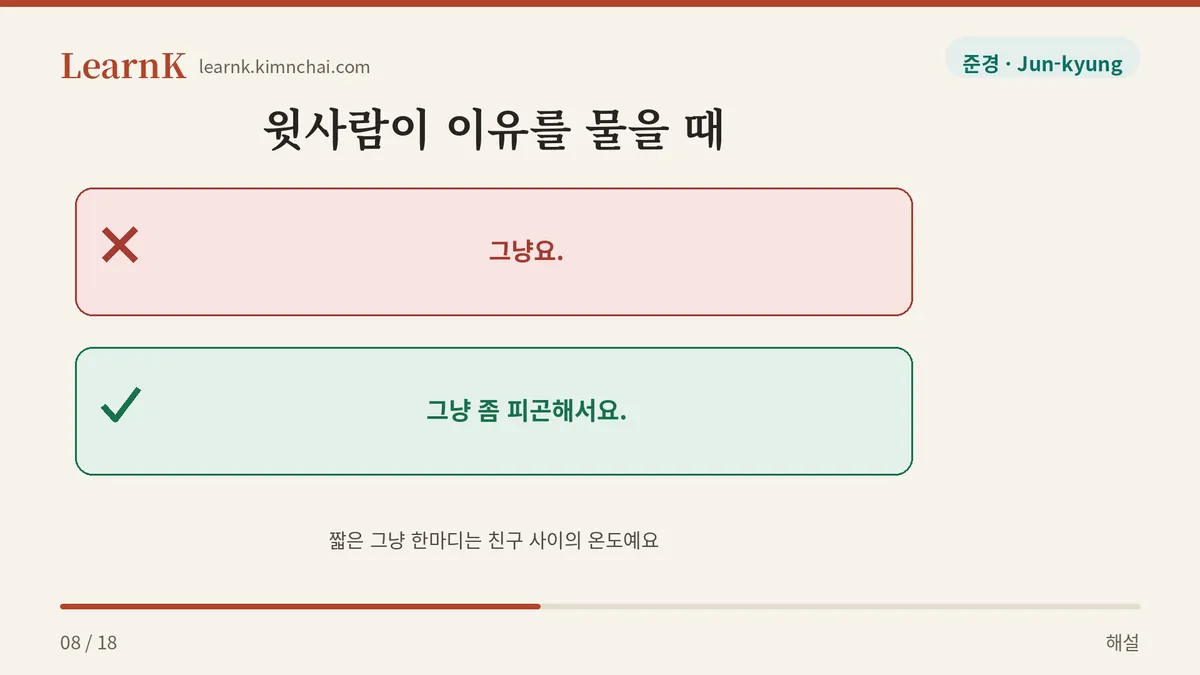
In Korean dramas, the scene where a character hides their true feelings — or is actually conflicted inside but doesn’t want to show it — and answers with a short “그냥” is almost a cliché. Picture a situation like the one below, where someone bats away a question about why with a single word.
“왜 웃어?” “그냥.” — A paraphrase of a common conversational situation in the drama Our Blues (tvN, 2022)
Here, ‘그냥’ often doesn’t mean there’s really no reason, but rather carries ‘a heart too complicated to put fully into words.’ That’s why, among Koreans, people can often guess how someone feels just from the tone of this one word.
Today’s Quiz
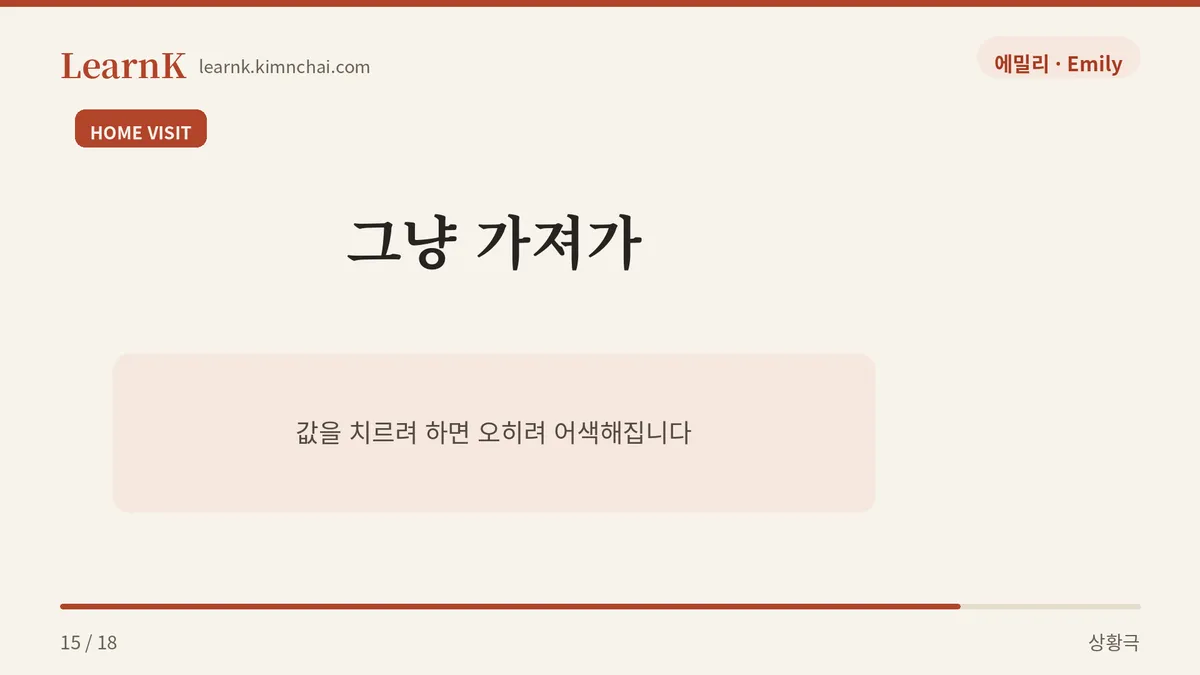
Which is the best thing to say when a friend hands you an expensive concert ticket for free?
- 그냥 가만두다
- 그냥 가져가 (geunyang gajyeoga)
- 그냥 걸었다
If you picked the right answer, you can now tell apart the four shades of ‘그냥’!
Definitions and example sentences are from the National Institute of Korean Language’s Basic Korean Dictionary (krdict.korean.go.kr); that portion of this post, including our translations, is licensed under CC BY-SA 2.0 KR.