화이팅 (hwaiting)! The National Cheer Koreans Shout Every Single Day
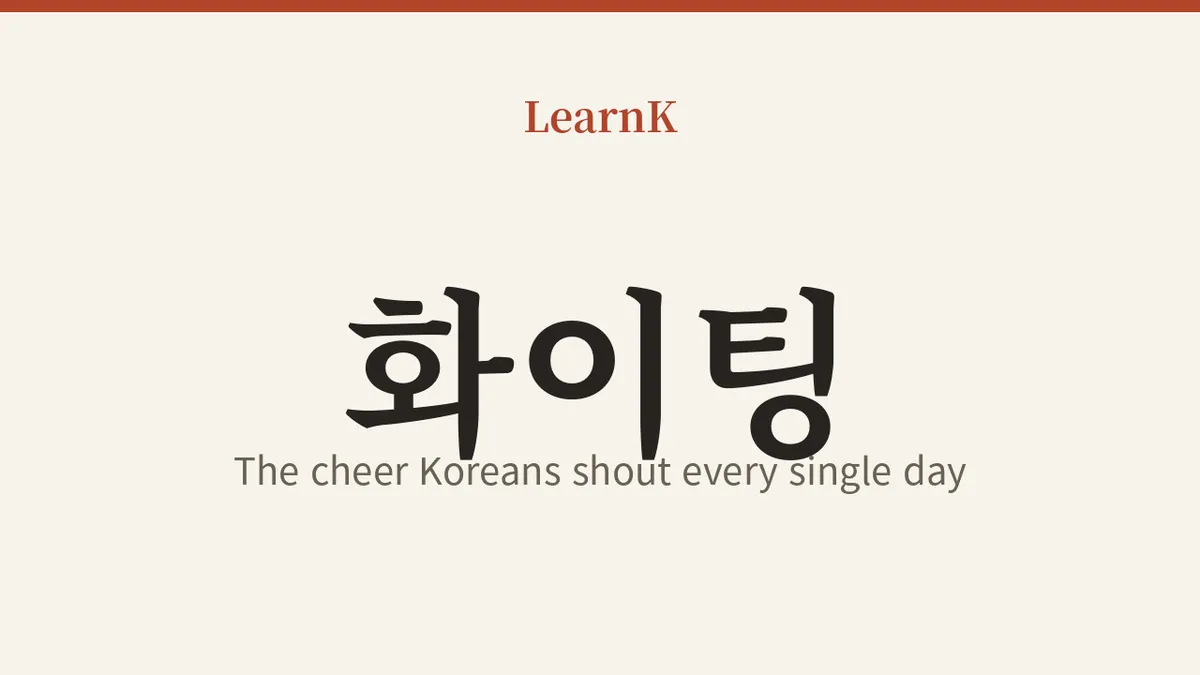
Walking behind a friend as they head into a job interview. Standing next to a teammate at the marathon starting line. Messaging a roommate still hunched over their desk the night before an exam — in all of these moments, Koreans offer one short but fiery phrase: 화이팅 (hwaiting). If you watch K-dramas, you’ve definitely seen a character clench a fist and shout it at least once. Today, let’s take a deep dive into 화이팅 (hwaiting), the national cheer that every fan of Korean culture needs to know.
화이팅
Meaning and Nuance
화이팅 (hwaiting) comes from the English word “fighting,” but the way it’s actually used is completely different. In English, “fighting” means someone is in the middle of a fight. In Korean, 화이팅 (hwaiting) is a shout of encouragement and support — “Hang in there!”, “Go get ‘em!”, “I’m rooting for you!” It isn’t telling anyone to actually fight. It’s a warm little word that pours courage and energy into someone facing something hard.
Two pronunciations are both in use: 화이팅 (hwaiting) and 파이팅 (paiting). By the official spelling rules, 파이팅 (paiting) is closer to standard, but in everyday conversation and on TV you’ll hear 화이팅 (hwaiting) far more often. Use either one — every Korean will understand you.
The core nuance is bright, positive energy. It fits best when you want to lift someone up with a “You can do this!” rather than when the moment calls for serious, heavy consolation.
Example Sentences by Situation
Situation 1 — To a friend with an exam tomorrow
내일 시험이지? 화이팅! 넌 충분히 잘할 수 있어. (naeil siheomiji? hwaiting! neon chungbunhi jalhal su isseo.) Your exam is tomorrow, right? 화이팅! You’re more than ready to do great.
This is the classic scene — handing a friend who studied all night a shot of confidence. Adding 잘할 수 있어 (jalhal su isseo), “you can do it,” after 화이팅 (hwaiting) makes the encouragement feel even more sincere.
Situation 2 — Everyone together at a company dinner
우리 팀 이번 프로젝트, 다 같이 화이팅 해요! (uri tim ibeon peurojekteu, da gachi hwaiting haeyo!) Team, let’s all give this project everything we’ve got!
Here 화이팅 (hwaiting) is used like a verb. 화이팅 하다 (hwaiting hada) becomes a teamwork chant meaning “let’s pull together, let’s do this.” It turns up constantly in group cheers, with everyone stacking their hands in the middle.
Situation 3 — Quietly, to a coworker who looks worn out
요즘 많이 힘들지? 그래도 화이팅이야. (yojeum manhi himdeulji? geuraedo hwaitingiya.) Things have been rough lately, haven’t they? Still — 화이팅.
It isn’t only for upbeat moments. Said in a low voice to someone who’s exhausted, it turns into a quiet “don’t give up, let’s hold on just a little longer.”
A Real Conversation
Scene: A neighborhood gym. One last set to go, and Emily is catching her breath in front of the barbell.
Jun-kyung: 자, 이번이 마지막 세트야. 세 개만 더 가자, 화이팅! Okay, this is the last set. Just three more — you got this!
Emily: 아 진짜 팔이 안 올라가… 나 오늘 여기까지만 하면 안 돼? Ugh, my arms seriously won’t go up… can’t I just stop here today?
Jun-kyung: 두 달을 꼬박 나왔는데 오늘 접으면 아깝잖아. 뒤에서 잡아 줄게. You’ve come in for two solid months — bailing today would be a waste. I’ll spot you.
Emily: 알았어. 대신 놓치면 진짜 죽는다. Fine. But if you drop it, you’re dead.
Jun-kyung: 걱정 마, 꽉 잡고 있어. 하나… 둘… 화이팅, 하나만 더! Don’t worry, I’ve got a firm hold. One… two… come on, just one more!
Emily: (바벨 내려놓으며) 끝! 아, 죽는 줄 알았네. 다음 주도 이렇게 화이팅 하자. (setting the barbell down) Done! Man, I thought I was gonna die. Let’s keep it up like this next week too.
Polite Speech, Casual Speech, and Similar Expressions
화이팅 (hwaiting) is an interjection, neither polite nor casual in itself, so you can say it exactly as is to a friend or to your boss. If you want to add some politeness, though, just attach something after it.
- Casual: 화이팅! (hwaiting!) — to friends and people younger than you
- Polite: 화이팅 하세요! (hwaiting haseyo!) — to elders, superiors, or someone you’ve just met
It’s worth picking up a few similar cheers alongside it.
- 힘내 (himnae) / 힘내세요 (himnaeseyo): means “find your strength,” and it’s gentler than 화이팅 (hwaiting) when you’re comforting someone who’s worn out.
- 아자아자 (aja aja): a cute, peppy cheer. It’s commonly tacked on, as in 아자아자 화이팅! (aja aja hwaiting!)
- 잘해 (jalhae): a direct “do well,” often used right alongside 화이팅 (hwaiting).
화이팅 in Dramas and in Daily Life
In Korean dramas, 화이팅 (hwaiting) is a device for raising the emotional temperature. The scene where the lead makes a big decision and turns for the door, and the person beside them lifts a fist and offers this word, has become a full-on cliché. It’s one short phrase, but it carries the trust of “I believe in you.”
Everyday life is no different. The cheering section at a sports match, the chant people shout while taking a company group photo, the emoji tacked onto the end of a KakaoTalk message — 화이팅 (hwaiting) is soaked deep into a Korean’s day. Which means that learning to use just this one word naturally will pull you a whole lot closer to your Korean friends.
Today’s Quiz
Your friend has a big presentation tomorrow and is a bundle of nerves. Which of the following is the most natural way to cheer them on?
- Say nothing, since 파이팅 (paiting) means “fight”
- Lift their spirits with “발표 잘할 거야, 화이팅!” (balpyo jalhal geoya, hwaiting!) — “You’re going to nail the presentation, 화이팅!”
- Tell them “화이팅 그만해” (hwaiting geumanhae) — “Enough with the 화이팅”
The answer is number 2. 화이팅 (hwaiting) is a word of encouragement that hands courage to someone facing something difficult — you’ve definitely got that down now, right? And 화이팅 to you in your Korean studies too!