제주도 (Jeju-do) — One Word for 'Korea's Southernmost Island,' and All the Excitement Packed Inside It

There’s one place name that keeps popping into Koreans’ minds — maybe while packing a suitcase, or while pulling up a search bar with a tired body on a Friday night. It’s 제주도 (Jeju-do). If you’re learning Korean and you ask a Korean friend, “Where are you going for your vacation this time?”, three or four out of ten will answer with this very word. Today, let’s take a deep look at the situations this one word comes up in — and the warmth it carries.
제주도
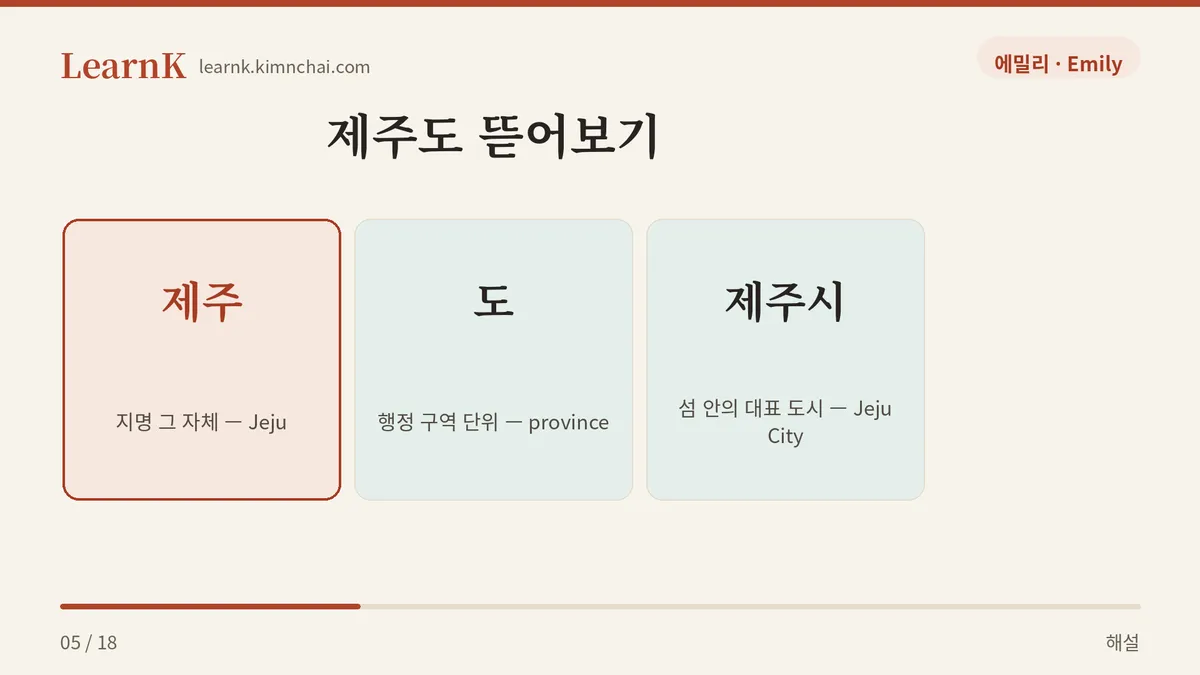
제주도 (Jeju-do) is an island at the southernmost tip of Korea, and also a ‘도 (do)’ — that is, an administrative region. With its black basalt stone walls unique to volcanic islands, its emerald-colored sea, and Hallasan Mountain rising tall in its center — for Koreans, Jeju is not just a place name but a symbol of ‘getting away’ and ‘rest.’ That’s why this word carries more than just geographic information. A single line like “제주도 갈래? (jejudo gallae?)” holds excitement, romance, and the anticipation of escaping everyday life all at once.
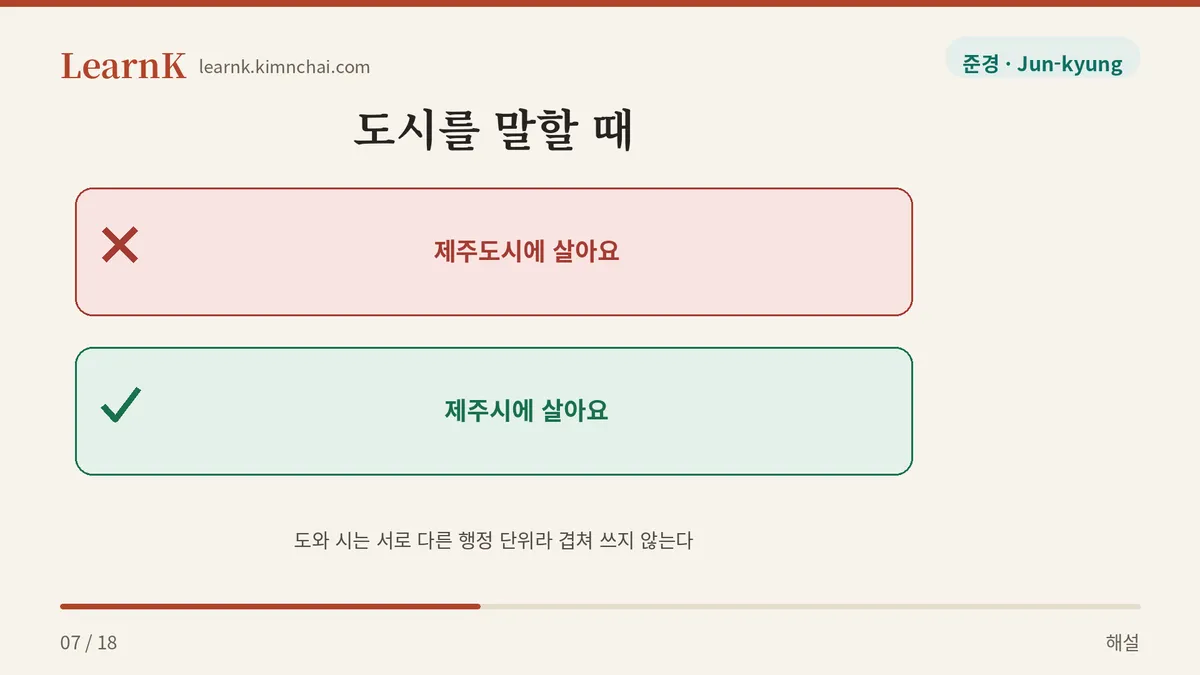
When pronouncing it, just read the three syllables clearly: ‘제주도 (Jeju-do).’ Keep in mind that you say 제주도 (Jeju-do) to refer to the island itself, and 제주시 (Jeju-si) to refer to its main city.
Checking with the National Institute of Korean Language Dictionary
Let’s start with an authoritative definition.
제주도 (noun): One of the administrative regional units of Korea, the ‘do.’ It is located at the southernmost point of Korea and is made up of several islands, including Jeju Island. — National Institute of Korean Language, Basic Korean Dictionary (krdict.korean.go.kr)
[en] Jeju-do Province — It is located in the southwestern part of Korea and consists of several islands, including Jeju Island. It is an international tourist destination with a beautiful natural environment… It was promoted to ‘Jesu Special Self-Governing Province’ in 2006. — National Institute of Korean Language, Basic Korean Dictionary (krdict.korean.go.kr)
The dictionary specifically highlights its beautiful nature, its well-developed tourism industry, and the fact that it’s ‘famous for 해녀 (haenyeo, female divers) and 말 (mal, horses).’ It also notes that it was promoted to ‘제주특별자치도 (Jeju Special Self-Governing Province)’ in 2006. Now, shall we look at some actual example sentences?
- 제주도로 갈까 해.
- 이번 여름에는 친척들이 다 같이 제주도로 여행을 갈 계획이다.
- 유민이는 제주도로 여행을 떠나기 전에 검색창을 띄우고 제주도 맛집을 검색했다.
- 지수야, 제주도행 항공편은 어떻게 됐어?
- 제주도의 한라산은 자연 경승이 수려하기로 유명하다. — National Institute of Korean Language, Basic Korean Dictionary (krdict.korean.go.kr)
The first sentence, “제주도로 갈까 해 (jejudo-ro galkka hae)” (I’m thinking of going to Jeju), shows a state where nothing’s confirmed yet but your heart is already leaning that way — the tone of someone just starting to bring up a travel plan. The third example is exactly what a Korean person’s trip prep looks like these days. You can picture it vividly: searching for ‘제주도 맛집 (jejudo matjip, great restaurants in Jeju)’ before even leaving. In the fourth, “제주도행 항공편 (jejudo-haeng hanggongpyeon),” you can see how attaching ‘-행 (-haeng)’ gives the meaning ‘bound for Jeju.’ The last sentence is an example of introducing Hallasan, Jeju’s icon, in a formal written style.
Seeing It in a Real Conversation
Scene: The domestic terminal of Gimpo Airport. Two people sit side by side in the chairs in front of the gate, waiting for the flight to Jeju.
Jun-kyung: 야, 우리 진짜 제주도 가는 거야? 나 아직도 실감이 안 나. Hey, are we really going to Jeju? It still doesn’t feel real.
Emily: 실감 안 나긴. 표까지 다 끊었잖아. 나 제주도 처음이라 완전 신났어. What do you mean it doesn’t feel real? We already booked the tickets. It’s my first time in Jeju, so I’m super excited.
Jun-kyung: 진짜? 한국 15년 살면서 한 번도 안 가봤다고? Seriously? You’ve lived in Korea 15 years and never once been?
Emily: 어, 신기하지. 근데 렌터카는 예약했어? 거기 해안 도로 드라이브가 그렇게 좋대. Yeah, funny right? But did you book a rental car? I heard the coastal road drive there is amazing.
Jun-kyung: 당연하지. 흑돼지 맛집도 벌써 다 찜해놨어. Of course. I’ve already got all the black-pork spots bookmarked.
Emily: 역시 준경이. 아, 방송 뜬다 — 탑승 시작인가 봐. 가자! That’s Jun-kyung for you. Oh, the announcement — looks like boarding’s starting. Let’s go!
Example Sentences by Situation
Let’s expand on how it’s used with some sentences we made ourselves.
Situation 1 — Asking about vacation plans: “올여름 휴가 제주도 어때? 비행기표 지금 예약하면 안 비싸.” (jejudo eottae?) — How about Jeju for this summer’s vacation? Plane tickets aren’t expensive if you book now. This is the most common way to suggest a travel destination to a friend.
Situation 2 — Sharing your impressions after a trip: “저 지난주에 제주도 다녀왔어요. 바다 색깔이 진짜 다르더라고요.” (jejudo danyeowasseoyo) — I went to Jeju last week. The color of the sea was really different. This is an expression for sharing your experience in polite speech.
Situation 3 — Talking about a direction or destination: “이 비행기 제주도행 맞죠?” (jejudo-haeng majjyo?) — This plane is bound for Jeju, right? This is a practical expression using ‘-행 (-haeng)’ to confirm a destination at the airport.
Polite vs. Casual Speech, and Similar Expressions
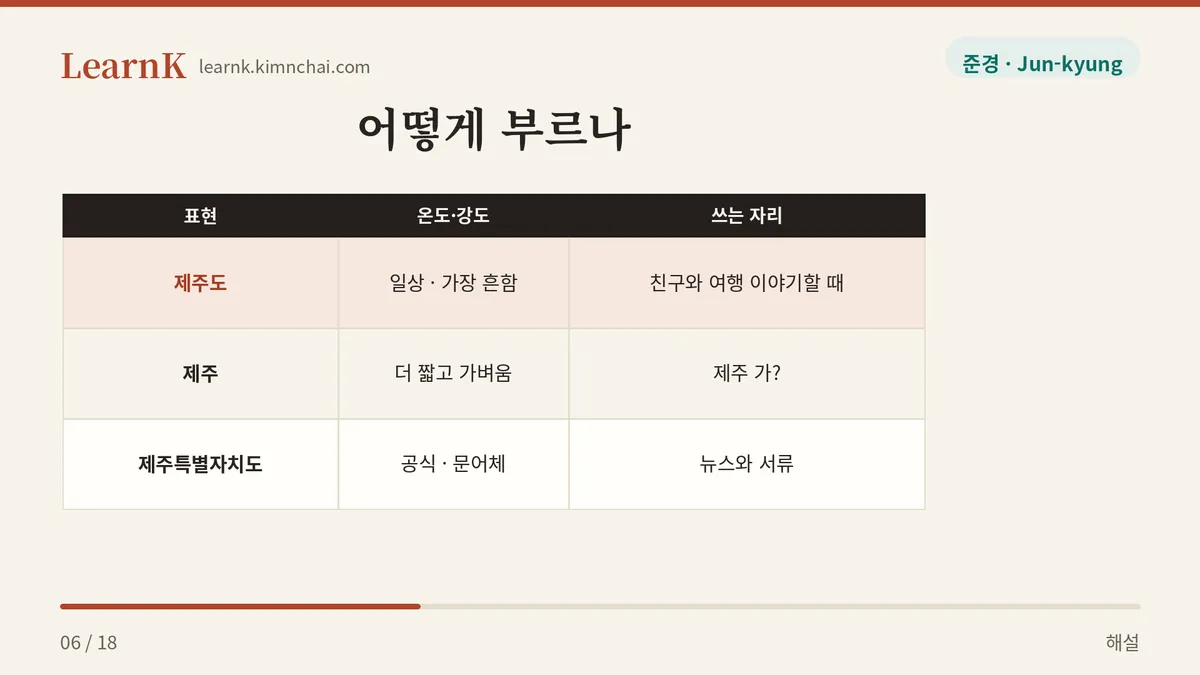
The place name itself doesn’t change form based on polite or casual speech. What changes are the particles and endings attached after it. In casual speech you say “제주도 가자! (jejudo gaja!)”, and in polite speech “제주도에 가시겠어요? (jejudo-e gasigesseoyo?)”. You also pick your particle depending on the situation: use ‘제주도로 (jejudo-ro)’ to emphasize the destination, and ‘제주도에 (jejudo-e)’ to pinpoint the arrival spot — that sounds most natural.
Similar words include 제주섬 (Jeju-seom), which refers to just the single island, and the official name 제주특별자치도 (Jeju Special Self-Governing Province). In everyday conversation, though, people almost always shorten it to ‘제주도 (jejudo)’ — or even shorter, just ‘제주 (Jeju)’. Like in “제주 가? (Jeju ga?)” (Going to Jeju?).
Cultural Background
In Korean dramas and variety shows, Jeju often appears as ‘the final destination of those who leave it all behind.’ It’s portrayed as the place a protagonist worn out by city life heads down to, letting go of everything — or as the first trip taken together with someone they love. And in reality, Jeju is the only place where Koreans can board a plane without a passport and encounter ‘foreign-looking’ scenery, which is how it earned the nickname ‘the most exotic travel destination within the country.’ That’s why when someone says “나 제주도 가고 싶다 (na jejudo gago sipda)” (I want to go to Jeju), it’s often not just a travel plan but an expression of the heart — “I want to rest a little,” “I want to get away.”
Closing Quiz
At the airport, if you want to naturally shorten “이 비행기 제주도로 가는 거 맞나요? (Is this plane going to Jeju?)” into “이 비행기 제주도( ) 맞죠?”, what letter should you attach after ‘제주도’?
(Answer: -행 (-haeng, 行) → “이 비행기 제주도행 맞죠? (i bihaenggi jejudo-haeng majjyo?)”)
Definitions and example sentences are from the National Institute of Korean Language’s Basic Korean Dictionary (krdict.korean.go.kr); that portion of this post, including our translations, is licensed under CC BY-SA 2.0 KR.